
WEEX Exchange Review: A Complete Guide for Beginners

The world of cryptocurrency is always changing, and selecting the appropriate exchange from the numerous options can prove to be quite challenging.
When assessing an exchange, the key factors to consider are security, user-friendliness, liquidity, and the variety of cryptocurrencies available. In a market that is both risky and full of opportunities, having a dependable and easy-to-use platform can be crucial.
WEEX distinguishes itself as a secure, effective, and user-friendly trading platform. In this overview, we will provide you with a thorough introduction to WEEX and all the information you need.
What Is WEEX?
WEEX Exchange, founded in 2018 with a substantial $100 million backing from a leading blockchain investment company, is a robust digital asset trading platform. Positioned as a centralized exchange (CEX), WEEX offers users the opportunity to engage in spot trading, futures trading with leverage up to 400x, over-the-counter (OTC) trading, and copy trading. Supporting a wide range of over 1000 cryptocurrencies, the platform serves a diverse global community of tokens traders.
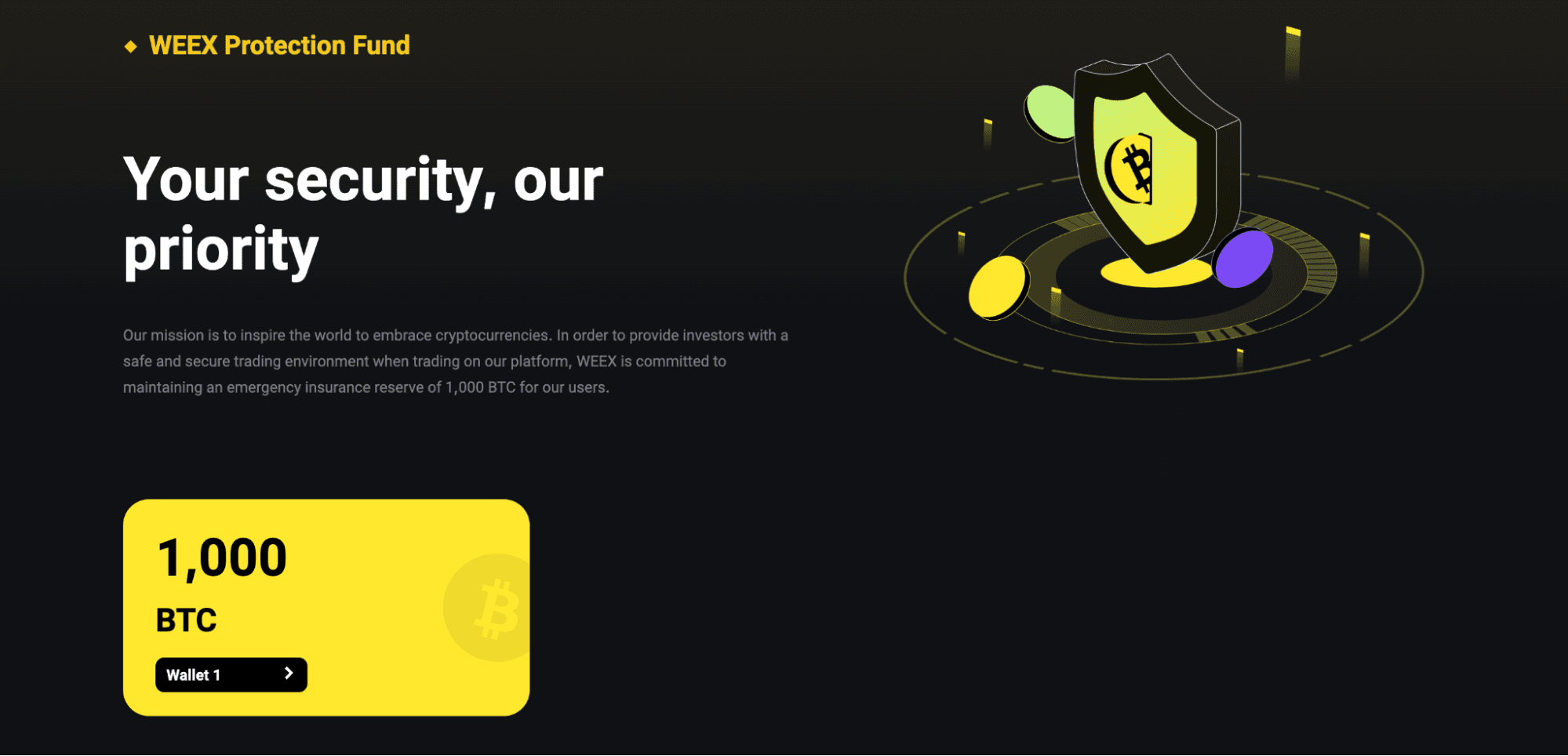
WEEX places great emphasis on security, boasting a 1,000 user protection fund and implementing advanced security protocols to safeguard user funds and information. This dedication to security, along with an intuitive interface and a wide range of trading tools, has resulted in a devoted and expanding user community at WEEX.
WEEX's affiliate and referral programs are notable for providing commissions of up to 50%, promoting community expansion and boosting user involvement. Whether you are interested in entering the trading realm or diversifying your investment holdings, WEEX integrates innovation, security, and user-focused functionalities to provide a premium cryptocurrency exchange experience.
How To Buy Cryptos On WEEX
Begin by accessing the WEEX website or downloading the app.
If you are currently in possession of a WEEX account, kindly access it by logging in.
Here is a concise manual, tap on this link to access A Step-by-Step Guide for How to Buy/Sell Cryptocurrency on WEEX.
Register and Complete KYC On WEEX
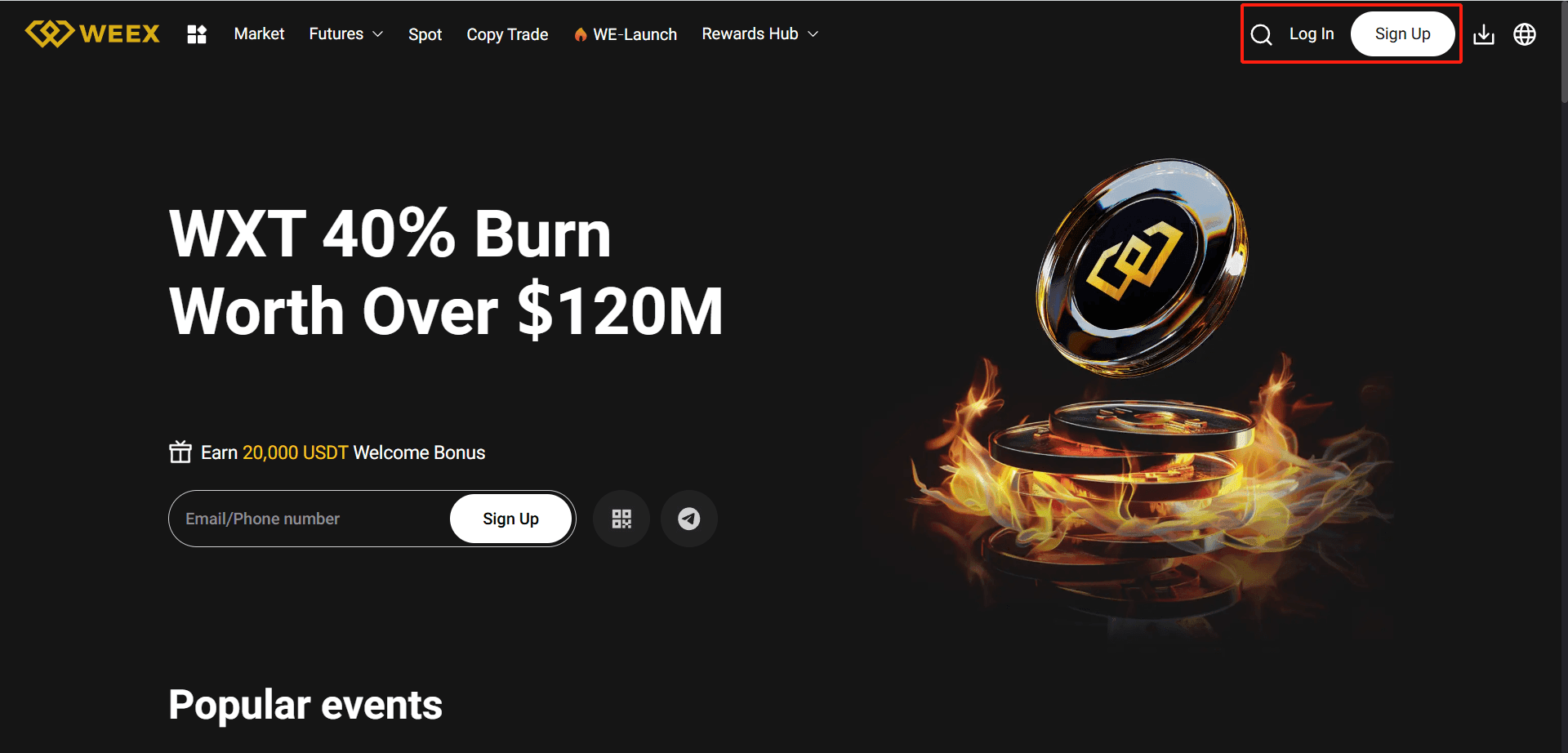
Access the WEEX registration portal or install the application and select [Sign up]. Register by providing the necessary information like email or mobile number. Ensure the accuracy of your email or phone number, and establish a strong and trustworthy password.
Please adhere to our straightforward registration procedure and make sure to input the referral code in the designated field.
In order to uphold the topmost security protocols, WEEX Exchange will take a proactive approach by mandating users to undergo KYC (Know Your Customer) identity verification according to their user tier.
To complete the KYC identity verification process, simply select the yellow profile icon located at the top left corner of your software's homepage and proceed to upload the required documents within the "Identity Verification" section.
Ensure that you do not input incorrect details, as this may result in the suspension of your account.
Take a look at our tutorial on how to set up an account and complete the WEEX KYC process. Once everything is ready, navigate to the WEEX referral program page to proceed.
Deposit and start trading
Deposits on WEEX are free.
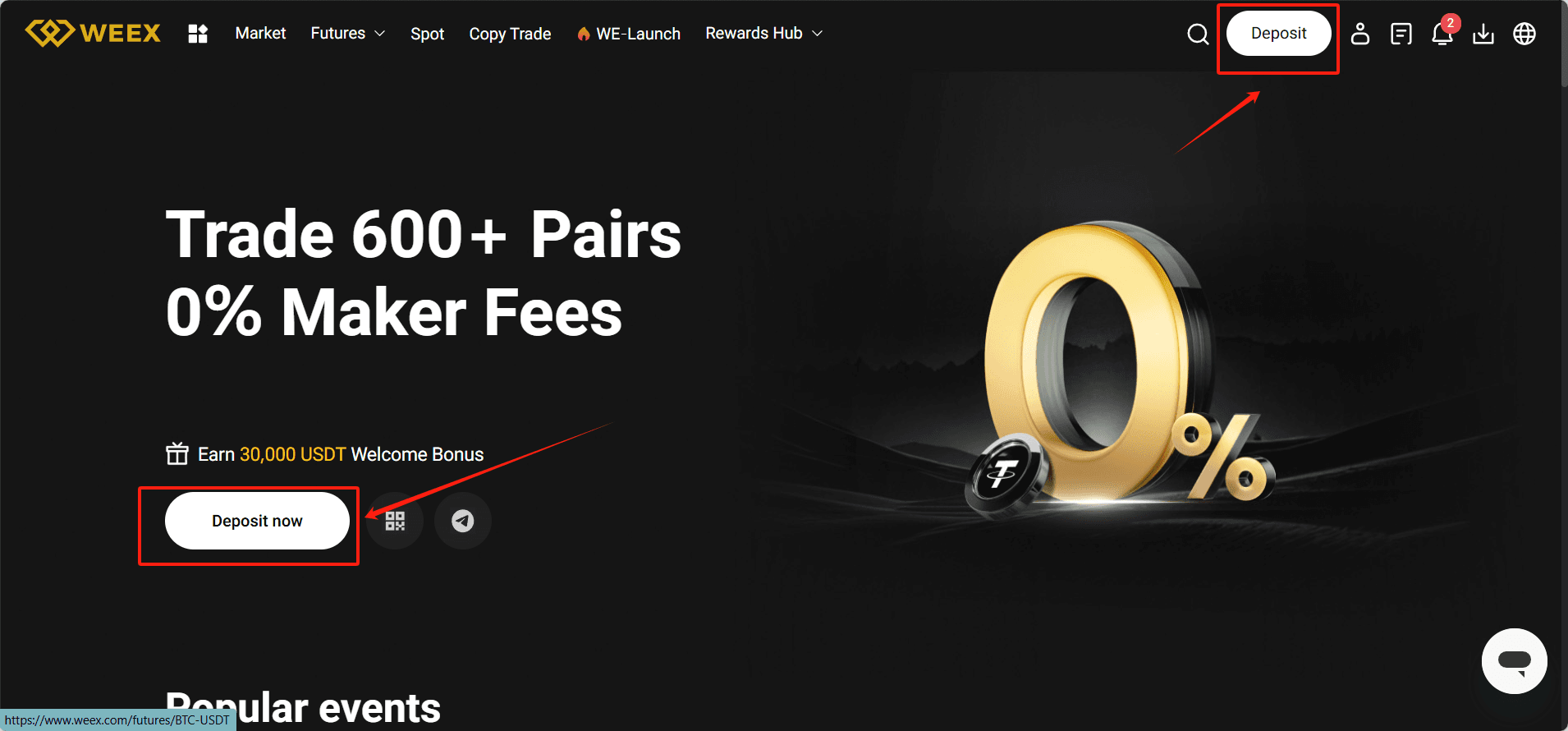
WEEX offers digital wallet services for token deposits. Upon logging into WEEX, you have the option to click [Assets] > click [Deposit] > select the cryptocurrency you own to deposit into the platform, select the desired cryptocurrency for deposit, and proceed to either manually copy the deposit address provided by WEEX or use the QR code scanning feature to initiate the transfer from an external digital wallet.
Explore our detailed instructions for a step-by-step guide on how to deposit on WEEX. By following these steps, you can kickstart your trading experience on WEEX.
Withdraw
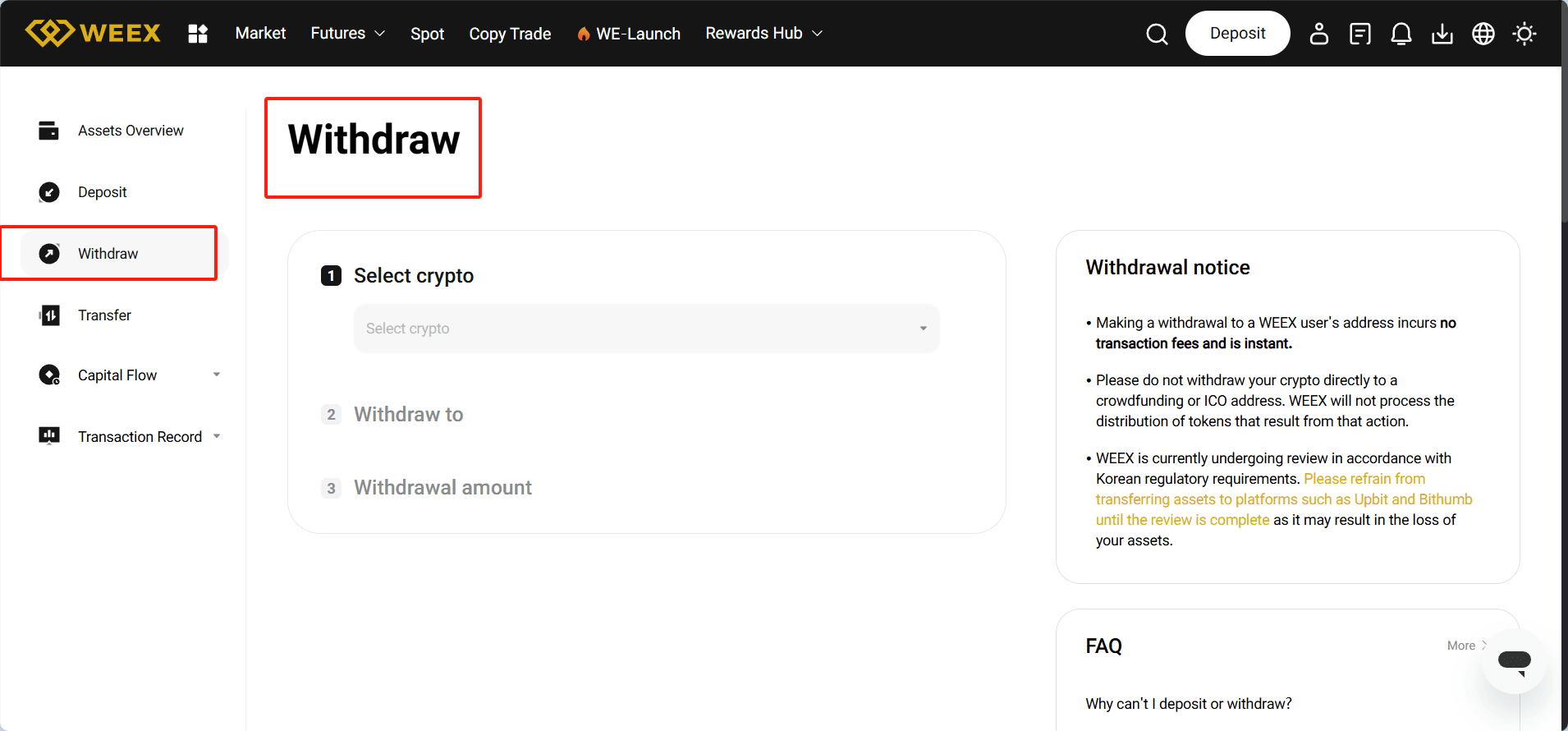
Making a withdrawal on WEEX is uncomplicated. If you are utilizing our WEEX application, once you have signed up or logged in, you can proceed by clicking on [Assets], then selecting [Withdraw], followed by choosing the cryptocurrency you wish to withdraw, the network, and entering the desired address and amount. Subsequently, you only need to exercise patience until the withdrawal process is finished.
Explore our guide for how to withdraw on WEEX to gain a better understanding.
Why Choose WEEX?
Strong Security and Trusted Trading:
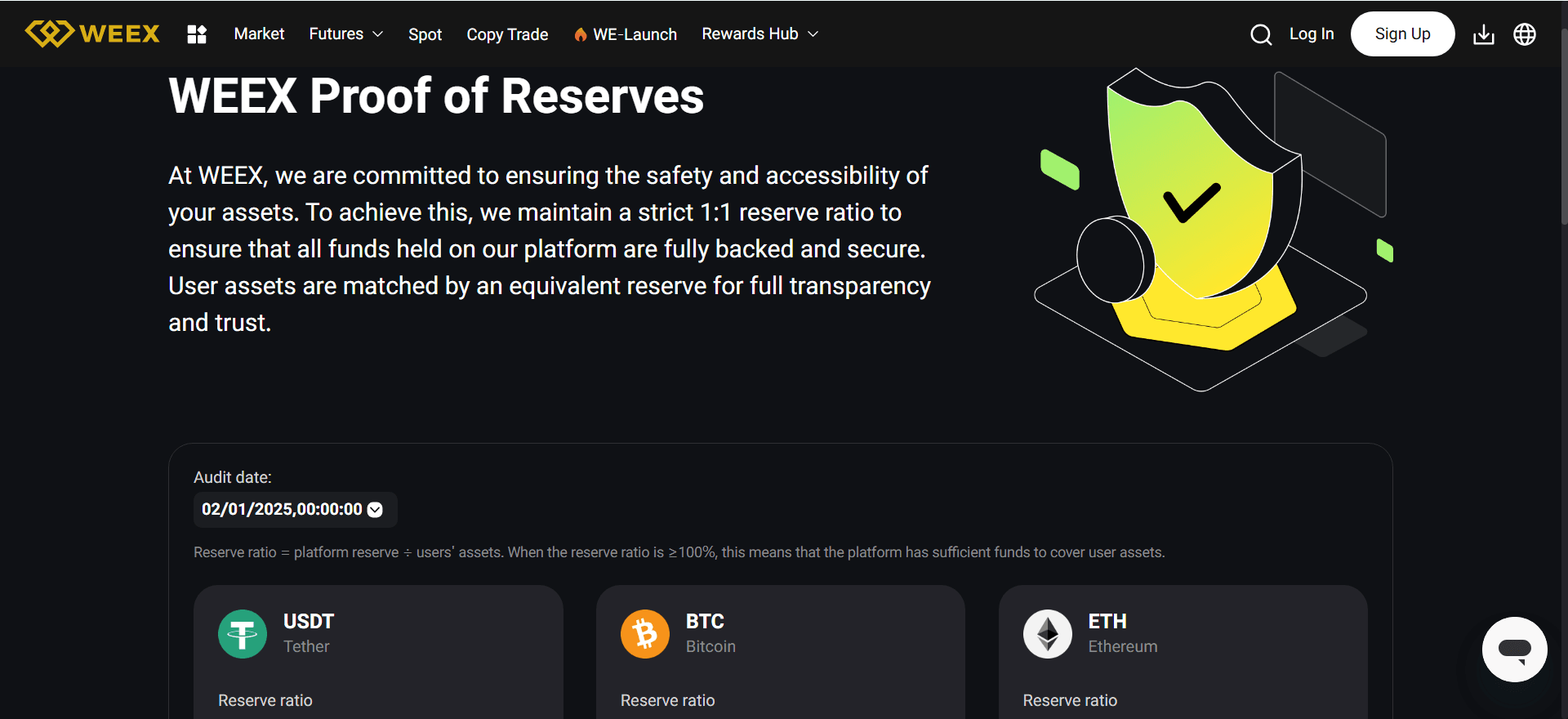
Security stands as a top priority in the operations of WEEX. The platform upholds a user protection fund of 1,000 BTC, along with transparently providing its address and Proof of Reserves (PoR). Additionally, WEEX implements sophisticated security protocols to safeguard user assets and information, guaranteeing a secure and reliable trading atmosphere.
Diverse Selection of Cryptocurrencies:
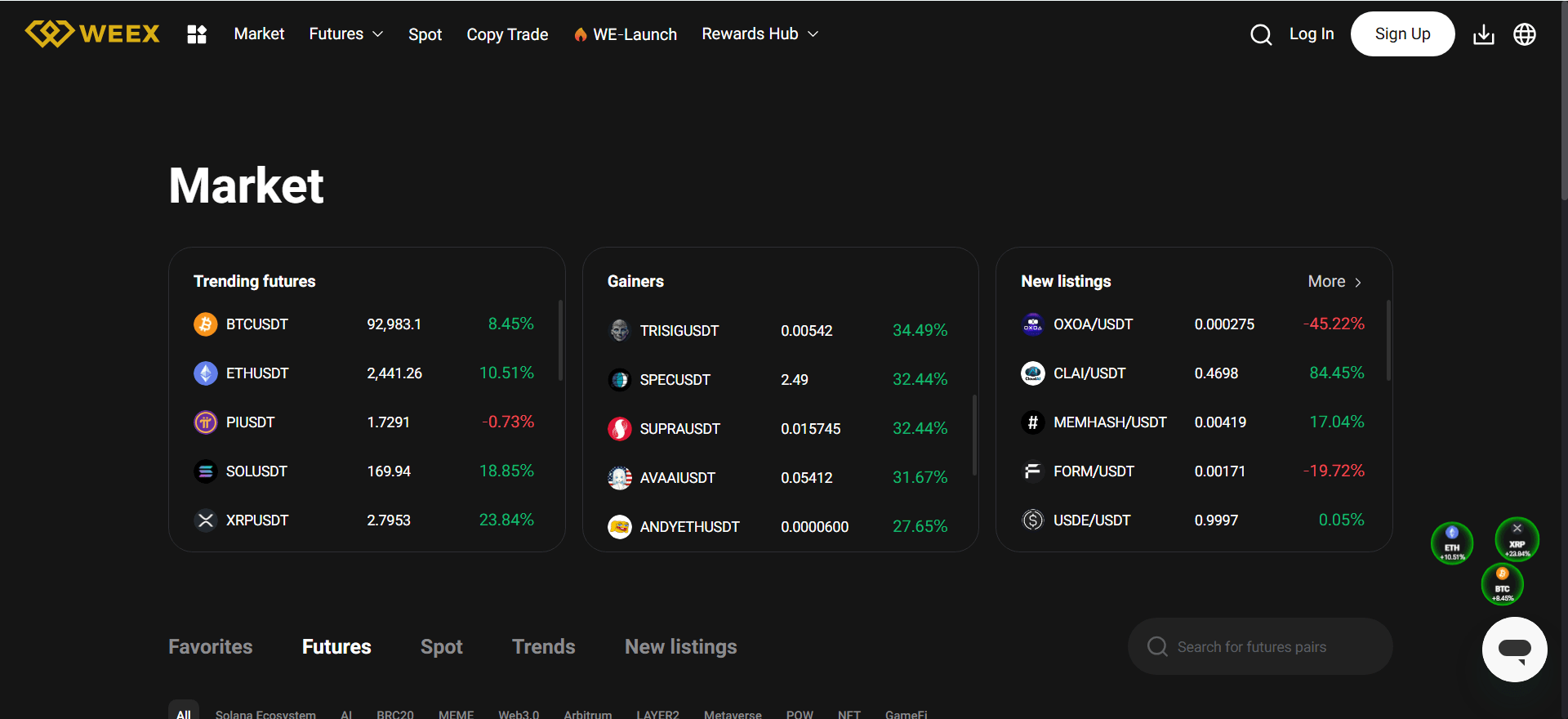
Supporting over 1000 cryptocurrencies, WEEX offers a wide range of digital assets for traders to diversify their investment portfolios. This includes popular cryptocurrencies such as BTC USDT, DOGE USDT, ETH USDT, ETC USDT, TRX USDT. By offering this extensive variety, WEEX enables users to capitalize on market trends, trade securely, and easily access their preferred assets.
Versatile Web and Mobile Trading Platform:
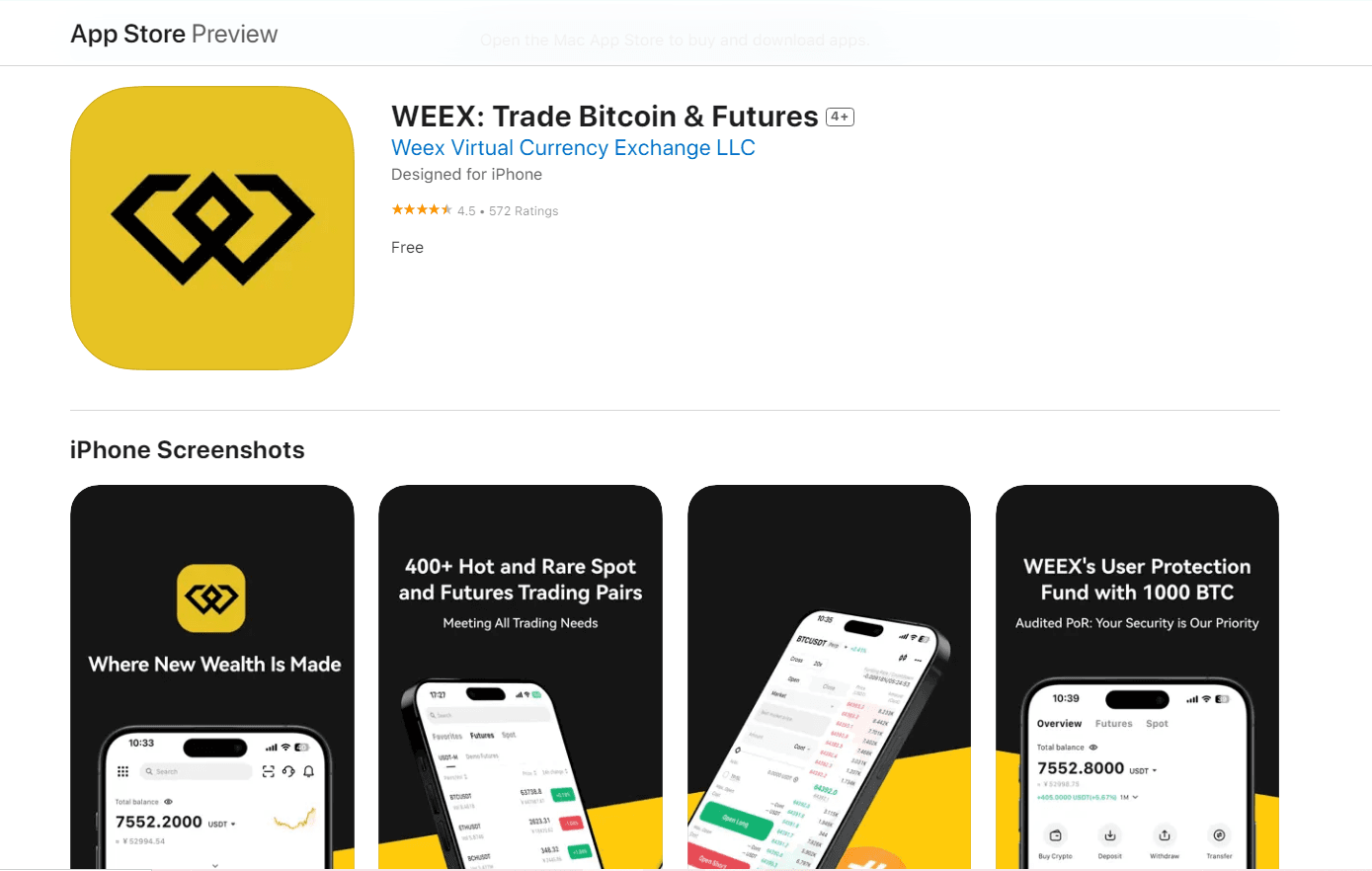
WEEX provides a functional trading experience on web as well as mobile apps, catering to traders seeking flexibility and convenience. Whether you are at home or on the go, the WEEX mobile application enables you to engage in cryptocurrency trading, monitor live market data, and manage all account preferences with just a few taps. Both platforms come equipped with advanced trading features, real-time price updates, and customizable charts, empowering users to make prompt and informed decisions. Regardless of your location or device, WEEX guarantees a seamless and effective trading journey.
Skilled Team:
WEEX's team brings together a team of experts hailing from prestigious backgrounds such as Wall Street, Silicon Valley, Citibank, and Google. Under the guidance of CEO and founder Peter, WEEX has emerged as a prominent player in the global crypto trading sphere, recognized for its cutting-edge solutions and user-centric design. Backed by a proficient technical squad, WEEX delivers a secure, seamless, and effective trading platform on a global scale. Responding to rapid expansion, WEEX has scaled its workforce to over 500 professionals, elevating service standards and fostering continuous product advancement. This strategic expansion enables WEEX to address the varied requirements of its worldwide user base, solidifying its position as a frontrunner in the cryptocurrency trading sector.
Varied Services and Tools:
WEEX functions as a centralized cryptocurrency exchange (CEX) that presents a complete set of trading instruments suitable for novices as well as seasoned traders. The platform delivers a variety of services, such as spot trading, futures trading with leverage of up to 400x, over-the-counter (OTC) trading, and copy trading. Whether one intends to engage in trading at prevailing market rates, leverage positions, or track skilled traders, WEEX furnishes all essential tools essential for achieving success.
Worldwide Presence:
WEEX is proud of its extensive global presence, providing services in various countries including the Japan, Turkey, India, the Philippines, and other nations. This worldwide footprint is supported by robust technical infrastructure, expert services, and a Affiliate Program that offers commission rebates of up to 70%. Since its inception, WEEX has experienced rapid expansion, currently catering to more than 5 million active users in 134 different countries. With a daily trading volume surpassing \$50 billion, WEEX holds a position in the top 12 on CoinMarketCap.
WEEX, with its ongoing growth, continues to be a preferred option for traders looking for a dependable and effective trading platform. The confidence of users around the globe is evidenced by its success. Providing more than 1,000 trading pairs, state-of-the-art security measures, support in multiple languages, and user-friendly features, WEEX ensures an unparalleled trading journey for its international user base.
Multilingual Community Support:
The platform's success is significantly driven by The WEEX community, which caters to distinct segments of users from around the globe. Each group is committed to establishing a space where traders, investors, and cryptocurrency enthusiasts can engage, exchange ideas, and benefit from each other's knowledge. While the global community unites members worldwide, provide region-specific assistance and conversations.
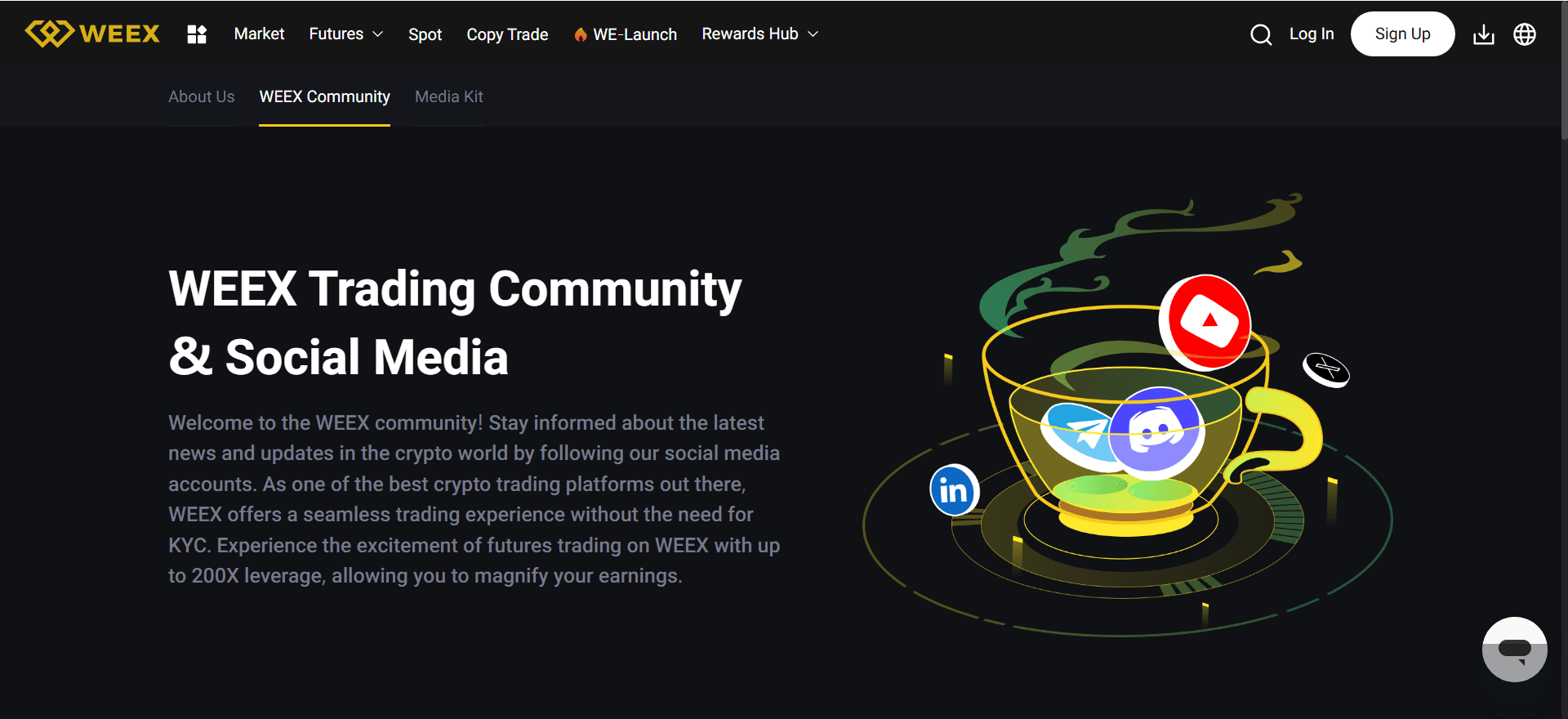
WEEX actively maintains a robust presence on various social media platforms to keep its communities informed and engaged. The community interacts via channels such as Twitter, Facebook, Medium, Telegram, and YouTube. Moreover, Discord and LinkedIn act as interactive platforms for more detailed discussions and professional networking. Whether sharing market updates, promotions, or community events, WEEX's social media engagement ensures that users remain well-connected and informed at all times.
Low Fees:
In normal circumstances, spot trading fees on WEEX are 0.1% for both makers and takers. Futures trading fees are 0.02% for makers and 0.08% for takers.
Yet, hold WXT, you have the opportunity to receive a discount of up to 70% on fees for trading futures, based on your WEEX VIP tier.
Excellent Customer Service
At WEEX, we are committed to delivering outstanding customer service in order to guarantee a fantastic customer experience. Should you come across any difficulties or require clarification, our proficient support staff is on standby to help. You have various options available to contact us effortlessly.
Telegram Support: Get the Telegram app on your device, then join our authorized channels for help:
Customer Support&Business Cooperation: @weikecs
English Assistance: @weexencs
VIP Support: support@weex.com
Artificial Intelligence Support: To receive immediate assistance, just utilize the AI-driven customer service function located at the bottom right of the WEEX site. Should the need arise, you have the option to engage with a live representative for tailored assistance.
Count on dependable and prompt support from WEEX whenever you require it.
WEEX Order Types
For a comprehensive understanding of the different types of orders on WEEX, their functionalities, and strategies for leveraging them effectively, refer to this complete guide to master different types of orders on WEEX.
Market Orders
Market orders are most appropriate for traders who value quick execution and assurance more than exact pricing. By placing a market order, the trade is promptly carried out at the prevailing market price, guaranteeing immediate completion without any delays. Such orders are well-suited for individuals looking to swiftly purchase or sell assets, unconcerned about minor price changes.
If Bitcoin (BTC/USDT) is priced at $96,000, initiating a market buy order guarantees immediate execution at the most favorable available price. This price may slightly differ, for instance $96,005 or $96,010, contingent upon market liquidity during the trade. While this ensures rapid transaction processing, the precise price may experience minor deviations from the listed market value due to market fluctuations and liquidity conditions.
Limit Orders
Limit orders provide traders with increased control over their transactions, enabling them to stipulate the precise price at which they want to purchase or sell an asset. In contrast to market orders, which are executed immediately at the current market price, limit orders are triggered only once the market reaches the designated price point. This precision feature prevents buying above or selling below the intended price, facilitating a more strategic approach to trading.
If Ethereum (ETH/USDT) is trading at $2,500, you have the option to set a buy limit order at $2,488. This particular order will be triggered solely if the market value decreases to $2,488 or less, guaranteeing the acquisition of ETH at your specified price point or a more favorable one.
At WEEX, traders can benefit from using limit orders to capitalize on price changes while retaining authority over their trading decisions. By incorporating limit orders, traders can improve trading flexibility and accuracy, enabling them to optimize their market participation.
Advanced Orders
Experienced traders can take advantage of WEEX's advanced order types, which offer increased flexibility and strategic choices for optimizing trading strategies.
Orders placed with the Good-Till-Canceled (GTC) option will remain active until they are fully executed or manually canceled by the trader, providing the trader with full control over the order's duration.
- A Good-Til-Canceled order for XRP USDT at $2 remains active in the order book until the price matches your condition or you cancel it manually.
Immediate-Or-Cancel (IOC) orders seek to execute the order immediately by filling as much of it as possible, while automatically canceling any portion that remains unfilled. This order type enables partial completion of trades when liquidity conditions allow.
- An Immediate-or-Cancel order for 2 SOL USDT at $135 may fill 1.5 SOL if liquidity allows, with the remaining 0.5 SOL canceled automatically.
Fill-Or-Kill (FOK) is an order type that mandates immediate execution of the entire order. In the event that the full order cannot be filled, it is promptly canceled to prevent any incomplete transactions.
- A Fill-or-Kill order for 3 MASK USDT at $2.1 executes only if all 3 MASK can be bought at that price; otherwise, it’s fully canceled.
By using the Post Only order type, your order will add liquidity to the market when acting as a maker order. If your order would match an existing one, it will be canceled to help you steer clear of taker fees. This approach supports market liquidity and taker fee avoidance, guaranteeing your advantages as a market maker.
- Placing a Post Only order at $92,900 ensures your order adds liquidity to the market, avoiding taker fees and rewarding you as a market maker.
Utilize Take Profit Orders to automatically exit a trade when a predetermined profit target is reached, allowing you to secure profits without constant monitoring. For example, if you bought Bitcoin (BTC) at $50,000 and set a take profit order at $55,000, the position would close automatically when the price reaches $55,000, locking in your gains.
- After buying AAVE USDT at $200, a take profit order set at $95,000 will automatically close your position when the price reaches $95,000, securing your gains.
The enhanced order varieties offered on WEEX enable users to enhance the efficiency of their trading strategies, control risk, and maximize profits in a volatile market setting.
WEEX Trading Types
Spot Trading
What is WEEX Spot Trading?
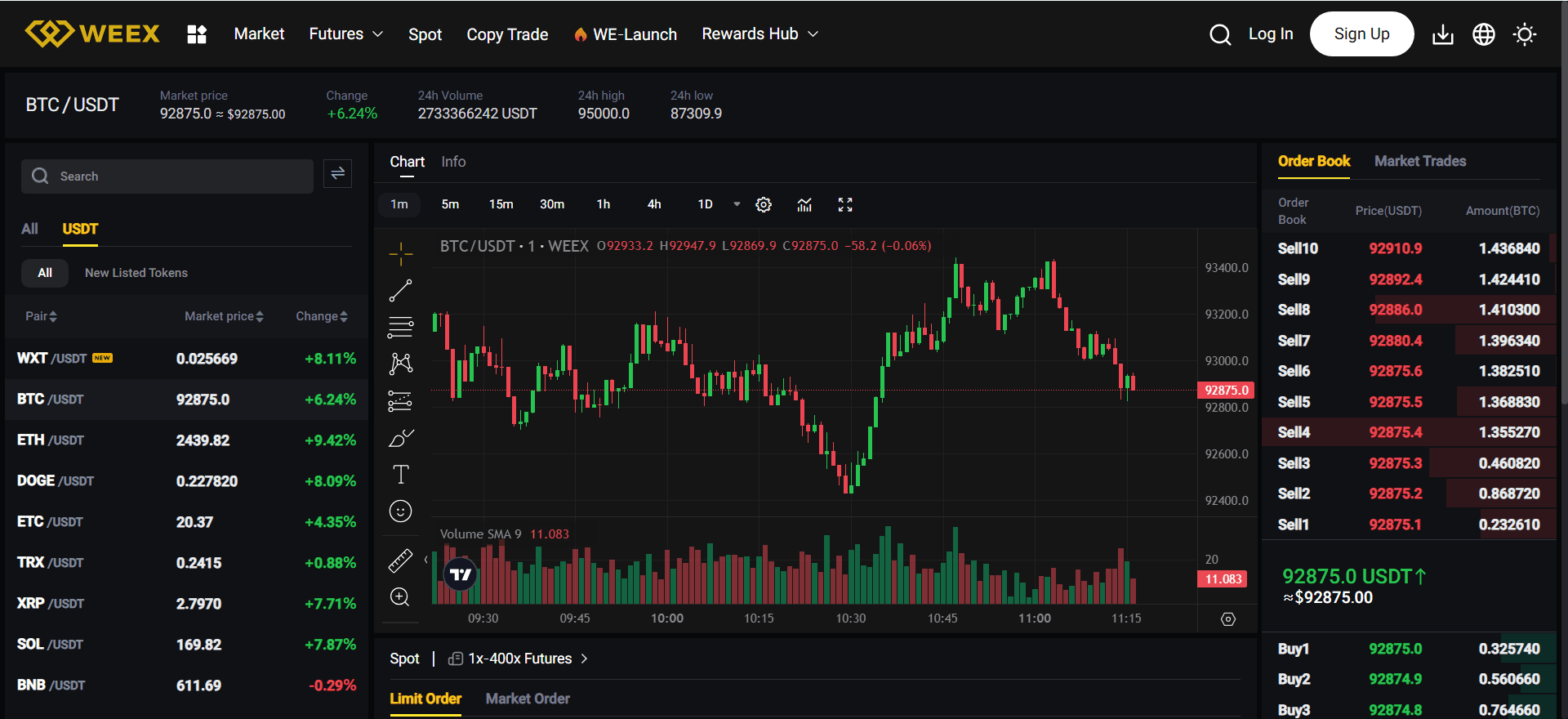
Spot trading is the most conventional method of trading in the cryptocurrency market, and WEEX Exchange offers a solid platform for traders to participate in these transactions. In spot trading, assets such as cryptocurrencies are purchased or sold immediately at the current market price. Essentially, spot trading involves swapping one cryptocurrency for another, with one coin serving as the pricing unit for acquiring other coins. Orders are matched based on a priority system that considers both price and time, ensuring that each trade is executed at the optimal price. This clear and open approach has made spot trading a favored option among many traders.
Here is a concise overview, access this comprehensive spot trading guide for beginners.
Step-By-Step-Guide
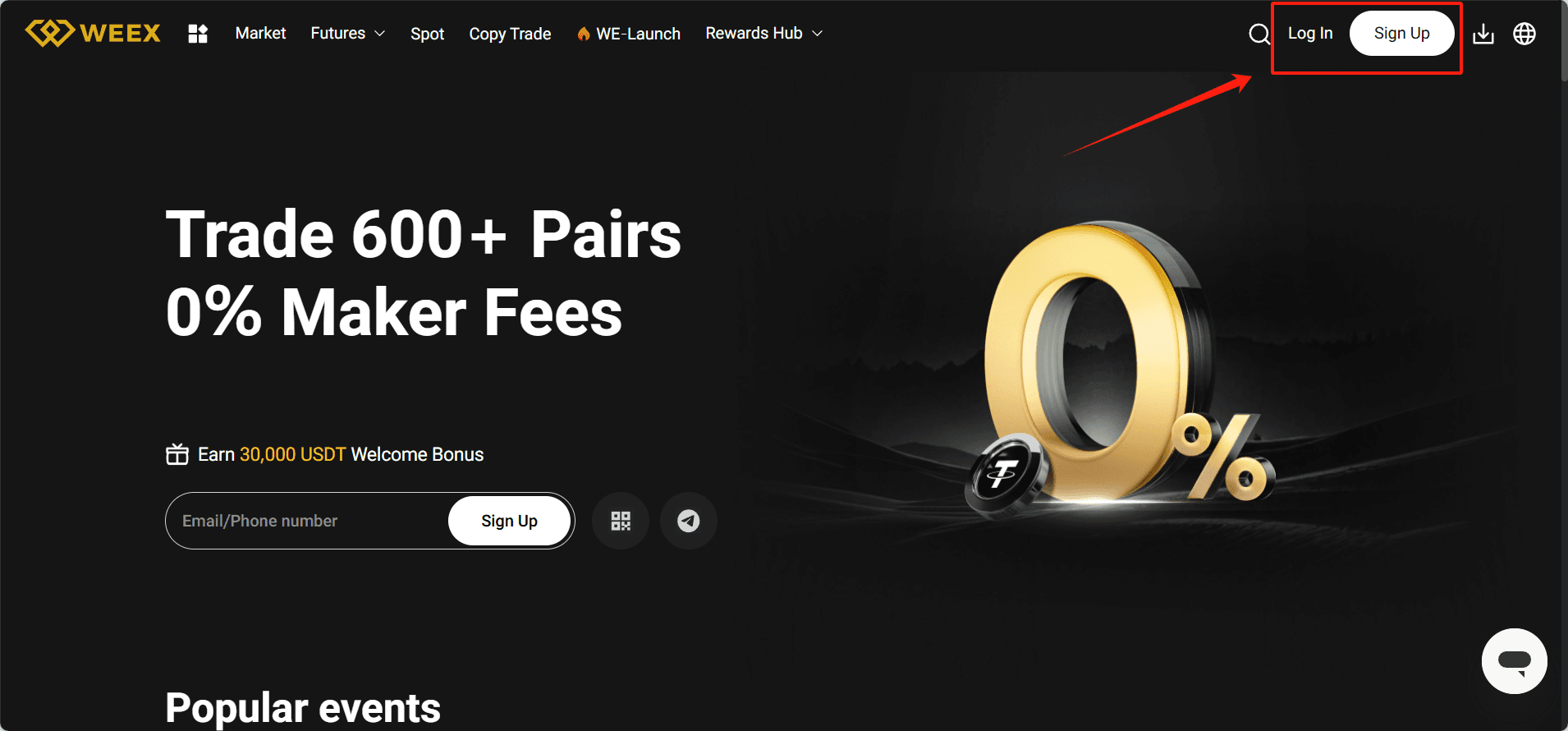
Step 1: Register or Log In
To access your account, select Log in at the top of the page. If you are new to WEEX, choose to sign up and refer to our detailed step-by-step instructions for assistance.
Ensure that you have finished the identity verification process for KYC (Know Your Customer).
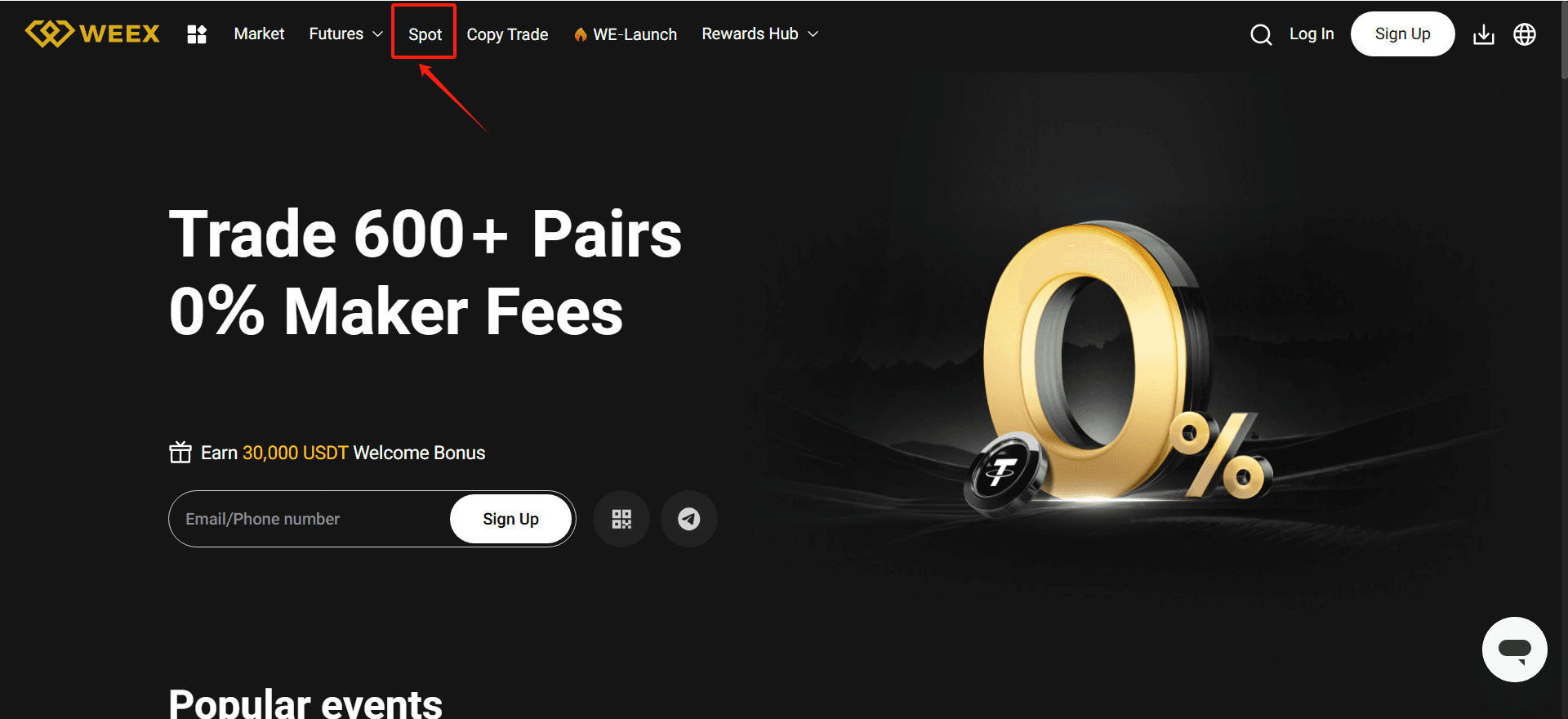
STEP 2: Go to Spot Trading
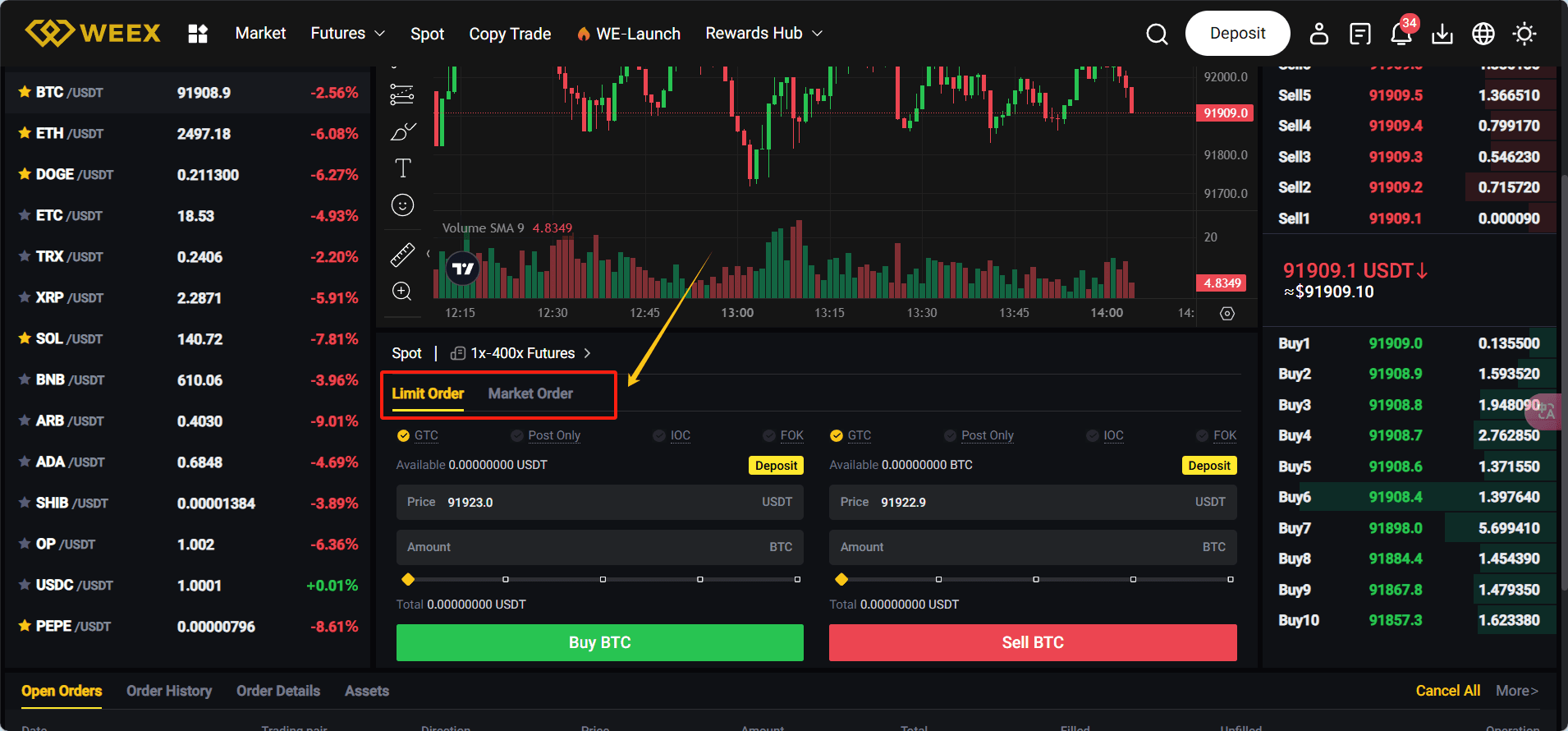
After logging in, simply select the "Spot" button located on the homepage's top section.
Accessing the Spot Trading Section within the WEEX platform.
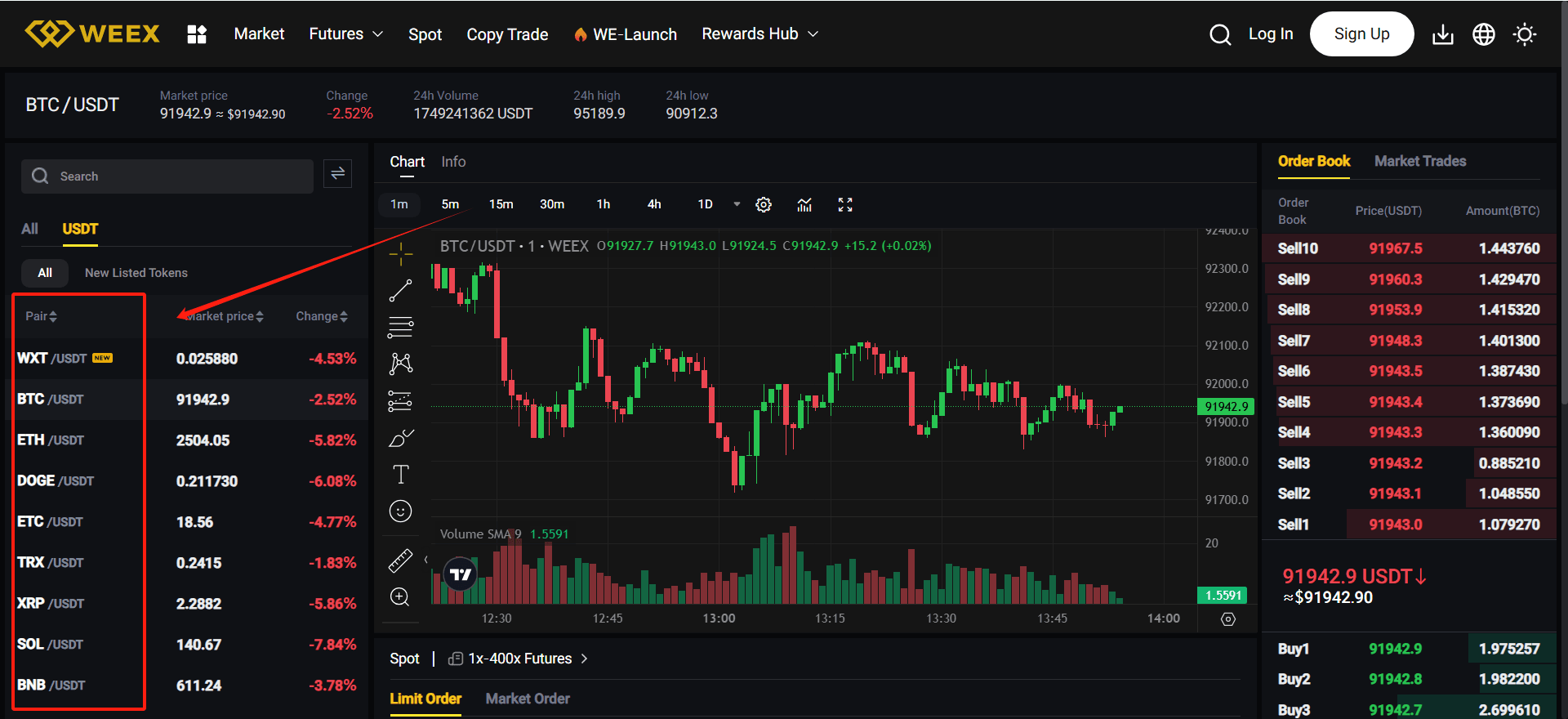
Step 3: Select a Trading Pair
Explore the trading pairs that are offered and select the specific one you wish to engage in trading with.
STEP 4: Place Your Order
Choose the order type that best suits your needs from the options provided (for example, market or limit).
Select either "Buy" or "Sell" and input the quantity.
Please examine the information carefully before placing your order.
STEP 5: Track Your Orders
Access Open Orders to see all current orders that are still awaiting processing. It is possible to make adjustments or terminate them as necessary.
View Order History: Review all your previous transactions, comprising both fulfilled and revoked orders.
Copy Trading
What is WEEX Copy Trading?
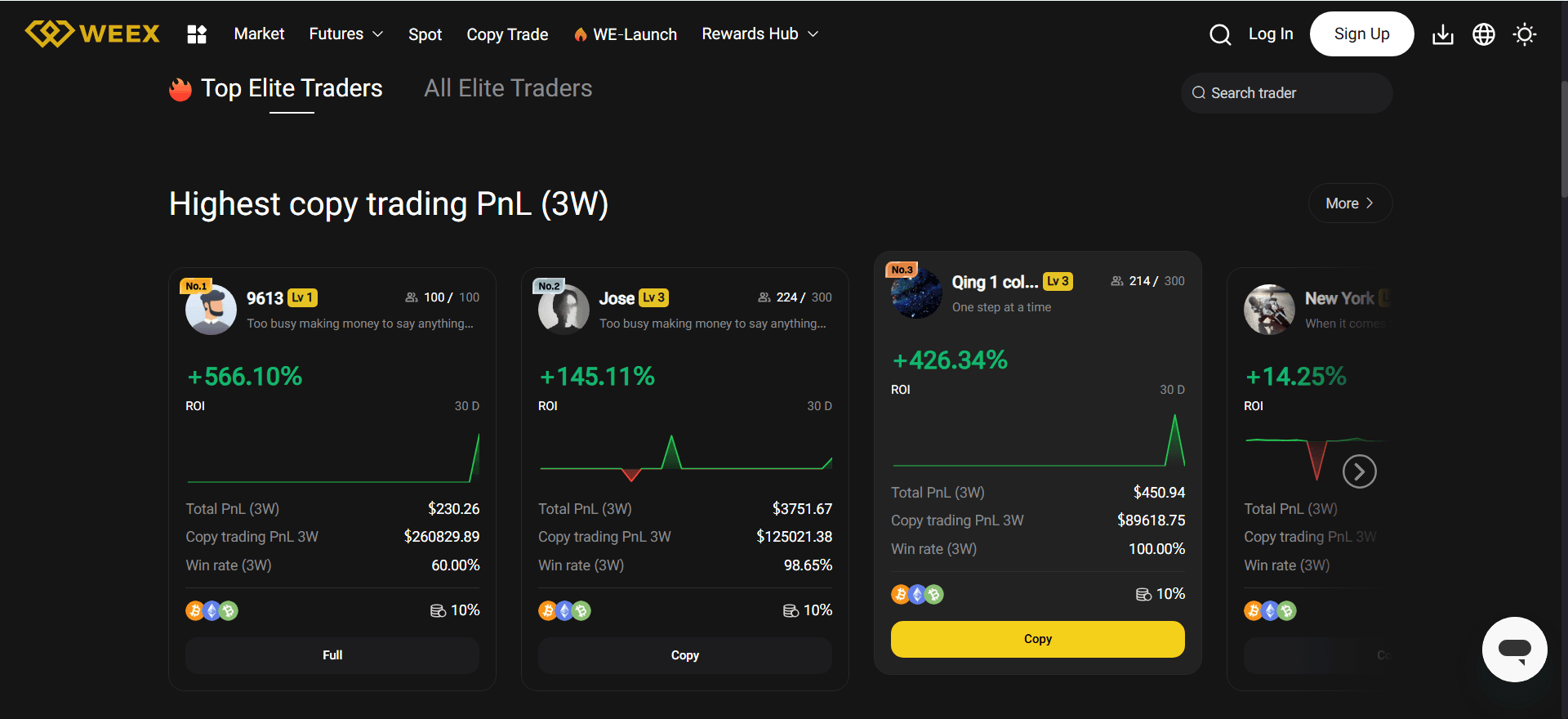
WEEX copy trading enables users to automatically replicate the trades of skilled and accomplished traders on the WEEX platform. By mimicking the strategies of top traders, novices or individuals with less experience can potentially benefit from their expertise. Users have the option to select traders to follow based on their performance, with the system automatically duplicating their trades in real-time. This functionality offers a straightforward entry point into cryptocurrency trading without requiring extensive market understanding, allowing for a hands-off trading experience while gaining insights from seasoned professionals.
What is WEEX Copy Trading Pro?
WEEX has launched the Copy Trading Pro function in order to streamline the process of entering the futures trading market. This feature offers traders and those who copy their trades a clear and easy-to-use platform for trading digital derivatives, with the goal of increasing profits and benefiting all involved parties.
Using WEEX Copy Trading Pro enables individuals to replicate the techniques used by professional traders. This feature allows users to generate income without having to conduct thorough market analysis or actively oversee trades. It is crucial to note that all trades, regardless of their outcomes, will be duplicated by followers. Therefore, it is vital to select traders whose methods are in line with your risk tolerance level.
Why WEEX Copy Trading?
For Copy Traders:
Traders who copy others' strategies can make profits effortlessly without the need to constantly keep an eye on charts all day long.
- Secure and Trustworthy:
WEEX meticulously picks out top traders globally, providing a range of leading strategists for users to select. Transparent and trustworthy trading is ensured through real-time trading data and trackable records of both leading and copied trades.
- Effortless Earnings:
- By simply clicking a button, users can copy multiple traders and sync their opening and closing actions to maximize profitability. Real-time monitoring of profit data from each copied trade allows for adjustments in the copied amount at any given moment. Users also have the flexibility to cease copying or secure profits by closing positions whenever they deem fit.
For Traders:
Traders have the opportunity to leverage the WEEX Traffic Pool, acquiring traffic as well as earning commissions from replicated trades.
- Lucrative Profit Sharing: Traders receive a 10% portion of profits from replicated trades.
- Greater Visibility: Connect with over 10,000 focused futures traders, with platform support to amplify your trading influence and increase your income.
Select this option to join the ranks of an Elite Trader.
Step-By-Step-Guide
STEP 1: Select a Copy Trader
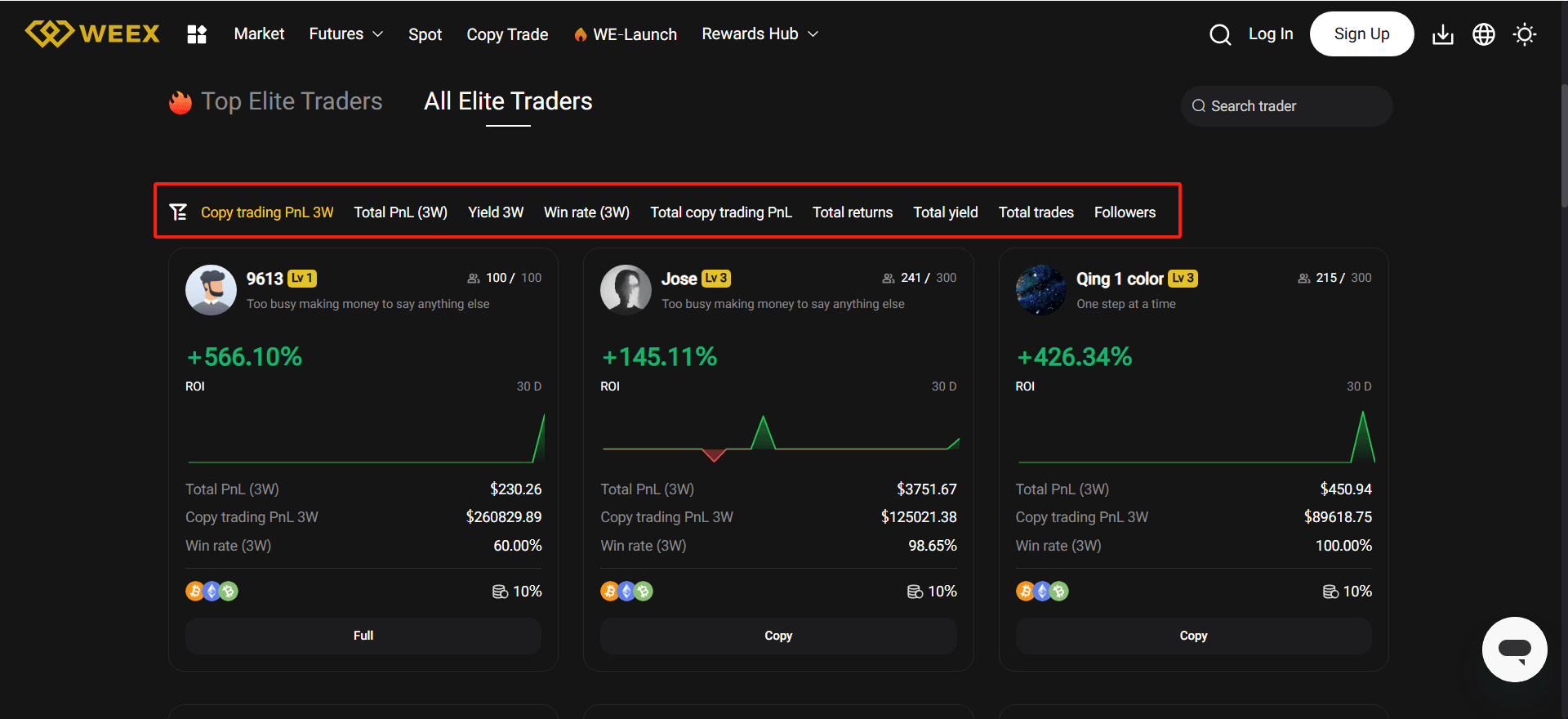
When choosing a top trader to replicate on the Copy Trading Pro platform, take into account various important performance metrics:
- Active Days: Duration counted from the registration date.
- 3-Week Copier Earnings: Total profits earned by copiers in the last three weeks.
- 3-Week PnL: Profit from the past three weeks ÷ the largest single opening position principal in that period.
- 3-Week Win Rate: Profitable orders in the last three weeks ÷ total orders in the same timeframe.
- 3-Week Profit (USDT): Total realized profits over the past three weeks.
- All-Time Copy Trading Profits: Total historical profits generated for copiers.
- Total PnL: Cumulative profits to date ÷ the largest single all-time opening position principal.
- Total Trades: Number of closed orders to date.
- Total Copiers: Number of unique copier accounts following this elite trader to date, counted once per account.
- Current Copiers: Number of users actively copying this elite trader at present.
STEP 2: Configure Copy Trading and Margin Settings
Select a copy trading mode:
- Uniform Mode: Consistent margin settings across all trading pairs.
- Separated Mode: Unique settings tailored for each trading pair.
Next, select your margin setting:
- Position Mode: Replicates your chosen leverage.
- Trader Mode: Adopts the leverage set by the trader.
- Custom Mode: Personalized leverage for individual trades.
Step 3: Set Copy Trade Amount and Customize Advanced Options
Specify the quantity for every trade (either fixed in USDT or based on portfolio ratio). Adjust risk control parameters like stop-loss, take-profit, and slippage ratios, and establish a maximum trading size.
Step 4: Validate and Initiate Copy Trading
Examine all configurations, select "Next" for validation, and verify that there are adequate funds in your futures account for executing the trades.
Futures
Know WEEX Futures Pro
A perpetual futures contract is a type of financial derivative that blends aspects of spot margin trading and futures trading. In contrast to regular futures contracts that have specific delivery dates, perpetual futures are standardized, incorporate margin trading, and settle instantly.
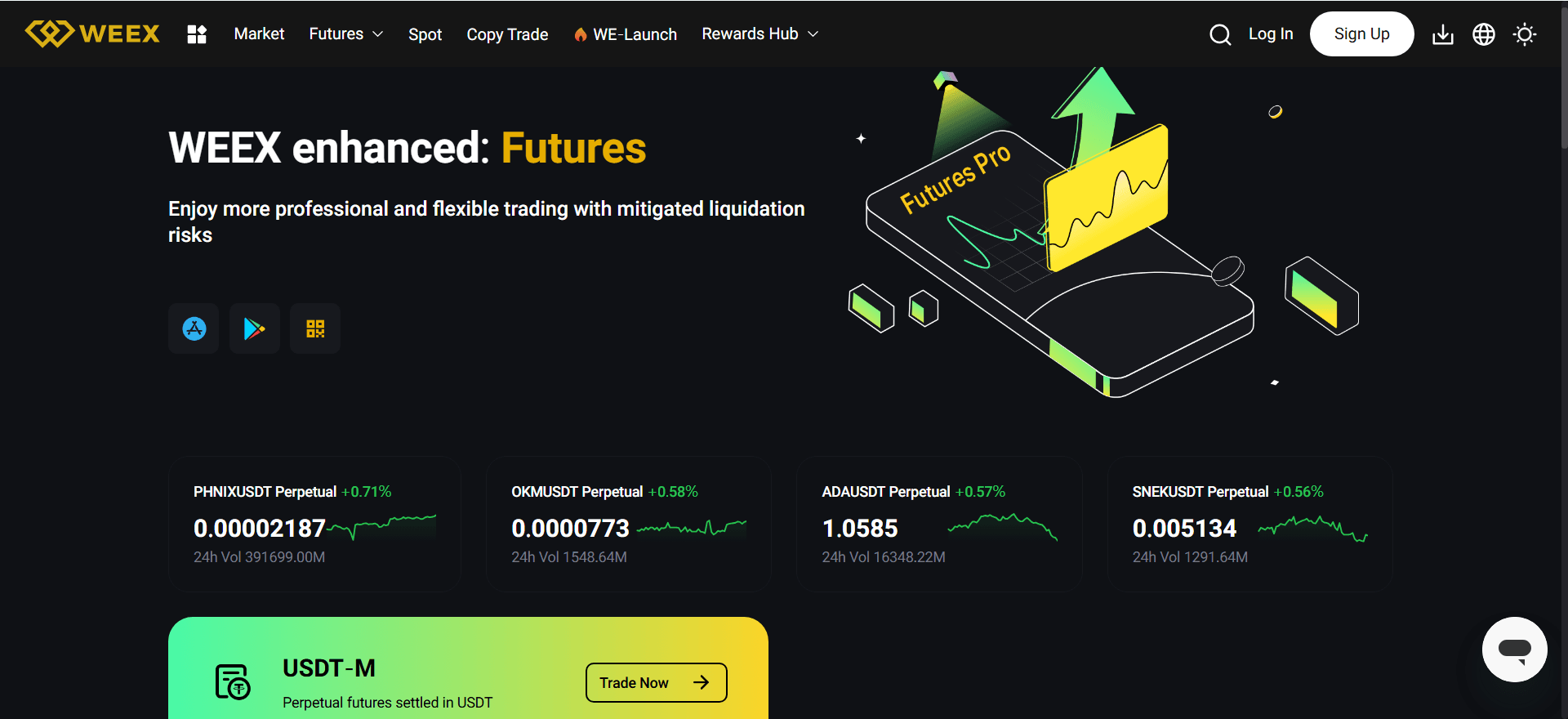
Perpetual futures contracts lack a set expiry date or delivery requirement, permitting traders to maintain their positions without time constraints. To keep the contract price aligned with the spot price, a funding system is implemented. This system involves the exchange of funding rates between long and short positions periodically, which serves to mitigate notable price discrepancies.
The WEEX Futures Pro platform is at the forefront of the cryptocurrency derivatives industry. It caters to seasoned traders seeking a comprehensive and sophisticated trading environment. Users can rely on this platform to manage cryptocurrency derivatives with precision and effectiveness.
WEEX Futures Pro is designed to cater to the requirements of cryptocurrency derivatives traders. It provides opportunities to engage in a wide range of financial products, going beyond the scope of just digital currencies. Users are able to participate in futures contracts trading and make predictions on the value of digital assets without possessing them.
Why WEEX Futures Pro?
The WEEX Futures Pro platform is equipped with a variety of functionalities specifically tailored for experienced traders. It includes sophisticated charting capabilities, live market information, and robust risk control functionalities. Furthermore, users have the option to access a trial edition to become acquainted with futures trading.
Notable characteristics consist of market, limit, and trigger orders, simulated trading, as well as a Futures Pro Calculator for determining PnL, settlement price, and break-even price. Additionally, it enables a maximum leverage of 400x.
Flexible Trading Solutions: Traders can utilize WEEX Futures Pro to conduct trades in different markets without the requirement to uphold margin for numerous positions, thereby enhancing effectiveness.
Broadened Investment Opportunities: Traders can enhance their investment portfolios by spreading their funds across various futures contracts, providing increased flexibility and more effective portfolio supervision.
Strong and Dependable: With smart risk control and a two-tier manual approach, WEEX Futures Pro guarantees safety, empowering traders to establish exact profit-taking and stop-loss levels for trading with security and assurance.
Here is a short overview, access this comprehensive guide for crypto traders on how to trade futures on WEEX.
Step-by-step Guide
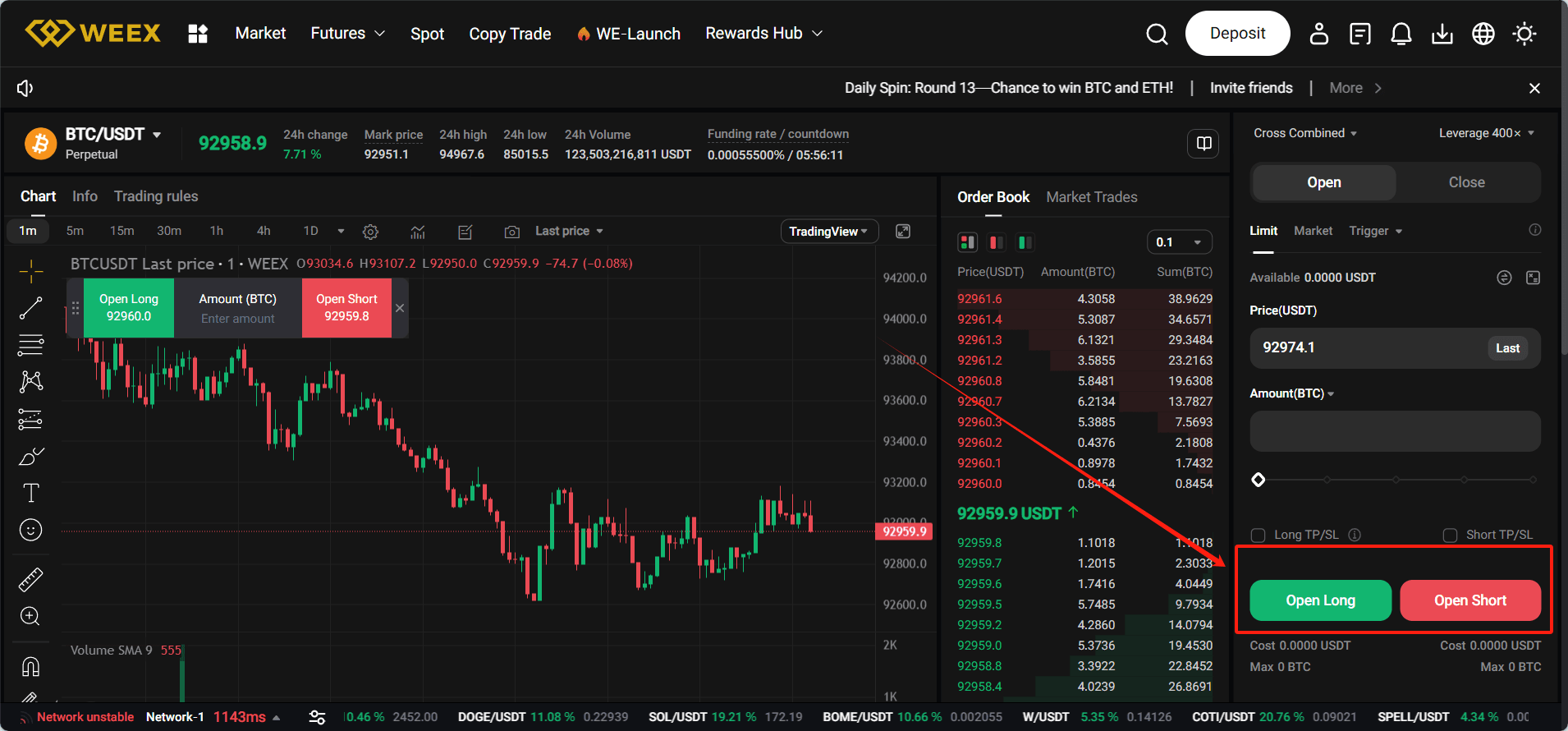
After setting up your account and depositing funds, you can start trading futures on WEEX swiftly and effortlessly in three simple steps! Follow these instructions using the BTC Perpetual/USDT illustration:
Step 1: Move Funds to Your Futures Account
Select the Deposit option to transfer cryptocurrency from a different wallet, and proceed to move assets from either your spot or futures account to your Futures Pro account.
Step 2: Profit from a Rising Market by Going Long
If you anticipate an increase in price and wish to initiate a long position, specify the price, quantity, and leverage. Subsequently, select "Open Long (Bullish)" to proceed.
To exit your position, simply select "Close," input the necessary information, and then choose "Close Long."
Step 3: Capitalize on a Falling Market by Going Short
If you anticipate a price decrease and wish to initiate a short position, specify the price, quantity, and leverage. Subsequently, select "Open Short (Bearish)" by clicking on it.
To exit your position, select "Close," input the required information, and then choose "Close Short."
WEEX Leverage
What is Margin?
When initiating a trade, the funds utilized as margin are secured and unavailable for additional trading activities.
Margin serves as a deposit in leveraged trading, enabling the amplification of the order size through the utilization of leverage.
Position Value = Margin x Leverage
This implies that the greater the leverage, the lesser the margin needed.
For instance, when trading Bitcoin using leverage at a market price of approximately 7,000 USDT, you would need to provide a margin of about 200 USDT (excluding fees) on our platform. This allows you to speculate on price fluctuations in both directions and potentially gain profits from them. Any losses incurred will be subtracted from the margin, and once the liquidation price is reached, your position will be automatically liquidated.
Consider the margin as a security deposit for your trade. When you close your position, we will refund the margin to you, adjusting for your profit or loss and any applicable fees. Lower margin usage results in higher leverage, amplifying the risk associated with market fluctuations. Conversely, higher margin utilization decreases leverage, widening the potential profit or loss margin and reducing overall risk. If you are worried about risk, you can choose the isolated position mode.
Margin can be calculated by dividing the product of Contract Quantity, Futures Face Value, and Open Price by Leverage. For instance, if you are trading 100 Dogecoins at an open price of 0.1779 with a leverage of 20x, the margin calculation is: Margin = (100 x 1 x 0.1779) ÷ 20 = 0.8895. For more precise results, utilize the [Calculator] located in the upper right corner of the futures page.
For additional margin details, please refer to the Margin section on the WEEX Futures website.
WEEX Margin Modes:
Cross margin mode
Cross margin functionality on WEEX enables leveraging all funds in a single futures account as margin for active positions. In case a position results in a loss surpassing the available account balance, it will be automatically closed. This feature enhances risk management capabilities, simplifying position management and evaluation. Moreover, the cross margin mode accommodates hedge trading, offering increased versatility in trading approaches.
Isolated margin mode
On WEEX, the isolated margin system assesses risks for short and long trades separately. If liquidation happens, only the margin assigned to that specific trade will be lost. Profits or losses from a closed position are settled into the margin for that trade. In the event of liquidation due to price fluctuations, the user will lose only the margin related to that position, with no impact on other funds in the futures account.
WEEX WE-Launch
What is We-Launch
Users have the opportunity to stake their WXT in pools and receive complimentary tokens from new WEEX WE-Launch premium projects. This platform provides a secure and uncomplicated method to participate in initial cryptocurrency offerings.
In past We-Launch initiatives, numerous well-received tokens like DOGS and TRUMP have taken part.
How to Join in WE-Launch?
In order to join the WEEX We-Launch event, you must register or sign in to your WEEX account and possess WXT tokens to qualify. For further information, refer to a detailed guide on the process.
Step 1: Register or Log In to WEEX
New users can refer to the guide on setting up a WEEX account. Existing users with a WEEX account can proceed to log in.
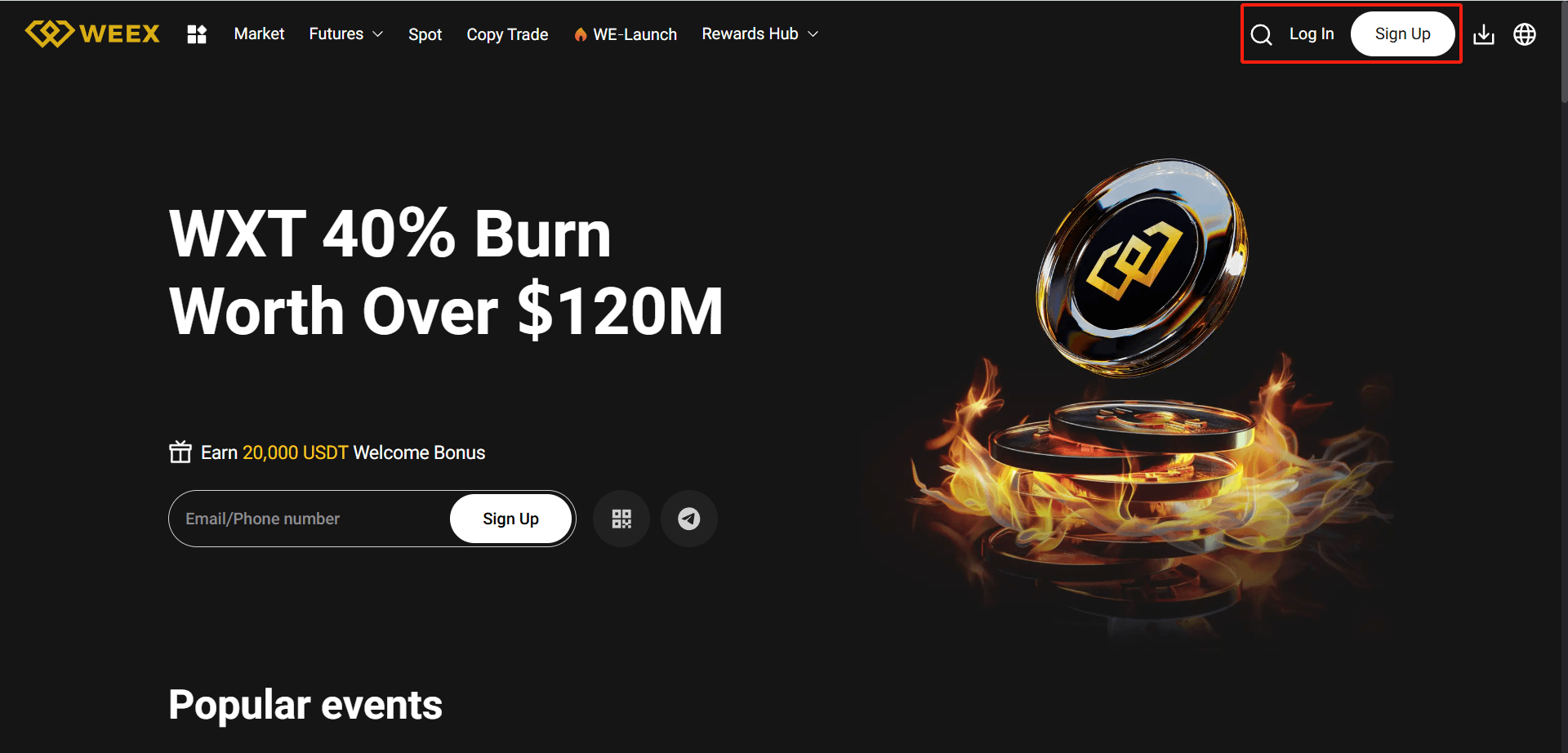
If you are utilizing a mobile device, kindly install the application in order to register or access your account on WEEX.

Step 2: Hold WXT to be qualified
To qualify, you need to maintain a minimum of 1000 WXT in your spot account for a period of two consecutive days. Below are the steps to purchase WXT on WEEX.
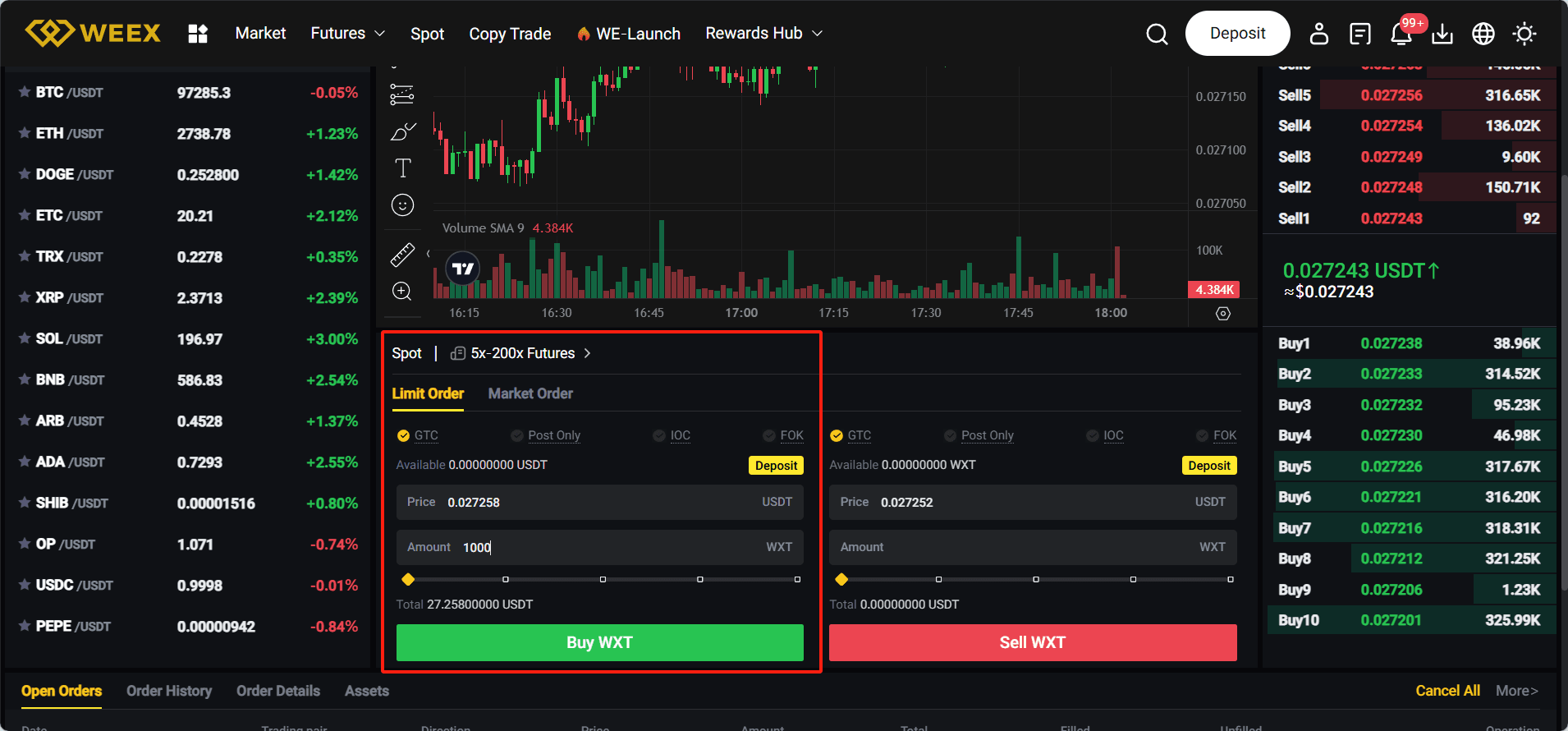
For Web
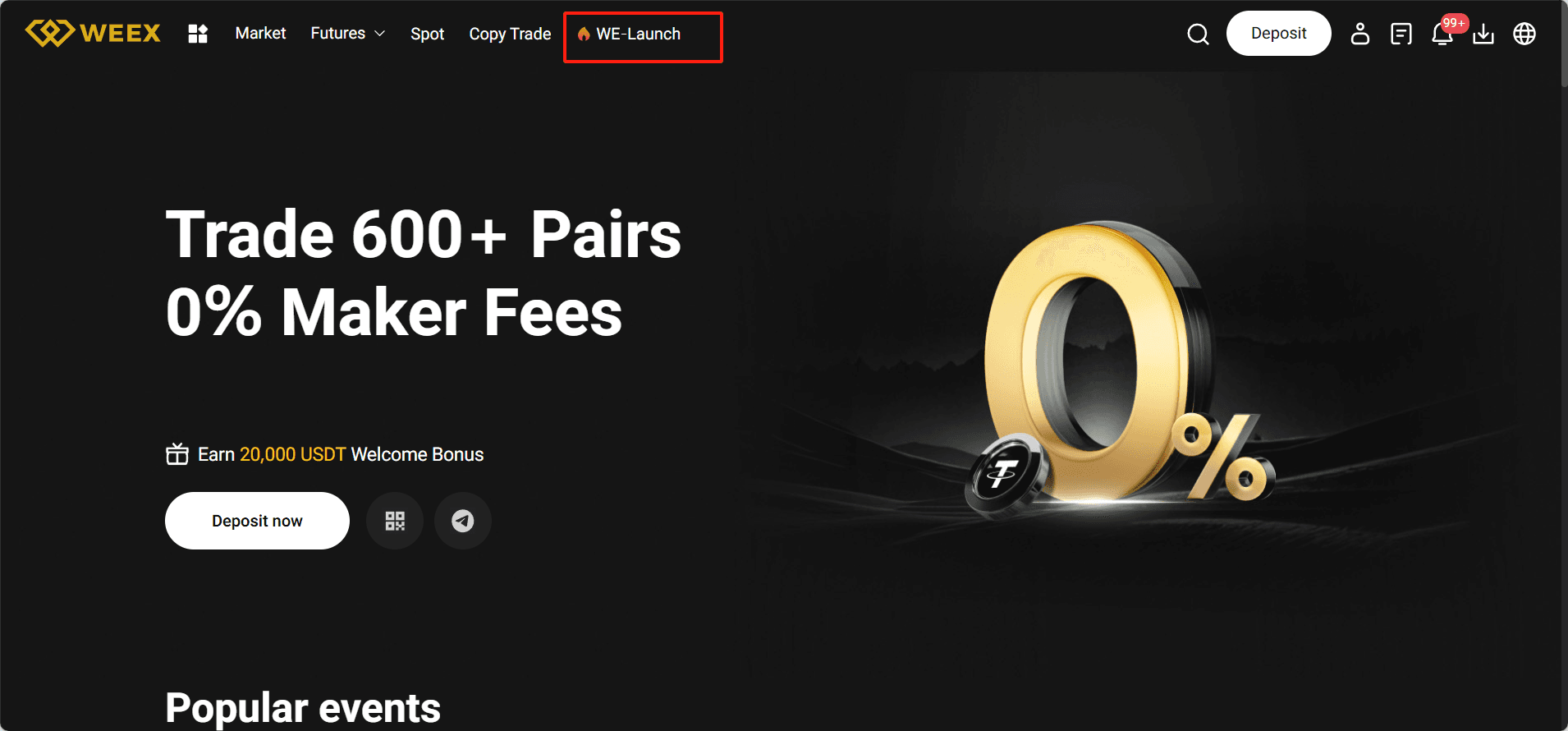
Engage in trading of WXT USDT on this platform or proceed to the We-Launch category located in the navigation menu and select it.
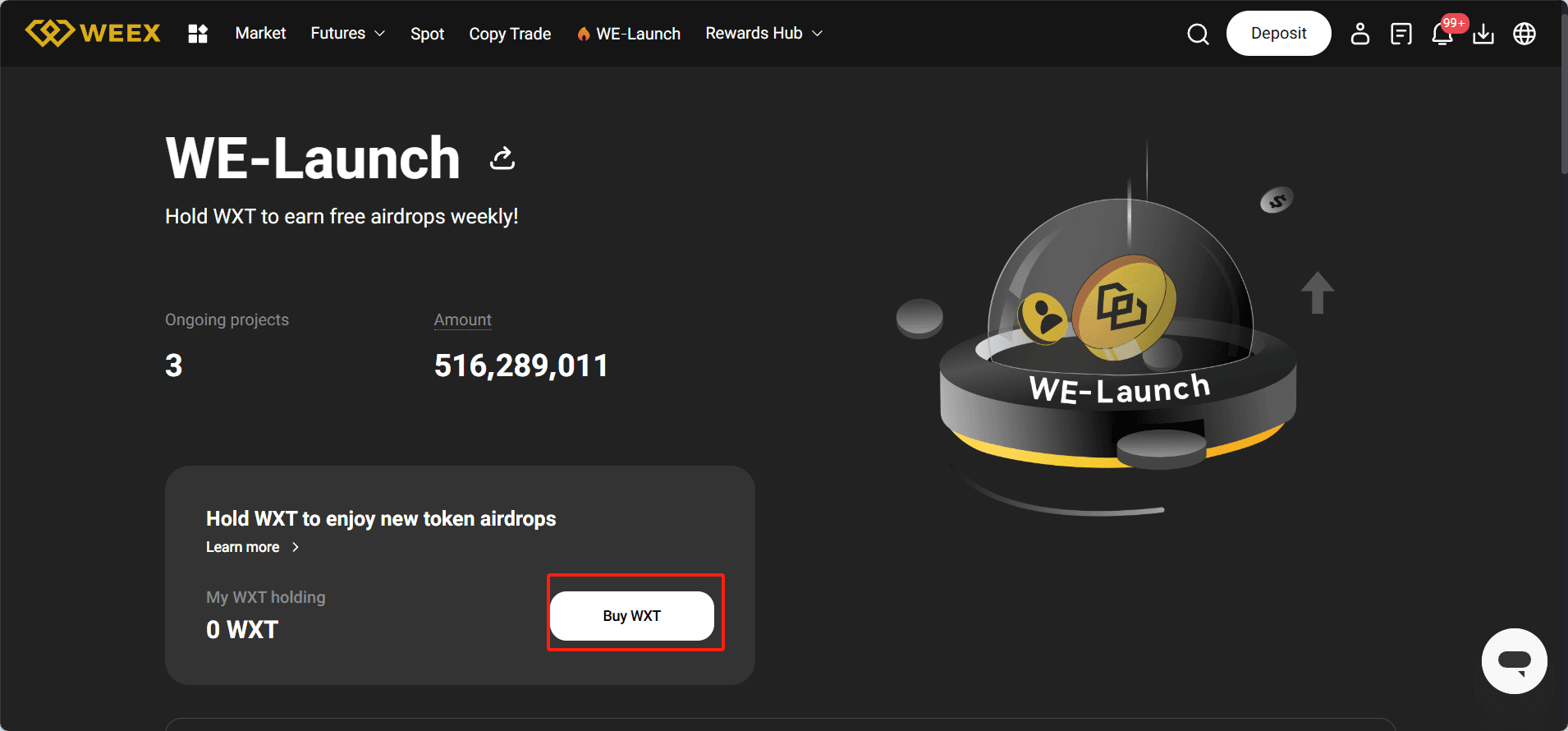
Press the Purchase button for WXT located on the webpage.
Please input the quantity of WXT you wish to purchase.
For Phone
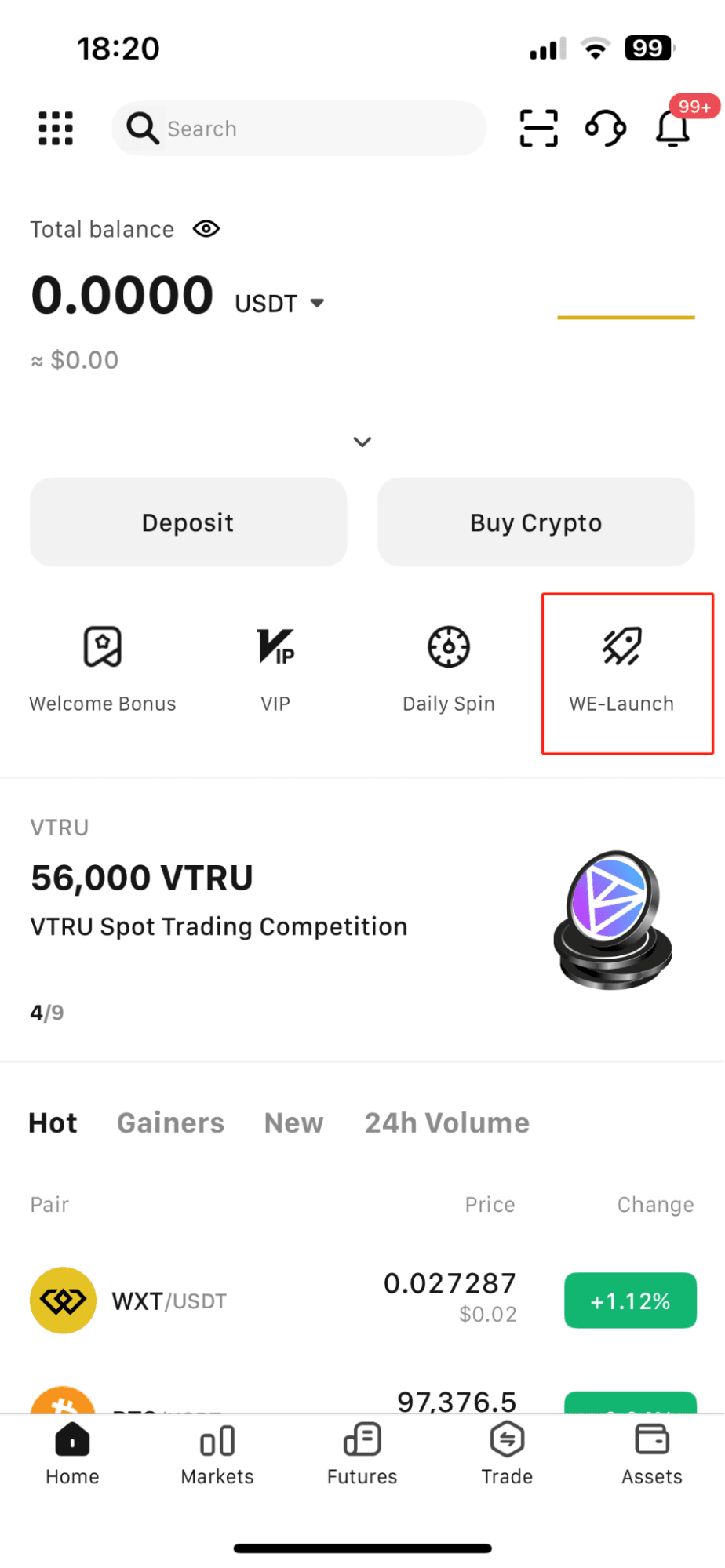
If you are on a mobile device, select the "WEEX WE-Launch" feature from the WEEX main page and proceed by clicking on the "Purchase WXT" tab.
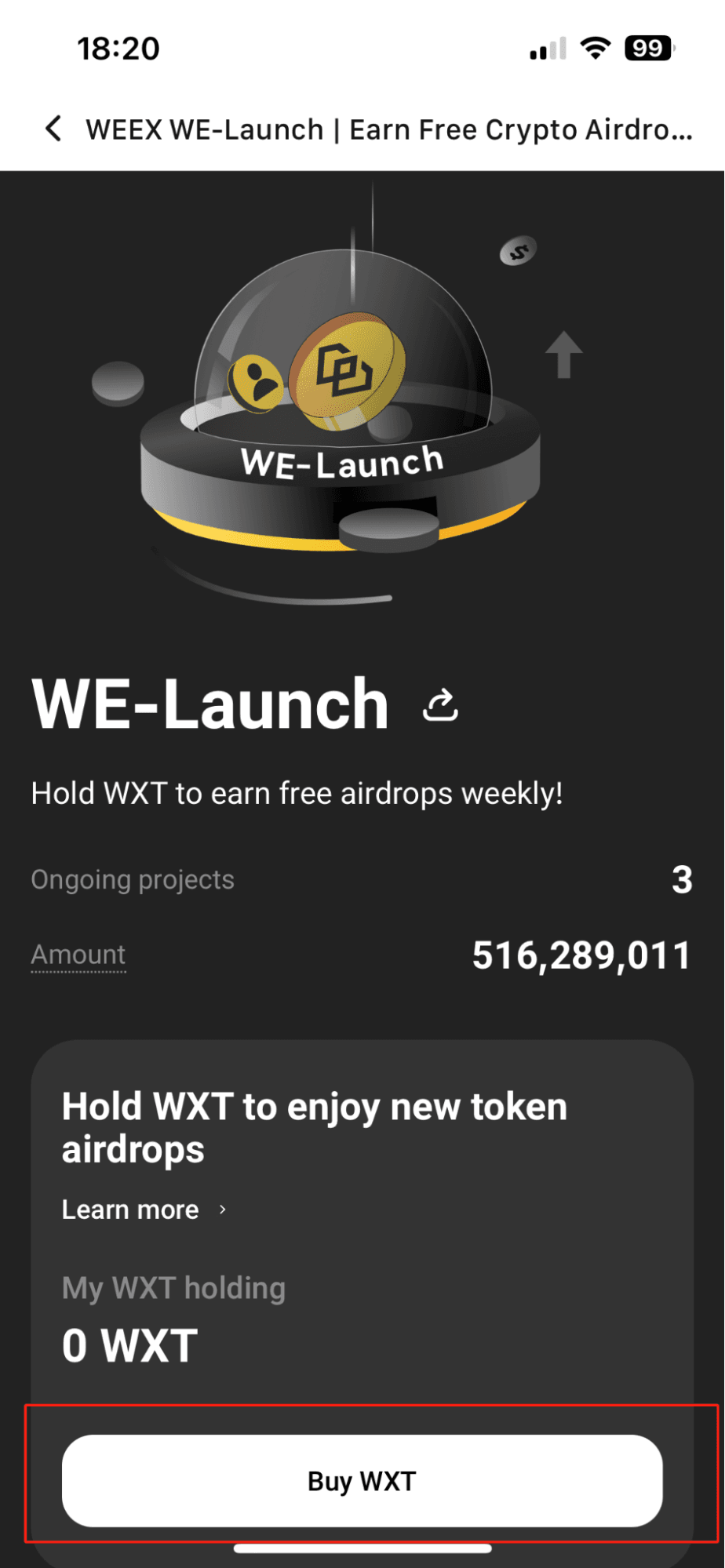
Input the quantity you wish to purchase, choose your preferred payment option, and assess the current exchange rate prior to finalizing the transaction.

To learn additional information on purchasing WXT, refer to this guide and proceed.
Please note:
- If your WXT balance drops below 1000 WXT for two consecutive days, your account will be suspended.
- Coins that are locked will not count toward the available amount for commitment.
Step 3: Select a Project and Commit WXT
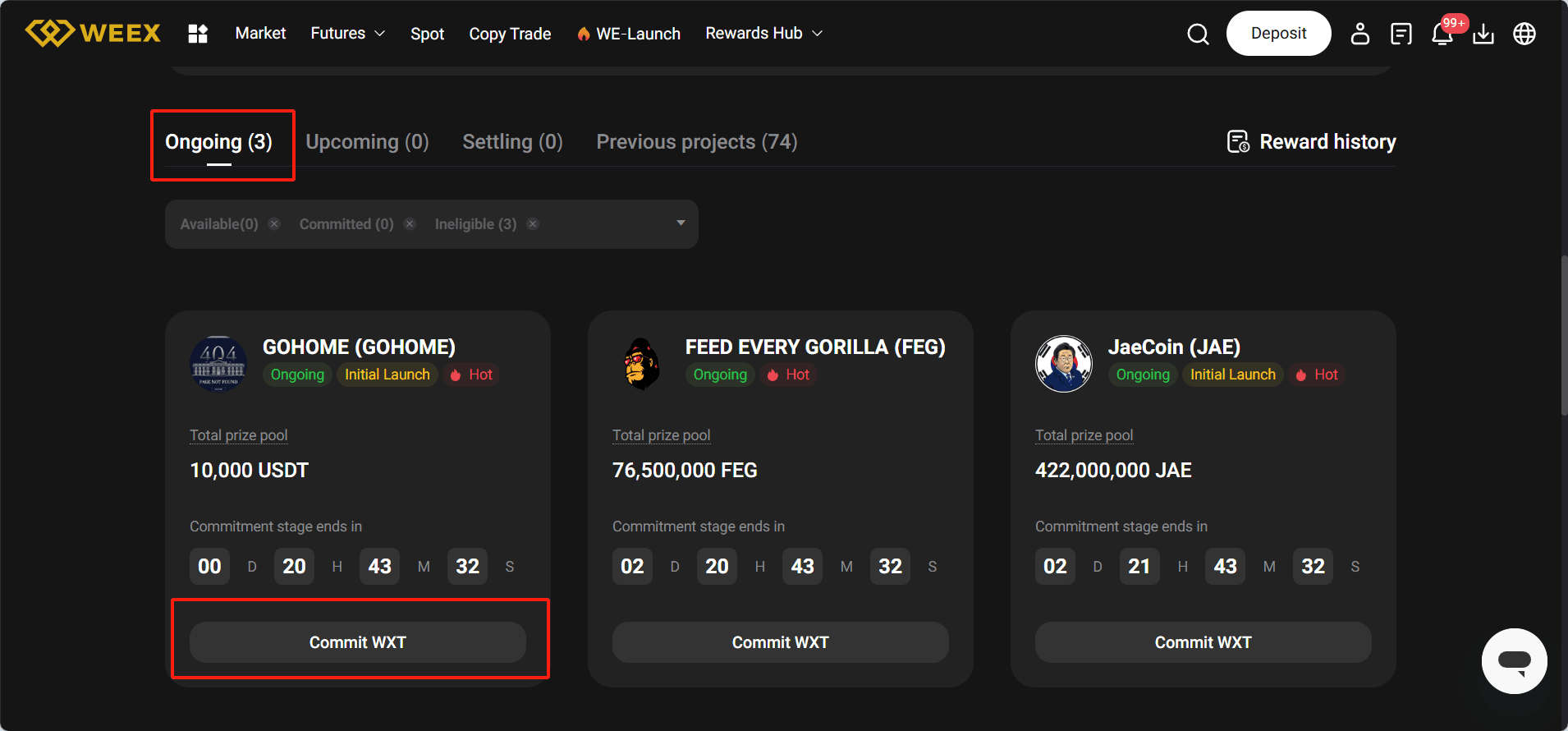
Navigate through the WEEX We-Launch webpage, review the current initiatives, select a project collection, and press the Commit WXT option.
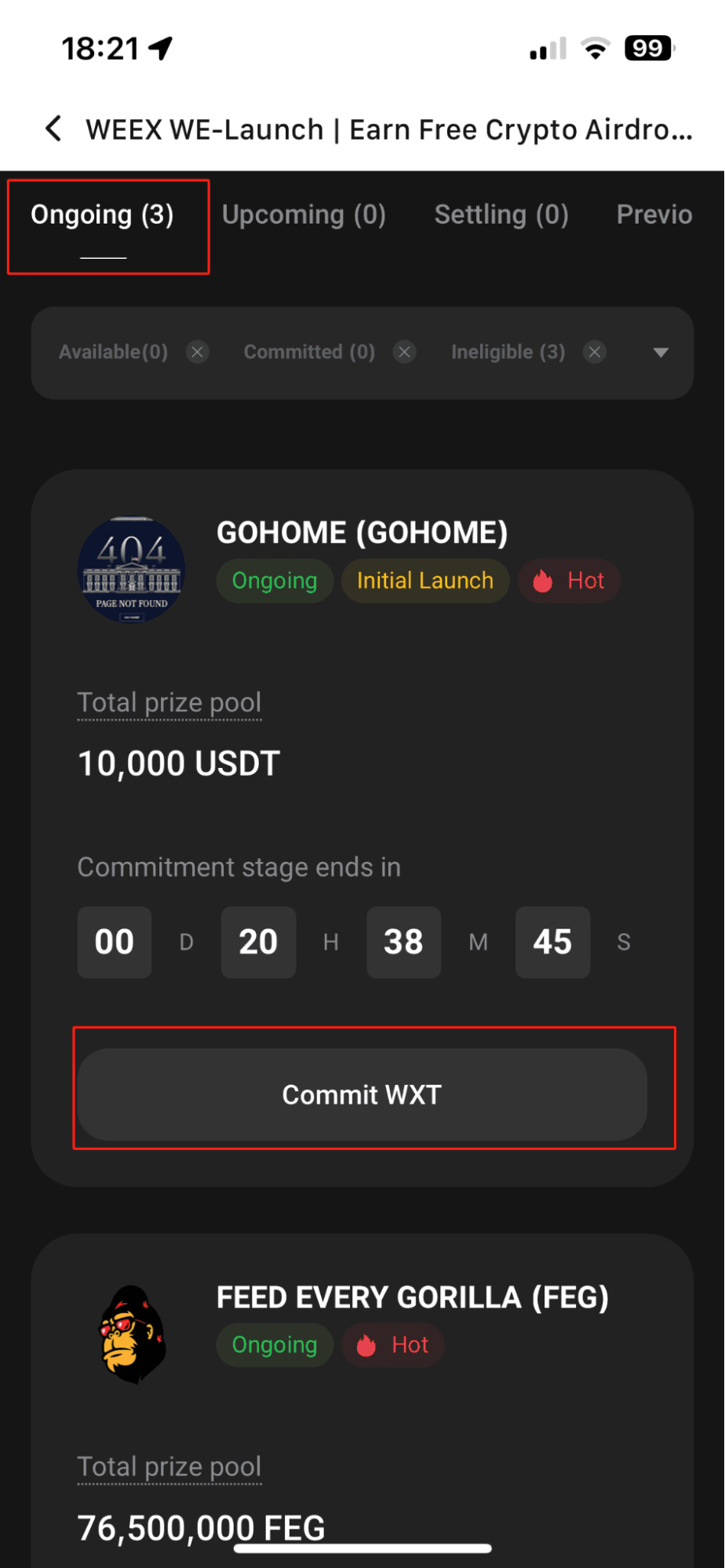
Note:
- If you qualify for a WE-Launch event, ensure you commit WXT during the designated period.
- The committed amount is solely for calculating rewards, and your WXT tokens will remain unfrozen.
Step 4: Monitor and Claim Your Rewards
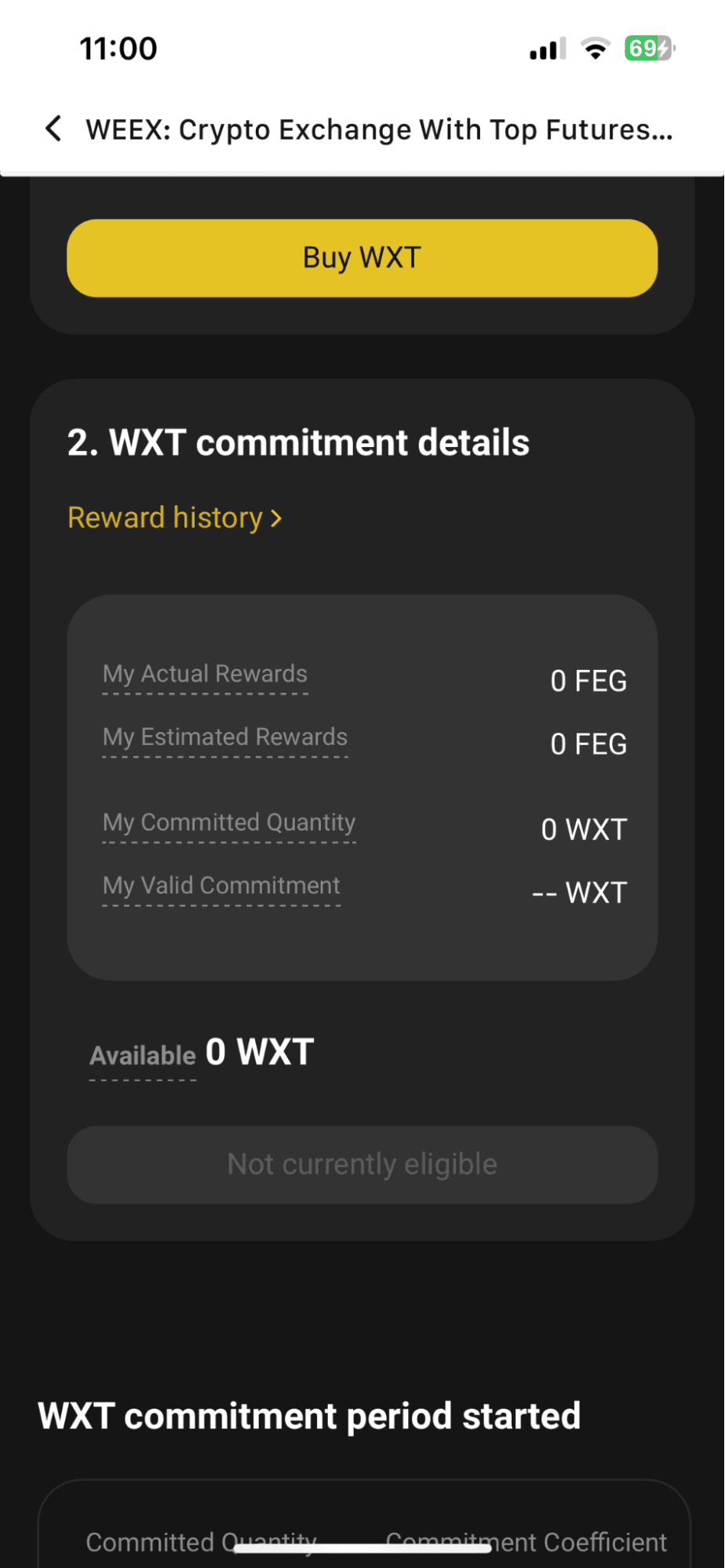
The airdrop incentive for individual participants is determined following the conclusion of the commitment phase. Nevertheless, you have the ability to verify your precise rewards, anticipated rewards, and legitimate WXT commitment on the dashboard of the project to which you have committed.
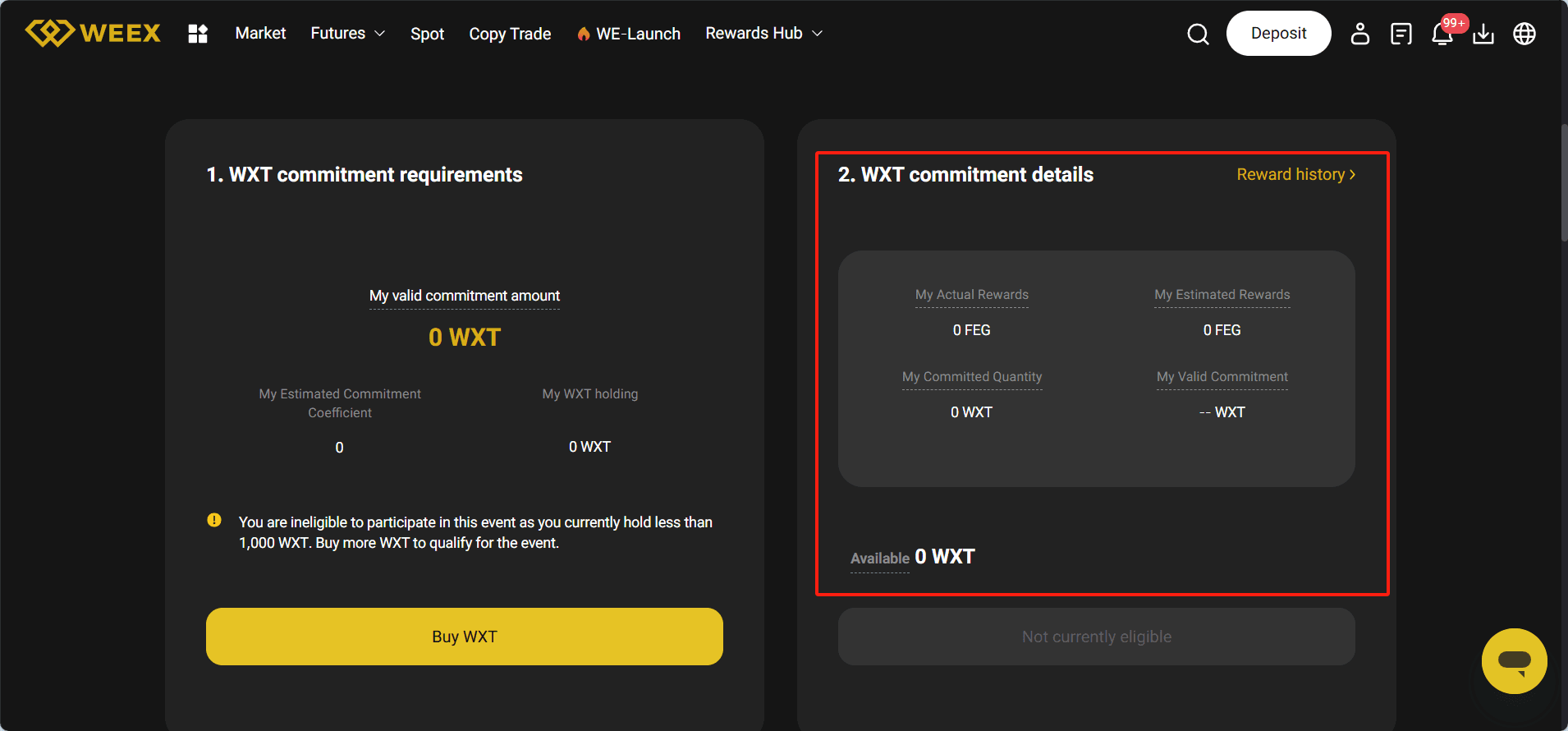
WEEX will determine the airdrop quantity by considering the proportion of a user's legitimate WXT commitment (quantity committed × commitment multiplier) in the overall prize pool, and then allocate the airdrops to the user's spot account.
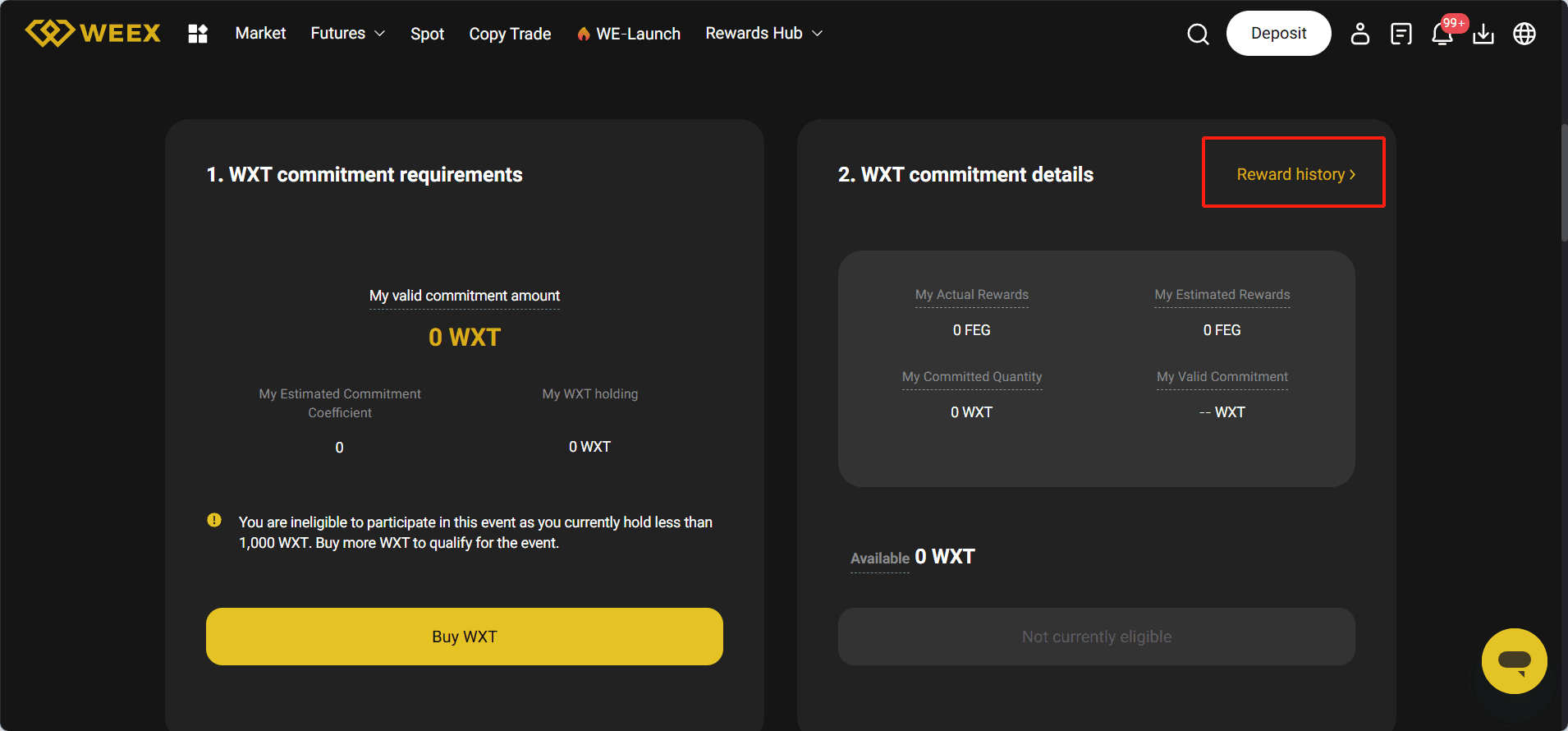
You have the ability to review your reward history at this location:
WEEX Affiliate & Referral Programs
WEEX Affiliate Program
What is the Affiliate Program
The WEEX Affiliate Program targets influencers, content producers, and people with a significant fan base, providing them with an opportunity to generate income through the promotion of WEEX and the recruitment of fresh users to the platform.
How to participate WEEX Affiliate Program
Getting started with the WEEX Affiliate Program is easy and uncomplicated. To learn more, refer to this quick guide that explains the process in detail.
To begin, simply follow these simple instructions:
Step 1: Register or Log In
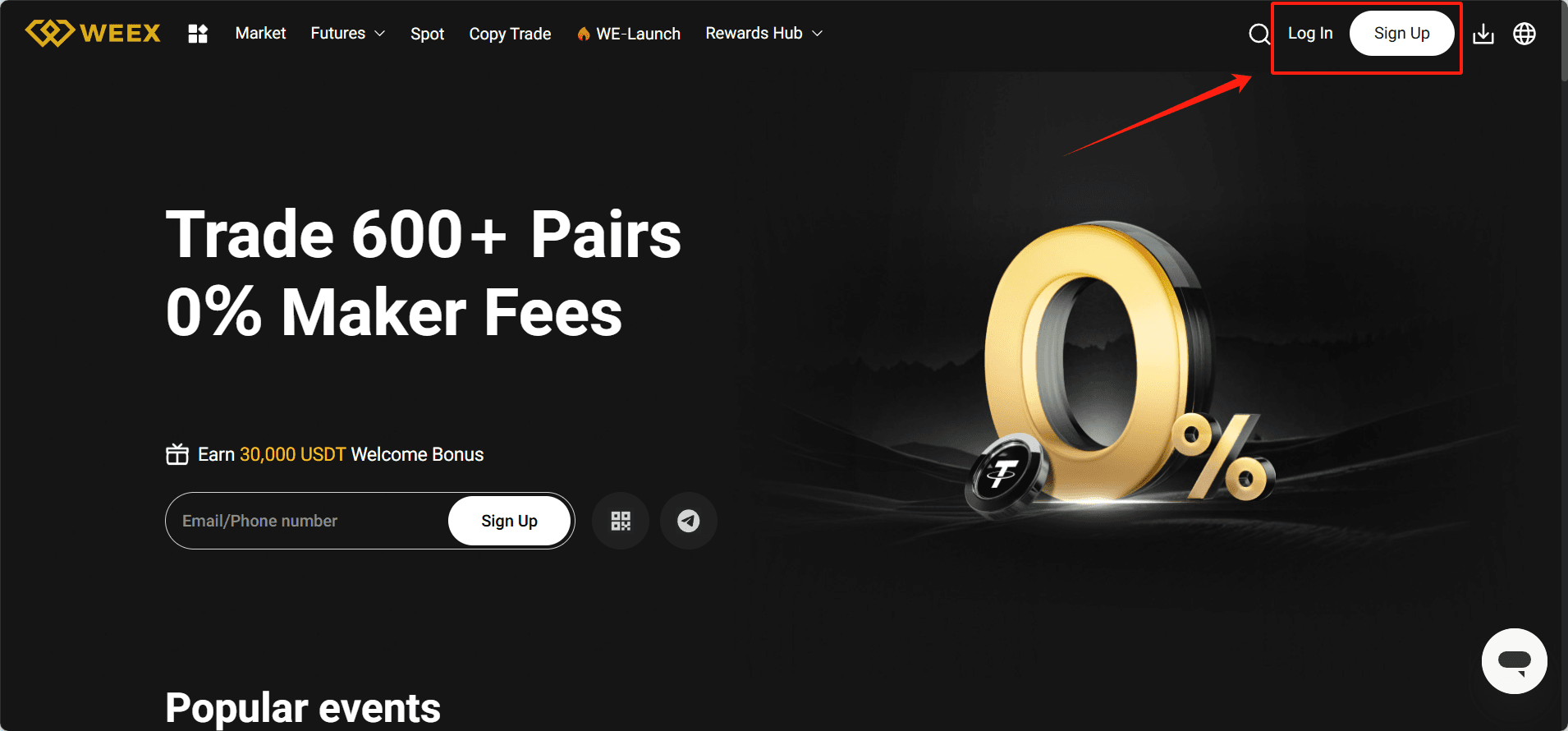
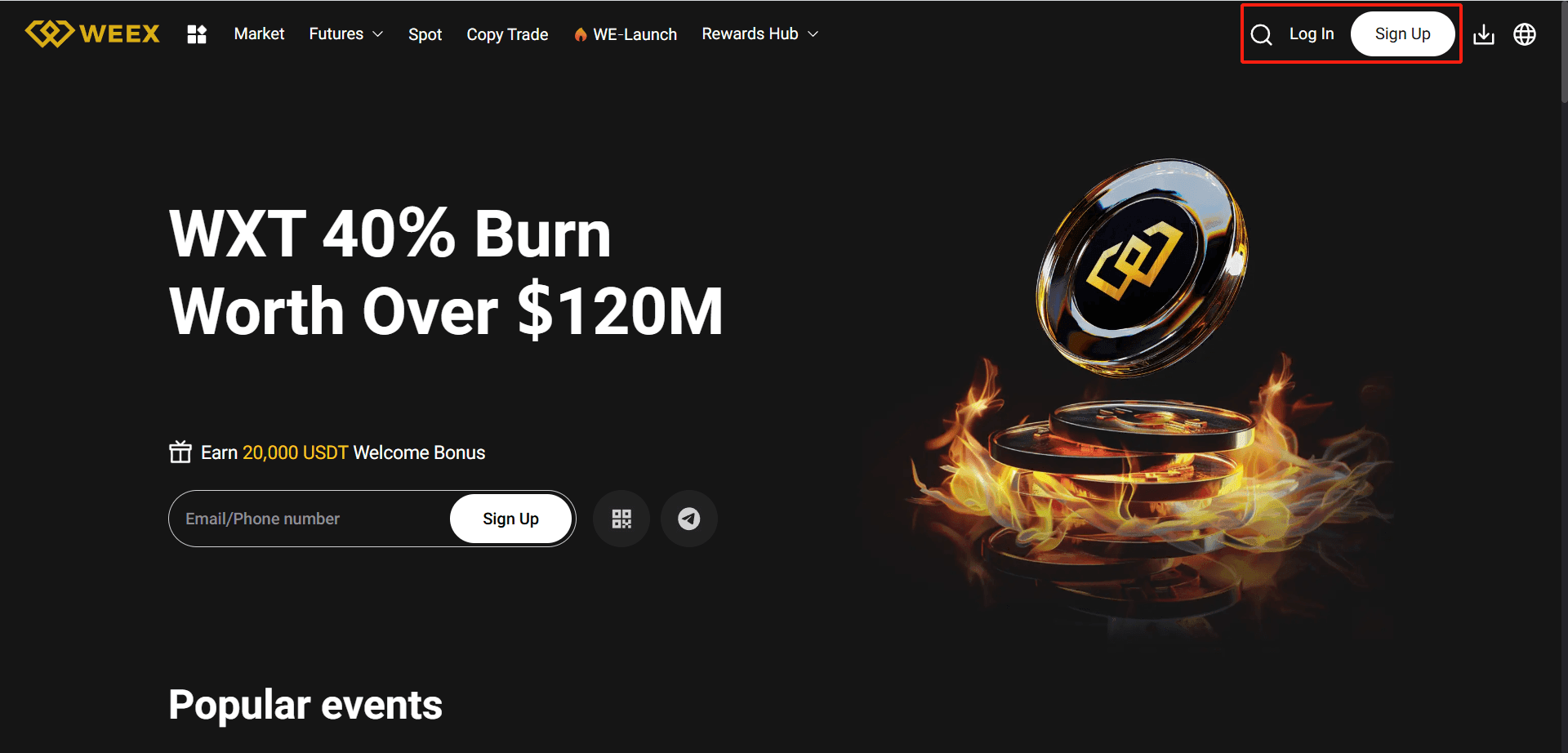
Explore the WEEX Affiliate Platform or get the app. Simply tap on the "Log In" option located at the top. If you are new, select "Sign Up" and refer to the detailed instructions. Remember to finalize the KYC (Know Your Customer) identity verification process.
Step 2: Complete Your Application
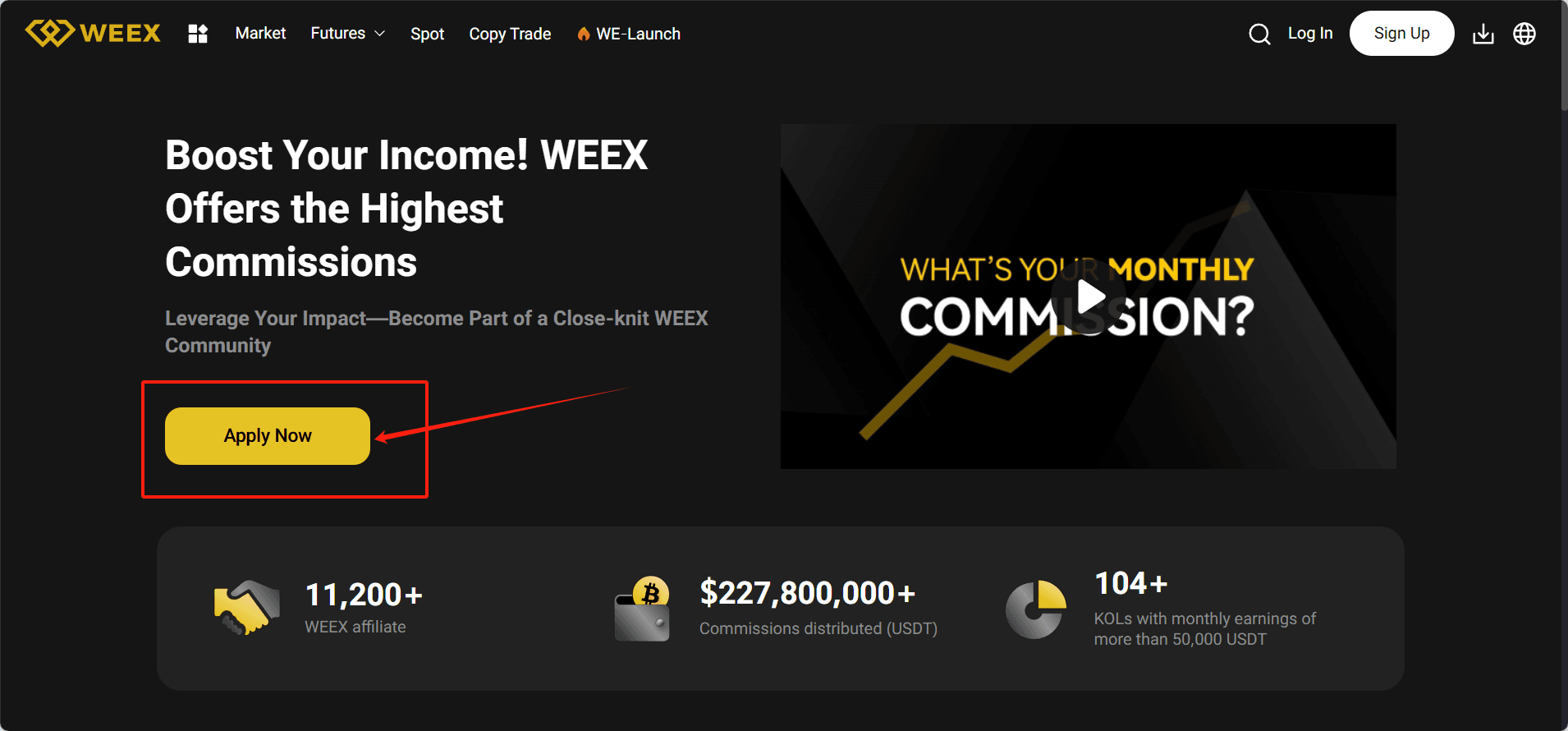
Simply press the "Apply Now" button and complete the application form by including information regarding your platform/channel, followers, members, and personal details. Furnish precise and thorough information to enhance the likelihood of your application being approved.
Step 3: Await Approval
Upon receipt of your application, WEEX will proceed with a review of your submission. This process generally requires 1-2 working days. Upon approval, an email confirmation will be sent to you, and you can expect to be contacted by the WEEX Affiliate team.
Step 4: Explore Your Affiliate Dashboard
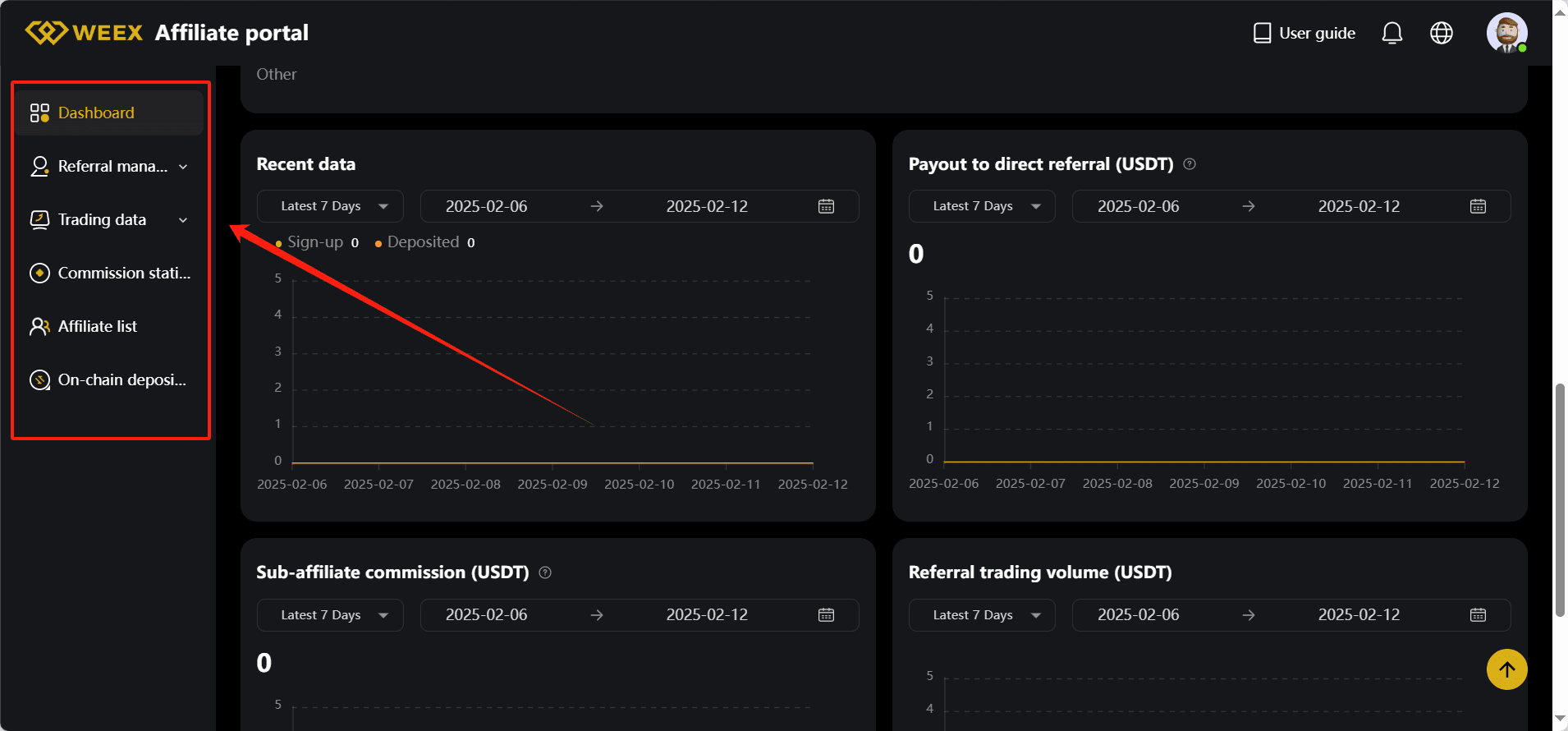
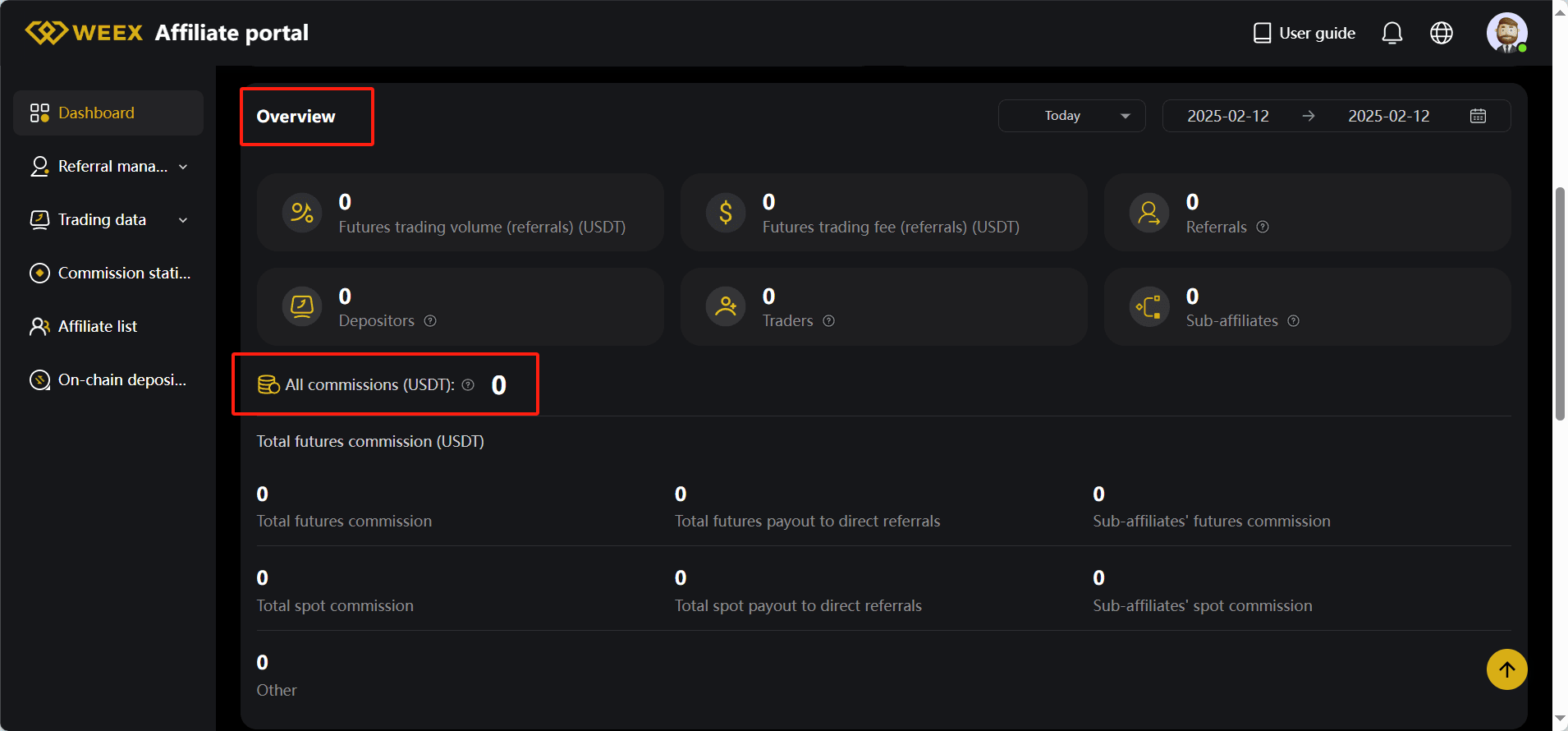
After receiving authorization, access your WEEX affiliate dashboard. This platform enables you to oversee your referrals, monitor trading statistics, and review your overall earnings.
Step 5: Share Your Unique Affiliate Links
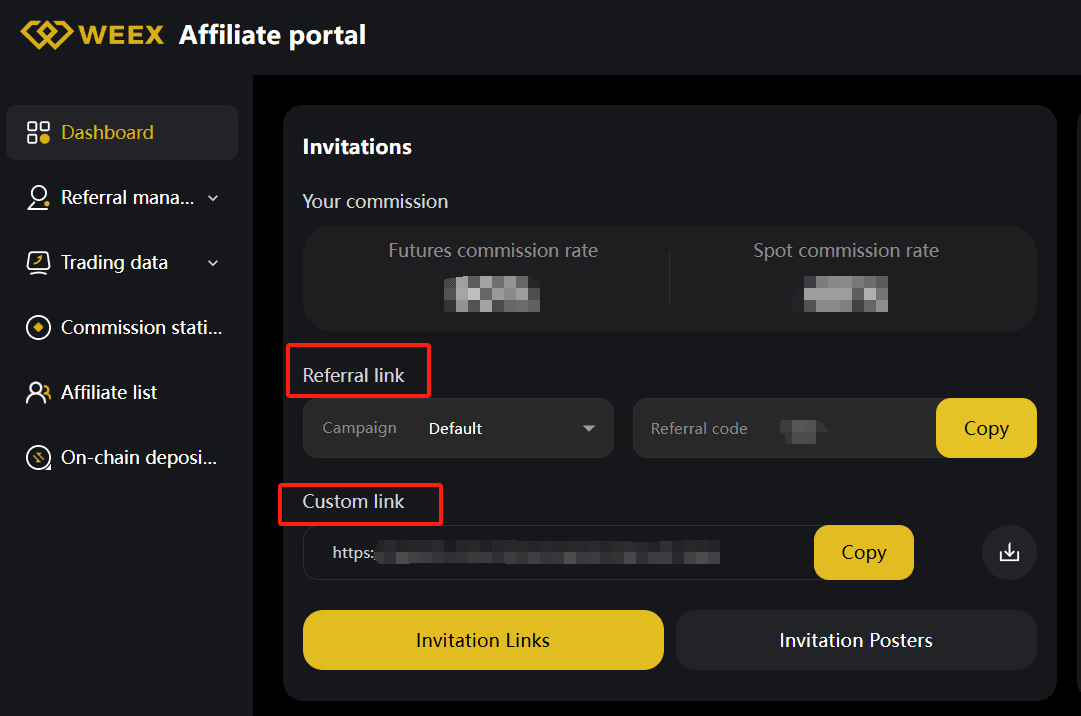
Create personalized referral links and codes, or obtain the QR code from the dashboard to distribute on your website, blog, social platforms, or advertising efforts.
Step 6: Monitor Your Earnings and Results
Utilize the WEEX dashboard for real-time tracking of your commissions and performance. Evaluate your outcomes and adapt your tactics to optimize your profits.
WEEX Referral Program
What is WEEX Referral Program
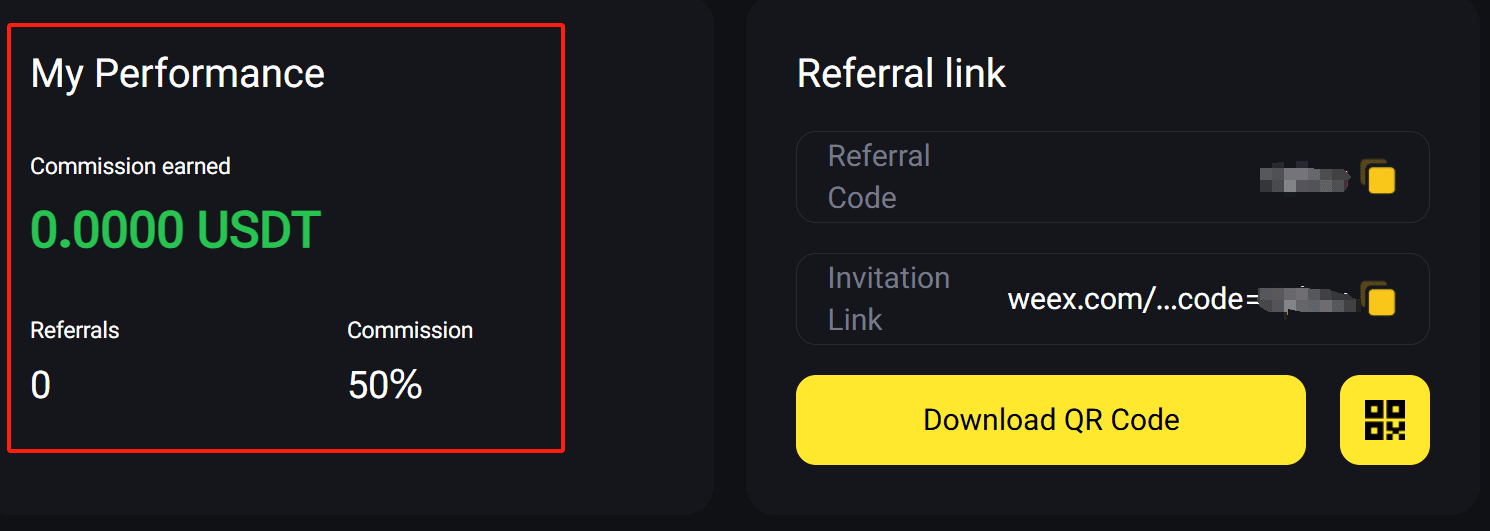
The WEEX cryptocurrency exchange provides an affiliate program known as the WEEX referral program. Participants are given a referral code or invite link to share with their acquaintances, or they can opt to share a QR code for scanning. Upon registration by those they refer, the referrer will receive a commission equal to 50% of the fees generated.
For example, if a referral conducts a $120 crypto trade resulting in a $12 fee, the referrer will receive $6. Likewise, if the referral engages in a $2,000 trade incurring a $200 fee, the referrer will earn $100.
How to Participate In WEEX Referral Program
Participating in the WEEX referral program is easy. Just distribute your referral link or code, and when your referral signs up, you will receive a commission. For additional information, refer to this step-by-step guide of the process.
Prepared to begin making money? Simply adhere to these uncomplicated instructions:
Step 1: Register or Log In
- For New Users: Go to the WEEX signup page or download the app and select [Sign Up]. Enter your email or phone number, making sure it’s correct, and create a strong password. Finish the registration steps and input the referral code in the provided field.
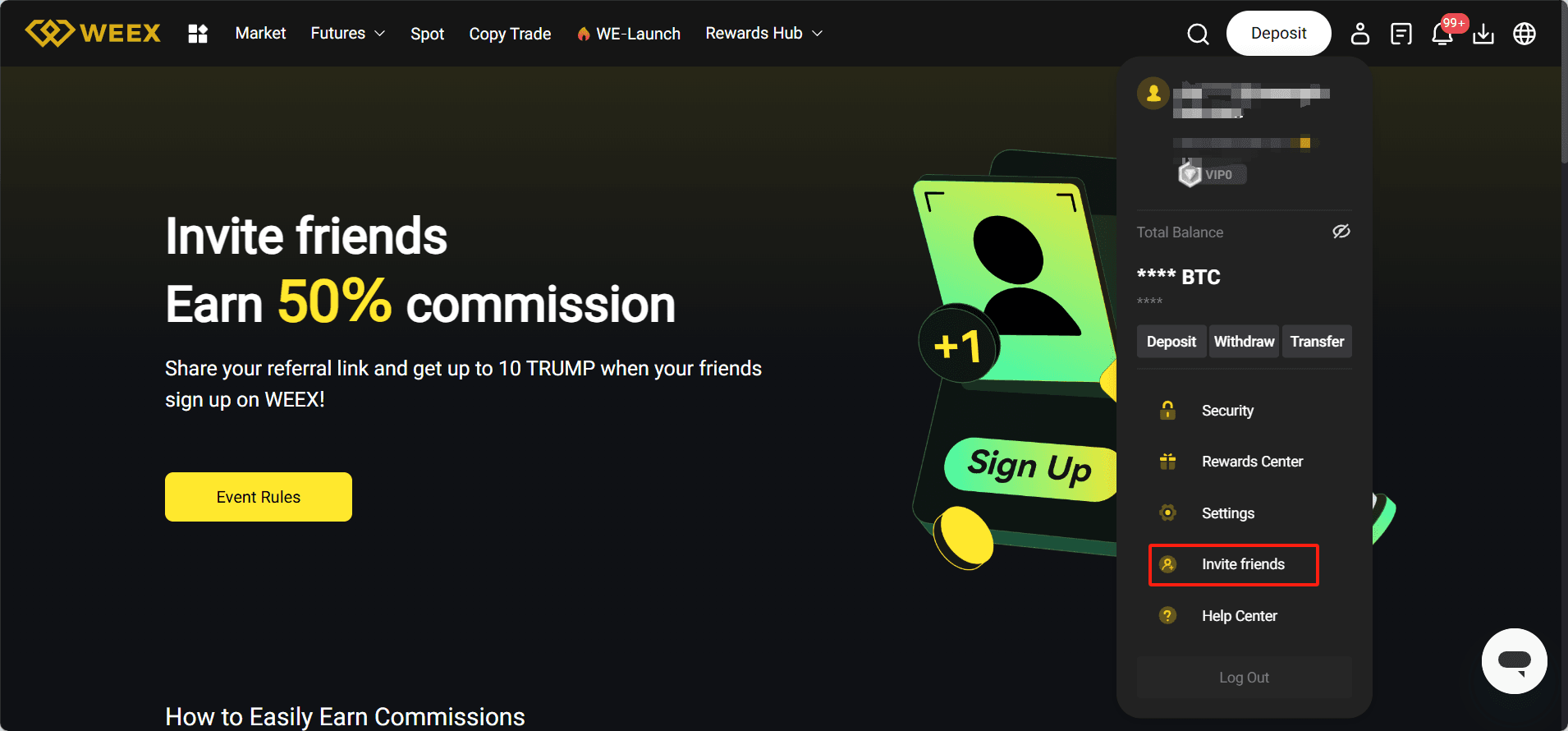
- For Existing Users: Sign into your account, hover over your profile, and select "Invite Friends," or go to the official WEEX Referral Program page.
Step 2: Fulfilling KYC Verification (Identity Verification)
In order to uphold the most stringent security protocols, WEEX mandates that users undergo KYC (Know Your Customer) verification corresponding to their level of access.
To complete the verification process, simply select the yellow profile icon located at the upper left corner of the homepage, and proceed to upload the required documents under the section labeled "Identity Verification."
Make sure to input precise data, as providing inaccurate information could lead to the suspension of your account. Refer to our KYC manual for guidance, and after verification, head to the WEEX referral scheme section.
Step 3: Distribute Your Referral Code/Link
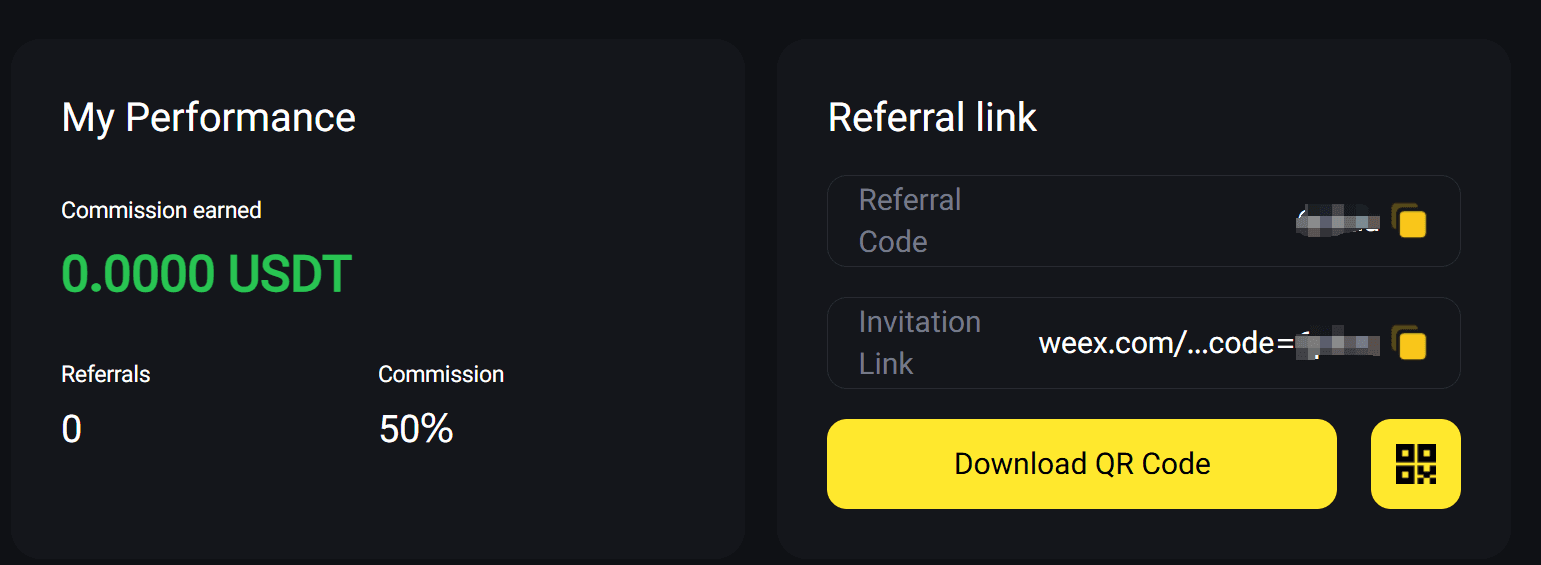
You have the option to either copy your unique referral code using the designated button, spread your referral link, or circulate a QR code that serves as your referral identifier through email, social platforms, or instant messaging. The more you distribute, the higher the potential rewards you may receive.
To ensure you receive your commission, it is essential that your referral code is applied by your referee when they register. Failure to do so will result in you not obtaining any bonus.
Step 4: Monitor Referrals & Earnings
To keep track of the rewards and bonuses you've accumulated, you can simply access the WEEX referral program page and navigate to the section labeled "My Performance." Within this area, you will be able to oversee the commissions you have generated and view the total count of users you have referred. This feature enables you to stay informed about your advancements and potential income.
WXT
What Is WXT (WEEX Token)?
WEEX token is a key element of the WEEX ecosystem, aiming to enrich the platform and deliver a range of advantages to users. Following its launch, WXT has experienced a remarkable surge of 384%, hitting a record peak of \$0.03391. Boasting a total token supply of 6 billion, WXT provides perks such as giveaways, reduced fees, and an impressive annual yield of 140%. Additionally, it implements a deflationary approach to enhance its long-term value.
WXT acts as an incentive system for the WEEX community, providing special perks such as access to the launchpad, reduced trading fees, and early access to WEEX events. Through the possession and utilization of WXT, individuals can benefit from potential long-range profits and an enhanced trading environment as the WEEX platform expands further.
Learn how to buy WXT now!
Why Pick WXT?
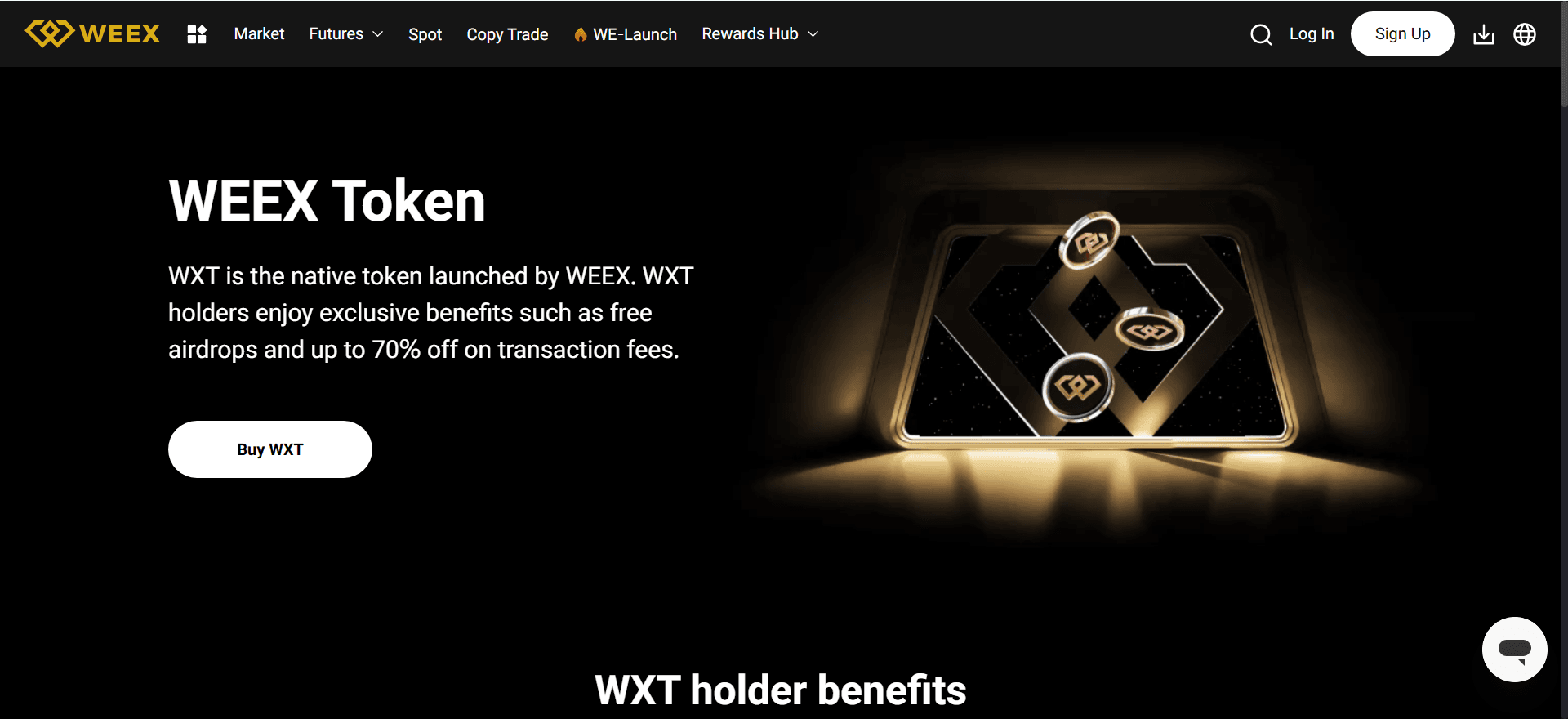
The WXT token provides a wide array of advantages that enrich your WEEX platform experience. By participating in WXT events on WE-Launch, users can obtain complimentary token airdrops from well-known projects and benefit from a 140% APY by holding WXT. WXT holders receive priority access to WE-Launch events, increased reward multipliers, and the chance to purchase new project tokens at attractive prices.
Moreover, WXT demonstrates increasing on-chain functionality, encompassing its involvement in decentralized finance (DeFi) and NFT markets, along with applications that span across different ecosystems in DEXs and wallets. Moreover, holders of WXT possess the ability to participate in voting processes concerning platform-related decisions, such as the addition of new coins and enhancements to existing features. They are also empowered to put forward governance proposals aimed at shaping the platform's future progression.
Owning WXT also comes with additional advantages, such as reduced trading fees, increased referral rewards, special event incentives, and frequent token distributions. Holding WXT can elevate your VIP status, providing access to varying discount levels, while elite traders who possess WXT receive a greater percentage of profits.
Burn WXT
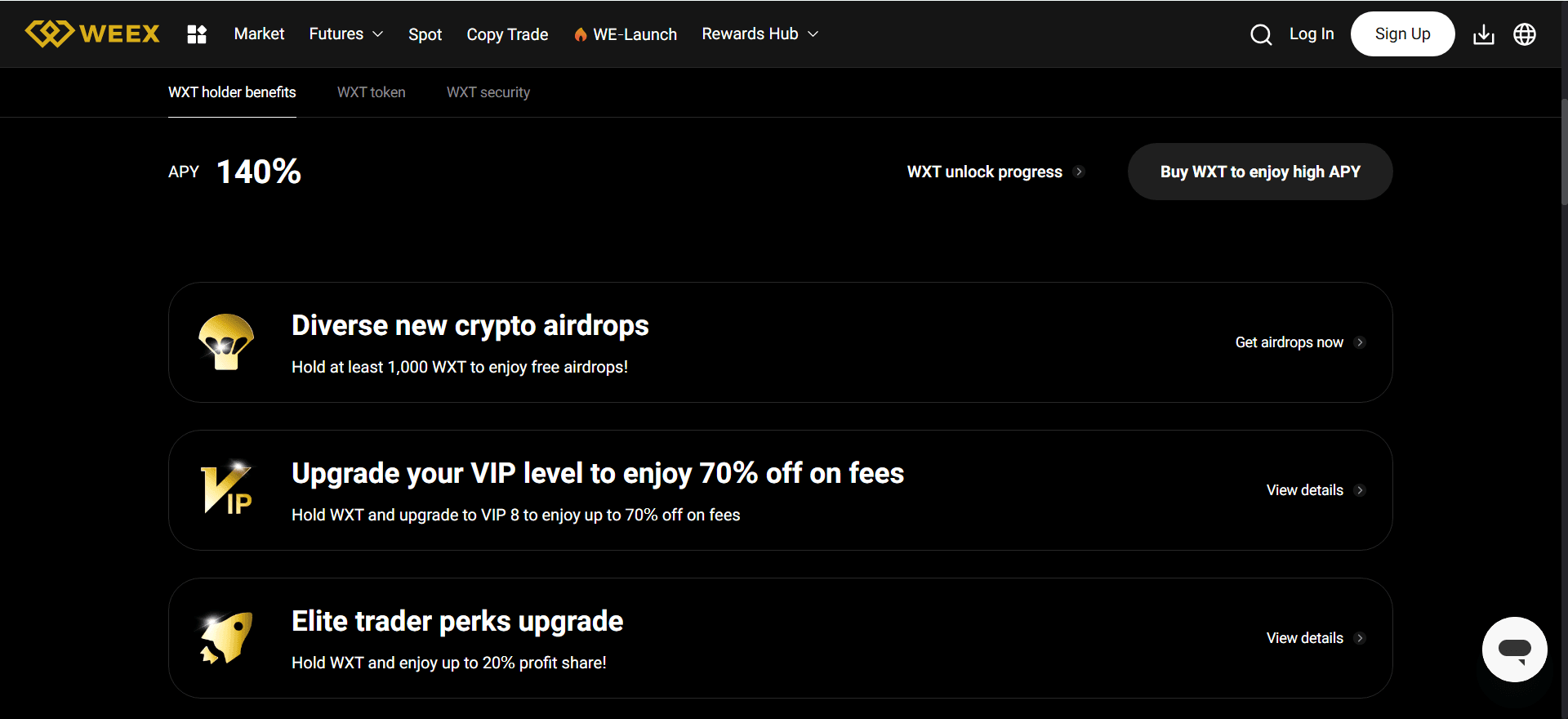
The deflationary approach of the WXT burn mechanism involves periodically taking out a portion of WXT tokens from circulation, which decreases the overall supply and has the potential to boost the token's value in the long term. This strategy is executed through the purchase and permanent removal of WXT tokens by WEEX from the open market, driven by platform revenues or specific milestones. The advantages include heightened scarcity, sustained rewards for holders, market steadiness, and increased trust within the community. By diminishing the token supply, the burn mechanism establishes scarcity, which in turn elevates the token's value as demand grows. Furthermore, it contributes to the growth of the WEEX ecosystem by attracting investors, improving liquidity, and reinforcing user trust. Through transparent burn processes, WEEX showcases its dedication to creating sustainable value, positioning WXT as a promising asset in the realm of cryptocurrency.
The WXT burns scheduled for the first quarter of 2025 were successfully carried out by WEEX. By utilizing a transparent burn mechanism on January 31, 2025, the platform permanently eliminated 4,000,000,000 WXT (4 billion tokens) from circulation. This deflationary measure is in line with the project's dedication to improving token functionality and maintaining value stability. It represents a significant advancement in the project's updated whitepaper strategy aimed at managing supply-demand dynamics effectively and nurturing sustainable ecosystem development.
Fees On WEEX
Deposits and Withdrawals
Deposits made to WEEX are free.
Weex does not impose any fees on users for cryptocurrency withdrawals; however, users are responsible for covering the network or miners fee, which can fluctuate based on the specific cryptocurrency and network circumstances.
The withdrawal charges for WEEX are available on this page: Rate Standards
When utilizing our WEEX application, simply select the profile icon located at the top left corner and then navigate to [Fee Rates] to access the withdrawal fee rates applicable to all cryptocurrencies.
Click here for access to the full WEEX WXT guide.
Trading Fees
Under usual conditions, both makers and takers are charged a 0.1% fee for spot trading on WEEX. For futures trading, makers pay a fee of 0.02% while takers pay 0.08%.
By holding WXT, you have the opportunity to receive a discount of up to 70% for futures trading fees based on your WEEX vip level. The discount amount increases with the level of your membership. Register or sign in to WEEX today!
To access the regulations and fee structure, simply select the assets icon located in the corner, navigate to [Futures], and choose [Enjoy up to 70% off transaction fees].
Furthermore, occasional trading fee discounts are also provided by WEEX, hence it is advisable to refer to the latest event announcements!
The trading fees for WEEX spot trading and futures trading are available on this page: Rate Standards.
WEEX VIP
The WEEX VIP program is specifically created to provide top-notch assistance and benefits to valued customers. Being a VIP grants you immediate contact with an assigned account manager accessible 24/7 through a dedicated VIP communication channel for resolving any account concerns. This guarantees a tailored, effective service without the usual waiting times or obstacles.
Being a WEEX VIP offers more than just superior customer service. VIPs receive priority treatment for withdrawals, ensuring quick and straightforward transactions without the need for complex verification processes for large sums. Moreover, VIPs are spared from extended lock-up periods and collateral requirements, enhancing transaction efficiency and flexibility. To become eligible, just provide your UID to the customer service team. If you meet the requirements, you will be assigned a dedicated account manager and granted full VIP benefits.
Complete the VIP application form today in order to join the ranks of WEEX VIP members!
WEEX Global Ambassador
Success in football relies on executing accurate maneuvers at the appropriate time, blending speed, precision, and a solid strategy. Similar to the dynamics on the field, triumph in the cryptocurrency market necessitates timely choices, meticulous planning, and a dependable ally to navigate the market fluctuations. This is why the collaboration between Michael Owen and WEEX has been forged---each move pushes WEEX × weex ambassador Owen closer to triumph. By leveraging Owen's strategic acumen and precision alongside WEEX's cutting-edge platform and unwavering commitment to security, this partnership strives to introduce a winning strategy to the realm of cryptocurrency exchange. Just as a cohesive football team operates in harmony, WEEX Owen embodies the strength of teamwork and the determination to excel.

WEEX Vision for 2025
- Enhanced Trading Tools: Continuously developing advanced features to elevate the user experience.
- Worldwide Expansion: Growing its presence to unite traders and communities globally.
- Uncompromising Security: Upholding robust security standards while embracing cutting-edge innovations.
Grateful for the community’s trust and support, WEEX welcomes you to join its mission to redefine cryptocurrency trading. Explore more possibilities by visiting the official WEEX website today.
Conclusion
WEEX stands out as a top cryptocurrency exchange that combines security, innovation, and user-centered design seamlessly. By establishing a 1,000 BTC user protection fund and ensuring transparency through Proof of Reserves, WEEX places a strong emphasis on trust and the safety of assets. Offering a wide range of services including spot trading, 400x leveraged futures, copy trading, and WE-Launch token pools, WEEX caters to traders of all levels, supported by a selection of over 1,500 trading pairs and competitive low fees. The platform's WXT token ecosystem, which is designed to be deflationary, its presence in 134 countries worldwide, and strategic partnerships such as Michael Owen's ambassadorship, all contribute to reinforcing its competitive advantage.
For individuals in the trading world looking for a safe, feature-packed, and community-driven platform, WEEX serves as the entrance to the upcoming trends in cryptocurrency. Gain access to exclusive incentives, reduced fees, and early entry to promising projects by registering today and becoming one of the 5 million users influencing the future of digital finance. Embark on your WEEX journey and explore cutting-edge innovation in trading.
WEEX aims to shape the future of the digital assets industry through the provision of a secure, private, and user-friendly platform. The objective of the WEEX ecosystem is to establish a self-sustaining financial system powered by blockchain technology, offering a range of applications to democratize access to blockchain technology. By connecting cryptocurrency with traditional finance, WEEX is striving to lower entry barriers and introduce cutting-edge products, envisioning a future where digital assets assume a central role in everyday activities.
FAQ (Frequently Asked Questions)
How many cryptocurrencies are available on WEEX?
Supporting more than 1000 cryptocurrencies, WEEX offers a wide variety of digital assets for traders to diversify their portfolios effectively. This selection includes established cryptocurrencies, enabling users to capitalize on market opportunities, trade securely, and conveniently access their preferred assets.
Is WEEX a secure platform?
Affirmative, WEEX is secure. Safety is a key priority for WEEX, demonstrated through various measures including a 1,000 BTC margin pool and dual-layer risk control systems that blend smart technology with manual supervision. In addition, WEEX upholds a safe and confidential setting by utilizing servers located worldwide and employing advanced wallet management verification. Furthermore, WEEX delivers a top-notch futures trading platform offering benefits such as zero charges on tiered liquidations, immediate deposits and withdrawals, and specialized customer service.
How can I add funds to my WEEX account?
Adding funds to WEEX is simple and supports various methods. Refer to the Step-by-Step Guide to finalize your deposit and kickstart your trading or investment experience.
Where can I locate additional FAQs for WEEX?
Explore WEEX wiki to locate the inquiry you seek or navigate through our WEEX support for the solution you require.
You may also like

Crunch Time for the CLARITY Act: What’s in Store for Crypto?
The CLARITY Act, the most closely watched piece of crypto legislation in the U.S. history, has entered its final sprint.
Over the past few months, questions such as who should receive stablecoin yields, how to allocate liability in DeFi, and whether traditional banks would suffer a “bloodletting” have repeatedly stalled the bill. It wasn’t until recently that the deadlock was truly broken. Senator Thom Tillis confirmed on Monday that he and Senator Alsobrooks have been in talks with various parties for months and have finally produced a proposal that is broadly acceptable to all sides.
So, what exactly does the long-delayed CLARITY Act entail? And if it passes, what changes will it bring to the crypto market? This article provides an in-depth breakdown.
CLARITY Act Overview: Establishing Compliance and ClassificationThe Digital Asset Market Clarity Act (CLARITY Act) is the most ambitious attempt at crypto industry regulation by the U.S. Congress to date.
The bill passed the House of Representatives in July 2025 but has been stalled for an extended period due to disputes in the Senate.
Simply put, the bill primarily covers three key areas:
First, it clarifies the regulatory boundaries between the SEC and the CFTC. This is one of the most challenging issues facing those U.S. crypto companies. Currently, there is an overlap in the SEC and CFTC’s functions regarding the classification of digital assets, leaving companies facing long-standing uncertainty regarding their “regulatory status” from a compliance perspective.Second, establishing a regulatory framework for stablecoins. The bill imposes restrictions on stablecoin yields, but more crucially, it expands the scope of coverage—unlike the GENIUS Act signed in 2025, which targeted only issuers, the CLARITY Act extends to a broader range of entities, including trading platforms and wallet service providers, thereby filling a legislative gap.Third, strengthening investor protection and disclosure requirements. The bill strengthens the legal basis for holding parties accountable for fraudulent transactions, clarifies the criteria for determining market manipulation, and restricts insiders from abusing non-public information for illegal gains.Additionally, federal regulators will issue a stablecoin disclosure framework and a list of compliance activities within one year of the bill’s passage, establishing a more predictable compliance roadmap for the industry’s development.
The Key Compromise: How Does the Stablecoin Yield Provision Balance the Interests of Both Sides?It is clear that the biggest stumbling block preventing this bill from moving forward has been the issue of stablecoin yields—specifically, where the money comes from and whether it will siphon deposits away from banks—which has long been a major point of contention between the traditional banking sector and the crypto industry.
The key to breaking this deadlock lies in the compromise text on stablecoin yields reached by Senators Thom Tillis and Angela Alsobrooks. The provision explicitly prohibits crypto companies from paying “any form of interest or yield” (i.e., similar to bank deposits or interest-bearing products without cause) solely because customers hold stablecoins. However, it preserves room for rewards based on “real activity,” such as trading rebates, membership benefits, and on-chain interaction incentives.
Traditional banks have long feared that high-yield stablecoins would erode their deposit base, leading to massive capital outflows. This ban directly positions stablecoins as “payment tools” rather than “savings products,” effectively putting their minds at ease.
On the other hand, while crypto project teams cannot directly pay interest, they can still gain market share through product innovation, boosting user engagement, and expanding use cases.
In my view, this compromise may appear to be a mere semantic game on the surface, but it effectively amounts to a “redefinition of function”—stablecoins have shifted from their previous role as “savings-like assets” seeking risk-free returns back to that of “base money” for payments, settlements, and ecosystem incentives. However, the exact criteria for determining “real activity” remain vague, and this is likely to become a new battleground for all parties vying for regulatory interpretation in the future.
Following the key compromise, the probability of the bill being signed into law in 2026 surged to 70% on the prediction market Polymarket, setting a monthly high. https://polymarket.com/event/clarity-act-signed-into-law-in-2026
With the implementation of this compromise, the probability of the bill being signed into law in 2026 on the prediction market Polymarket briefly surged to 70%, setting a monthly record.
However, on the very day this article was written, U.S. banking trade groups still stated that the Senate’s stablecoin incentive compromise was “not sufficient”—they fear that the wording of the ban is not firm enough and that disguised economic incentives might emerge.
Clearly, this battle is far from over.
What Changes Will the Crypto Market See?In fact, on every level, the CLARITY Act is more than just a simple update to regulatory terminology; it marks a landmark shift for the U.S. crypto market as it moves from a “pilot phase” to “institutionalization,” and the crypto market will benefit from this.
Leading compliance players see a revaluation: As a leader in compliant stablecoins, Circle (CRCL) is one of the bill’s biggest beneficiaries, with its stock surging 20% on Monday alone. As interest income from reserve assets grows and USDC continues to expand its market share across multiple use cases, Circle’s profit outlook is expected to become increasingly clear, enabling its transformation from a “crypto cyclical stock” to a “Web3+AI infrastructure stock.”Stablecoin ecosystem stands to benefit directly: Stablecoins are explicitly defined as “payment tools” rather than “deposit-like products.” This represents a major boon for cross-border payments, the tokenization of RWA (real-world assets), and AI-driven business models, helping to revitalize sectors such as DeFi, PayFi, and RWA.Overall market sentiment is improving: As a “macro-level” development, the CLARITY Act will further boost risk appetite as btc-42">Bitcoin recently rebounded to the $80,000 mark.The next two weeks will be a critical window for the CLARITY Act’s passage. The crypto industry has made clear concessions regarding the flexibility of financial products to alleviate the concerns of the traditional financial system. This concession is not a retreat, but a strategic trade-off.
Of course, this does not mean everything is settled—the banking sector continues to question the boundaries of “real-world activities,” and regulatory responsibilities for DeFi have not yet been fully clarified. But at the very least, for the entire crypto industry, a “clear bill” that can be implemented is more important than a “perfect bill.” And the active progress being made at this stage is itself a sign that crypto assets are moving toward a mature capital market.

What Are TradeFi Perpetual Contracts? Complete Guide 2026
If you trade crypto on WEEX, you already know how perpetual contracts work. No expiry. USDT settled. Leverage up to your risk tolerance.
Now imagine trading gold, oil, or Tesla stock the exact same way.
That is what TradeFi Perpetual Contracts on WEEX do. They bring traditional markets into your crypto workflow.
Let us break down what are tradfi perpetual contracts, how stock tokens work, and when you should care about trading hours.
What Are TradeFi Perpetual Contracts on WEEX?TradeFi perpetual contracts on WEEX are USDT-settled futures that track the price of traditional financial assets — stocks, commodities, precious metals.
You do not own the underlying asset. You just trade its price movement.
Same margin system as crypto perpetuals on WEEX. Same funding rates. Same liquidation logic.
But there is one difference: the asset behaves like traditional markets, not crypto.
What you can trade on WEEX:Precious metals (gold, silver)Commodities (oil, natural gas)Stocks (Tesla, Apple, NVIDIA)Key features on WEEX:24/7 access – No waiting for NYSE to openNo expiry – Hold as long as you wantUp to 400x LeverageUSDT settled – No currency conversionSo how do tradfi perpetual contracts work on WEEX? Exactly like crypto perps. But the price source changes.
What Are Stock Tokens on WEEX?Stock tokens on WEEX are digital assets pegged to real stock prices. Think of them as a tracking device, not the actual stock.
If Tesla moves 5% in Nasdaq, the Tesla stock token on WEEX moves 5%.
Advantages of TradFi Perpetual Contract on WEEXThis is where tradfi perpetual contracts 24/7 trading on WEEX gets interesting.
Because stock tokens track real stocks, their volatility depends on whether the US stock market is open.
Period (ET)VolatilityLiquidityWhat happens on WEEXTrading hours (9:30 AM – 4:00 PM)LowHighTight spreads, price tracks closelyPre/after market (4:30 AM – 9:30 AM & 4:00 PM – 8:00 PM)HighMediumPrice jumps possible, fewer ordersMarket closed (weekends/holidays)Potentially highLowNo real price reference. News can cause big movesWhy this Matters for You on WEEXIf you trade during US market hours, expect smooth price action.
If you trade pre-market or weekends on WEEX, you are betting on sentiment without live price feeds. That cuts both ways.
Pre market stock token volatility can be an opportunity or a trap. Know which window you are in.
How WEEX TradeFi Perpetual Contracts Differ from Crypto PerpsSame mechanics. Different parameters.
TradeFi perpetual contracts on WEEX follow the same margin, funding rate, and liquidation rules as crypto perps. But WEEX adjusts two things:
Index price calculation – Uses multiple traditional market data sourcesMark price deviation limits – Tighter or wider depending on asset liquidityWhy? Because traditional markets have closing hours. Crypto does not. WEEX has to decide how to price the token when NYSE is asleep.
The contract works the same. The price source works differently.
How to Trade TradeFi Perpetual Contracts on WEEXOn WEEX, follow these steps:
Go to WEEX official website, click on Futures and then select TradFi.Choose trading pair, margin mode , set stop loss/ take profit and leverage for your order.No separate account needed. Same USDT balance. Same interface.
WEEX keeps it unified. One account. One wallet. Two markets.
ConclusionWhat are TradeFi perpetual contracts on WEEX? Crypto-style futures for stocks, gold, and oil. Same USDT settlement. Same leverage. Same account.
One catch: volatility follows NYSE hours. Liquidity drops on weekends. Trade market hours for smoother moves. Trade off-hours if you want to front-run news — but know the risks.
Ready to trade? Sign up on WEEX Now and Start your TradFi journey!
FAQWhat are TradeFi perpetual contracts on WEEX?They are USDT-settled futures contracts on WEEX that track traditional assets like stocks, gold, and oil. You trade price movement without owning the underlying asset.
What is the difference between stock tokens and real stocks?Real stocks give you ownership, voting rights, and dividends. Stock tokens on WEEX only give you price exposure.
Can I trade TradeFi perpetual contracts 24/7 on WEEX?Yes. Unlike traditional markets, TradeFi perpetual contracts on WEEX trade 24/7, including weekends and holidays.
What assets can I trade with TradeFi perpetual contracts on WEEX?Precious metals (gold, silver), commodities (oil, natural gas), and stocks (Tesla, Apple, NVIDIA, etc.).
How do I start trading TradeFi perpetual contracts on WEEX?Go to the futures trading page on WEEX, select Perpetual → USDT → Commodity or Stock, and choose your asset.

How to Trade Futures on WEEX 2026: Best Guide and Strategies for Beginners
You've heard the stories. Someone turned 500 into 50,000 overnight trading futures contracts. Someone else got liquidated in minutes.
Futures trading isn't magic. It's not gambling either — if you understand how it works.
This guide covers the basics of futures trading on WEEX Futures. You'll learn what futures contracts are, where they came from, how they work in crypto vs. traditional markets, and exactly how to place your first trade on WEEX.
No fluff. No AI nonsense. Just a clear, usable guide.
Key TakeawaysFutures contract = agreement to buy/sell an asset at a fixed future date and priceOrigins – Modern futures started with CBOT in 1848 (but tulip futures appeared in 17th-century Netherlands)WEEX Futures offers 1,700+ trading pairs including BTC and ETH perpetual futuresUp to 400x leverage on WEEX – high capital efficiency but high riskCrypto futures trade 24/7, no physical delivery, higher volatility than traditional futuresWhat Is a Futures Contract?A futures contract is a legal agreement to buy or sell an asset at a predetermined price on a specific future date.
Unlike buying crypto on spot (you get it immediately), futures lock in today's price for a future transaction.
Example: If you think Bitcoin will be 100k in three months but it′s 70k today — you can buy a futures contract at $70k. If you're right, you profit. If you're wrong, you lose.
Common underlying assets: oil, gold, corn, stocks, forex, and yes — crypto.
History of Futures ContractsFutures trading isn't new. It's older than most countries.
Ancient roots: Merchants locked in prices for wool, spices, and metals to avoid market swings.
17th century Netherlands: Tulip futures appeared. Yes, people traded contracts on flowers. It ended badly (Tulip Mania), but the concept stuck.
1848 – The big one: 82 merchants founded the Chicago Board of Trade (CBOT) . This became the world's first formal futures exchange. Standardized contracts followed — specifying quantity, quality, and delivery date.
That standardization changed everything. Trading became faster, cheaper, and more accessible.
How Futures Contracts WorkLet's make this concrete. No crypto jargon yet — just corn.
The situation:
Alice grows corn. Her cost = $100/ton.Candy buys corn. Her budget = max $110/ton.They sign a futures contract before harvest at $105/ton.
At harvest, three scenarios:
td {white-space:nowrap;border:0.5pt solid #dee0e3;font-size:10pt;font-style:normal;font-weight:normal;vertical-align:middle;word-break:normal;word-wrap:normal;}
ScenarioMarket PriceAlice's ProfitWho Wins?Higher yield (price drops)Below $100More than $5Candy (buys cheap)Expected yield~$100$5Both fairLower yield (price spikes)Above $100Less than $5Alice (locked in higher price)Key insight: Candy locks in supply. Alice locks in price certainty. Futures contracts aren't just for speculation — they're risk management tools.
And yes, you can sell your contract to someone else before expiration.
Crypto Futures vs. Traditional Futures – Key Differencestd {white-space:nowrap;border:0.5pt solid #dee0e3;font-size:10pt;font-style:normal;font-weight:normal;vertical-align:middle;word-break:normal;word-wrap:normal;}
FeatureTraditional FuturesCrypto Futures (WEEX)Underlying assetOil, gold, stocks, cornBTC, ETH, altcoinsTrading hoursExchange hours (not 24/7)24/7/365Physical deliverySometimes requiredNo delivery (cash-settled)Cross-border restrictionsSignificantMinimalVolatilityLowerHigher (more opportunity & risk)Market sizeTrillions (gold alone ~$20T)~$3.8T (growing fast)Why crypto futures matter: 24/7 trading + no delivery + higher volatility = more trading opportunities. But that volatility cuts both ways.
Why Trade Futures on WEEX?WEEX Futures stands out for a few reasons:
Massive pair selectionOver 1,700 trading pairs. Not just BTC and ETH perpetual futures — also trending pairs like PEPE, TRUMP, and other high-volatility assets.
Up to 400x leverageHigh leverage = high capital efficiency. Also high risk. WEEX lets you choose your multiplier.
Low feesSome pairs even have 0% maker and taker fees. Check the current list.
User-friendly interfaceBoth web and mobile app. Clean terminal with all essential tools.
Isolated margin by default (safer for beginners)Your losses stay contained to one position. WEEX doesn't force cross margin on new users.
How to Trade Futures on WEEX: Step-by-Step GuideStep 1: Create WEEX AccountGo to WEEX official website, click on "Sign Up" and create your account.
Step 2: Transfer Funds to Futures AccountGo to Wallet → Transfer from Spot to Futures account. You can't trade futures with spot balance directly.
Step 3: Choose Your Trading PairSelect BTCUSDT, ETHUSDT, or any of the 1,600+ pairs.
Step 4: Pick Your Margin ModeTwo options:
ModeHow It WorksBest ForIsolated MarginMargin is limited to one position. If liquidated, only that position is affected.Beginners (default)Cross MarginMargin is shared across all positions. Profits from one can support another.Advanced traders hedgingWEEX defaults to Isolated Margin for new users. Keep it that way until you know what you're doing.
Step 5: Set LeverageWEEX offers up to 400x depending on the pair.
Important: Higher leverage = smaller price move wipes you out.
Example: 400x leverage = 0.2% move against you = liquidation. No joke.
Start with 3x-10x as a beginner.
Step 6: Place Your OrderOpen Long = you expect price to go upOpen Short = you expect price to go downEnter price and quantity. Set TP/SL (take profit / stop loss) before confirming.
Step 7: Monitor Your PositionCheck the bottom panel for:
Unrealized PnLLiquidation priceCurrent marginAdd more margin if needed to avoid liquidation.
Futures Trading TipsHave a Plan Before You Click BuyMost traders lose because they don't plan.
Your plan needs:
Entry priceTake profit targetStop loss levelPosition size (risk 1-2% of account per trade)Example ($10,000 account):
Max risk per trade: $200 (2%)Stop loss at 5% → position size = $4,000Don't skip this math.
Learn Basic Technical AnalysisYou don't need to be a pro. Just know these:
Support & Resistance:
Support = price tends to bounce upResistance = price tends to bounce downRSI (Relative Strength Index):
Above 70 = overbought (might go down)Below 30 = oversold (might go up)Moving Average (MA):
Short-term MA crosses above long-term MA = "golden cross" (bullish)Opposite = "death cross" (bearish)Control Your EmotionsThe crypto market is a psychological battlefield.
Don't:
Chase pumps (FOMO)Panic sell dips (fear)Add to losing positions (hope)Do:
Stick to your planTake breaksWalk away when frustratedRisk ManagementUse low leverage at first (3x-10x)500x is for pros who understand exact liquidation levelsDiversify pairs – don't put everything into one tradeAdjust position size based on market conditionsUncertain market? Smaller sizeClear trend? Can size upFinal ThoughtsFutures trading on WEEX Futures isn't rocket science — but it's not a slot machine either.
Futures contracts are tools. You can use them to hedge risk (like Alice and Candy with corn) or to speculate on price moves with leverage (most crypto traders).
The key difference with crypto futures: 24/7 trading, no delivery, and higher volatility. That means more opportunities — and more ways to lose money fast.
Start small. Use isolated margin. Set stop losses. Keep leverage low (3x-10x). And never trade money you can't afford to lose. WEEX gives you the tools. The rest is up to you.
Ready to trade? WEEX offers zero fees, instant execution, and the security you need. Sign up on WEEX Now and Start Trading!
FAQWhat are futures contracts in crypto?A futures contract is an agreement to buy or sell a cryptocurrency at a fixed price on a specific future date. No delivery required — settled in cash.
Is WEEX Futures safe for beginners?Yes. WEEX defaults to isolated margin mode, which limits losses to one position. Start with low leverage (3x-5x) and small position sizes.
What's the maximum leverage on WEEX Futures?Up to 400x depending on the trading pair. Higher leverage = higher risk. Beginners should avoid high leverage.
Does WEEX charge fees for futures trading?Some pairs have 0% maker and taker fees. Check the current fee schedule on WEEX.
Latest Updates on WEEXIf you want to buy WXT now, you can sign up for a WEEX account.
Welcome Bonus from WEEX — Claim Up to 30,000 USDT! Join Now!
How to Open Futures Positions with Spot Assets on WEEX Exchange 2026: Full Guide for Beginners
You see a futures setup. Your analysis is perfect. But your futures account is dry — and your funds are sitting in spot.
Most traders would stop. Transfer funds manually. Miss the entry.
Not anymore. WEEX now lets you open futures positions directly using spot assets. No manual redemption. No back-and-forth transfers. The system handles it automatically.
If you're into futures trading but hate keeping idle funds in your futures account, this guide is for you.
Let's break down exactly how it works — step by step.
What Is This Feature?Here's the problem this solves:
You keep most of your funds in spot (to hold). Your futures account has very little. A trading opportunity appears. You need margin — fast.
Normally, you'd:
Redeem from flexible savingsTransfer to spotTransfer to futuresFinally open the positionBy then, price moved.
With WEEX futures feature:
You select spot as "available" accounts. The system does steps 1-3 automatically. You just place the order.
This is a game changer for active futures trading without keeping large idle balances in your futures account.
Requirements Before Using This FeatureBefore you try to open futures positions this way, check these boxes:
Your spot account or flexible savings account holds available assets (USDT or other supported margin assets)On the futures trading page, you manually select those accounts under "Available"You are not in multi-asset margin mode (not supported yet)You are placing a standard order — not a planned order or trailing stop (those aren't supported yet)Simple enough. Now let's walk through the actual steps.
Step-by-Step: How to Enable Spot Assets for Futures TradingStep 1: Go to WEEX Futures Trading PageGo to WEEX official website and log into your WEEX account. Navigate to the Futures trading interface.
Step 2: Find Funds SectionLook at the order placement area. You'll see a button . This controls which accounts can be used for margin.
Step 3: Select Accounts You Want to UseClick Available. You'll see options:
Futures account (selected by default)Spot accountSelect one or both of the additional accounts. Your choice.
Step 4: Place Your Futures OrderEnter price and quantity as usual. Submit the order.
What happens next:
If futures balance is enough → system uses futures only.
If futures balance is insufficient → system automatically redeems from flexible savings and/or transfers from spot to cover the gap.
Position opens. You did nothing extra.
Important NotesBefore using this for futures trading on WEEX, understand these limitations:
Redemption and transfer still take a few seconds. Network conditions apply.Can still fail – If flexible savings redemption fails (limits, system issues), your order fails.No auto re-staking – Redeemed assets don't go back to flexible savings automatically.Liquidation won't touch spot – If you get liquidated, your spot and flexible savings assets are safe. Only futures account is affected.Not supported in multi-asset margin mode – Switch modes if you want this feature.Who Is This Feature For?This feature makes sense for three types of traders:
Yield seekers – You keep funds in flexible savings earning interest but still want to trade futures instantly.Active futures traders – You hate holding large idle balances in futures account. Pull only when needed.Isolated position swing traders – You need to add margin quickly without manual redemption steps.If you're a passive long-term holder who never trades futures? Ignore this. If you trade actively? Learn it.
ConclusionOpen futures positions on WEEX without manual fund shuffling? Yes. And it works.
The feature is simple: select spot as available accounts. The system does the rest when your futures balance falls short.
It's not for everyone. Multi-asset margin mode and advanced order types aren't supported yet. But for standard futures trading, it saves time and reduces friction.
If you're tired of missing entries because your funds are stuck in savings or spot — enable this today. Test with a small position first. Then scale.
Ready to trade? WEEX offers zero fees, instant execution, and the security you need. Sign up on WEEX Now and Start Trading!
FAQWhat does it mean to open futures positions using spot assets?It means if your futures account balance is insufficient, WEEX automatically transfers the needed amount from your spot account to cover margin. No manual transfer required.
Does WEEX charge extra fees for using spot or flexible savings as margin?No. You only pay standard futures trading fees. No extra fee for auto-redemption or auto-transfer.
If I get liquidated, will WEEX take my spot or flexible savings assets?No. Liquidation only affects your futures account balance. Spot and flexible savings assets are never touched.
Latest Updates on WEEXIf you want to buy WXT now, you can sign up for a WEEX account.
Welcome Bonus from WEEX — Claim Up to 30,000 USDT! Join Now!

How to Make Money With Cryptocurrency 2026: Pro Tips for Beginners
Cryptocurrency is digital money on a blockchain. No banks. No governments. Just you and a wallet.
Bitcoin started it. Now there are thousands of coins. Some you trade. Some you stake. Some you just hold and hope.
For beginners, crypto looks like easy money. It's not. You can make money. You can also lose it fast. This guide walks through the real ways to earn without the fluff.
4 Main Ways to Make Money With CryptoBuy and HODLYou buy a coin and hold it. Months. Years. You don't touch it. You sell when the price goes up.
Works best with established coins like Bitcoin or Ethereum. Not meme coins. HODL is for patience. Most beginners panic sell. Don't.
Crypto TradingYou buy low. Sell high. Hours or days later. Day trading, swing trading, scalping.
Harder than it looks. Most traders lose money. Start small. Use a platform with low fees like WEEX. They offer spot and futures with zero fees on some pairs.
StakingYou lock your coins in a network. The network pays you rewards. Think of it like a savings account but for crypto.
Staking works on Proof-of-Stake blockchains like Ethereum, Solana, Cardano. You earn 3-20% APY depending on the coin. WEEX has a staking section where you can stake popular coins without running your own node.
Earning Passive IncomeSome platforms pay you for lending your crypto. Others give airdrops and bounties. Smaller income. But it adds up. You can activate Auto Earn on WEEX to grow your passive income.
Crypto Trading TipsTip 1 – Never trade more than you can lose. Seriously.
Tip 2 – Use stop-losses. They automatically sell if price drops too much.
Tip 3 – Don't chase green candles. If a coin is up 200% in a day, you're late.
Tip 4 – Check volume. Low volume means you get bad fills. WEEX shows real-time volume on all pairs.
Tip 5 – Start with spot trading. Futures and leverage are for experienced traders.
Buy and HODL Strategy: Does It Still Work?Yes. But only for certain coins.
Bitcoin and Ethereum have proven themselves over multiple cycles. You buy. You hold through ups and downs. You sell years later.
The trick is not panic selling when price drops 30%. That happens. It always recovers. Eventually.
Many beginners try HODL with random meme coins. That's not HODL. That's gambling.
Staking for Passive IncomeStaking is the closest thing to "crypto on autopilot."
You stake your coins. You earn rewards. You claim them weekly or monthly.
Which coins are good for staking?
Ethereum (ETH) – ~3-5% APYSolana (SOL) – ~6-7% APYCardano (ADA) – ~3-4% APYOn WEEX, you can stake several of these directly. No need to run your own validator. Just click, stake, earn.
Read More: What is WEEX Staking? Your Guide to Earning Passive Crypto Income in 2026
Common Beginner MistakesMistake 1: Buying the top of a hype coin. You see everyone talking about it. You buy. It crashes. That's the pattern.
Mistake 2: No stop-loss. Price drops 50%. You hold. It drops more. Use a stop-loss.
Mistake 3: Leaving crypto on a sketchy exchange. Use a platform with a track record. WEEX has been around since 2018. Millions of users.
Mistake 4: Investing money you need for rent. Crypto goes down sometimes. It can stay down for months. Only use extra money.
Why Choose WEEX for Crypto TradingYou don't need ten different platforms. WEEX does the main things.
Spot trading – Buy and sell normally.Futures trading – For when you have experience.Staking – Earn passive income.Copy trading – Follow experienced traders.Low fees – Zero fees on some pairs.Security – Enterprise-grade protection. No major hacks.And it's simple. No confusing charts everywhere. You can learn as you go.
Final ThoughtsMaking money with crypto is possible, but it's not free money. You learn the basics, start small, take a few losses, and learn again. Trading can pay off quickly but it's risky—prices swing hard and fast. HODL pays slower but with less stress; you just buy and wait for years. Staking pays a steady yield but locks your coins for a set period. Each strategy fits a different personality. Pick the one that matches your patience and risk tolerance.
Use WEEX to keep things simple. The platform handles the complex stuff so you can focus on learning and growing. And one rule never changes: never risk more than you can afford to lose. Crypto has ups and downs. The downs can hurt if you overextend. Start small, be patient, and let time do the heavy lifting.
Ready to trade? WEEX offers zero fees, instant execution, and the security you need. Sign up on WEEX Now and Start Trading!
FAQCan a beginner really make money with crypto?Yes. But not overnight. Start with small amounts. Learn the market. Use a safe platform like WEEX. Many beginners earn from staking or long-term holding.
What's the easiest way to make money with crypto for a beginner?Staking is the easiest. Buy a coin, stake it on WEEX, and earn rewards. No active trading needed. Buy-and-hold is also simple but requires patience.
Is crypto trading profitable for beginners?It can be. But most beginners lose money at first because they trade emotionally. Start with small trades. Use stop-losses. Focus on learning before making big moves.
How do I start buying crypto on WEEX?Create a free account. Complete identity verification. Deposit funds using bank transfer, card, or crypto. Then buy Bitcoin, Ethereum, or any listed coin. Takes about 10 minutes.
Is staking safe on WEEX?Yes. WEEX secures staked assets with institutional-grade security. Do your own research on each coin, but the platform itself is reliable.
Best Crypto Passive Income Strategies for May 2026
Forget holding and hoping. In May 2026, the smartest money in crypto isn't just sitting idle—it’s working 24/7. But with the explosion of exchange products, where do you actually get the best yield without losing sleep?
While many platforms lock your funds, two features are changing the game for investors: WEEX Staking and WEEX Auto Earn.
If you want high-yield crypto passive income, you need a strategy that balances the high APRs of staking with the liquidity of auto-earning bots. Here is your technical roadmap for May 2026.
Why Staking Beats Trading in 2026The market is currently range-bound. This means day trading is expensive (high fees, high risk), but crypto passive income through staking is hitting a sweet spot.
Most exchanges offer 2-3% APY. However, WEEX Staking disrupts this by offering up to 100% APR for new users . This isn't just "savings"; it’s a high-yield strategy to hedge against market volatility.
WEEX Staking vs. WEEX Auto EarnTo maximize your returns, you need to understand the difference between these two powerhouses:
WEEX Staking: The High-Yield Lock-UpThis is for those who want exposure to major cryptocurrencies like BTC, ETH, SOL, and USDD .
The Benefit: Higher, stable interest rates.The Trade-off: Fixed-term options are illiquid (your coins are locked).Best for: Long-term holders who don't need cash now and want a fixed staking reward schedule.WEEX Auto Earn: The Liquid GoldmineThis is WEEX’s flagship tool for flexible passive income. It works on your USDT balance .
The Benefit: Zero lock-up. You get auto-compounding interest daily.The Mechanics: It uses a unified account model. Your Spot, Future, and Funding balances all count towards earning without moving funds.Best for: Traders who want to earn on idle cash between trades.How to Maximize Crypto IncomeTo get high click-through rates, you need a unique angle. Here is the "Hybrid Stacking" strategy for May 2026:
Capture the New User Bonus: Sign up for WEEX. New users get 100% APR on Auto Earn for the first 7 days (up to $100) . This effectively doubles your stable coins instantly.Diversify into Flexible Staking: Move profits into WEEX Flexible Staking. Unlike fixed staking, this lets you withdraw anytime—perfect for uncertain market conditions.Auto-Compounding: Keep WEEX Auto Earn active on your trading margin. Because it supports contract accounts, you earn crypto passive income even while placing leveraged trades.Which One is Better?Choose WEEX Auto Earn if you want a "set-and-forget" income. The interest accrues hourly and pays out daily. You can turn it off anytime to trade meme coins.Choose WEEX Staking if you are holding ETH or SOL long-term. The APR is locked, shielding you from rate drops.Don't put all your eggs in one basket. Allocate 50% of your USDT to WEEX Auto Earn for daily cash flow, and 30% to WEEX Staking for long-term asset growth.
ConclusionCrypto passive income isn’t a myth, but it requires the right tool. WEEX Staking provides the security and yield for major coins, while WEEX Auto Earn provides the liquidity and insane 100% new-user APR.
Don't let your exchange balance sit at 0% while you wait for the next pump.
Ready to trade? WEEX offers zero fees, instant execution, and the security you need. Sign up on WEEX Now and Start Trading!
FAQQ1: What is the difference between WEEX Staking and WEEX Auto Earn?WEEX Staking usually requires you to lock assets (like BTC or ETH) for a fixed period to get a specific APR. WEEX Auto Earn is a flexible, no-lock-up product for USDT that automatically compounds interest daily, allowing instant withdrawal .
Q2: Is the 100% APR on WEEX Auto Earn real?Yes, for May 2026, new users who complete KYC can earn up to 100% APR on their first $100 USDT in WEEX Auto Earn for the first 7 days. After the promotion, rates normalize to competitive levels (up to 13% or standard 3.5% base rate) .
Q3: Are my funds safe with WEEX Staking?Staking involves protocol and platform risk. WEEX is a cex-7529">centralized exchange with security measures, but crypto passive income is never risk-free. Rates fluctuate, and while flexible staking allows withdrawals, fixed staking may penalize early withdrawal by deducting rewards .
Q4: Can I use WEEX Auto Earn while trading futures?Yes. This is a unique advantage of WEEX. The Auto Earn feature calculates interest based on the available balance in your contract account, meaning you earn passive yield while waiting for a trade entry .
Q5: Which assets are supported in WEEX Staking?The first batch includes major cryptos: BTC, ETH, SOL, USDD, and BDX. WEEX has also announced upcoming support for USDC Staking, expanding your options for stablecoin yield .
Latest Updates on WEEXIf you want to buy WXT now, you can sign up for a WEEX account.
Welcome Bonus from WEEX — Claim Up to 30,000 USDT! Join Now!

WEEX Copy Trading Explained: Is It Legit, Profitable, and How to Start
Let's be honest. You've seen the ads. "Make money while sleeping." "Copy top traders with one click." Sounds like a dream—or a scam.
So which is it?
Copy trading is real. It's been around since 2005, long before crypto existed. But "real" doesn't mean "risk-free." This guide focuses on WEEX copy trading—how it works, whether it's profitable, and the exact steps to start.
What Is Copy Trading on WEEX?Copy trading lets you automatically mirror the trades of an experienced trader—called a "lead trader" on WEEX. When they open a position, your account opens the same position. When they close, you close.
You don't need to read charts. You don't need to understand support and resistance. You just pick a lead trader, set your budget, and WEEX handles the execution.
How WEEX copy trading works in simple terms:
You pick a lead trader. You allocate $500 to copy them. They buy BTC futures. Your account buys BTC futures proportionally. They take profit at 10%. You take profit at 10%. You pay them a cut of your profit. That's it.
Why WEEX Copy Trading?WEEX has built a reputation for transparency and ease of use. Here's what sets it apart.
Transparent Lead Trader DashboardWEEX shows you everything before you commit: win rate, ROI, maximum drawdown, trade count, average hold time, and favorite trading pairs. No hidden metrics. No cherry-picked data.
Spot and Perpetual OptionsUnlike some platforms that only offer futures copy trading, WEEX gives you a choice:
TypeWhat It CopiesRisk LevelBest ForSpot copy tradingSpot market buys/sellsLowerBeginners, longer-term holdersPerpetual copy tradingFutures with leverageHigherExperienced, short-term tradersStart with spot copy trading if you're new. Leverage adds complexity and risk.
Competitive FeesProfit-sharing ratios on WEEX typically range from 5–13%, depending on the lead trader. Standard trading fees (maker/taker) apply on top. All disclosed upfront.
Is Copy Trading Legit?Yes. Copy trading is legit as a technology and a service.
WEEX operates with transparent policies. Lead traders have verifiable live track records—not backtested fantasies. The platform doesn't guarantee returns (any platform that does is an immediate red flag).
How to spot legit copy trading platforms (WEEX passes all these):
Lead traders have verifiable track records (live, not backtested)Performance data shows drawdowns, not just returnsYou can see profit-sharing ratios upfrontThe platform doesn't guarantee returnsIs WEEX Copy Trading Profitable?The honest answer: it can be, but most copy traders don't beat buy-and-hold.
Even professional traders have losing months. When you copy them, you copy their losses too. A lead trader with a 60% win rate still loses 40% of their trades. If you start copying during a losing streak, you'll lose money.
Realistic expectations on WEEX:
If a lead trader makes 20% in a month, you might net 17–18% after fees. If they lose 10%, you lose that full 10% plus any fees on closed winning trades.
The uncomfortable truth: Many lead traders on copy trading platforms are not profitable long-term. Some have blown accounts before. Check their maximum drawdown before clicking "Copy."
How to Copy Trade on WEEX: Step-by-StepHere's exactly how to copy trade on WEEX from start to finish.
Step 1: Create and Verify Your AccountGo to WEEX official website. Click "Sign Up." Use email or phone number. Complete basic KYC (identity verification).
Step 2: Deposit FundsNavigate to "Assets" → "Deposit." USDT is the most common currency for copy trading. You can deposit via:
Crypto transfer (from another wallet or exchange)Card payment (faster but higher fees)Bank transfer (slower but lower fees)Deposit at least $50–100 to start. Smaller amounts work but limit your ability to copy multiple traders.
Step 3: Navigate to Copy TradingGo to the top navigation menu. Click "Copy Trading." Choose spot if you're new. Choose perpetual only if you understand leverage risks.
Step 4: Choose Lead TradersThis is the most important step. Don't just pick the one with the highest ROI.
WEEX's lead trader dashboard shows you:
MetricWhat to Look ForWin rate50–70% is solid. Above 80% is suspiciousROI (return on investment)Compare against BTC's performance in same periodMaximum drawdownBelow 30% is saferTotal tradesAt least 100+ closed tradesActive durationAt least 3–6 monthsAUM (assets under management)Higher AUM = more trustProfit-sharing ratio5–13% is typicalTip: Copy 3–5 lead traders with different styles—one trend follower, one scalper, one swing trader. Don't put everything on one person.
Step 5: Configure Your Copy SettingsOnce you pick a lead trader, click "Copy" or "Follow." WEEX will ask you to configure:
Copy amount: Total capital allocated to this lead trader (e.g., $200)Max position per trade (optional): Limits how much goes into a single tradeCopy ratio: 1x means you copy proportionally to their position size relative to their capitalStop-loss settings (if available): Auto-stop copying if losses exceed a thresholdStep 6: Confirm and Start CopyingClick "Confirm." WEEX will start mirroring their trades automatically. You'll see open positions appear in your "My Copy Trading" section.
That's it. Your account now trades automatically based on the lead trader's moves.
Step 7: Monitor and AdjustCheck weekly, not hourly. Lead traders change strategies. Market conditions shift.
What to monitor:
Is the lead trader still active? (last trade date)Has their drawdown increased beyond historical averages?Are they taking unusual risks (e.g., suddenly using higher leverage)?If you see red flags, click "Stop Copying" and move your funds to another lead trader.
Advantages of Copy Trading on WEEXNo FOMO, Less EmotionWhen you copy a disciplined trader, you avoid panic buys and fear sells. Their strategy replaces your impulses.
Time SavingNo chart staring. No 3 AM trade entries. Copy trading frees up hours each week.
Transparent Performance DataWEEX shows you everything upfront—win rate, drawdown, trade history, favorite pairs. You can vet lead traders like you'd vet a contractor.
Flexible Risk ControlsYou set the copy amount. You set position limits. You can copy multiple traders. You stay in control.
Final Thoughts: Is WEEX Copy Trading Worth It?Yes, if you use it as a learning tool. No, if you treat it as passive income.
WEEX copy trading is legit. The technology works as advertised. The platform is transparent.
But profitability depends entirely on who you copy and how you manage risk. Most people skip the research step. They pick the trader with the shiniest number. Then they lose money and blame copy trading.
Ready to trade? WEEX offers zero fees, instant execution, and the security you need. Sign up on WEEX Now and Start Copy Trading!
FAQIs WEEX copy trading legit or a scam?WEEX copy trading is legit. WEEX is a registered platform with transparent lead trader data, verifiable track records, and no "guaranteed returns" claims. As with any trading, losses are possible.
Is copy trading profitable on WEEX?It can be, but there are no guarantees. Profitability depends entirely on lead trader selection and market conditions. Many copy traders lose money.
How much money do I need to start copy trading on WEEX?You can start with as little as $50–100. Smaller amounts work but limit your ability to copy multiple lead traders.
Can I lose money copy trading on WEEX?Yes. Copy trading copies losses as well as gains. If the lead trader loses, you lose proportionally. Never copy with money you can't afford to lose.
What's the difference between spot copy trading and perpetual copy trading on WEEX?Spot copy trading copies spot market trades with no leverage—lower risk. Perpetual copy trading copies futures trades with leverage—higher risk and potential reward. Start with spot.
Tokenized Stocks 101: When the World's 7+3 Most Valuable Companies Become Crypto's Underlying Assets
The trend of tokenizing U.S. stocks is unstoppable: U.S. stocks and related ETFs are being extensively tokenized, allowing users to freely buy and sell these “tokenized stocks” on-chain, enabling 24/7 trading, low barriers to entry, and highly combinable on-chain asset allocation.
Among all tokenized U.S. stock assets, the most liquid and most representative of the “U.S. stock market ethos” are the seven tech giants known as the “Magnificent Seven”—Apple (AAPL), Microsoft (MSFT), NVIDIA (NVDA), Amazon (AMZN), Google’s parent company Alphabet (GOOGL), Meta (META), and Tesla (TSLA).
They account for over 80% of the volatility in the U.S. stock market.
In today’s guide, we’ll explore the overall structure of the U.S. stock market, the business evolution of the Magnificent Seven, and finally discuss how three upcoming “rising stars” set to go public will reshape the market.
I. The U.S. Stock Market: A Bull Market Dominated by the “Magnificent Seven”The U.S. stock market, benchmarked by the S&P 500 Index, has a total market capitalization exceeding $50 trillion, but it is highly concentrated among tech giants. As of April 2026, the “Seven Sisters” collectively accounted for approximately 33.7% of the S&P 500’s weighting (up from just 12.5% in 2016), with a combined market capitalization of about $20 trillion. The top 10 stocks sometimes account for nearly 40% of the index.
Simply put: buying an S&P 500 ETF ≈ buying the “Seven Sisters.”
For ordinary investors, a straightforward question arises: what does this actually mean? The most intuitive answer is that whether you make money or not depends largely on these seven companies.
This structure gives rise to the typical “long bull, short bear” characteristic of the U.S. stock market:
Dual-engine growth driven by earnings and buybacks: These giants consistently maintain free cash flow profit margins of 15%+, combined with annual stock buybacks in the hundreds of billions of dollars, creating a structural bull market characterized by “a floor on the downside and leverage on the upside.”Highly simplified macro-level pricing: The Fed’s interest rate path determines the denominator of valuations, the pace of AI commercialization determines the numerator of earnings, and global dollar liquidity determines market elasticity.Bear markets feature “sharp declines and gradual recoveries”: When macroeconomic headwinds or liquidity tightening occur, indices typically experience a rapid 10%–15% pullback within 1–3 months. However, passive fund allocations and institutional bottom-fishing quickly restore the upward trend, with bear market cycles generally lasting no longer than six months.For on-chain investors, understanding this structure implies that trading U.S. RWA essentially involves trading the discounted cash flows of a few core assets and macro liquidity premiums. If systemic volatility occurs in the broader market, on-chain prices typically revert to their anchored levels within 1–3 minutes through arbitrage mechanisms.
II. A Detailed Breakdown: The Deep Integration of the “Seven Sisters” and AI1. NVIDIA—The Computing Power Provider of the AI Era
NVIDIA is the world’s highest-valued publicly traded company and the investment with the fastest profit growth, the most direct benefits, and the greatest certainty in the current AI wave. It is also closely tied to the AI sector of the cryptocurrency market.
- Main Business: GPU chips, with the data center business accounting for approximately 91% of the company’s total revenue.
- Market Capitalization: Approximately $5.09 trillion as of the end of April 2026, with a weighting of about 7.85% in the S&P 500.
- Performance: GPUs based on the Blackwell architecture hold a near-monopoly in the global AI training sector. CEO Jensen Huang has publicly stated that the company’s market capitalization could reach $10 trillion in the future.
Click to Trade NVDAON/USDT
2 Apple — Consumer Hardware × Service Ecosystem Empire
Apple is the world’s second-largest company by market capitalization. Its core business consists of the iPhone, a “super product,” coupled with a service ecosystem spanning over 2.5 billion active devices.
- Main Business: iPhone sales + monetization of the service ecosystem (App Store, Apple Music, iCloud, etc.).
- Market Cap: Approximately $3.97 trillion as of the end of April 2026, with a weighting of about 6.12%.
- Performance: Q1 FY2026 revenue of $143.8 billion, up 16% year-over-year; EPS of $2.84, up 19% year-over-year, exceeding expectations across the board. Services revenue surpassed $30 billion for the first time.
Click to Trade AAPLON/USDT
3. Microsoft — The “Shovel Seller” of Cloud Computing × AI
Microsoft has transformed from a traditional software company selling Windows and Office into a cloud computing and AI integration giant centered on Azure cloud services.
- Core Businesses: Azure cloud services + Copilot AI office assistant + enterprise software.
- Market Cap: Approximately $3.15 trillion as of the end of April 2026, with a weighting of about 4.86%.
- Financial Results: Q3 FY2026 revenue of $82.9 billion (up 18% YoY), EPS of $4.27 (exceeded expectations); Microsoft Cloud revenue: $54.5 billion (up 29% YoY); annualized AI revenue run rate exceeded $37 billion (up 123%). Demand for AI Copilot and Azure remains strong, but AI investments have put slight pressure on gross margins.
Click to Trade MSFTON/USDT
4 Amazon — E-commerce Empire × Cloud Computing King
Amazon is the most diversified of the “Big Seven,” but its true profit engines are AWS (cloud computing) and advertising.
- Core Businesses: E-commerce (traffic base) + AWS Cloud (profit core) + Advertising (fastest-growing major business).
- Market Cap: Approximately $2.83 trillion as of the end of April 2026, with a weighting of about 4.37%.
- Financial Results: Q1 2026 revenue of $181.5 billion (up 17% YoY), EPS of $2.78 (beat expectations); AWS cloud business revenue of $37.6 billion (up 28% YoY, the fastest growth in 15 quarters). AWS accounts for only about 17–18% of total revenue but contributes over 60% of operating profit; Annualized revenue from the advertising business has exceeded $70 billion, with growth exceeding 20%.
Click to Trade AMZNON/USDT
Alphabet, Google’s Parent Company—The “Trio” of Search × AI × CloudAlphabet holds nearly 90% of the global search engine market share, while also owning Google Cloud, the world’s third-largest cloud platform, and DeepMind, the leading AI research organization.
Core Businesses: Search Advertising (Cash Cow) + Google Cloud (Rapid Growth) + AI Business.Market Cap: Approximately $4.20 trillion combined, with a combined weighting of about 6.51%.Performance: Q1 2026 revenue of $109.9 billion (up 22% YoY), EPS of $5.11 (significantly beating expectations); Google Cloud revenue of $20.0 billion (up 63%).Click to trade GOOGLON/USDT
6 Meta — The AI Advertising Machine of Social Media
After navigating the “metaverse slump” of 2022, Meta staged a strong rebound in 2025 driven by AI advertising.
Core Business: Social media advertising across the Facebook, Instagram, and WhatsApp ecosystem.Market Cap: Approximately $1.70 trillion as of the end of April 2026, with a weighting of about 2.62%.Performance: Daily active users (across the entire suite) reached 3.58 billion, continuing to grow even at this massive scale. Annualized revenue from the AI advertising automation tool Advantage+ has reached $60 billion, with AI-driven ad impressions growing by 18% and average ad prices rising by 6%.Trade METAON/USDT
Tesla — The Narrative King: From Selling Cars to Selling the “Future”Tesla is the most unique of the “Seven Sisters”—there is a significant tension between its actual financial performance (car sales) and its capital market narrative (autonomous driving + robotics).
Core Businesses: Electric vehicle manufacturing + energy storage + Full Self-Driving (FSD) system + Optimus robot.Market Cap: Approximately $1.40 trillion as of the end of April 2026, with a weighting of about 2.1% .Performance: 2025 marked the first full-year revenue decline, down approximately 3%; the market is watching for signs of recovery following persistently weak delivery numbers.Click to Trade TSLAON/USDT
It is worth noting that the Q1 2026 earnings season has reached its peak—on April 29–30, Amazon, Alphabet, Microsoft, and Meta reported strong results, with Apple following suit the next day. The short-term impact of these earnings reports on stock prices is evident. However, overall, the “Big Seven” are expected to see total Q1 earnings grow by approximately 14.5% to 20.3% year-over-year, remaining the primary drivers of overall earnings growth for the S&P 500.
Further Reading: RWA Eco Week: Share $60,000!
III. A New Variable Deserves Close Attention: The Three Mega IPOs of 2026The landscape of the “Seven Sisters” is not set in stone. In 2026, three of the largest private tech companies in history are lining up for IPOs—once they go public, they may not only redefine the “Seven Sisters” but also bring about a systemic disruption to the liquidity structure of global capital markets.
We previously discussed this in our article, “How the Three Most Valuable IPOs of 2026 Will Ignite a New RWA Narrative?”:
SpaceX — The Space EconomyLaunch missions and Starlink (satellite internet) account for the vast majority of revenue, with combined revenue for these two businesses projected to exceed $20 billion in 2026. SpaceX has quietly filed for an IPO, planning to go public around June 2026, with its target valuation raised from an earlier $1.75 trillion to over $2 trillion.
OpenAI — The King of AI Applications, Parent Company of ChatGPTAs the pioneer of generative AI, OpenAI’s annualized revenue has surged to $25 billion. OpenAI plans to go public as early as the fourth quarter of 2026, with a target valuation of approximately $1 trillion.
Anthropic — AI Safety Company, Developer of the Claude ModelAs OpenAI’s main rival, Anthropic positions itself as a provider of “safe and reliable AI.” It has attracted significant investment from Amazon and Google, with a valuation pegged at $350 billion, making it a darling of the enterprise AI market. Anthropic is considering an IPO as early as October of this year, targeting a valuation of approximately $900 billion.
However, all three of these soon-to-be-listed companies are currently operating at a loss. Under the S&P 500’s inclusion criteria (which require four consecutive quarters of profitability), they cannot be passively included in major indices in the short term, meaning they lack the automatic buying support from trillions of dollars in passive investment funds.
SpaceX’s strategy is to list on the Nasdaq and seek inclusion in the Nasdaq-100 index as soon as possible. Nasdaq, for its part, is proposing new rules to help large-cap new companies like SpaceX gain rapid index inclusion. Once included in the NASDAQ-100 Index, SpaceX’s stock would directly enter the investment universe of passive funds and ETFs, attracting substantial holdings from both institutional passive investors and retail investors.
IV. Conclusion: Investment Considerations Following the On-Chain Integration of U.S. StocksWith the entry of top-tier institutions like Nasdaq and the NYSE, RWA is transitioning from a niche narrative to a core topic in mainstream finance. The RWA tokenization products from the “Seven Sisters” serve as the best “ambassadors” for this trend, providing the crypto industry with compelling arguments to persuade mainstream investors.
It is foreseeable that the combination of tokenization and DeFi composability will give rise to entirely new financial scenarios, such as pre-IPO subscription trading, hedging, yield aggregation, collateralized lending, and arbitrage strategies. On-chain stocks will evolve from mere trading instruments into a full layer of financial infrastructure.
Although the integration of cryptocurrencies and RWA is deepening, leading to occasional convergence in price performance, fundamental and technical analysis of the stock market may still differ from that of cryptocurrencies. When purchasing tokenized stocks on-chain, users must still ask themselves the same questions they would in a traditional brokerage account:
What is this company actually worth? Is the current price undervalued?
As the Q1 2026 earnings season unfolds and the countdown begins for three of the largest IPOs in history, the market is rewriting these answers one by one—and we will continue to follow the story.

TradFi vs DeFi: Key Differences and Why It Matters in 2026
The financial world is evolving. To understand where money is heading, you first need to understand TradFi vs DeFi. Traditional finance (TradFi) refers to the existing financial system – banks, stock markets, bond markets, venture capital, and hedge funds. It is built around centralized institutions that manage money, provide services, and enforce rules. Decentralized finance (DeFi) developed as an alternative. Instead of relying on banks or brokers, DeFi uses blockchain, smart contracts, and open networks to let people trade, lend, and borrow directly. Some see TradFi vs DeFi as a competition. In reality, they are more likely to coexist – and increasingly overlap. This article breaks down the key differences, challenges, and future of both systems, and how you can trade DeFi tokens on WEEX.
What Is TradFi? Key FeaturesTraditional finance (TradFi) is the financial system we interact with every day. It includes:
Banks (savings, loans, mortgages)Stock markets (equity trading)Bond markets (debt instruments)Venture capital and hedge fundsInsurance companiesKey features of TradFi:
FeatureDescriptionCentralized structureRelies on institutions like banks, regulators, and investment firmsTraditional banking systemBanks operate under licenses issued by regulatorsStrong regulationKYC, capital requirements, and liquidity standards enforcedUser protectionsDeposit insurance, fraud prevention, legal recourseTradFi depends heavily on trust in these organizations. This ensures stability and protection, but also limits who can enter the market.
What Is DeFi? How It DiffersDecentralized finance (DeFi) was developed as an alternative to TradFi. Instead of relying on banks or brokers, DeFi uses blockchain technology and smart contracts.
Key features of DeFi:
Decentralized by design – Removes intermediaries; transactions execute through smart contractsCrypto-native system – Runs on digital assets, not fiat currencyFewer restrictions – Anyone with a wallet can access DeFiLower barriers to entry – No credit checks or minimum balancesHigher risk, higher openness – Innovation is easier, but scams and exploits are more commonPopular ethereum.org/en/defi/">DeFi applications include decentralized exchanges (DEXs) like Uniswap, lending platforms like Aave, and yield farming protocols.
TradFi vs DeFi: Head-to-Head ComparisonAspectTradFiDeFiControlCentralized (banks, brokers)Decentralized (smart contracts)AccessRequires ID, credit check, approvalAnyone with a walletSpeedDays for settlementMinutes or secondsFeesHigh (intermediaries take cuts)Lower (automated systems)TransparencyLimitedFull on-chain visibilityRegulationHeavy (KYC, AML, capital rules)Limited or noneUser protectionDeposit insurance, legal recourseVery limitedInnovation speedSlow (regulation, legacy systems)Fast (open source, permissionless)Challenges of TradFiWhile TradFi is stable and trusted, it faces several challenges:
Slow to change – Strict regulations and legacy systems make innovation difficultHigh costs – Intermediaries (banks, brokers) take fees, making transactions expensiveLimited accessibility – Not everyone can easily access traditional financial services, especially in underbanked regionsOperating hours – Markets close on weekends and holidaysGeographic restrictions – Cross-border payments are slow and costlyChallenges of DeFiDeFi also has significant limitations:
Smart contract risk – Bugs or exploits can lead to loss of fundsRegulatory uncertainty – Future regulations could restrict or ban DeFi activitiesNo consumer protections – No FDIC insurance, no chargebacksVolatility – Crypto prices can swing dramaticallyUser responsibility – Losing private keys means losing funds permanentlyThe Future: Convergence, Not ReplacementTradFi isn't going away. It is stable, trusted, and deeply embedded in the global economy. But it is starting to evolve:
Central banks are exploring digital currencies (CBDCs)Fintech platforms are adding crypto servicesInstitutions are studying how to integrate blockchainAt the same time, DeFi is maturing but still faces regulatory and security challenges. The most likely outcome isn't one replacing the other – but a hybrid system where TradFi and DeFi work together.
How to Trade DeFi Tokens on WEEXFor traders looking to gain exposure to the DeFi sector, WEEX offers a wide range of DeFi token trading pairs.
Step‑by‑step to trade DeFi tokens on WEEX:
Sign up for a WEEX account (email or phone)Complete KYC verificationDeposit USDT into your WEEX walletGo to the spot market and search for DeFi tokens like UNI, AAVE, or LINKEnter the amount and click BuyWEEX offers low fees, deep liquidity, and advanced trading tools including futures and grid trading bots.
Frequently Asked Questions (FAQ)Q1: What is the main difference between TradFi and DeFi?TradFi is centralized, relying on banks and brokers. DeFi is decentralized, using blockchain and smart contracts for peer-to-peer transactions.
Q2: Is DeFi safer than TradFi?No. TradFi offers deposit insurance, legal recourse, and regulatory oversight. DeFi offers transparency and control but has higher risks like smart contract exploits and no consumer protections.
Q3: Can TradFi and DeFi coexist?Yes. The most likely future is a hybrid system where traditional institutions integrate blockchain technology and DeFi protocols adopt regulatory compliance measures.
Q4: How do I start with DeFi?You can start by setting up a crypto wallet (e.g., MetaMask), purchasing crypto on an exchange like WEEX, and exploring DeFi applications like Uniswap or Aave.
Q5: How can I trade DeFi tokens on WEEX?Sign up on WEEX, complete KYC, deposit USDT, and trade DeFi tokens like UNI, AAVE, or LINK on the spot market.
ConclusionUnderstanding TradFi vs DeFi is essential for anyone navigating the modern financial landscape. TradFi offers stability, regulation, and consumer protections. DeFi offers openness, innovation, and accessibility. The future of finance isn't about one replacing the other – it's about convergence. As central banks explore digital currencies and institutions adopt blockchain, a hybrid system is emerging.
Ready to explore DeFi trading? Sign up on WEEX today. Trade UNI/USDT, AAVE/USDT, LINK/USDT, and other DeFi tokens with low fees and deep liquidity.
If you want to buy WXT now, you can sign up for a WEEX account.
Welcome Bonus from WEEX — Claim Up to 30,000 USDT! Join Now!
Risk Disclaimer: This article is for informational purposes only and does not constitute financial advice. DeFi trading involves significant risk, including smart contract vulnerabilities, market volatility, regulatory uncertainty, and potential loss of funds. TradFi and DeFi have different risk profiles. Always conduct your own research (DYOR) before making any investment decisions. WEEX does not endorse any specific project or token. Trade responsibly.

How to Short Bitcoin on WEEX: A Step-by-Step Guide to Short-Selling BTC
Bitcoin has done well over time. No argument there. But it doesn't go up forever. Every bull run ends. Corrections happen. Bear markets hurt.
If you only know how to buy and hold, you miss half the game.
Shorting Bitcoin lets you make money when the price drops. It's not magic. It's just trading the other direction. This guide walks you through exactly how to go short on BTC, the risks you can't ignore, and the tools—like futures trading—that make it possible.
Long vs Short: What's the Difference?If you're long on Bitcoin, you profit when the price goes up. Buy low, sell high. That's the basic move.
If you're short on Bitcoin, you profit when the price goes down. Sell high first, then buy back low later.
PositionProfit whenHow it worksLongPrice ↑Buy now, sell laterShortPrice ↓Sell borrowed BTC now, buy back laterBeing short means you're betting against the market. When everyone else is panicking, you're green.
How Does Shorting Bitcoin Work?The exchange handles the messy parts. But you should know what's happening under the hood.
Step-by-step mechanics:
You borrow Bitcoin from the exchangeThe exchange immediately sells that BTC at current market price (you get ~$60k)You wait. Price drops to $50kYou buy back 1 BTC for $50kYou return the 1 BTC to the exchangeYou keep the $10k difference (minus fees)That's it. You sold high before you even owned the asset. Then bought it back cheaper later.
If the price goes up instead? You're in trouble. We'll get to that.
When Should You Go Short on Bitcoin?Timing matters more for shorts than longs. A long position can wait out a dip. A short position bleeds if the price rallies.
Good times to consider shorting:
Clear bear market trends (like 2022's 65% drop)Overbought conditions showing reversal signalsDeath crosses (50-day MA falling below 200-day MA)RSI showing bearish divergenceBad times to short:
Strong uptrend with no reversal signsBefore major positive catalysts (halvings, ETF news)When funding rates are extremely negative (too many shorts already)Experienced short sellers use technical analysis for timing. No one guesses right every time.
Leverage and Futures Trading: The AmplifierHere's where futures trading comes in.
When you go short using futures or perpetual swaps, you can add leverage. Leverage means you borrow extra funds from the exchange to increase position size.
Example with 10x leverage:
You have $1,000 in your accountYou open a short position worth $10,000A 10% move against you = 100% loss of your $1,000Leverage is not free money. It's a risk multiplier. In crypto's volatile market, a sudden 5% pump can wipe out a highly leveraged short position in minutes.
Rule of thumb: If you're new to futures trading, start with 1x (no leverage). Learn how the position behaves. Then decide if you want more exposure.
How to Short Bitcoin on WEEX: Step-by-Step GuideWEEX is a solid choice for shorting Bitcoin, especially if you're looking for deep liquidity and user-friendly futures tools. The platform supports up to 400x leverage on BTC/USDT perpetual swaps, though I'd strongly advise against cranking it that high unless you really know what you're doing.
Weex offers futures trading with up to 400x leverage on multiple markets.
Navigate to Weex futures trading pageSelect BTC/USDT PerpetualSet leverage using the leverage selectorChoose order type: Limit or MarketEnter position size or margin amountSet take-profit or stop-loss in the order panelClick Open Short to open the positionConfirm order details and submitAdvanced Tools for Short SellersNot for beginners. But worth knowing.
Perpetual Swaps Funding RatesPerpetual swaps charge funding rates every 8 hours. If you're short and funding is positive, you pay. If funding is negative, you receive payment.
Stop-Loss OrdersAlways use a stop-loss when shorting. Set it just above a recent high or resistance level. This caps your loss if the market reverses.
Take-Profit OrdersSet a target. Greed kills short positions. If BTC hits your target, take the win and move on.
ConclusionShorting Bitcoin gives you a way to profit from drops. In a market known for 30-50% corrections, that's valuable.
But the risks are real. Infinite loss potential isn't marketing hype. It's math.
Use stop-losses. Start with low or no leverage. Demo trade until you understand how shorts behave during volatile moves. And never short more than you can afford to lose.
For execution, choose a platform with deep liquidity and clear fee structures. Register, complete verification, enable security features, and start small.
Ready to trade? WEEX gives you up to 400x leverage, zero fees, instant execution, and the security you need. Sign up now and start trading!
FAQWhat does it mean to short Bitcoin?Shorting Bitcoin means betting the price will fall. You borrow BTC, sell it at current price, then buy it back cheaper later to return it. The difference is your profit.
Is shorting Bitcoin riskier than buying?Yes. When you buy spot Bitcoin, your maximum loss is what you paid. When you short, losses can theoretically be infinite if the price keeps rising.
What is leverage in futures trading?Leverage lets you control a larger position with less capital. 10x leverage means a 1,000accountcontrols1,000accountcontrols10,000. But it amplifies losses as much as gains.
Can I short Bitcoin without leverage?Yes. Use 1x leverage (no leverage) on perpetual swaps or margin trade by borrowing 1:1. Your losses are smaller but still uncapped in theory.
How to Go Long in Futures: WEEX Guide 2026
Going long is the first thing most traders learn.
Buy low. Sell high. That is the dream.
But in futures trading, going long works differently than spot. Leverage changes everything. Funding costs appear. Liquidation becomes real.
This guide shows exactly how to go long on WEEX futures, what to check before clicking buy, and how to avoid the mistakes that wipe out new traders.
What Does "Go Long" Mean in Futures Trading?Going long means opening a futures position that profits when the asset price rises.
Simple example:
A trader goes long on BTC at 80,000.Pricerisesto80,000.Pricerisesto85,000. The trader profits $5,000 per BTC (minus fees and funding).
Same trader goes long at 80,000.Pricedropsto80,000.Pricedropsto75,000. The trader loses $5,000.
td {white-space:nowrap;border:0.5pt solid #dee0e3;font-size:10pt;font-style:normal;font-weight:normal;vertical-align:middle;word-break:normal;word-wrap:normal;}
PositionPrice Goes UpPrice Goes DownLong (buy)ProfitLossShort (sell)LossProfitFutures trading allows leverage. A trader does not need to put up full value. But leverage amplifies both gains and losses.
Why Go Long Instead of Just Buying Spot?Reason 1 – Leverage multiplies returns
Spot trading: 1,000buys1,000buys1,000 of BTC. Price rises 10%. Trader makes $100.
Futures with 10x leverage: 1,000margincontrols1,000margincontrols10,000 of BTC. Same 10% rise makes $1,000. That is 100% return on margin.
Same leverage works against the trader if price drops.
Reason 2 – No need to hold the asset
A spot buyer must hold actual Bitcoin. A futures long position only requires margin. No wallet setup. No custody concerns.
Reason 3 – Access to more markets
WEEX futures offer longs on BTC, ETH, SOL, and dozens of other pairs. Spot trading may have fewer options or lower liquidity.
How to Go Long on WEEX: Step-by-Step GuideWEEX offers futures trading with up to 400x leverage on select markets. The following steps work for both web and mobile.
1. Navigate to Weex futures trading page
2. Select the trading pair (BTC, ETH, SOL, etc.)
3. Set leverage using the leverage selector
4. Choose order type: Limit or Market
5. Enter position size or margin amount
6. Set take-profit or stop-loss in the order panel
7. Click Open Long to open the position
8. Confirm order details and submit
What to Check Before Confirming a Long PositionBefore clicking Buy / Long, a trader should review five things.
Leverage setting and liquidation priceHigher leverage means lower liquidation distance. At 100x leverage, a 1% move against the position wipes it out.
Stop-loss levelThe stop-loss defines maximum acceptable loss. Without one, a trader relies on hope. Hope does not work in futures trading.
Current funding rateIf funding rate is positive, long positions pay shorts every 8 hours. Holding through multiple funding intervals adds cost.
Available margin and margin modeCross margin uses all available balance. Isolated margin limits risk to the specific position. Beginners should use isolated margin.
Position size relative to account sizeA single position should not risk more than 1-2% of total account value. That is a common rule among professional traders.
Common Mistakes When Going Long on FuturesNo stop-lossThe most expensive mistake in futures trading. A trader who does not set a stop-loss will eventually lose everything.
Over-leveraging400x leverage sounds exciting. It also means a 0.25% move against the position causes liquidation. Most traders should use 2x to 10x, not 400x.
Ignoring funding ratesPositive funding means long positions pay. Holding for days without checking funding costs can turn a winning trade into a loser.
No take-profitGreed kills trades. A take-profit locks in gains. Without one, a trader watches price rise, then fall, then rise again, then lose everything.
Long vs Short: Which Strategy Fits?FactorGoing LongGoing ShortMarket directionBullishBearishNatural feelingComfortableUncomfortable for mostMax lossLimited to marginTheoretically unlimitedFunding impactPays if positivePays if negativeBest forUptrends, breakoutsDowntrends, overbought conditionsMost beginners start with long positions. That makes sense. Going long feels natural. But a trader who only knows longs misses half the market.
How WEEX Futures Compare to Other PlatformsFeatureWEEXTypical CompetitorsMaximum leverageUp to 400xOften 50x-100xFeesCompetitiveVaries widelyMarkets100+ futures pairsUsually fewerExecutionInstantVariesThe main difference for most traders is leverage range. WEEX offers higher maximum leverage. That does not mean a trader should use it. But the option exists.
ConclusionGoing long on futures is simple in concept: profit when price rises. But the details matter. Leverage kills unprepared traders. Funding costs add up. Liquidation happens fast.
A trader who uses stop-losses, starts with low leverage, and checks funding rates has a real advantage over most retail traders.
Ready to trade? WEEX gives you up to 400x leverage, zero fees, instant execution, and the security you need. Sign up now and start trading!
FAQWhat does going long mean in crypto futures?Going long means opening a futures position that profits when the price of an asset rises.
How does a trader go long on WEEX?Select the market, set leverage, choose order type, enter position size, set TP/SL, and click Buy/Long.
What leverage can be used on WEEX futures?WEEX offers up to 400x leverage on select markets. Lower leverage is recommended for beginners.
How do I manage risk when trading long or short?Use stop-loss orders, size your trades conservatively, and follow a defined risk-to-reward ratio. Monitoring volatility and avoiding overtrading are also key to staying in control.
How does a trader avoid liquidation when going long?Set a stop-loss below entry. Avoid over-leveraging. Use isolated margin mode.
How to Go Short in Futures Trading: Weex Guide 2026
Most crypto traders only know one direction: up. They buy. They hope. They watch red candles and panic. That is spot trading. Limited. One-way.
Futures trading changes that. A trader can go short. Profit when prices drop. Hedge existing positions. Trade both bull and bear markets.
This guide shows exactly how to go short on WEEX, why it works, and the risks every trader should understand before opening a short position.
What Does "Go Short" Mean in Futures Trading?Going short means opening a futures position that profits when the asset price falls.
A simple example:
A trader shorts BTC at 80,000.Pricedropsto80,000.Pricedropsto75,000. The trader profits $5,000 per BTC (minus fees and funding).
Same trader shorts BTC at 80,000.Pricerisesto80,000.Pricerisesto85,000. The trader loses $5,000.
PositionPrice Goes UpPrice Goes DownLong (buy)ProfitLossShort (sell)LossProfitFutures trading allows profit from both directions. Spot trading only profits from rising prices.
Why does this matter? Because crypto markets do not only go up. Bear markets happen. Corrections happen. Shorting lets a trader act on those views instead of sitting in cash.
Why Go Short?Directional convictionA trader believes BTC is overpriced. Maybe a crash is coming. Maybe just a correction.
A short futures position lets that trader act on the view. No need to own the asset first. Open a sell position. If price drops, the position generates profit.
With up to 10x leverage on Weex, a 5% drop produces a 50% return on margin. Same leverage works against the trader if price rises.
Hedging existing holdingsA trader holds crypto and does not want to sell. Reasons include tax implications or long-term belief. But the trader is nervous about a short-term drop.
Opening a short position solves this. If price falls, the short gains offset spot losses. The portfolio stays flat while the market drops.
Professional traders use this constantly.
How to Go Short on Weex: Step by StepWeex offers futures trading with up to 400x leverage on multiple markets.
1. Navigate to Weex futures trading page
2. Select the trading pair (BTC, ETH, SOL, etc.)
3. Set leverage using the leverage selector
4. Choose order type: Limit or Market
5. Enter position size or margin amount
6. Set take-profit or stop-loss in the order panel
7. Click Open Short to open the position
8. Confirm order details and submit
What Futures Markets Can Be Shorted on Weex?Weex supports short positions across major crypto futures markets including:
BTC, ETH, SOL, ADA, DOGE, LTC, XRP, and other supported pairs.
Traders should check the platform for the current full list. New markets are added regularly.
Short vs Long: Risk Profiles ComparasionFactorLong PositionShort PositionMaximum lossLimited to marginTheoretically unlimitedFunding impactPays if rate negativePays if rate negativeEmotional difficultyLow (feels natural)Higher (feels uncomfortable)Squeeze riskNoYes (short squeeze)Most new traders find shorting more difficult psychologically. That is normal. Starting small, using lower leverage, and always setting stop-losses helps build experience.
Pro Tips for Shorting Crypto FuturesTip 1: Start with 2x to 3x leverage, not 10xLeverage amplifies both gains and losses. A trader should master the direction first, then add leverage.
Tip 2: Check funding rates before holding overnightPositive funding pays the short trader. Negative funding costs the short trader. Ignoring funding rates is a common mistake.
Tip 3: Set stop-loss 5% to 10% above entryA stop-loss set too tight gets triggered by normal market volatility. Giving the trade room to breathe improves success rates.
Tip 4: Short into resistance, not after a crashThe best short entries are near obvious resistance levels. The worst entry is after price has already dropped 20%.
Read More: How to Set a Stop-Loss Order on WEEX: Full Guide 2026
Common Mistakes When Going ShortNo stop-lossThe most common and most expensive mistake. A trader who does not set a stop-loss deserves the loss.
Over-leveraging10x leverage on a short position means a 10% price rise liquidates the position. That move happens often in crypto.
Ignoring funding ratesHolding a short position for days without checking funding rates can lead to unexpected costs.
ConclusionFutures trading opens opportunities that spot trading cannot offer. Going short lets a trader profit from down moves, hedge an existing portfolio, and trade full market cycles.
But shorting carries real risks. Unlimited loss potential. Funding costs. Fast liquidation during short squeezes.
A trader who uses stop-losses on every trade, checks funding rates before holding overnight, and starts with low leverage has a much better chance of success.
Weex provides a straightforward platform to go short on BTC, ETH, and other major futures markets. The tools are there. Risk management is up to the trader.
Ready to trade? WEEX gives you up to 400x leverage, zero fees, instant execution, and the security you need. Sign up now and start trading!
FAQWhat does go short mean in crypto futures?Going short means opening a futures position that profits when the price of an asset falls.
How does a trader go short on Weex?Select the market, set leverage, choose order type, enter position size, set TP/SL, and click Sell/Short.
Can a trader short Bitcoin?Yes. BTC futures are available on Weex and most major exchanges.
What leverage can be used for shorting on Weex?Weex offers up to 10x leverage on crypto futures. Lower leverage is recommended for beginners.
Is shorting riskier than going long?Yes. Losses on a short position are theoretically unlimited. A long position can only go to zero.
What Is Polymarket? And How Polymarket Works
Polymarket is a decentralized prediction market platform where users can bet on real-world event outcomes using cryptocurrencies. Built on the Polygon network, Polymarket leverages blockchain technology and smart contracts to provide transparent, secure, and low-cost speculation on events ranging from political elections to sports outcomes and economic indicators. As of April 2026, Polymarket continues to be the largest decentralized prediction market by trading volume. This article covers how Polymarket works, its fee structure, risks, and how you can gain exposure to the prediction market sector through related tokens on WEEX.
What Is Polymarket?Polymarket is a decentralized prediction market platform built on the Polygon blockchain, where users can trade on the outcomes of real-world events such as elections, economic data releases, or cryptocurrency prices. Unlike traditional betting, users are not wagering against a bookmaker; instead, they trade with one another by buying and selling “Yes/No” shares based on the probability of an event occurring, with market prices reflecting collective expectations. The platform gained significant traction during the 2024 U.S. presidential election and has continued to see steady user growth since then.
Polymarket operates through smart contracts that automatically execute trades and settlements on-chain, ensuring transparency and eliminating the need for intermediaries. Leveraging Polygon’s scalability, it offers low fees and high efficiency. Users typically connect a crypto wallet and use stablecoins such as USDC to participate, turning their views on future events into tradable probability-based assets.
How Does Polymarket Decentralized Prediction Market Work?To understand Polymarket, it comes down to three main pieces: how trading works, how the system is built, and how markets are settled.
1. Trading, Order Book, and Prices
Polymarket uses a central limit order book, similar to a stock exchange. You can either place an order at a price you’re willing to trade at and wait, or take someone else’s existing order.
Prices usually range from $0.01 to $1.00, reflecting the market’s view of probability. For example, if you buy a “Yes” share at $0.65 and the outcome is “Yes,” it pays out $1.00, so you make $0.35 per share. If the outcome is “No,” the share goes to $0.
2. Blockchain Structure
Polymarket runs on Polygon, a scaling network connected to Ethereum, and uses USDC for trading. This setup allows:
At the same time, users are responsible for their own security. Losing access to a wallet or getting hacked usually means the funds are gone for good.
3. Time-Based Markets
Markets have different timeframes, from as short as 5 minutes to as long as a year. Short-term markets (like 5–15 minutes) tend to move quickly and carry higher risk.
4. Market Resolution
Polymarket uses UMA’s optimistic oracle to settle markets. Someone proposes the result and puts up a bond (around 750 USDC). There’s then a short window (about 2 hours) where others can challenge it. If no one disputes, the result is accepted and winning shares pay $1.00. If there is a dispute, UMA token holders vote to decide the final outcome.
Polymarket charges minimal fees, primarily to cover transaction costs and incentivize liquidity providers:
Fee TypeAmountNotesTrading fees$0No fees for buying/selling sharesDeposit fee$3 or 0.3% (whichever is higher)Plus network gas feesWithdrawal feeNetwork gas fees onlyVaries by network congestionLiquidity provider rewardsPaid from transaction feesIncentivizes liquidityPolymarket does not charge additional market fees, making it more cost-effective than many traditional and decentralized competitors.
How Is This Different From Normal Betting?Polymarket is closer to a financial market than a typical gambling site. In normal sports betting, a bookmaker sets the odds with a built-in house advantage. On Polymarket, the price of each outcome is mostly determined by what other users are willing to pay.
Prediction markets aggregate information from a large number of people. When many users risk money on an outcome, the market price serves as a rough estimate of probability. If "Yes" shares cost $0.70, the market is roughly saying there is a 70% chance the event will happen.
Polymarket Funding, Valuation, and GrowthPolymarket has attracted major investment:
DateEventDetailsOctober 2025$2B investment from ICE$9B valuationJanuary 2026Secondary valuation~$11.6BMarch 2026Early funding talks~$20B valuationSports markets have become especially important, making up about 39% of trading activity. The 2026 Super Bowl produced approximately $795 million in volume across related markets.
How to Trade Prediction Market-Related Tokens on WEEXWhile Polymarket itself does not have a native token, traders can gain exposure to the prediction market and blockchain infrastructure sectors on WEEX.
Step‑by‑step to trade on WEEX:
Sign up for a WEEX account (email or phone)Complete KYC verificationDeposit USDT into your WEEX walletGo to the spot market and search for tokens like POL/USDT (Polygon) or other infrastructure projectsEnter the amount and click BuyWEEX offers low fees, deep liquidity, and advanced trading tools including futures and grid trading bots.
ConclusionPolymarket has established itself as the leading decentralized prediction market, offering transparent, peer-to-peer trading on real-world events. With its 2026 fee model shift, December 2025 CFTC approval for US re-entry, and significant valuation growth, Polymarket continues to evolve. While risks remain – including smart contract vulnerabilities and wallet security – the platform has built a strong track record.
Ready to gain exposure to the prediction market sector? Sign up on WEEX today. Trade POL/USDT and other blockchain infrastructure tokens with low fees and deep liquidity.
Frequently Asked Questions (FAQ)Q1: What is Polymarket?
Polymarket is a decentralized prediction market platform where users trade shares on real-world event outcomes using USDC on the Polygon blockchain.
Q2: Did Polymarket get CFTC approval?
Yes. In December 2025, Polymarket received CFTC approval to re-enter the US market through a regulated Designated Contract Market structure.
Q3: How does Polymarket make money?
In 2026, Polymarket shifted to a fee-based revenue model. Users also pay bid-ask spreads and blockchain gas fees.
Q4: Is Polymarket safe to use?
Polymarket has a track record of honoring outcomes and payouts. However, risks include smart contract bugs, wallet security, and regulatory changes.
Q5: How can I invest in prediction markets on WEEX?
Trade POL/USDT (Polygon) and other blockchain infrastructure tokens on WEEX to gain exposure to the sector.
Risk Disclaimer: This article is for informational purposes only and does not constitute financial advice. Prediction markets involve significant risk, including market volatility, potential loss of invested funds, regulatory changes, and smart contract vulnerabilities. Past performance does not guarantee future results. Always conduct your own research (DYOR) before making any investment decisions. WEEX does not endorse any specific project or platform. Trade responsibly.

What Is Leverage in Futures Trading? How It Works and Risks
The attraction of leverage in cryptocurrency futures is undeniable: the ability to control large positions with minimal capital. For many traders, the dream of "using a small amount to win big" is what brings them to the crypto market. However, market data from early 2026 indicates that a high percentage of retail participants lose money not because of bad market direction, but because they fail to grasp the fundamental nature of their tools. This article directly addresses three core questions: What is leverage in futures trading? How does the mechanic function in real-time? And what are the primary risks involved? By examining practical operations on platforms like WEEX, we will provide a comprehensive roadmap for beginners to navigate this high-stakes environment safely.
What Is Leverage in Futures Trading? (Definition and Essence)In the context of financial derivatives, leverage is defined as the ratio of borrowed funds to the initial margin provided by the trader. It serves as a multiplier that increases your purchasing power, allowing you to open a position that exceeds the value of your actual account balance. In the crypto trading community, this is commonly expressed through multipliers such as 2x, 5x, 10x, 50x, or even 100x.
To illustrate, consider a 10:1 (10x) leverage ratio. If you wish to open a $100,000 position in Bitcoin, you only need to provide $10,000 as margin. The exchange effectively "loans" you the remaining $90,000. The essence of leverage is using a smaller amount of collateral to "pry" open a much larger nominal position. While maximum leverage limits vary—with most crypto platforms offering 2x to 100x and some perpetual contracts reaching 125x—the core principle remains capital efficiency.
How Leverage Works in the Crypto MarketUnderstanding the mechanics of leverage requires a look at the relationship between your margin, the multiplier, and the resulting market exposure.
The Mathematical Meaning of the Leverage MultiplierThe leverage multiplier determines the amplification of your margin relative to the total value of your trade. The fundamental formula used by trading engines is: Nominal Position = Margin × Leverage Multiplier. For example, if you allocate 500 USDT as margin and select 20x leverage, your total market exposure is 10,000 USDT. Your profits and losses are then calculated based on this $10,000 value, meaning a 5% move in the underlying asset price results in a 100% gain or loss on your initial margin.
Leverage Multiplier vs. Actual Leverage: A Crucial DistinctionA major point of confusion for beginners is the difference between platform-allowed leverage and actual leverage. The leverage multiplier is the fixed upper limit provided by the exchange, such as a 100x cap on BTC perpetual contracts, allowing entry with only 1% margin. However, actual leverage is the real magnification of your capital based on your total account equity and current exposure. If your account holds $1,000 but you only open a $2,000 position, your actual leverage is 2x, regardless of whether the platform allows you to go up to 100x. Professionals prioritize actual leverage as it dictates true risk.
Common Leverage Ranges Across Trading PairsAs of 2026, the cryptocurrency market offers some of the most aggressive leverage options globally. Generally, leverage ranges between 2:1 and 100:1. Highly liquid assets like Bitcoin and Ethereum often support up to 125x leverage on perpetual contracts due to their deep order books. In contrast, smaller altcoins typically have lower leverage caps to protect the exchange and traders from extreme price slippage. It is essential to note that each platform and individual trading pair may have unique rules regarding margin tiers.
Practical Adjustments for Trading on WEEXWhen you register on WEEX, you gain access to a streamlined interface for adjusting your exposure. On the Web version, users navigate to "Futures Trading" > "USDT-M Contracts," where leverage and margin modes (Cross/Isolated) can be toggled in the top right corner. For mobile App users, simply click the "Futures" tab and locate the leverage setting in the top left corner. While specific interfaces vary, the logic is consistent: you must manually verify your leverage before every trade to ensure it aligns with your current risk strategy.
The Significant Risks of High Leverage ExposureWhile leverage amplifies potential returns, the risks are equally magnified, especially during the sharp volatility cycles seen in 2026.
The Mechanics of Forced LiquidationLiquidation occurs when your account equity falls below the maintenance margin requirement. Because high leverage tightens the gap between your entry and exit points, the margin for error is minimal. At 100x leverage, a mere 1% adverse move results in the exchange automatically closing your position to prevent further losses.
Cascading Deleveraging and Market VolatilityHigh systemic leverage can trigger cascading liquidations. When a price drop forces large positions to close, the resulting sell pressure drives prices lower, triggering even more liquidations. This "waterfall" effect often leads to the flash crashes and aggressive price wicks characteristic of the crypto futures market.
Risks in Copy Trading ScenariosOn platforms like WEEX, leverage mismatch is a primary risk in copy trading. If a follower uses 50x leverage while the lead trader uses 2x, the follower can be liquidated during a minor pullback that the lead trader easily survives. Always ensure your leverage settings align with the strategy you are copying.
A Summary Table of Potential Trading RisksRisk TypeDescriptionResulting ImpactLiquidationEquity falls below maintenance levels.Total loss of margin for that position.Cascading EffectMass liquidations drive price further.Rapid price crashes or "waterfall" events.Leverage MismatchFollower leverage exceeds lead trader's.Follower liquidates while leader stays safe.Capital DepletionHigh actual leverage on a small balance.Rapid account wipeout during volatility.Professional Strategies for Managing Leverage RiskSuccess in futures trading is defined by capital preservation and downside management rather than just predicting price direction.
Prioritizing Actual Leverage Over Platform LimitsNever use maximum leverage just because it is available. For beginners in 2026, keeping actual leverage between 2x and 5x is a standard safety rule. This provides a buffer against 10%–20% market corrections, ensuring you stay in the game during temporary drawdowns.
The 1% Risk Rule and Position SizingNever risk more than 1% to 2% of your total account balance on a single trade. By calculating position size based on your stop-loss distance—rather than just maxing out your buying power—you prevent a single bad trade from devastating your entire portfolio.
Non-Negotiable Stop-Loss OrdersLeverage reduces your room for error, making stop-loss orders essential. Determine your exit price before entering a trade to remove emotional bias. On WEEX, you can set these orders simultaneously with your entry to protect against sudden market wicks.
Isolated Margin vs. Cross MarginIsolated margin restricts risk to a single trade, while Cross margin uses your entire account balance as collateral. For those using leverage, Isolated mode is highly recommended as it segregates risk and prevents a single failing position from wiping out your entire account.
Debunking Common Myths in Leveraged TradingMythThe RealityMax leverage equals max skill.Professionals use low actual leverage; high leverage is often gambling.You can "wait out" a drawdown.With high leverage, time is a luxury; liquidation is often instantaneous.Leverage only affects profit.Every gain is mirrored by a proportional increase in potential total loss.Copy trading is "set and forget."You must still actively manage your margin and leverage settings.Conclusion: Respecting the Tool for Long-Term SuccessLeverage is a sophisticated instrument designed for capital efficiency. It allows you to control significant positions with minimal margin, but it requires extreme discipline. The key to longevity in the 2026 crypto market is distinguishing between platform limits and your actual risk exposure. By utilizing isolated margin on WEEX, adhering to the 1% risk rule, and maintaining a low actual leverage, you can harness the benefits of futures while protecting your capital from liquidation. Leverage is a tool for professional growth—treat it with respect to ensure long-term success.
Stay updated with the latest market insights and exclusive rewards —Follow WEEX on X and join the WEEX Telegram Group
DISCLAIMER: WEEX and affiliates provide digital asset exchange services, including derivatives and margin trading, onlywhere legal and for eligible users. All content is general information, not financial advice-seek independentadvice before trading. Cryptocurrency trading is high risk and may result in total loss. By using WEEX services you accept all related risks and terms. Never invest more than you can afford to lose. See our Terms of Use and Risk Disclosure for details.
Funding Rates Explained: How They Work and Affect Your Trades
A funding rate is a periodic payment between long and short traders. Its main job is to keep the price of a perpetual contract close to the actual market price of the asset. Since perpetual contracts never expire, they need this mechanism to prevent the trading price from drifting too far away from the spot price. When the contract price is higher than the spot price, longs pay shorts. When it is lower, shorts pay longs.
Think of it as a balance. For a $30,000 position, a +0.01% rate means a long trader pays $3. If the rate is -0.01%, that same trader receives $3 from the short side. This peer-to-peer exchange ensures the market stays efficient without requiring a physical delivery date or a fixed contract end.
How Funding Rates Work in Crypto MarketsFunding rates work through periodic settlements, usually every eight hours. These payments are not fees collected by the exchange. Instead, the platform simply moves money from one group of traders to another. The rate is calculated based on two things: interest rates and the "premium" (the price difference between the futures contract and the spot market). If many people are buying with leverage, the premium grows, and the funding rate rises to encourage a balance.
This system makes perpetual futures different from traditional quarterly futures. Traditional contracts naturally reach the spot price at expiration. Because perpetuals lack an end date, the funding rate acts as a constant "tug-of-war" that pulls the contract price back to reality. It ensures that the market reflects the true value of the underlying asset at all times.
How Funding Rates Affect Your Trading CostsThe funding rate is a direct factor in your total trading cost. Every time a settlement happens, the fee is either added to or subtracted from your account margin. If you are on the "paying" side of a high-leverage trade, these costs can add up quickly. Over several days, a high rate can significantly reduce your profit or even turn a winning trade into a losing one if the price does not move fast enough to cover the expense.
Traders must account for these costs when planning a long-term position. To manage this effectively, you should first register on WEEX to access professional tools that track these rates in real-time. On WEEX, the transparency of rate updates allows you to see exactly how much you are paying per settlement. This helps you decide whether to hold a position through a settlement period or close it early to save on costs.
Funding Rates as Hidden Costs or IncomeWhile many see funding rates as a "hidden cost," they can also be a significant source of income. If you take a position against the majority sentiment, you get paid to wait. For example, during a massive bull run when longs are paying shorts, a short seller collects those fees. This can act as a "rebate" that lowers your entry price or provides a steady stream of passive income while your trade remains open.
Conversely, for the majority side, it is a persistent drain on capital. This "funding bleed" is why some traders avoid holding large leveraged positions during periods of extreme market euphoria. Understanding who is paying whom allows you to treat the funding rate as a strategic tool rather than a mystery fee. Whether it is an expense or a gain depends entirely on your position relative to the rest of the market.
Monitoring Sentiment and Negative RatesFunding rates are excellent indicators of market psychology. A negative funding rate often signals that the market is too bearish. This usually happens when the contract price trades at a discount to the spot price. In these cases, short sellers are paying longs to keep their trades open. Historically, deeply negative rates have preceded market bounces because they indicate that the selling pressure might be exhausted.
By watching these shifts, you can spot when a market is "overcrowded." If everyone is shorting and paying high fees to do so, a small price jump could trigger a massive short squeeze. Using the minute-by-minute data on WEEX helps you identify these turning points. Integrating this sentiment data into your strategy allows you to trade with the logic of professional market makers rather than following the emotional crowd.
Market StateFunding RateActionImpact on MarginBullish OverheatPositive (+)Longs pay ShortsCost for Longs / Income for ShortsBearish PanicNegative (-)Shorts pay LongsIncome for Longs / Cost for ShortsMarket BalanceNear ZeroNeutralMinimal impact on both sidesFAQWhat is the difference between a funding rate and a trading fee?A trading fee is a commission paid to the exchange for executing your order. A funding rate is a payment between traders to keep the contract price stable. The exchange does not keep the funding money.
How often do I have to pay or receive funding?Most platforms settle every eight hours, typically at 00:00, 08:00, and 16:00 UTC. You only pay or receive the fee if you have an open position at that exact moment.
Can the funding rate help me predict price moves?Yes, extreme rates often suggest a market reversal is coming. Very high positive rates mean the market is over-leveraged and due for a dip. Very low negative rates suggest the market is oversold and due for a bounce.
Is it possible to trade just for the funding rate?Yes, this is called "funding arbitrage." Traders buy an asset on the spot market and short it on the futures market to cancel out price risk while collecting the funding payments from the other traders.
Why do rates change so quickly during volatility?Rates change because they are based on the gap between the contract price and the spot price. During high volatility, this gap widens quickly as traders rush in or out of positions, causing the rate to adjust to bring the prices back together.
Strategic SummaryThe funding rate is the pulse check for the entire crypto market. By understanding how it affects your costs and identifies sentiment, you gain a massive advantage over casual traders. Always check the current rates on WEEX before entering a trade to ensure you aren't walking into a high-cost trap. Use the rate to your advantage, either as a signal for a market reversal or as a source of steady income during one-sided trends.
Stay updated with the latest market insights and exclusive rewards — Follow WEEX on X and join the WEEX Telegram Group.
DISCLAIMER: WEEX and affiliates provide digital asset exchange services, including derivatives and margin trading, onlywhere legal and for eligible users. All content is general information, not financial advice-seek independentadvice before trading. Cryptocurrency trading is high risk and may result in total loss. By using WEEX services you accept all related risks and terms. Never invest more than you can afford to lose. See our Terms of Use and Risk Disclosure for details.

WEEX Futures Contracts Explained: Perpetual vs. Expiring Contracts
Choosing between perpetual and expiring futures is a critical decision for every crypto trader on WEEX. With derivatives now accounting for over 70% of market activity, understanding these instruments is essential for effective risk management and strategy execution. This guide provides a clear comparison of their mechanics, costs, and use cases to help you navigate the 2026 trading landscape with confidence.
KEY TAKEAWAYSPerpetual contracts have no expiration date and utilize funding rates to stay anchored to the spot market price.Expiring contracts feature a fixed settlement date, removing the need for periodic funding fee payments.Leverage on WEEX can reach up to 125x, but traders must distinguish between platform limits and effective leverage.Strategic selection depends on your holding period, cost sensitivity, and specific goals like hedging or arbitrage.WEEX provides professional-grade tools and liquidity for both instruments, catering to all experience levels.The Mechanics of Perpetual Futures ContractsPerpetual futures are a specialized type of derivative unique to the cryptocurrency ecosystem. Unlike traditional futures found in commodities or equity markets, these contracts never expire. This unique design allows traders to hold a position for as long as they wish, provided their account maintains the necessary margin. This eliminates the "rollover" risk associated with traditional futures, where traders must manually close an expiring position and open a new one in the next contract cycle.
How Funding Rates Stabilize PricesBecause perpetual contracts lack a settlement date, they require a mechanism to ensure the contract price does not drift too far from the actual spot price of the asset. This is achieved through the Funding Rate. When the market is overly bullish and the contract price exceeds the spot price, long position holders pay a fee to short position holders. Conversely, in a bearish market where the contract price is lower than the spot price, shorts pay longs. According to insights from Binance Research, these payments usually occur every eight hours and serve as an economic incentive for traders to keep the market balanced.
Benefits for Trend and Momentum TradersFor most retail investors, perpetual contracts are the preferred choice due to their simplicity. They offer high liquidity, making it easier to enter and exit large positions with minimal slippage. Because there is no deadline to worry about, they are perfect for capturing long-term price trends or executing quick scalping strategies. If you are looking to start your journey with these instruments, you should first register on WEEX to access one of the most liquid trading environments in the industry.
Understanding Expiring Futures ContractsExpiring contracts, also known as delivery futures, represent a more traditional approach to derivatives. These contracts have a set lifecycle—typically weekly, bi-weekly, or quarterly—and a fixed settlement date. At the moment of expiration, the contract automatically closes, and all profits or losses are realized based on a predefined index price.
Convergence and the Absence of Funding FeesThe defining characteristic of expiring contracts is the absence of funding rates. Instead of periodic fee exchanges, the contract price naturally converges with the spot price as the delivery date approaches. In the early stages of a quarterly contract, there may be a "basis"—a price difference between the future and the spot. As the clock ticks down toward expiration, this basis narrows to zero. This predictable price behavior is highly valued by institutional traders who want to avoid the volatility of funding fees over a long-term holding period.
Use Cases for Professional HedgingExpiring contracts are the primary tool for hedging and arbitrage. For example, a miner who wants to lock in the price of their future production might sell a quarterly contract. Since there are no funding fees, the miner knows exactly what their costs and returns will be regardless of market sentiment. Arbitrageurs also use these contracts to profit from the "basis" by simultaneously buying spot and selling futures, capturing the price difference as the contract nears settlement.
Key Differences: A Strategic ComparisonFeaturePerpetual FuturesExpiring FuturesExpiration DateIndefiniteFixed (Weekly/Quarterly)Funding FeesPeriodic (Every 8 hours)NonePrice AnchorFunding Rate mechanismNatural convergence at expiryRollover NeedsNot requiredManual rollover requiredBest ForActive trading & trend followingHedging & long-term arbitrageLiquidityGenerally higherVaries by contract cycleMastering Leverage and Risk ManagementLeverage is a double-edged sword that amplifies both potential profits and potential losses. WEEX provides traders with significant flexibility, allowing for leverage up to 125x on major pairs like BTC and ETH. However, using high leverage requires a sophisticated understanding of margin mechanics.
Effective Leverage vs. Maximum LeverageOne common mistake among beginners is confusing the platform's maximum leverage with their actual effective leverage. Maximum leverage is the ceiling set by the exchange. Effective leverage, however, is calculated by dividing your total position value by your account equity. For instance, if you have $1,000 in your account and you open a $3,000 position, your effective leverage is 3x, even if the platform allows for 100x. Maintaining a low effective leverage (typically 2x to 5x) is a hallmark of successful long-term traders.
Liquidation and Margin ModesWhen the market moves against a leveraged position, the margin used to back that trade may fall below the "maintenance margin" level. If this happens, a forced liquidation is triggered to prevent the account from falling into a negative balance. WEEX offers two primary margin modes: Isolated and Cross. Isolated margin limits the risk to a specific trade, while Cross margin uses the entire available balance to prevent liquidation. Research from the Bank for International Settlements (BIS) suggests that disciplined stop-loss usage is the most effective way to mitigate these risks in highly volatile environments.
How to Choose the Right Contract for Your StrategyYour choice should align with your specific financial goals and risk tolerance. If you are an active trader who follows market momentum and wants the ability to exit a trade at any moment without worrying about contract dates, perpetual futures are likely your best fit. They provide the most "spot-like" experience while offering the benefits of leverage.
Conversely, if you have a specific timeline for a hedge or you find that funding fees are eroding your profits during a long-term hold, expiring contracts offer a more stable cost structure. They are also excellent for "Basis Trading," where you bet on the narrowing gap between the futures price and the spot price. For those still learning, a common professional insight is to start with perpetual contracts at very low leverage to understand how price action and funding rates interact before moving into more complex expiring structures.
WEEX Copy Trading and Leverage BehaviorWEEX is renowned for its copy trading ecosystem, which allows users to mirror the trades of professional investors. When participating in copy trading, leverage behavior is a critical factor to monitor. Users can choose to "Follow Trader's Leverage" or "Set Custom Leverage." If you choose to follow the trader, your risk profile will match theirs exactly. If you set a custom limit, the system will automatically adjust your position size based on your available margin. It is vital to ensure your account is sufficiently funded to handle the trader's strategy, as different leverage settings can lead to different liquidation prices for the follower compared to the leader.
Final PerspectiveThere is no single "better" contract; there is only the right tool for a specific market condition. Perpetual contracts provide flexibility and high-frequency utility, while expiring contracts provide structural certainty and cost efficiency for hedging. Successful trading on WEEX involves mastering both and knowing when to switch between them. As the 2026 market continues to evolve, staying informed about these mechanics will be your greatest competitive advantage.
FAQWhat is the primary difference between perpetual and expiring futures?The main difference is the expiration date. Perpetual contracts never expire and use funding rates to stay aligned with the spot market. Expiring contracts have a fixed end date and do not charge funding fees, as their price naturally converges with the spot price at settlement.
Why do I have to pay or receive funding fees in perpetual trading?Funding fees are a balancing mechanism. When the contract price is higher than the spot price, longs pay shorts to discourage further buying and bring the price down. When the contract is lower, shorts pay longs to encourage buying. This keeps the market from deviating too far from the real value of the asset.
What happens if I don't close my expiring contract before the deadline?If you hold an expiring contract until its end date, the system will automatically settle the position at the final settlement price. Your profits or losses will be realized, and the position will close. To maintain exposure, you would need to manually open a new position in the next contract month.
Is leverage more dangerous in one contract type over the other?Leverage carries the same mathematical risk in both. However, because perpetual contracts have fluctuating funding fees, your maintenance margin can be slowly eroded over time if you are on the "paying" side of the rate. Expiring contracts offer more predictable holding costs but may have lower liquidity as they approach expiration.
How does WEEX protect users from extreme volatility?WEEX utilizes a "Mark Price" instead of the "Last Traded Price" to trigger liquidations. This prevents unfair liquidations caused by temporary price spikes or market manipulation on a single exchange. Additionally, tools like isolated margin and tiered leverage help users manage their individual risk levels effectively.
Can I trade both contract types on the WEEX mobile app?Yes, the WEEX mobile application provides full access to both perpetual and expiring futures. The interface allows you to switch between different contract cycles and adjust leverage settings seamlessly, ensuring you can manage your portfolio on the go.
Stay updated with the latest market insights and exclusive rewards — Follow WEEX on X and join the WEEX Telegram Group
DISCLAIMER: WEEX and affiliates provide digital asset exchange services, including derivatives and margin trading, onlywhere legal and for eligible users. All content is general information, not financial advice-seek independentadvice before trading. Cryptocurrency trading is high risk and may result in total loss. By using WEEX services you accept all related risks and terms. Never invest more than you can afford to lose. See our Terms of Use and Risk Disclosure for details.
How to Calculate Futures Leverage & Position Size on WEEX
Trading futures without understanding leverage and position size often leads to liquidation—even when your market direction is correct. This guide explains how to calculate futures leverage, determine position size, and manage risk effectively on WEEX.
How to Calculate Futures LeverageCore FormulaFutures leverage is the relationship between your margin and total position size.
Formulas:
Position Size = Margin × Leverage Margin = Position Size / Leverage
Example in PracticeScenario A: To open a BTC position worth 10,000 USDT with 10x leverage, you only need 1,000 USDT as margin.Scenario B: If you have 500 USDT margin and use 20x leverage, your maximum position size is 10,000 USDT.Leverage Multiple vs. Actual LeverageConceptDefinitionKey InsightLeverage MultipleMaximum leverage offered by the exchange (e.g., 100x).Sets the upper limit of your potential power.Actual LeverageReal exposure based on position size relative to account balance.Determines your real liquidation risk.Note: Just because 100x is available doesn't mean it should be used. Professional traders often operate between 2x and 10x to manage downside risk effectively.
How to Determine Your Position SizeRisk management comes before position size. A widely used rule is the 1%–2% rule: never risk more than 2% of your total account balance on a single trade.
Position Size FormulaPosition Size = Account Risk / Stop Loss Percentage
Example:
Account Balance: 5,000 USDTRisk (2%): 100 USDTStop Loss: 1% price movementCalculated Position Size: 100 / 0.01 = 10,000 USDTUsing 10x leverage, the required margin becomes 1,000 USDT. This keeps your actual risk aligned with your predefined limit.
Understanding LiquidationLiquidation occurs when your account equity falls below the maintenance margin required by the exchange.
High Leverage = Small Buffer: 50x leverage only allows for a ~2% price move against you before liquidation.Liquidation Cascades: Rapid price movements often trigger chain reactions of forced selling or buying, pushing prices further in a "liquidation cascade."How to Avoid Liquidation on WEEXMethodExplanationControl LeverageKeep actual leverage between 2x–5x for maximum stability.Stop-Loss OrdersAlways define your risk threshold before entering a trade.Isolated MarginLimit potential losses to a single position rather than your whole balance.Maintain Extra MarginAvoid deploying your full capital to ensure you have a buffer for volatility.How to Adjust Leverage on WEEXWeb: Navigate to Futures Trading and adjust leverage in the upper-right panel.App: Access the Futures section and modify leverage settings directly from the trading interface.Final ThoughtsLeverage and position size define your survival in futures trading more than your ability to predict the market. The key is not maximizing returns but controlling risk. By aligning position size with account risk and using conservative leverage, traders can stay in the market longer and improve consistency over time. WEEX provides flexible tools, but the responsibility for risk management always lies with the trader.
FAQHow to calculate futures leverage accurately?Futures leverage is calculated by dividing position size by margin. For example, a 10,000 USDT position with 1,000 USDT margin equals 10x leverage. This helps determine your exposure level.
What is the difference between leverage and actual leverage?Leverage refers to the maximum ratio offered by the exchange, while actual leverage reflects your real exposure based on your total account equity. Actual leverage is the true metric of your risk.
How to determine position size in futures trading?Position size is calculated based on account risk and stop-loss percentage. Traders typically risk 1%–2% of their total account per trade to maintain long-term stability.
Why do traders get liquidated even when the market direction is correct?Liquidation happens when margin drops below maintenance requirements. High leverage reduces your tolerance for price fluctuations, causing liquidation even during small, temporary adverse moves.
What is a safe leverage level for beginners?Most beginners should start with leverage between 2x and 5x. This provides amplified exposure while maintaining a significant buffer against market volatility.
Can I use different leverage for different trades on WEEX?Yes, WEEX allows flexible leverage settings per trade, enabling you to adjust risk levels based on specific market conditions and strategies.
Stay updated with the latest market insights and exclusive rewards — Follow WEEX on X and join the WEEX Telegram Group.
DISCLAIMER: WEEX and affiliates provide digital asset exchange services, including derivatives and margin trading, only where legal and for eligible users. All content is general information, not financial advice—seek independent advice before trading. Cryptocurrency trading is high risk and may result in total loss. By using WEEX services you accept all related risks and terms. Never invest more than you can afford to lose. See our Terms of Use and Risk Disclosure for details.;

How to Set Leverage on WEEX: A 2026 Step-by-Step Guide
Leverage lets you control a bigger position than the money you actually put in. On WEEX, leverage goes up to 10x for all clients – retail and professional alike. With 100margin,you can open a 100 margin,you can open a 1,000 position. That's 10x leverage. The setting works the same no matter how you got classified.
Leverage is one of the most important settings to understand before you trade. It decides your market exposure, how fast gains and losses add up, and how close your liquidation price sits to your entry. Getting leverage right isn't about maxing it out. It's about matching it to the move you expect and the loss you can take if you're wrong.
How Leverage WorksLeverage lets you control a bigger position than the money you put in.
Example: You have 100.With10xleverage,youcontrola100.With10xleverage,youcontrola1,000 position. If the price moves 1% in your favor, you gain 10(1010(10100). If it moves 1% against you, you lose $10.
That sounds great until it goes against you. A 10% move against a 10x position wipes out your entire $100.
Leverage also determines your liquidation price. Higher leverage = liquidation price closer to current price. Always check that number before clicking buy or sell.
How to Set Leverage on WEEXSetting leverage on WEEX is straightforward. You do it in the order panel before placing a trade.
Step-by-step Guide:
1. Open the WEEX trading interface and navigate to the perps or margin section.
2. Choose your margin mode – Isolated or Cross.
3. Find the leverage selector. It shows as a multiplier (e.g., 10x).
4. Click the leverage value. A slider or input field pops up.
5. Adjust to your chosen level. WEEX offers up to 400x leverage on some trading pairs.
6. Watch the estimated liquidation price update automatically. If it's uncomfortably close to current price, lower your leverage.
7. Place your order.
Key point: Leverage is set per order, not per account. You can use 2x on one position and 10x on another.
Isolated Margin vs Cross Margin: What's the Difference?Your leverage setting and margin mode work together. You need to understand both.
Isolated Margin
Risk is limited to the margin you put into that specific position.If the trade gets liquidated, you only lose that position's margin. The rest of your account stays safe.Best for: most traders, especially beginners. You know exactly how much you can lose.Cross Margin (called "Selected" on some platforms)
Your entire account balance backs all open positions.A losing position can use margin from winning positions to stay alive longer.But if the total account drops below maintenance margin, everything gets liquidated at once.Best for: hedging or advanced traders who know what they're doing.WEEX advice for beginners: Use Isolated Margin with lower leverage. Know your max loss before you enter the trade.
How to Choose the Right LeverageThere's no "correct" leverage for everyone. It depends on your strategy, risk tolerance, and how much room you want before liquidation.
Ask yourself this: "How much am I willing to lose on this trade?" Not "how much leverage can I get?"
Set your max acceptable loss first. Then adjust leverage so your stop-loss triggers before liquidation. That way you exit on your terms, not the platform's.
Low Leverage (1x–3x)Gives your position room to breathe. A 2x position needs a 50% move against you to get liquidated.
When to use low leverage:
Holding positions for hours or daysExpecting volatility and don't want to get shaken outLess certain about timingNew to derivativesHigh Leverage (7x–400x)Compresses the distance between entry and liquidation. At 100x, a 1% move against you wipes out your margin.
When higher leverage might make sense:
Well-defined entry with a tight stop-lossActively monitoring the positionShort-term, high-conviction tradeExperienced traderWhen to avoid high leverage:
Holding overnightUncertain about timingNew to tradingCan't watch the positionWEEX offers up to 400x leverage. That does not mean you should use it. Most professionals trade under 10x.
A Useful Rule of ThumbBefore placing any leveraged order, check the estimated liquidation price in the order panel. If it's closer to current price than you're comfortable with, lower your leverage or add more margin.
Don't guess. The number is right there.
ConlusionSetting leverage on WEEX is simple. The order panel shows you everything. Leverage slider, liquidation price, margin required.
The hard part is choosing the right leverage for your risk level. Start low. 2x or 3x. Use isolated margin. Set stop-losses. Check liquidation price before every trade.
High leverage is tempting. One good trade and you double your money. One bad trade and you lose everything. The math doesn't care about your feelings.
Ready to trade? WEEX offers zero fees, instant execution, and the security you need. Sign up on WEEX Now and Start Trading!
FAQHow do I set leverage on WEEX?On web: open the order panel, find the leverage selector, click it, adjust the slider. On app: tap the leverage value in the order panel, use the slider to adjust. Leverage is set per order.
What is the maximum leverage on WEEX?WEEX offers up to 400x leverage on some pairs. Most traders should never use that. Start with 2x-10x.
What's the difference between isolated and cross margin on WEEX?Isolated margin limits risk to one position. Cross margin shares your whole account balance across all positions. For beginners, isolated is safer.
What leverage should a beginner use on WEEX?Start with 2x or 3x leverage. Use isolated margin. Trade small position sizes. Learn how liquidation works with tiny amounts first.
Is high leverage dangerous?Yes. High leverage compresses your liquidation price. A 1% move against a 100x position wipes out your margin. Only experienced traders should use high leverage, and only with tight stop-losses.
Crunch Time for the CLARITY Act: What’s in Store for Crypto?
The CLARITY Act, the most closely watched piece of crypto legislation in the U.S. history, has entered its final sprint.
Over the past few months, questions such as who should receive stablecoin yields, how to allocate liability in DeFi, and whether traditional banks would suffer a “bloodletting” have repeatedly stalled the bill. It wasn’t until recently that the deadlock was truly broken. Senator Thom Tillis confirmed on Monday that he and Senator Alsobrooks have been in talks with various parties for months and have finally produced a proposal that is broadly acceptable to all sides.
So, what exactly does the long-delayed CLARITY Act entail? And if it passes, what changes will it bring to the crypto market? This article provides an in-depth breakdown.
CLARITY Act Overview: Establishing Compliance and ClassificationThe Digital Asset Market Clarity Act (CLARITY Act) is the most ambitious attempt at crypto industry regulation by the U.S. Congress to date.
The bill passed the House of Representatives in July 2025 but has been stalled for an extended period due to disputes in the Senate.
Simply put, the bill primarily covers three key areas:
First, it clarifies the regulatory boundaries between the SEC and the CFTC. This is one of the most challenging issues facing those U.S. crypto companies. Currently, there is an overlap in the SEC and CFTC’s functions regarding the classification of digital assets, leaving companies facing long-standing uncertainty regarding their “regulatory status” from a compliance perspective.Second, establishing a regulatory framework for stablecoins. The bill imposes restrictions on stablecoin yields, but more crucially, it expands the scope of coverage—unlike the GENIUS Act signed in 2025, which targeted only issuers, the CLARITY Act extends to a broader range of entities, including trading platforms and wallet service providers, thereby filling a legislative gap.Third, strengthening investor protection and disclosure requirements. The bill strengthens the legal basis for holding parties accountable for fraudulent transactions, clarifies the criteria for determining market manipulation, and restricts insiders from abusing non-public information for illegal gains.Additionally, federal regulators will issue a stablecoin disclosure framework and a list of compliance activities within one year of the bill’s passage, establishing a more predictable compliance roadmap for the industry’s development.
The Key Compromise: How Does the Stablecoin Yield Provision Balance the Interests of Both Sides?It is clear that the biggest stumbling block preventing this bill from moving forward has been the issue of stablecoin yields—specifically, where the money comes from and whether it will siphon deposits away from banks—which has long been a major point of contention between the traditional banking sector and the crypto industry.
The key to breaking this deadlock lies in the compromise text on stablecoin yields reached by Senators Thom Tillis and Angela Alsobrooks. The provision explicitly prohibits crypto companies from paying “any form of interest or yield” (i.e., similar to bank deposits or interest-bearing products without cause) solely because customers hold stablecoins. However, it preserves room for rewards based on “real activity,” such as trading rebates, membership benefits, and on-chain interaction incentives.
Traditional banks have long feared that high-yield stablecoins would erode their deposit base, leading to massive capital outflows. This ban directly positions stablecoins as “payment tools” rather than “savings products,” effectively putting their minds at ease.
On the other hand, while crypto project teams cannot directly pay interest, they can still gain market share through product innovation, boosting user engagement, and expanding use cases.
In my view, this compromise may appear to be a mere semantic game on the surface, but it effectively amounts to a “redefinition of function”—stablecoins have shifted from their previous role as “savings-like assets” seeking risk-free returns back to that of “base money” for payments, settlements, and ecosystem incentives. However, the exact criteria for determining “real activity” remain vague, and this is likely to become a new battleground for all parties vying for regulatory interpretation in the future.
Following the key compromise, the probability of the bill being signed into law in 2026 surged to 70% on the prediction market Polymarket, setting a monthly high. https://polymarket.com/event/clarity-act-signed-into-law-in-2026
With the implementation of this compromise, the probability of the bill being signed into law in 2026 on the prediction market Polymarket briefly surged to 70%, setting a monthly record.
However, on the very day this article was written, U.S. banking trade groups still stated that the Senate’s stablecoin incentive compromise was “not sufficient”—they fear that the wording of the ban is not firm enough and that disguised economic incentives might emerge.
Clearly, this battle is far from over.
What Changes Will the Crypto Market See?In fact, on every level, the CLARITY Act is more than just a simple update to regulatory terminology; it marks a landmark shift for the U.S. crypto market as it moves from a “pilot phase” to “institutionalization,” and the crypto market will benefit from this.
Leading compliance players see a revaluation: As a leader in compliant stablecoins, Circle (CRCL) is one of the bill’s biggest beneficiaries, with its stock surging 20% on Monday alone. As interest income from reserve assets grows and USDC continues to expand its market share across multiple use cases, Circle’s profit outlook is expected to become increasingly clear, enabling its transformation from a “crypto cyclical stock” to a “Web3+AI infrastructure stock.”Stablecoin ecosystem stands to benefit directly: Stablecoins are explicitly defined as “payment tools” rather than “deposit-like products.” This represents a major boon for cross-border payments, the tokenization of RWA (real-world assets), and AI-driven business models, helping to revitalize sectors such as DeFi, PayFi, and RWA.Overall market sentiment is improving: As a “macro-level” development, the CLARITY Act will further boost risk appetite as btc-42">Bitcoin recently rebounded to the $80,000 mark.The next two weeks will be a critical window for the CLARITY Act’s passage. The crypto industry has made clear concessions regarding the flexibility of financial products to alleviate the concerns of the traditional financial system. This concession is not a retreat, but a strategic trade-off.
Of course, this does not mean everything is settled—the banking sector continues to question the boundaries of “real-world activities,” and regulatory responsibilities for DeFi have not yet been fully clarified. But at the very least, for the entire crypto industry, a “clear bill” that can be implemented is more important than a “perfect bill.” And the active progress being made at this stage is itself a sign that crypto assets are moving toward a mature capital market.
What Are TradeFi Perpetual Contracts? Complete Guide 2026
If you trade crypto on WEEX, you already know how perpetual contracts work. No expiry. USDT settled. Leverage up to your risk tolerance.
Now imagine trading gold, oil, or Tesla stock the exact same way.
That is what TradeFi Perpetual Contracts on WEEX do. They bring traditional markets into your crypto workflow.
Let us break down what are tradfi perpetual contracts, how stock tokens work, and when you should care about trading hours.
What Are TradeFi Perpetual Contracts on WEEX?TradeFi perpetual contracts on WEEX are USDT-settled futures that track the price of traditional financial assets — stocks, commodities, precious metals.
You do not own the underlying asset. You just trade its price movement.
Same margin system as crypto perpetuals on WEEX. Same funding rates. Same liquidation logic.
But there is one difference: the asset behaves like traditional markets, not crypto.
What you can trade on WEEX:Precious metals (gold, silver)Commodities (oil, natural gas)Stocks (Tesla, Apple, NVIDIA)Key features on WEEX:24/7 access – No waiting for NYSE to openNo expiry – Hold as long as you wantUp to 400x LeverageUSDT settled – No currency conversionSo how do tradfi perpetual contracts work on WEEX? Exactly like crypto perps. But the price source changes.
What Are Stock Tokens on WEEX?Stock tokens on WEEX are digital assets pegged to real stock prices. Think of them as a tracking device, not the actual stock.
If Tesla moves 5% in Nasdaq, the Tesla stock token on WEEX moves 5%.
Advantages of TradFi Perpetual Contract on WEEXThis is where tradfi perpetual contracts 24/7 trading on WEEX gets interesting.
Because stock tokens track real stocks, their volatility depends on whether the US stock market is open.
Period (ET)VolatilityLiquidityWhat happens on WEEXTrading hours (9:30 AM – 4:00 PM)LowHighTight spreads, price tracks closelyPre/after market (4:30 AM – 9:30 AM & 4:00 PM – 8:00 PM)HighMediumPrice jumps possible, fewer ordersMarket closed (weekends/holidays)Potentially highLowNo real price reference. News can cause big movesWhy this Matters for You on WEEXIf you trade during US market hours, expect smooth price action.
If you trade pre-market or weekends on WEEX, you are betting on sentiment without live price feeds. That cuts both ways.
Pre market stock token volatility can be an opportunity or a trap. Know which window you are in.
How WEEX TradeFi Perpetual Contracts Differ from Crypto PerpsSame mechanics. Different parameters.
TradeFi perpetual contracts on WEEX follow the same margin, funding rate, and liquidation rules as crypto perps. But WEEX adjusts two things:
Index price calculation – Uses multiple traditional market data sourcesMark price deviation limits – Tighter or wider depending on asset liquidityWhy? Because traditional markets have closing hours. Crypto does not. WEEX has to decide how to price the token when NYSE is asleep.
The contract works the same. The price source works differently.
How to Trade TradeFi Perpetual Contracts on WEEXOn WEEX, follow these steps:
Go to WEEX official website, click on Futures and then select TradFi.Choose trading pair, margin mode , set stop loss/ take profit and leverage for your order.No separate account needed. Same USDT balance. Same interface.
WEEX keeps it unified. One account. One wallet. Two markets.
ConclusionWhat are TradeFi perpetual contracts on WEEX? Crypto-style futures for stocks, gold, and oil. Same USDT settlement. Same leverage. Same account.
One catch: volatility follows NYSE hours. Liquidity drops on weekends. Trade market hours for smoother moves. Trade off-hours if you want to front-run news — but know the risks.
Ready to trade? Sign up on WEEX Now and Start your TradFi journey!
FAQWhat are TradeFi perpetual contracts on WEEX?They are USDT-settled futures contracts on WEEX that track traditional assets like stocks, gold, and oil. You trade price movement without owning the underlying asset.
What is the difference between stock tokens and real stocks?Real stocks give you ownership, voting rights, and dividends. Stock tokens on WEEX only give you price exposure.
Can I trade TradeFi perpetual contracts 24/7 on WEEX?Yes. Unlike traditional markets, TradeFi perpetual contracts on WEEX trade 24/7, including weekends and holidays.
What assets can I trade with TradeFi perpetual contracts on WEEX?Precious metals (gold, silver), commodities (oil, natural gas), and stocks (Tesla, Apple, NVIDIA, etc.).
How do I start trading TradeFi perpetual contracts on WEEX?Go to the futures trading page on WEEX, select Perpetual → USDT → Commodity or Stock, and choose your asset.
How to Trade Futures on WEEX 2026: Best Guide and Strategies for Beginners
You've heard the stories. Someone turned 500 into 50,000 overnight trading futures contracts. Someone else got liquidated in minutes.
Futures trading isn't magic. It's not gambling either — if you understand how it works.
This guide covers the basics of futures trading on WEEX Futures. You'll learn what futures contracts are, where they came from, how they work in crypto vs. traditional markets, and exactly how to place your first trade on WEEX.
No fluff. No AI nonsense. Just a clear, usable guide.
Key TakeawaysFutures contract = agreement to buy/sell an asset at a fixed future date and priceOrigins – Modern futures started with CBOT in 1848 (but tulip futures appeared in 17th-century Netherlands)WEEX Futures offers 1,700+ trading pairs including BTC and ETH perpetual futuresUp to 400x leverage on WEEX – high capital efficiency but high riskCrypto futures trade 24/7, no physical delivery, higher volatility than traditional futuresWhat Is a Futures Contract?A futures contract is a legal agreement to buy or sell an asset at a predetermined price on a specific future date.
Unlike buying crypto on spot (you get it immediately), futures lock in today's price for a future transaction.
Example: If you think Bitcoin will be 100k in three months but it′s 70k today — you can buy a futures contract at $70k. If you're right, you profit. If you're wrong, you lose.
Common underlying assets: oil, gold, corn, stocks, forex, and yes — crypto.
History of Futures ContractsFutures trading isn't new. It's older than most countries.
Ancient roots: Merchants locked in prices for wool, spices, and metals to avoid market swings.
17th century Netherlands: Tulip futures appeared. Yes, people traded contracts on flowers. It ended badly (Tulip Mania), but the concept stuck.
1848 – The big one: 82 merchants founded the Chicago Board of Trade (CBOT) . This became the world's first formal futures exchange. Standardized contracts followed — specifying quantity, quality, and delivery date.
That standardization changed everything. Trading became faster, cheaper, and more accessible.
How Futures Contracts WorkLet's make this concrete. No crypto jargon yet — just corn.
The situation:
Alice grows corn. Her cost = $100/ton.Candy buys corn. Her budget = max $110/ton.They sign a futures contract before harvest at $105/ton.
At harvest, three scenarios:
td {white-space:nowrap;border:0.5pt solid #dee0e3;font-size:10pt;font-style:normal;font-weight:normal;vertical-align:middle;word-break:normal;word-wrap:normal;}
ScenarioMarket PriceAlice's ProfitWho Wins?Higher yield (price drops)Below $100More than $5Candy (buys cheap)Expected yield~$100$5Both fairLower yield (price spikes)Above $100Less than $5Alice (locked in higher price)Key insight: Candy locks in supply. Alice locks in price certainty. Futures contracts aren't just for speculation — they're risk management tools.
And yes, you can sell your contract to someone else before expiration.
Crypto Futures vs. Traditional Futures – Key Differencestd {white-space:nowrap;border:0.5pt solid #dee0e3;font-size:10pt;font-style:normal;font-weight:normal;vertical-align:middle;word-break:normal;word-wrap:normal;}
FeatureTraditional FuturesCrypto Futures (WEEX)Underlying assetOil, gold, stocks, cornBTC, ETH, altcoinsTrading hoursExchange hours (not 24/7)24/7/365Physical deliverySometimes requiredNo delivery (cash-settled)Cross-border restrictionsSignificantMinimalVolatilityLowerHigher (more opportunity & risk)Market sizeTrillions (gold alone ~$20T)~$3.8T (growing fast)Why crypto futures matter: 24/7 trading + no delivery + higher volatility = more trading opportunities. But that volatility cuts both ways.
Why Trade Futures on WEEX?WEEX Futures stands out for a few reasons:
Massive pair selectionOver 1,700 trading pairs. Not just BTC and ETH perpetual futures — also trending pairs like PEPE, TRUMP, and other high-volatility assets.
Up to 400x leverageHigh leverage = high capital efficiency. Also high risk. WEEX lets you choose your multiplier.
Low feesSome pairs even have 0% maker and taker fees. Check the current list.
User-friendly interfaceBoth web and mobile app. Clean terminal with all essential tools.
Isolated margin by default (safer for beginners)Your losses stay contained to one position. WEEX doesn't force cross margin on new users.
How to Trade Futures on WEEX: Step-by-Step GuideStep 1: Create WEEX AccountGo to WEEX official website, click on "Sign Up" and create your account.
Step 2: Transfer Funds to Futures AccountGo to Wallet → Transfer from Spot to Futures account. You can't trade futures with spot balance directly.
Step 3: Choose Your Trading PairSelect BTCUSDT, ETHUSDT, or any of the 1,600+ pairs.
Step 4: Pick Your Margin ModeTwo options:
ModeHow It WorksBest ForIsolated MarginMargin is limited to one position. If liquidated, only that position is affected.Beginners (default)Cross MarginMargin is shared across all positions. Profits from one can support another.Advanced traders hedgingWEEX defaults to Isolated Margin for new users. Keep it that way until you know what you're doing.
Step 5: Set LeverageWEEX offers up to 400x depending on the pair.
Important: Higher leverage = smaller price move wipes you out.
Example: 400x leverage = 0.2% move against you = liquidation. No joke.
Start with 3x-10x as a beginner.
Step 6: Place Your OrderOpen Long = you expect price to go upOpen Short = you expect price to go downEnter price and quantity. Set TP/SL (take profit / stop loss) before confirming.
Step 7: Monitor Your PositionCheck the bottom panel for:
Unrealized PnLLiquidation priceCurrent marginAdd more margin if needed to avoid liquidation.
Futures Trading TipsHave a Plan Before You Click BuyMost traders lose because they don't plan.
Your plan needs:
Entry priceTake profit targetStop loss levelPosition size (risk 1-2% of account per trade)Example ($10,000 account):
Max risk per trade: $200 (2%)Stop loss at 5% → position size = $4,000Don't skip this math.
Learn Basic Technical AnalysisYou don't need to be a pro. Just know these:
Support & Resistance:
Support = price tends to bounce upResistance = price tends to bounce downRSI (Relative Strength Index):
Above 70 = overbought (might go down)Below 30 = oversold (might go up)Moving Average (MA):
Short-term MA crosses above long-term MA = "golden cross" (bullish)Opposite = "death cross" (bearish)Control Your EmotionsThe crypto market is a psychological battlefield.
Don't:
Chase pumps (FOMO)Panic sell dips (fear)Add to losing positions (hope)Do:
Stick to your planTake breaksWalk away when frustratedRisk ManagementUse low leverage at first (3x-10x)500x is for pros who understand exact liquidation levelsDiversify pairs – don't put everything into one tradeAdjust position size based on market conditionsUncertain market? Smaller sizeClear trend? Can size upFinal ThoughtsFutures trading on WEEX Futures isn't rocket science — but it's not a slot machine either.
Futures contracts are tools. You can use them to hedge risk (like Alice and Candy with corn) or to speculate on price moves with leverage (most crypto traders).
The key difference with crypto futures: 24/7 trading, no delivery, and higher volatility. That means more opportunities — and more ways to lose money fast.
Start small. Use isolated margin. Set stop losses. Keep leverage low (3x-10x). And never trade money you can't afford to lose. WEEX gives you the tools. The rest is up to you.
Ready to trade? WEEX offers zero fees, instant execution, and the security you need. Sign up on WEEX Now and Start Trading!
FAQWhat are futures contracts in crypto?A futures contract is an agreement to buy or sell a cryptocurrency at a fixed price on a specific future date. No delivery required — settled in cash.
Is WEEX Futures safe for beginners?Yes. WEEX defaults to isolated margin mode, which limits losses to one position. Start with low leverage (3x-5x) and small position sizes.
What's the maximum leverage on WEEX Futures?Up to 400x depending on the trading pair. Higher leverage = higher risk. Beginners should avoid high leverage.
Does WEEX charge fees for futures trading?Some pairs have 0% maker and taker fees. Check the current fee schedule on WEEX.
Latest Updates on WEEXIf you want to buy WXT now, you can sign up for a WEEX account.
Welcome Bonus from WEEX — Claim Up to 30,000 USDT! Join Now!
How to Open Futures Positions with Spot Assets on WEEX Exchange 2026: Full Guide for Beginners
You see a futures setup. Your analysis is perfect. But your futures account is dry — and your funds are sitting in spot.
Most traders would stop. Transfer funds manually. Miss the entry.
Not anymore. WEEX now lets you open futures positions directly using spot assets. No manual redemption. No back-and-forth transfers. The system handles it automatically.
If you're into futures trading but hate keeping idle funds in your futures account, this guide is for you.
Let's break down exactly how it works — step by step.
What Is This Feature?Here's the problem this solves:
You keep most of your funds in spot (to hold). Your futures account has very little. A trading opportunity appears. You need margin — fast.
Normally, you'd:
Redeem from flexible savingsTransfer to spotTransfer to futuresFinally open the positionBy then, price moved.
With WEEX futures feature:
You select spot as "available" accounts. The system does steps 1-3 automatically. You just place the order.
This is a game changer for active futures trading without keeping large idle balances in your futures account.
Requirements Before Using This FeatureBefore you try to open futures positions this way, check these boxes:
Your spot account or flexible savings account holds available assets (USDT or other supported margin assets)On the futures trading page, you manually select those accounts under "Available"You are not in multi-asset margin mode (not supported yet)You are placing a standard order — not a planned order or trailing stop (those aren't supported yet)Simple enough. Now let's walk through the actual steps.
Step-by-Step: How to Enable Spot Assets for Futures TradingStep 1: Go to WEEX Futures Trading PageGo to WEEX official website and log into your WEEX account. Navigate to the Futures trading interface.
Step 2: Find Funds SectionLook at the order placement area. You'll see a button . This controls which accounts can be used for margin.
Step 3: Select Accounts You Want to UseClick Available. You'll see options:
Futures account (selected by default)Spot accountSelect one or both of the additional accounts. Your choice.
Step 4: Place Your Futures OrderEnter price and quantity as usual. Submit the order.
What happens next:
If futures balance is enough → system uses futures only.
If futures balance is insufficient → system automatically redeems from flexible savings and/or transfers from spot to cover the gap.
Position opens. You did nothing extra.
Important NotesBefore using this for futures trading on WEEX, understand these limitations:
Redemption and transfer still take a few seconds. Network conditions apply.Can still fail – If flexible savings redemption fails (limits, system issues), your order fails.No auto re-staking – Redeemed assets don't go back to flexible savings automatically.Liquidation won't touch spot – If you get liquidated, your spot and flexible savings assets are safe. Only futures account is affected.Not supported in multi-asset margin mode – Switch modes if you want this feature.Who Is This Feature For?This feature makes sense for three types of traders:
Yield seekers – You keep funds in flexible savings earning interest but still want to trade futures instantly.Active futures traders – You hate holding large idle balances in futures account. Pull only when needed.Isolated position swing traders – You need to add margin quickly without manual redemption steps.If you're a passive long-term holder who never trades futures? Ignore this. If you trade actively? Learn it.
ConclusionOpen futures positions on WEEX without manual fund shuffling? Yes. And it works.
The feature is simple: select spot as available accounts. The system does the rest when your futures balance falls short.
It's not for everyone. Multi-asset margin mode and advanced order types aren't supported yet. But for standard futures trading, it saves time and reduces friction.
If you're tired of missing entries because your funds are stuck in savings or spot — enable this today. Test with a small position first. Then scale.
Ready to trade? WEEX offers zero fees, instant execution, and the security you need. Sign up on WEEX Now and Start Trading!
FAQWhat does it mean to open futures positions using spot assets?It means if your futures account balance is insufficient, WEEX automatically transfers the needed amount from your spot account to cover margin. No manual transfer required.
Does WEEX charge extra fees for using spot or flexible savings as margin?No. You only pay standard futures trading fees. No extra fee for auto-redemption or auto-transfer.
If I get liquidated, will WEEX take my spot or flexible savings assets?No. Liquidation only affects your futures account balance. Spot and flexible savings assets are never touched.
Latest Updates on WEEXIf you want to buy WXT now, you can sign up for a WEEX account.
Welcome Bonus from WEEX — Claim Up to 30,000 USDT! Join Now!
How to Make Money With Cryptocurrency 2026: Pro Tips for Beginners
Cryptocurrency is digital money on a blockchain. No banks. No governments. Just you and a wallet.
Bitcoin started it. Now there are thousands of coins. Some you trade. Some you stake. Some you just hold and hope.
For beginners, crypto looks like easy money. It's not. You can make money. You can also lose it fast. This guide walks through the real ways to earn without the fluff.
4 Main Ways to Make Money With CryptoBuy and HODLYou buy a coin and hold it. Months. Years. You don't touch it. You sell when the price goes up.
Works best with established coins like Bitcoin or Ethereum. Not meme coins. HODL is for patience. Most beginners panic sell. Don't.
Crypto TradingYou buy low. Sell high. Hours or days later. Day trading, swing trading, scalping.
Harder than it looks. Most traders lose money. Start small. Use a platform with low fees like WEEX. They offer spot and futures with zero fees on some pairs.
StakingYou lock your coins in a network. The network pays you rewards. Think of it like a savings account but for crypto.
Staking works on Proof-of-Stake blockchains like Ethereum, Solana, Cardano. You earn 3-20% APY depending on the coin. WEEX has a staking section where you can stake popular coins without running your own node.
Earning Passive IncomeSome platforms pay you for lending your crypto. Others give airdrops and bounties. Smaller income. But it adds up. You can activate Auto Earn on WEEX to grow your passive income.
Crypto Trading TipsTip 1 – Never trade more than you can lose. Seriously.
Tip 2 – Use stop-losses. They automatically sell if price drops too much.
Tip 3 – Don't chase green candles. If a coin is up 200% in a day, you're late.
Tip 4 – Check volume. Low volume means you get bad fills. WEEX shows real-time volume on all pairs.
Tip 5 – Start with spot trading. Futures and leverage are for experienced traders.
Buy and HODL Strategy: Does It Still Work?Yes. But only for certain coins.
Bitcoin and Ethereum have proven themselves over multiple cycles. You buy. You hold through ups and downs. You sell years later.
The trick is not panic selling when price drops 30%. That happens. It always recovers. Eventually.
Many beginners try HODL with random meme coins. That's not HODL. That's gambling.
Staking for Passive IncomeStaking is the closest thing to "crypto on autopilot."
You stake your coins. You earn rewards. You claim them weekly or monthly.
Which coins are good for staking?
Ethereum (ETH) – ~3-5% APYSolana (SOL) – ~6-7% APYCardano (ADA) – ~3-4% APYOn WEEX, you can stake several of these directly. No need to run your own validator. Just click, stake, earn.
Read More: What is WEEX Staking? Your Guide to Earning Passive Crypto Income in 2026
Common Beginner MistakesMistake 1: Buying the top of a hype coin. You see everyone talking about it. You buy. It crashes. That's the pattern.
Mistake 2: No stop-loss. Price drops 50%. You hold. It drops more. Use a stop-loss.
Mistake 3: Leaving crypto on a sketchy exchange. Use a platform with a track record. WEEX has been around since 2018. Millions of users.
Mistake 4: Investing money you need for rent. Crypto goes down sometimes. It can stay down for months. Only use extra money.
Why Choose WEEX for Crypto TradingYou don't need ten different platforms. WEEX does the main things.
Spot trading – Buy and sell normally.Futures trading – For when you have experience.Staking – Earn passive income.Copy trading – Follow experienced traders.Low fees – Zero fees on some pairs.Security – Enterprise-grade protection. No major hacks.And it's simple. No confusing charts everywhere. You can learn as you go.
Final ThoughtsMaking money with crypto is possible, but it's not free money. You learn the basics, start small, take a few losses, and learn again. Trading can pay off quickly but it's risky—prices swing hard and fast. HODL pays slower but with less stress; you just buy and wait for years. Staking pays a steady yield but locks your coins for a set period. Each strategy fits a different personality. Pick the one that matches your patience and risk tolerance.
Use WEEX to keep things simple. The platform handles the complex stuff so you can focus on learning and growing. And one rule never changes: never risk more than you can afford to lose. Crypto has ups and downs. The downs can hurt if you overextend. Start small, be patient, and let time do the heavy lifting.
Ready to trade? WEEX offers zero fees, instant execution, and the security you need. Sign up on WEEX Now and Start Trading!
FAQCan a beginner really make money with crypto?Yes. But not overnight. Start with small amounts. Learn the market. Use a safe platform like WEEX. Many beginners earn from staking or long-term holding.
What's the easiest way to make money with crypto for a beginner?Staking is the easiest. Buy a coin, stake it on WEEX, and earn rewards. No active trading needed. Buy-and-hold is also simple but requires patience.
Is crypto trading profitable for beginners?It can be. But most beginners lose money at first because they trade emotionally. Start with small trades. Use stop-losses. Focus on learning before making big moves.
How do I start buying crypto on WEEX?Create a free account. Complete identity verification. Deposit funds using bank transfer, card, or crypto. Then buy Bitcoin, Ethereum, or any listed coin. Takes about 10 minutes.
Is staking safe on WEEX?Yes. WEEX secures staked assets with institutional-grade security. Do your own research on each coin, but the platform itself is reliable.
Best Crypto Passive Income Strategies for May 2026
Forget holding and hoping. In May 2026, the smartest money in crypto isn't just sitting idle—it’s working 24/7. But with the explosion of exchange products, where do you actually get the best yield without losing sleep?
While many platforms lock your funds, two features are changing the game for investors: WEEX Staking and WEEX Auto Earn.
If you want high-yield crypto passive income, you need a strategy that balances the high APRs of staking with the liquidity of auto-earning bots. Here is your technical roadmap for May 2026.
Why Staking Beats Trading in 2026The market is currently range-bound. This means day trading is expensive (high fees, high risk), but crypto passive income through staking is hitting a sweet spot.
Most exchanges offer 2-3% APY. However, WEEX Staking disrupts this by offering up to 100% APR for new users . This isn't just "savings"; it’s a high-yield strategy to hedge against market volatility.
WEEX Staking vs. WEEX Auto EarnTo maximize your returns, you need to understand the difference between these two powerhouses:
WEEX Staking: The High-Yield Lock-UpThis is for those who want exposure to major cryptocurrencies like BTC, ETH, SOL, and USDD .
The Benefit: Higher, stable interest rates.The Trade-off: Fixed-term options are illiquid (your coins are locked).Best for: Long-term holders who don't need cash now and want a fixed staking reward schedule.WEEX Auto Earn: The Liquid GoldmineThis is WEEX’s flagship tool for flexible passive income. It works on your USDT balance .
The Benefit: Zero lock-up. You get auto-compounding interest daily.The Mechanics: It uses a unified account model. Your Spot, Future, and Funding balances all count towards earning without moving funds.Best for: Traders who want to earn on idle cash between trades.How to Maximize Crypto IncomeTo get high click-through rates, you need a unique angle. Here is the "Hybrid Stacking" strategy for May 2026:
Capture the New User Bonus: Sign up for WEEX. New users get 100% APR on Auto Earn for the first 7 days (up to $100) . This effectively doubles your stable coins instantly.Diversify into Flexible Staking: Move profits into WEEX Flexible Staking. Unlike fixed staking, this lets you withdraw anytime—perfect for uncertain market conditions.Auto-Compounding: Keep WEEX Auto Earn active on your trading margin. Because it supports contract accounts, you earn crypto passive income even while placing leveraged trades.Which One is Better?Choose WEEX Auto Earn if you want a "set-and-forget" income. The interest accrues hourly and pays out daily. You can turn it off anytime to trade meme coins.Choose WEEX Staking if you are holding ETH or SOL long-term. The APR is locked, shielding you from rate drops.Don't put all your eggs in one basket. Allocate 50% of your USDT to WEEX Auto Earn for daily cash flow, and 30% to WEEX Staking for long-term asset growth.
ConclusionCrypto passive income isn’t a myth, but it requires the right tool. WEEX Staking provides the security and yield for major coins, while WEEX Auto Earn provides the liquidity and insane 100% new-user APR.
Don't let your exchange balance sit at 0% while you wait for the next pump.
Ready to trade? WEEX offers zero fees, instant execution, and the security you need. Sign up on WEEX Now and Start Trading!
FAQQ1: What is the difference between WEEX Staking and WEEX Auto Earn?WEEX Staking usually requires you to lock assets (like BTC or ETH) for a fixed period to get a specific APR. WEEX Auto Earn is a flexible, no-lock-up product for USDT that automatically compounds interest daily, allowing instant withdrawal .
Q2: Is the 100% APR on WEEX Auto Earn real?Yes, for May 2026, new users who complete KYC can earn up to 100% APR on their first $100 USDT in WEEX Auto Earn for the first 7 days. After the promotion, rates normalize to competitive levels (up to 13% or standard 3.5% base rate) .
Q3: Are my funds safe with WEEX Staking?Staking involves protocol and platform risk. WEEX is a cex-7529">centralized exchange with security measures, but crypto passive income is never risk-free. Rates fluctuate, and while flexible staking allows withdrawals, fixed staking may penalize early withdrawal by deducting rewards .
Q4: Can I use WEEX Auto Earn while trading futures?Yes. This is a unique advantage of WEEX. The Auto Earn feature calculates interest based on the available balance in your contract account, meaning you earn passive yield while waiting for a trade entry .
Q5: Which assets are supported in WEEX Staking?The first batch includes major cryptos: BTC, ETH, SOL, USDD, and BDX. WEEX has also announced upcoming support for USDC Staking, expanding your options for stablecoin yield .
Latest Updates on WEEXIf you want to buy WXT now, you can sign up for a WEEX account.
Welcome Bonus from WEEX — Claim Up to 30,000 USDT! Join Now!
Contents
Popular coins


