
- Buy Crypto
- Markets
 Futures
- Spot
- Copy Trade
 Earn
Earn- More
ARK Founder "Wood Sister" 2026 Prediction: Gold Peak, Dollar Rebound, Bitcoin Enters Independent Price Movement

Original Title: Cathie Wood's 2026 Outlook: The US Economy Is A Coiled Spring
Original Author: Cathie Wood, Founder of ARK Invest
Original Translation: Ying Zhao, Wall Street News
ARK Invest founder Cathie Wood (aka "Wood Sister") released a macro outlook in her latest 2026 New Year Investor Letter, likening the next three years to "Reaganomics on steroids." She pointed out that with deregulation, tax cuts, sound monetary policy, and the integration of innovative technologies, the US stock market will usher in another "golden age," and the upcoming surge in the US dollar may put an end to the upward momentum of the gold price.
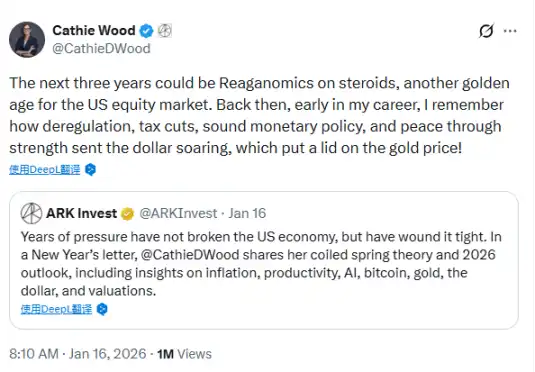
Specifically, Cathie Wood believes that despite the continuous growth in real GDP over the past three years, the underlying US economy has actually experienced a rolling recession and is currently in a "coiled spring" state, poised for a strong rebound in the coming years. She particularly emphasized that with David Sacks leading the charge as the first AI and cryptocurrency czar to relax regulations and the effective corporate tax rate moving towards 10%, the US economic growth will receive a substantial policy dividend.
At a macro level, Wood predicts that, driven by a productivity boom, inflation will be further controlled and may even turn negative. She expects that the nominal GDP growth rate in the US over the next few years will remain in the range of 6% to 8%, primarily driven by productivity gains rather than inflation.
In terms of market impact, Wood predicts that the relative advantage of US investment returns will drive a significant appreciation in the US dollar exchange rate, echoing the situation in the 1980s when the US dollar almost doubled. She warned that despite the significant price increase in gold over the past few years, the strengthening of the US dollar will suppress the price of gold, while Bitcoin, due to its supply mechanism and low asset correlation, will show a different trend from gold.
Regarding the market valuation issue that investors are concerned about, Wood does not believe that an AI bubble has formed. She pointed out that although the current price-to-earnings ratio is at a historical high, as AI, robots, and other technologies drive a productivity boom, the growth in corporate earnings will absorb the high valuations, and the market may achieve positive returns while experiencing a contraction in the price-to-earnings ratio, similar to the bull market path in the mid to late 1990s.
Here is the original text of the Investor Letter:
Wishing a Happy New Year to ARK's investors and other supporters! We greatly appreciate your support.
As outlined in this letter, we truly believe that investors have many reasons to remain optimistic! We hope you enjoy our discussion. From an economic history perspective, we are at a crucial moment.
Coiled Spring Ready to Unleash
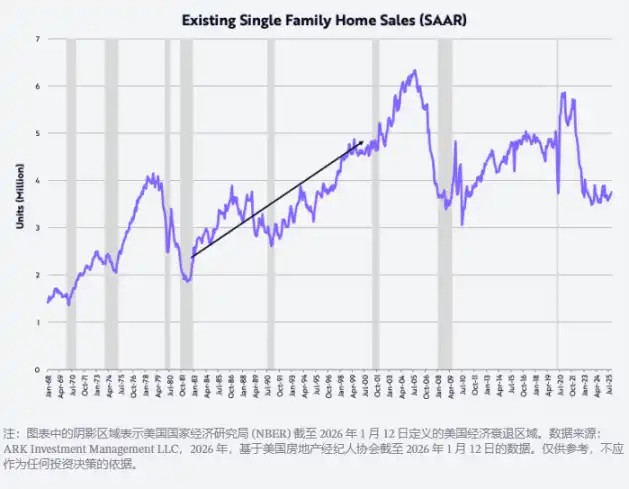
Despite the continuous growth in the real Gross Domestic Product (GDP) of the United States over the past three years, the underlying structure of the U.S. economy has undergone a rolling recession and gradually transformed into a tightly compressed spring, poised for a strong rebound in the coming years. In response to the supply shock related to the COVID-19 pandemic, the Federal Reserve raised the federal funds rate from 0.25% in March 2022 to a significant 5.5% by July 2023 over a 16-month period, a record 22-fold increase. This rate hike has pushed housing, manufacturing, AI-related capital expenditures, and the U.S. middle-to-low-income segment into a recession, as depicted in the chart below.
Measured by existing home sales volume, the housing market plummeted 40% from an annualized 5.9 million units in January 2021 to 3.5 million units in October 2023. This level was last seen in November 2010, and over the past two years, existing home sales have been fluctuating around this level. This demonstrates how tightly the spring has been compressed: the current level of existing home sales is equivalent to the early 1980s when the U.S. population was approximately 35% lower than it is now.
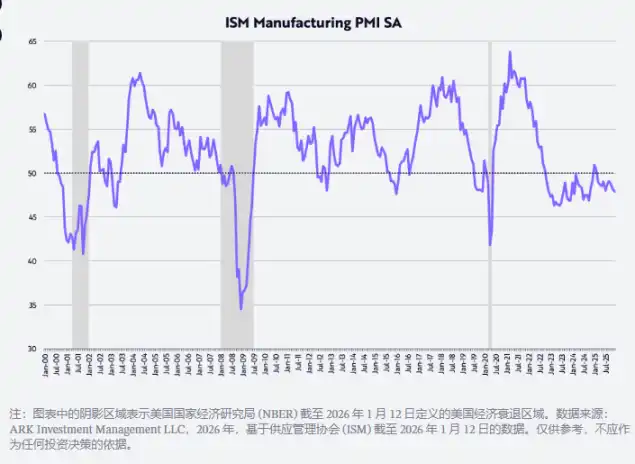
Measured by the U.S. Purchasing Managers' Index (PMI), the manufacturing sector has been in a contraction phase for about three years. According to this diffusion index, 50 is the threshold between expansion and contraction, as shown in the chart below.
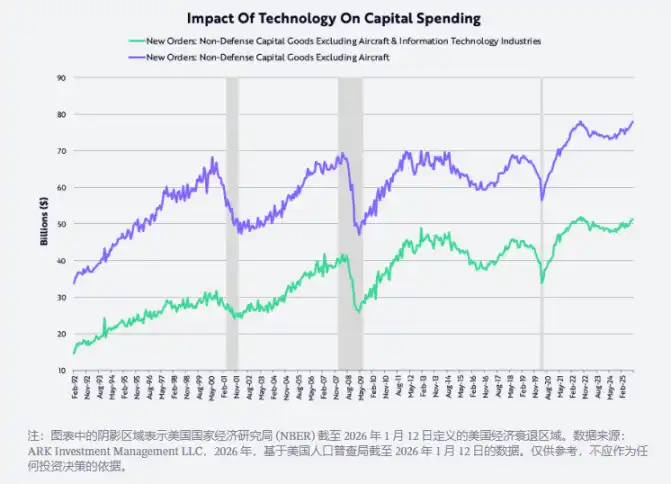
Meanwhile, capital expenditures, excluding defense and aircraft, peaked in mid-2022, and since then, regardless of technological influences, the expenditure level has rebounded to that peak. In fact, this capital expenditure metric struggled for over 20 years to break through since the burst of the tech and telecom bubble until 2021 when the supply shock of the COVID-19 pandemic forced both digital and physical investments to accelerate. The once spending ceiling appears to have transformed into a spending floor as AI, robotics, energy storage, blockchain technology, and multi-omics sequencing platforms are poised and ready to usher in a golden age. Following the technology and telecom bubble of the 1990s, a $700 billion spending peak lasted for 20 years, and now, as illustrated below, this may be the strongest capital expenditure cycle in history. We believe the AI bubble is far from materializing!
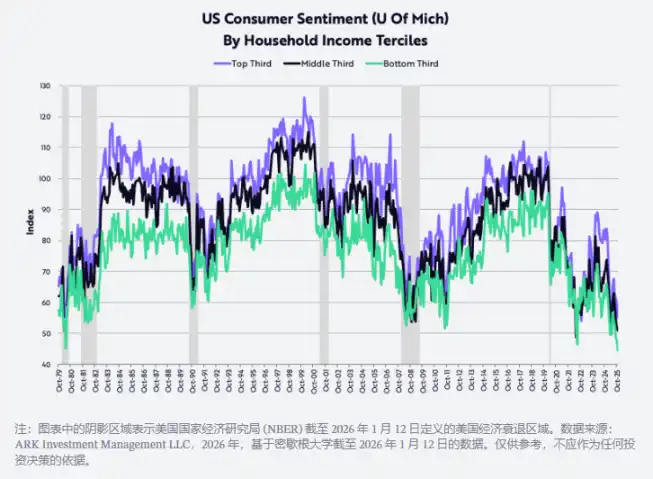
Meanwhile, data from the University of Michigan shows that confidence among the middle- and low-income groups has dropped to the lowest level since the early 1980s. Back then, double-digit inflation and high interest rates severely eroded purchasing power, pushing the U.S. economy into a prolonged recession. Additionally, as shown in the chart below, confidence among high-income individuals has also declined in recent months. In our view, consumer confidence is currently one of the most tightly compressed and rebound-ready "springs."
Relaxing Regulations, while Reducing Taxes, Inflation, and Interest Rates
Benefiting from a combination of relaxed regulations, reduced taxes (including tariffs), inflation, and interest rates, the rolling recession that the U.S. has experienced over the past few years could rapidly and dramatically reverse in the next year and beyond.
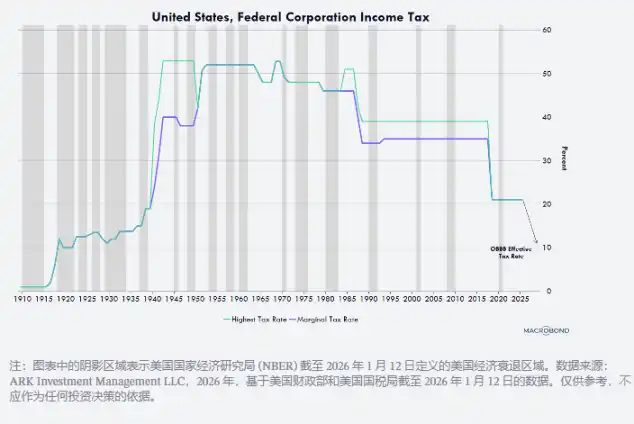
Regulatory relaxation is unleashing innovation across various sectors, led by the first "AI and Crypto Czar" David Sacks. Meanwhile, reductions in tips, overtime pay, and social security taxes will provide a significant tax refund to U.S. consumers this quarter, potentially driving the annualized growth rate of real disposable income from around 2% in the second half of 2025 to around 8.3% this quarter. Furthermore, as manufacturing facilities, equipment, software, and domestic R&D expenses enjoy accelerated depreciation, the effective tax rate for businesses will be reduced to near 10% (as shown in the chart below), with an expected substantial increase in corporate tax refunds, and 10% is one of the lowest tax rates globally.
For example, any business that starts construction of a manufacturing plant in the U.S. by the end of 2028 can achieve full depreciation in the first year of operation, rather than spreading it over 30 to 40 years as in the past. Equipment, software, and domestic R&D expenses can also achieve 100% depreciation in the first year. This cash flow favorable policy was permanently established in last year's budget and retroactively applies from January 1, 2025.
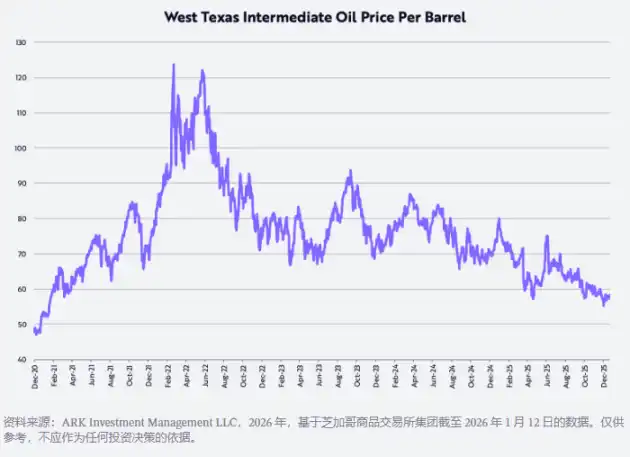
Over the past few years, inflation measured by the Consumer Price Index (CPI) has stubbornly hovered in the 2% to 3% range, but in the coming years, for several reasons as shown in the chart below, the inflation rate is likely to decline to an unexpectedly low level—even potentially negative. Firstly, the West Texas Intermediate (WTI) crude oil price has fallen by about 53% since its peak around $124 per barrel on March 8, 2022, post-COVID-19 pandemic, currently down by about 22% year-on-year.
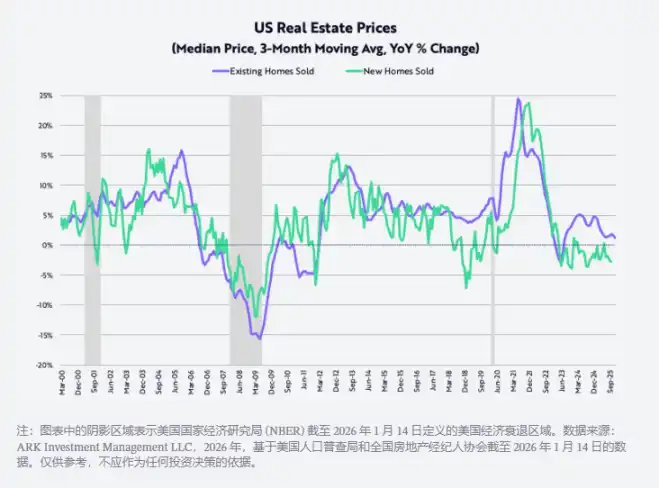
Since peaking in October 2022, the sales price of new single-family homes has decreased by about 15%; meanwhile, the price inflation rate of existing single-family homes — based on a three-month moving average — has dropped from a year-on-year rate of about 24% at the peak post-June 2021 pandemic to approximately 1.3%, as shown in the chart below.
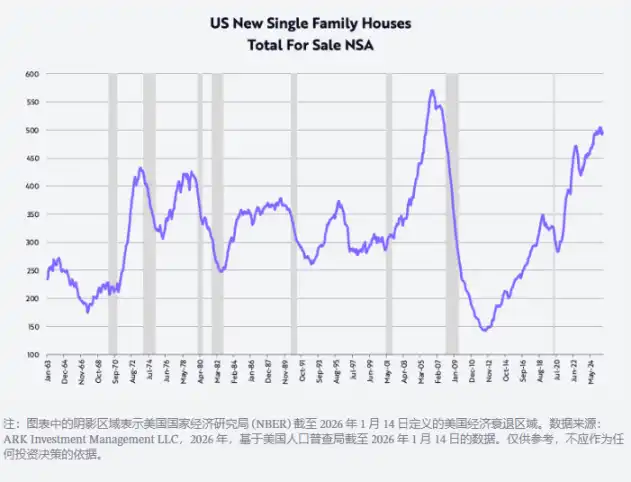
In the fourth quarter, in order to digest a close to 500,000-unit inventory of new single-family homes (the highest level since the eve of the global financial crisis in October 2007, as shown in the chart below), the top three homebuilders significantly reduced prices, with year-on-year declines as follows: Lennar -10%, KB Homes -7%, and DR Horton -3%. The impact of these price declines will lag in reflecting on the Consumer Price Index (CPI) over the next few years.
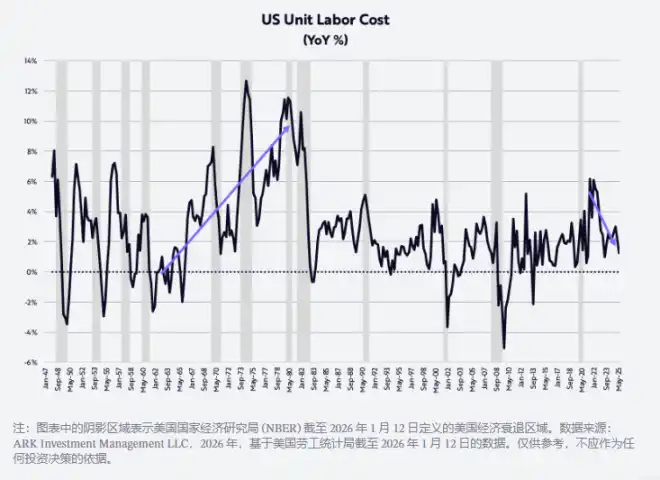
Lastly, as one of the most potent forces to counter inflation, nonfarm productivity has grown against the backdrop of continued decline, increasing by 1.9% year-on-year in the third quarter. In stark contrast to the 3.2% growth in hourly compensation, the improvement in productivity has reduced the unit labor cost inflation rate to 1.2%, as shown below. This figure does not show the cost-push inflation reminiscent of the 1970s!
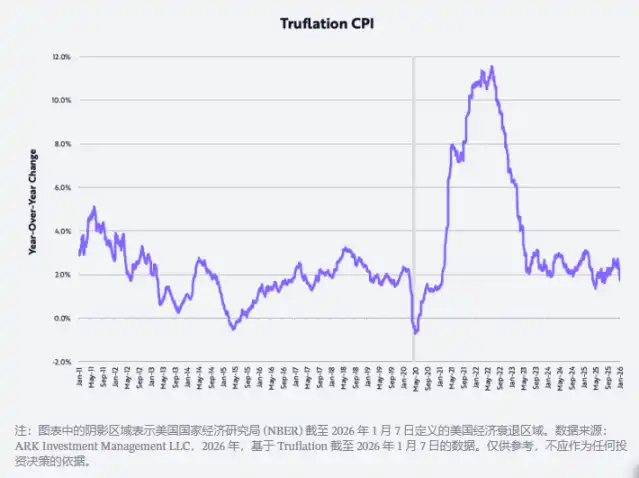
This improvement is also validated: the inflation rate, as measured by Truflation, has recently decreased year-on-year to 1.7%, as shown in the chart below, almost 100 basis points (bps) lower than the inflation rate calculated based on the Consumer Price Index (CPI) by the U.S. Bureau of Labor Statistics (BLS).
Productivity Boom
In fact, if our research on technology-driven disruptive innovation is correct, then over the next few years, influenced by cyclical and secular factors, the nonfarm productivity growth rate should accelerate to 4-6% annually, further dampening unit labor cost inflation. The convergence between major innovation platforms under development — artificial intelligence, robotics, energy storage, public blockchain technology, and multi-omics technology — is not only expected to drive productivity growth to sustainable new highs but also poised to create immense wealth.
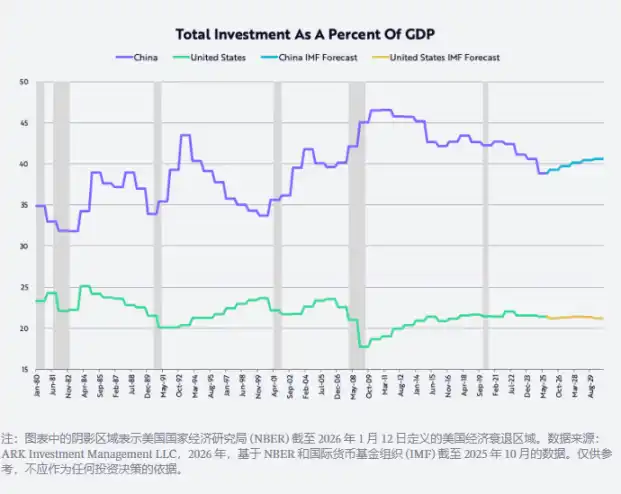
The productivity gains could also help correct significant geopolitical economic imbalances in the global economy. Businesses can channel the benefits of productivity enhancement into one or more of the following four strategic directions: expanding profit margins, increasing R&D and other investments, raising wages, and/or lowering prices. In China, raising wages for higher productivity workers and/or increasing profit margins can help the economy overcome structural issues of overinvestment. Since joining the World Trade Organization (WTO) in 2001, China's investment as a percentage of GDP has averaged around 40%, nearly double that of the U.S., as shown in the chart below. Increasing wages will drive the Chinese economy towards a consumption-oriented transformation, moving away from the path of commodification.
However, in the short term, technology-driven productivity gains may continue to slow US job growth, leading to an increase in the unemployment rate from 4.4% to above 5.0% and prompting the Fed to continue cutting rates. Subsequently, relaxation of regulations and other fiscal stimulus measures should amplify the impact of low rates and accelerate GDP growth in the second half of 2026. Meanwhile, inflation may continue to decelerate, driven not only by declines in oil prices, housing, and tariffs but also benefiting from technological advancements that drive productivity growth and lower unit labor costs.
Surprisingly, artificial intelligence training costs are decreasing by 75% per year, while artificial intelligence inference costs (i.e., the cost of running AI application models) are seeing a whopping 99% annual decrease (based on some benchmark data). The unprecedented decline in various technology costs is expected to fuel a surge in its per-unit growth. Therefore, we anticipate that the US nominal GDP growth rate will remain in the range of 6% to 8% in the coming years, mainly driven by productivity growth of 5% to 7%, labor growth of 1%, and an inflation rate of -2% to +1%.
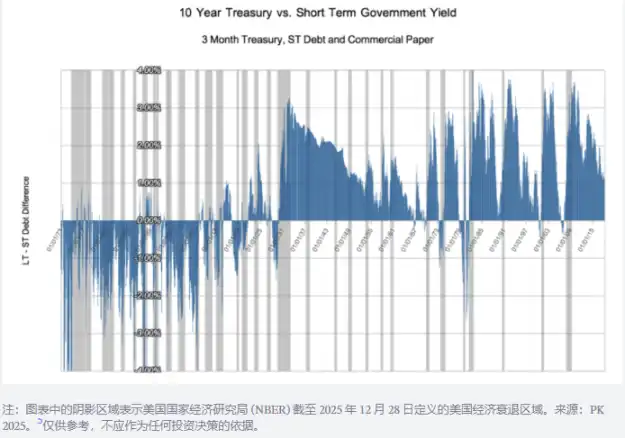
The deflationary effect brought about by artificial intelligence and the other four innovation platforms will continue to accumulate, shaping an economic environment similar to the period leading up to 1929 when the last major technological revolution was sparked by the internal combustion engine, electricity, and the telephone. During that period, short-term interest rates moved in sync with nominal GDP growth, while long-term rates responded to the deflationary undercurrents accompanying technological prosperity, causing the yield curve to invert by an average of around 100 basis points, as shown in the diagram below.
Other New Year Thoughts
Gold Price Surge and Bitcoin Price Decline
During 2025, the price of gold surged by 65%, while the price of Bitcoin declined by 6%. Many observers attribute the rise in gold price to inflation risks, as gold surged from $1600 per ounce to $4300 per ounce since the end of the US stock market bear market in October 2022, marking a 166% increase. However, another explanation is that global wealth growth (evidenced by a 93% increase in the MSCI Global Stock Index) exceeded the annualized growth rate of global gold supply by about 1.8%. In other words, the incremental demand for gold may have exceeded its supply growth. Interestingly, during the same period, the price of Bitcoin surged by 360%, while its supply growth rate was only about 1.3% annually. It is worth noting that gold and Bitcoin miners' reactions to these price signals could be dramatically different: gold miners can respond by increasing gold production, while Bitcoin cannot achieve this. Based on mathematical calculations, Bitcoin is projected to grow by approximately 0.82% annually over the next two years, after which its growth rate will slow to around 0.41% per year.
Long-Term View of Gold Price
Measured by market cap to M2 money supply ratio, the gold price has only been higher than this level once in the past 125 years, during the early 1930s in the Great Depression. At that time, the price of gold was fixed at $20.67 per ounce, while the M2 money supply plummeted by about 30% (as shown in the chart below). Recently, the ratio of gold to M2 has exceeded the previous peak reached in 1980 when inflation and interest rates surged to double digits. In other words, from a historical perspective, the gold price has reached an extremely high level.
From the chart below, it can also be seen that the long-term decline in this ratio is closely related to the strong returns of the stock market. According to research by Ibbotson and Sinquefield, since 1926, stocks have had a compound annual return of about 10%. After the ratio reached two major long-term peaks in 1934 and 1980, stock prices as measured by the Dow Jones Industrial Average (DJIA) achieved returns of 670% and 1015% over 35 and 21 years ending in 1969 and 2001, with annualized returns of 6% and 12%, respectively. It is worth noting that small-cap stocks had annualized returns of 12% and 13%, respectively.
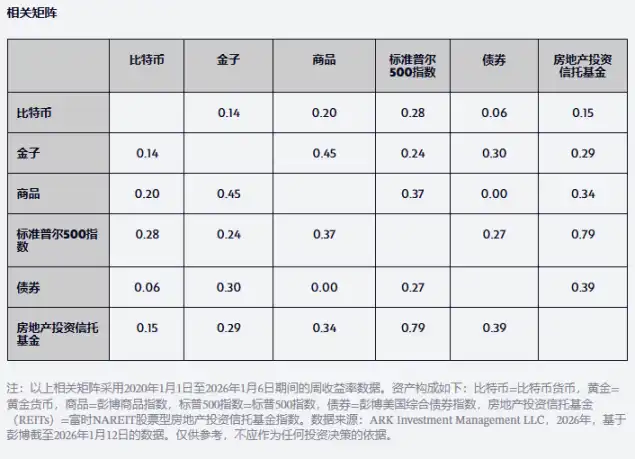
For asset allocators, another important consideration is Bitcoin's returns relative to gold and its lower correlation with returns from other major asset classes since 2020, as shown in the table below. It is worth noting that the correlation between Bitcoin and gold is even lower than the S&P 500 index's correlation with bonds. In other words, for asset allocators seeking higher risk-adjusted returns in the coming years, Bitcoin should be a good diversified investment choice.
Outlook on the U.S. Dollar
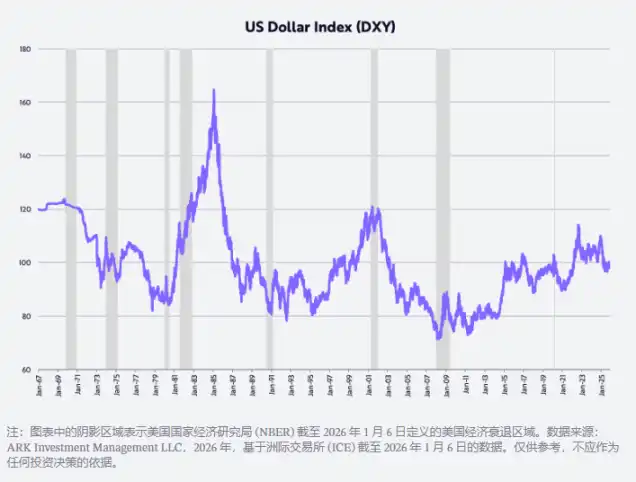
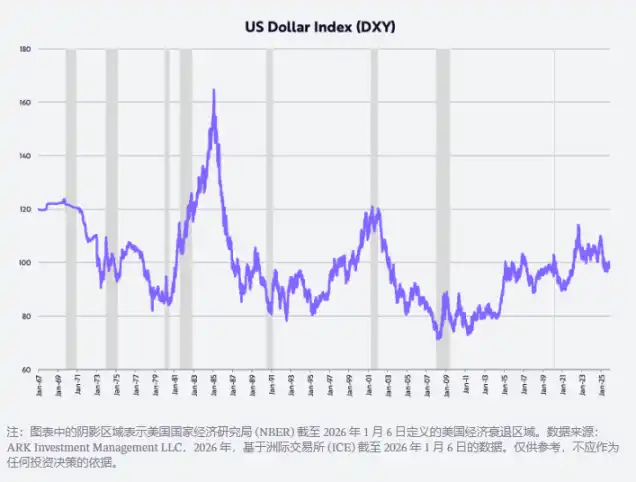
In recent years, a popular assertion has been the end of the U.S. exceptionalism, with the dollar seeing its largest first-half drop since 1973 and the largest full-year drop since 2017. Last year, measured by the trade-weighted dollar index (DXY), the dollar fell by 11% in the first half and 9% for the full year. If our predictions on fiscal policy, monetary policy, deregulation, and U.S.-led technological breakthroughs are correct, then the U.S. investment returns will outperform other regions in the world, boosting the dollar exchange rate. The policies of the Trump administration mirror the situation in the early 1980s during the Reaganomics era, when the dollar exchange rate nearly doubled, as shown in the chart below.
AI Hype
As shown below, the booming development of artificial intelligence is driving capital expenditure to its highest level since the late 1990s. In 2025, investment in data center systems (including computing, networking, and storage equipment) grew by 47% to nearly $500 billion, and is expected to grow by another 20% in 2026 to around $600 billion, far surpassing the long-term trend of $150–200 billion per year in the decade before the launch of ChatGPT. The enormity of this investment begs the question: "What is the return on this investment? And where will it be seen?"
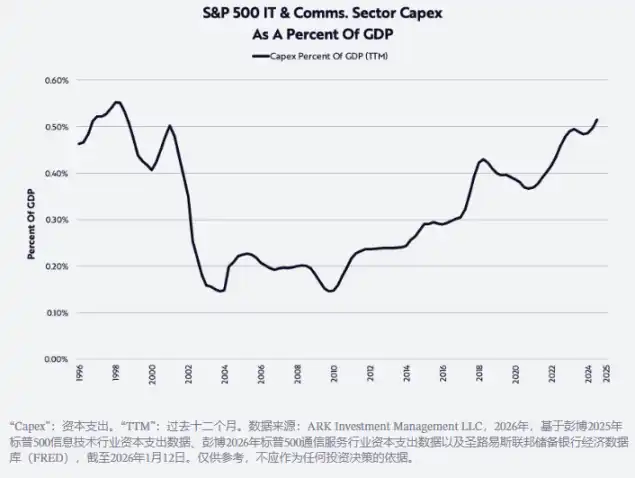
In addition to semiconductor and publicly listed large cloud companies, pre-IPO AI-native enterprises are also benefiting from growth and return on investment. AI companies are among the fastest-growing companies in history. Our research indicates that consumer adoption of AI is happening at twice the pace of internet adoption in the 1990s, as shown below.
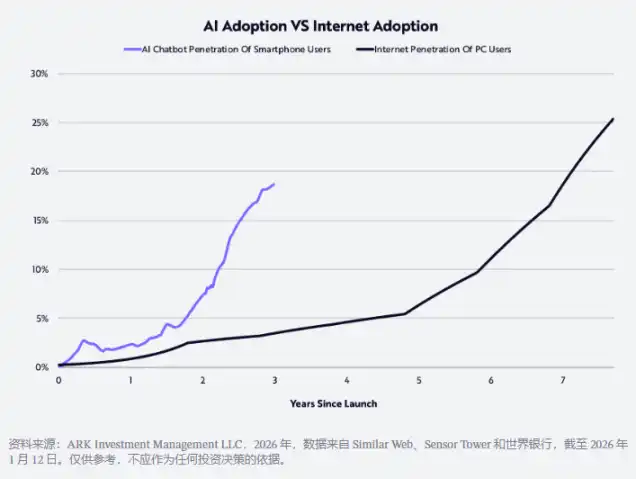
By the end of 2025, it is reported that OpenAI and Anthropic will have annual revenues of $20 billion and $9 billion, respectively, compared to $1.6 billion and $100 million in the same period last year, representing a growth of 12.5x and 90x, respectively! Rumor has it that both companies are considering initial public offerings (IPOs) in the next year or two to raise funds to support the large-scale investments required for their product models.
As OpenAI's Head of Applications, Fidji Simo, puts it: "The capabilities of AI models far exceed what most people experience in their daily lives, and 2026 is the year to bridge that gap. Leaders in the AI field will be those who can translate cutting-edge research into products that are genuinely useful for individuals, businesses, and developers." This year, with more humanized, intuitive, and integrated user experiences, we can expect substantial progress in this area. ChatGPTHealth is an early example, being a section within the ChatGPT platform dedicated to helping users improve their health based on personal health data.
Within enterprises, many AI applications are still in their infancy, hindered by bureaucracy, inertia, and/or prerequisites such as restructuring and building data infrastructure, resulting in slow progress. By 2026, organizations may realize the need to leverage their own data to train models and iterate quickly, or risk being left behind by more agile competitors. AI-driven use cases should offer real-time and exceptional customer service, faster product release cycles, and help startups create more value with fewer resources.
Market Overvaluation
Many investors are concerned about the stock market being overvalued, currently sitting at historical highs as shown in the chart below. Our own valuation assumption is for the price-to-earnings (P/E) ratio to revert to around 20 times, the average level of the past 35 years. Some of the most significant bull markets have been accompanied by P/E compression. For example, from mid-October 1993 to mid-November 1997, the S&P 500 Index delivered an annualized return of 21%, with its P/E ratio contracting from 36 times to 10 times. Similarly, from July 2002 to October 2007, the S&P 500 Index saw an annualized return of 14%, as its P/E ratio declined from 21 times to 17 times. Given our expectation for real GDP growth being driven by productivity enhancements and moderating inflation, the same dynamic is likely to repeat in this market cycle, potentially even more pronounced.
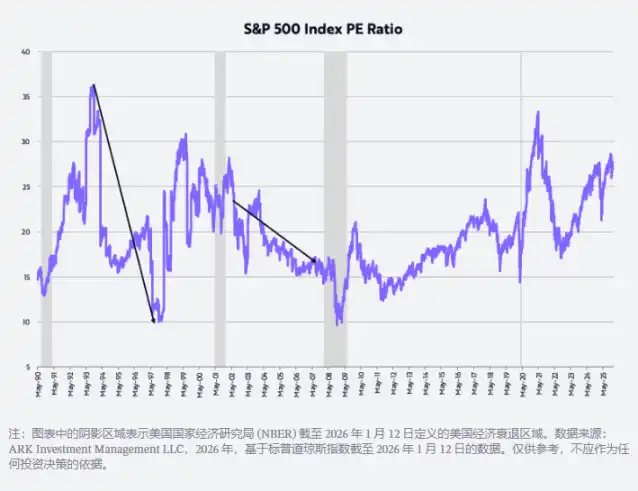
As always, a big shoutout to ARK's investors and other supporters, and special thanks to Dan, Will, Katie, and Keith for helping me craft this lengthy New Year's message!
You may also like

Token Cannot Compound, Where Is the Real Investment Opportunity?

February 6th Market Key Intelligence, How Much Did You Miss?

China's Central Bank and Eight Other Departments' Latest Regulatory Focus: Key Attention to RWA Tokenized Asset Risk
Foreword: Today, the People's Bank of China's website published the "Notice of the People's Bank of China, National Development and Reform Commission, Ministry of Industry and Information Technology, Ministry of Public Security, State Administration for Market Regulation, China Banking and Insurance Regulatory Commission, China Securities Regulatory Commission, State Administration of Foreign Exchange on Further Preventing and Dealing with Risks Related to Virtual Currency and Others (Yinfa [2026] No. 42)", the latest regulatory requirements from the eight departments including the central bank, which are basically consistent with the regulatory requirements of recent years. The main focus of the regulation is on speculative activities such as virtual currency trading, exchanges, ICOs, overseas platform services, and this time, regulatory oversight of RWA has been added, explicitly prohibiting RWA tokenization, stablecoins (especially those pegged to the RMB). The following is the full text:
To the people's governments of all provinces, autonomous regions, and municipalities directly under the Central Government, the Xinjiang Production and Construction Corps:
Recently, there have been speculative activities related to virtual currency and Real-World Assets (RWA) tokenization, disrupting the economic and financial order and jeopardizing the property security of the people. In order to further prevent and address the risks related to virtual currency and Real-World Assets tokenization, effectively safeguard national security and social stability, in accordance with the "Law of the People's Republic of China on the People's Bank of China," "Law of the People's Republic of China on Commercial Banks," "Securities Law of the People's Republic of China," "Law of the People's Republic of China on Securities Investment Funds," "Law of the People's Republic of China on Futures and Derivatives," "Cybersecurity Law of the People's Republic of China," "Regulations of the People's Republic of China on the Administration of Renminbi," "Regulations on Prevention and Disposal of Illegal Fundraising," "Regulations of the People's Republic of China on Foreign Exchange Administration," "Telecommunications Regulations of the People's Republic of China," and other provisions, after reaching consensus with the Cyberspace Administration of China, the Supreme People's Court, and the Supreme People's Procuratorate, and with the approval of the State Council, the relevant matters are notified as follows:
(I) Virtual currency does not possess the legal status equivalent to fiat currency. Virtual currencies such as Bitcoin, Ether, Tether, etc., have the main characteristics of being issued by non-monetary authorities, using encryption technology and distributed ledger or similar technology, existing in digital form, etc. They do not have legal tender status, should not and cannot be circulated and used as currency in the market.
The business activities related to virtual currency are classified as illegal financial activities. The exchange of fiat currency and virtual currency within the territory, exchange of virtual currencies, acting as a central counterparty in buying and selling virtual currencies, providing information intermediary and pricing services for virtual currency transactions, token issuance financing, and trading of virtual currency-related financial products, etc., fall under illegal financial activities, such as suspected illegal issuance of token vouchers, unauthorized public issuance of securities, illegal operation of securities and futures business, illegal fundraising, etc., are strictly prohibited across the board and resolutely banned in accordance with the law. Overseas entities and individuals are not allowed to provide virtual currency-related services to domestic entities in any form.
A stablecoin pegged to a fiat currency indirectly fulfills some functions of the fiat currency in circulation. Without the consent of relevant authorities in accordance with the law and regulations, any domestic or foreign entity or individual is not allowed to issue a RMB-pegged stablecoin overseas.
(II)Tokenization of Real-World Assets refers to the use of encryption technology and distributed ledger or similar technologies to transform ownership rights, income rights, etc., of assets into tokens (tokens) or other interests or bond certificates with token (token) characteristics, and carry out issuance and trading activities.
Engaging in the tokenization of real-world assets domestically, as well as providing related intermediary, information technology services, etc., which are suspected of illegal issuance of token vouchers, unauthorized public offering of securities, illegal operation of securities and futures business, illegal fundraising, and other illegal financial activities, shall be prohibited; except for relevant business activities carried out with the approval of the competent authorities in accordance with the law and regulations and relying on specific financial infrastructures. Overseas entities and individuals are not allowed to illegally provide services related to the tokenization of real-world assets to domestic entities in any form.
(III) Inter-agency Coordination. The People's Bank of China, together with the National Development and Reform Commission, the Ministry of Industry and Information Technology, the Ministry of Public Security, the State Administration for Market Regulation, the China Banking and Insurance Regulatory Commission, the China Securities Regulatory Commission, the State Administration of Foreign Exchange, and other departments, will improve the work mechanism, strengthen coordination with the Cyberspace Administration of China, the Supreme People's Court, and the Supreme People's Procuratorate, coordinate efforts, and overall guide regions to carry out risk prevention and disposal of virtual currency-related illegal financial activities.
The China Securities Regulatory Commission, together with the National Development and Reform Commission, the Ministry of Industry and Information Technology, the Ministry of Public Security, the People's Bank of China, the State Administration for Market Regulation, the China Banking and Insurance Regulatory Commission, the State Administration of Foreign Exchange, and other departments, will improve the work mechanism, strengthen coordination with the Cyberspace Administration of China, the Supreme People's Court, and the Supreme People's Procuratorate, coordinate efforts, and overall guide regions to carry out risk prevention and disposal of illegal financial activities related to the tokenization of real-world assets.
(IV) Strengthening Local Implementation. The people's governments at the provincial level are overall responsible for the prevention and disposal of risks related to virtual currencies and the tokenization of real-world assets in their respective administrative regions. The specific leading department is the local financial regulatory department, with participation from branches and dispatched institutions of the State Council's financial regulatory department, telecommunications regulators, public security, market supervision, and other departments, in coordination with cyberspace departments, courts, and procuratorates, to improve the normalization of the work mechanism, effectively connect with the relevant work mechanisms of central departments, form a cooperative and coordinated working pattern between central and local governments, effectively prevent and properly handle risks related to virtual currencies and the tokenization of real-world assets, and maintain economic and financial order and social stability.
(5) Enhanced Risk Monitoring. The People's Bank of China, China Securities Regulatory Commission, National Development and Reform Commission, Ministry of Industry and Information Technology, Ministry of Public Security, State Administration of Foreign Exchange, Cyberspace Administration of China, and other departments continue to improve monitoring techniques and system support, enhance cross-departmental data analysis and sharing, establish sound information sharing and cross-validation mechanisms, promptly grasp the risk situation of activities related to virtual currency and real-world asset tokenization. Local governments at all levels give full play to the role of local monitoring and early warning mechanisms. Local financial regulatory authorities, together with branches and agencies of the State Council's financial regulatory authorities, as well as departments of cyberspace and public security, ensure effective connection between online monitoring, offline investigation, and fund tracking, efficiently and accurately identify activities related to virtual currency and real-world asset tokenization, promptly share risk information, improve early warning information dissemination, verification, and rapid response mechanisms.
(6) Strengthened Oversight of Financial Institutions, Intermediaries, and Technology Service Providers. Financial institutions (including non-bank payment institutions) are prohibited from providing account opening, fund transfer, and clearing services for virtual currency-related business activities, issuing and selling financial products related to virtual currency, including virtual currency and related financial products in the scope of collateral, conducting insurance business related to virtual currency, or including virtual currency in the scope of insurance liability. Financial institutions (including non-bank payment institutions) are prohibited from providing custody, clearing, and settlement services for unauthorized real-world asset tokenization-related business and related financial products. Relevant intermediary institutions and information technology service providers are prohibited from providing intermediary, technical, or other services for unauthorized real-world asset tokenization-related businesses and related financial products.
(7) Enhanced Management of Internet Information Content and Access. Internet enterprises are prohibited from providing online business venues, commercial displays, marketing, advertising, or paid traffic diversion services for virtual currency and real-world asset tokenization-related business activities. Upon discovering clues of illegal activities, they should promptly report to relevant departments and provide technical support and assistance for related investigations and inquiries. Based on the clues transferred by the financial regulatory authorities, the cyberspace administration, telecommunications authorities, and public security departments should promptly close and deal with websites, mobile applications (including mini-programs), and public accounts engaged in virtual currency and real-world asset tokenization-related business activities in accordance with the law.
(8) Strengthened Entity Registration and Advertisement Management. Market supervision departments strengthen entity registration and management, and enterprise and individual business registrations must not contain terms such as "virtual currency," "virtual asset," "cryptocurrency," "crypto asset," "stablecoin," "real-world asset tokenization," or "RWA" in their names or business scopes. Market supervision departments, together with financial regulatory authorities, legally enhance the supervision of advertisements related to virtual currency and real-world asset tokenization, promptly investigating and handling relevant illegal advertisements.
(IX) Continued Rectification of Virtual Currency Mining Activities. The National Development and Reform Commission, together with relevant departments, strictly controls virtual currency mining activities, continuously promotes the rectification of virtual currency mining activities. The people's governments of various provinces take overall responsibility for the rectification of "mining" within their respective administrative regions. In accordance with the requirements of the National Development and Reform Commission and other departments in the "Notice on the Rectification of Virtual Currency Mining Activities" (NDRC Energy-saving Building [2021] No. 1283) and the provisions of the "Guidance Catalog for Industrial Structure Adjustment (2024 Edition)," a comprehensive review, investigation, and closure of existing virtual currency mining projects are conducted, new mining projects are strictly prohibited, and mining machine production enterprises are strictly prohibited from providing mining machine sales and other services within the country.
(X) Severe Crackdown on Related Illegal Financial Activities. Upon discovering clues to illegal financial activities related to virtual currency and the tokenization of real-world assets, local financial regulatory authorities, branches of the State Council's financial regulatory authorities, and other relevant departments promptly investigate, determine, and properly handle the issues in accordance with the law, and seriously hold the relevant entities and individuals legally responsible. Those suspected of crimes are transferred to the judicial authorities for processing according to the law.
(XI) Severe Crackdown on Related Illegal and Criminal Activities. The Ministry of Public Security, the People's Bank of China, the State Administration for Market Regulation, the China Banking and Insurance Regulatory Commission, the China Securities Regulatory Commission, as well as judicial and procuratorial organs, in accordance with their respective responsibilities, rigorously crack down on illegal and criminal activities related to virtual currency, the tokenization of real-world assets, such as fraud, money laundering, illegal business operations, pyramid schemes, illegal fundraising, and other illegal and criminal activities carried out under the guise of virtual currency, the tokenization of real-world assets, etc.
(XII) Strengthen Industry Self-discipline. Relevant industry associations should enhance membership management and policy advocacy, based on their own responsibilities, advocate and urge member units to resist illegal financial activities related to virtual currency and the tokenization of real-world assets. Member units that violate regulatory policies and industry self-discipline rules are to be disciplined in accordance with relevant self-regulatory management regulations. By leveraging various industry infrastructure, conduct risk monitoring related to virtual currency, the tokenization of real-world assets, and promptly transfer issue clues to relevant departments.
(XIII) Without the approval of relevant departments in accordance with the law and regulations, domestic entities and foreign entities controlled by them may not issue virtual currency overseas.
(XIV) Domestic entities engaging directly or indirectly in overseas external debt-based tokenization of real-world assets, or conducting asset securitization activities abroad based on domestic ownership rights, income rights, etc. (hereinafter referred to as domestic equity), should be strictly regulated in accordance with the principles of "same business, same risk, same rules." The National Development and Reform Commission, the China Securities Regulatory Commission, the State Administration of Foreign Exchange, and other relevant departments regulate it according to their respective responsibilities. For other forms of overseas real-world asset tokenization activities based on domestic equity by domestic entities, the China Securities Regulatory Commission, together with relevant departments, supervise according to their division of responsibilities. Without the consent and filing of relevant departments, no unit or individual may engage in the above-mentioned business.
(15) Overseas subsidiaries and branches of domestic financial institutions providing Real World Asset Tokenization-related services overseas shall do so legally and prudently. They shall have professional personnel and systems in place to effectively mitigate business risks, strictly implement customer onboarding, suitability management, anti-money laundering requirements, and incorporate them into the domestic financial institutions' compliance and risk management system. Intermediaries and information technology service providers offering Real World Asset Tokenization services abroad based on domestic equity or conducting Real World Asset Tokenization business in the form of overseas debt for domestic entities directly or indirectly venturing abroad must strictly comply with relevant laws and regulations. They should establish and improve relevant compliance and internal control systems in accordance with relevant normative requirements, strengthen business and risk control, and report the business developments to the relevant regulatory authorities for approval or filing.
(16) Strengthen organizational leadership and overall coordination. All departments and regions should attach great importance to the prevention of risks related to virtual currencies and Real World Asset Tokenization, strengthen organizational leadership, clarify work responsibilities, form a long-term effective working mechanism with centralized coordination, local implementation, and shared responsibilities, maintain high pressure, dynamically monitor risks, effectively prevent and mitigate risks in an orderly and efficient manner, legally protect the property security of the people, and make every effort to maintain economic and financial order and social stability.
(17) Widely carry out publicity and education. All departments, regions, and industry associations should make full use of various media and other communication channels to disseminate information through legal and policy interpretation, analysis of typical cases, and education on investment risks, etc. They should promote the illegality and harm of virtual currencies and Real World Asset Tokenization-related businesses and their manifestations, fully alert to potential risks and hidden dangers, and enhance public awareness and identification capabilities for risk prevention.
(18) Engaging in illegal financial activities related to virtual currencies and Real World Asset Tokenization in violation of this notice, as well as providing services for virtual currencies and Real World Asset Tokenization-related businesses, shall be punished in accordance with relevant regulations. If it constitutes a crime, criminal liability shall be pursued according to the law. For domestic entities and individuals who knowingly or should have known that overseas entities illegally provided virtual currency or Real World Asset Tokenization-related services to domestic entities and still assisted them, relevant responsibilities shall be pursued according to the law. If it constitutes a crime, criminal liability shall be pursued according to the law.
(19) If any unit or individual invests in virtual currencies, Real World Asset Tokens, and related financial products against public order and good customs, the relevant civil legal actions shall be invalid, and any resulting losses shall be borne by them. If there are suspicions of disrupting financial order and jeopardizing financial security, the relevant departments shall deal with them according to the law.
This notice shall enter into force upon the date of its issuance. The People's Bank of China and ten other departments' "Notice on Further Preventing and Dealing with the Risks of Virtual Currency Trading Speculation" (Yinfa [2021] No. 237) is hereby repealed.

Former Partner's Perspective on Multicoin: Kyle's Exit, But the Game He Left Behind Just Getting Started
Why Bitcoin Is Falling Now: The Real Reasons Behind BTC's Crash & WEEX's Smart Profit Playbook
Bitcoin's ongoing crash explained: Discover the 5 hidden triggers behind BTC's plunge & how WEEX's Auto Earn and Trade to Earn strategies help traders profit from crypto market volatility.

Wall Street's Hottest Trades See Exodus

Vitalik Discusses Ethereum Scaling Path, Circle Announces Partnership with Polymarket, What's the Overseas Crypto Community Talking About Today?

Believing in the Capital Markets - The Essence and Core Value of Cryptocurrency

Polymarket's 'Weatherman': Predict Temperature, Win Million-Dollar Payout

$15K+ Profits: The 4 AI Trading Secrets WEEX Hackathon Prelim Winners Used to Dominate Volatile Crypto Markets
How WEEX Hackathon's top AI trading strategies made $15K+ in crypto markets: 4 proven rules for ETH/BTC trading, market structure analysis, and risk management in volatile conditions.

A nearly 20% one-day plunge, how long has it been since you last saw a $60,000 Bitcoin?

Raoul Pal: I've seen every single panic, and they are never the end.

Key Market Information Discrepancy on February 6th - A Must-Read! | Alpha Morning Report

2026 Crypto Industry's First Snowfall
The Harsh Reality Behind the $26 Billion Crypto Liquidation: Liquidity Is Killing the Market
Why Is Gold, US Stocks, Bitcoin All Falling?

Key Market Intelligence for February 5th, how much did you miss out on?

Wintermute: By 2026, crypto had gradually become the settlement layer of the Internet economy
Token Cannot Compound, Where Is the Real Investment Opportunity?
February 6th Market Key Intelligence, How Much Did You Miss?
China's Central Bank and Eight Other Departments' Latest Regulatory Focus: Key Attention to RWA Tokenized Asset Risk
Foreword: Today, the People's Bank of China's website published the "Notice of the People's Bank of China, National Development and Reform Commission, Ministry of Industry and Information Technology, Ministry of Public Security, State Administration for Market Regulation, China Banking and Insurance Regulatory Commission, China Securities Regulatory Commission, State Administration of Foreign Exchange on Further Preventing and Dealing with Risks Related to Virtual Currency and Others (Yinfa [2026] No. 42)", the latest regulatory requirements from the eight departments including the central bank, which are basically consistent with the regulatory requirements of recent years. The main focus of the regulation is on speculative activities such as virtual currency trading, exchanges, ICOs, overseas platform services, and this time, regulatory oversight of RWA has been added, explicitly prohibiting RWA tokenization, stablecoins (especially those pegged to the RMB). The following is the full text:
To the people's governments of all provinces, autonomous regions, and municipalities directly under the Central Government, the Xinjiang Production and Construction Corps:
Recently, there have been speculative activities related to virtual currency and Real-World Assets (RWA) tokenization, disrupting the economic and financial order and jeopardizing the property security of the people. In order to further prevent and address the risks related to virtual currency and Real-World Assets tokenization, effectively safeguard national security and social stability, in accordance with the "Law of the People's Republic of China on the People's Bank of China," "Law of the People's Republic of China on Commercial Banks," "Securities Law of the People's Republic of China," "Law of the People's Republic of China on Securities Investment Funds," "Law of the People's Republic of China on Futures and Derivatives," "Cybersecurity Law of the People's Republic of China," "Regulations of the People's Republic of China on the Administration of Renminbi," "Regulations on Prevention and Disposal of Illegal Fundraising," "Regulations of the People's Republic of China on Foreign Exchange Administration," "Telecommunications Regulations of the People's Republic of China," and other provisions, after reaching consensus with the Cyberspace Administration of China, the Supreme People's Court, and the Supreme People's Procuratorate, and with the approval of the State Council, the relevant matters are notified as follows:
(I) Virtual currency does not possess the legal status equivalent to fiat currency. Virtual currencies such as Bitcoin, Ether, Tether, etc., have the main characteristics of being issued by non-monetary authorities, using encryption technology and distributed ledger or similar technology, existing in digital form, etc. They do not have legal tender status, should not and cannot be circulated and used as currency in the market.
The business activities related to virtual currency are classified as illegal financial activities. The exchange of fiat currency and virtual currency within the territory, exchange of virtual currencies, acting as a central counterparty in buying and selling virtual currencies, providing information intermediary and pricing services for virtual currency transactions, token issuance financing, and trading of virtual currency-related financial products, etc., fall under illegal financial activities, such as suspected illegal issuance of token vouchers, unauthorized public issuance of securities, illegal operation of securities and futures business, illegal fundraising, etc., are strictly prohibited across the board and resolutely banned in accordance with the law. Overseas entities and individuals are not allowed to provide virtual currency-related services to domestic entities in any form.
A stablecoin pegged to a fiat currency indirectly fulfills some functions of the fiat currency in circulation. Without the consent of relevant authorities in accordance with the law and regulations, any domestic or foreign entity or individual is not allowed to issue a RMB-pegged stablecoin overseas.
(II)Tokenization of Real-World Assets refers to the use of encryption technology and distributed ledger or similar technologies to transform ownership rights, income rights, etc., of assets into tokens (tokens) or other interests or bond certificates with token (token) characteristics, and carry out issuance and trading activities.
Engaging in the tokenization of real-world assets domestically, as well as providing related intermediary, information technology services, etc., which are suspected of illegal issuance of token vouchers, unauthorized public offering of securities, illegal operation of securities and futures business, illegal fundraising, and other illegal financial activities, shall be prohibited; except for relevant business activities carried out with the approval of the competent authorities in accordance with the law and regulations and relying on specific financial infrastructures. Overseas entities and individuals are not allowed to illegally provide services related to the tokenization of real-world assets to domestic entities in any form.
(III) Inter-agency Coordination. The People's Bank of China, together with the National Development and Reform Commission, the Ministry of Industry and Information Technology, the Ministry of Public Security, the State Administration for Market Regulation, the China Banking and Insurance Regulatory Commission, the China Securities Regulatory Commission, the State Administration of Foreign Exchange, and other departments, will improve the work mechanism, strengthen coordination with the Cyberspace Administration of China, the Supreme People's Court, and the Supreme People's Procuratorate, coordinate efforts, and overall guide regions to carry out risk prevention and disposal of virtual currency-related illegal financial activities.
The China Securities Regulatory Commission, together with the National Development and Reform Commission, the Ministry of Industry and Information Technology, the Ministry of Public Security, the People's Bank of China, the State Administration for Market Regulation, the China Banking and Insurance Regulatory Commission, the State Administration of Foreign Exchange, and other departments, will improve the work mechanism, strengthen coordination with the Cyberspace Administration of China, the Supreme People's Court, and the Supreme People's Procuratorate, coordinate efforts, and overall guide regions to carry out risk prevention and disposal of illegal financial activities related to the tokenization of real-world assets.
(IV) Strengthening Local Implementation. The people's governments at the provincial level are overall responsible for the prevention and disposal of risks related to virtual currencies and the tokenization of real-world assets in their respective administrative regions. The specific leading department is the local financial regulatory department, with participation from branches and dispatched institutions of the State Council's financial regulatory department, telecommunications regulators, public security, market supervision, and other departments, in coordination with cyberspace departments, courts, and procuratorates, to improve the normalization of the work mechanism, effectively connect with the relevant work mechanisms of central departments, form a cooperative and coordinated working pattern between central and local governments, effectively prevent and properly handle risks related to virtual currencies and the tokenization of real-world assets, and maintain economic and financial order and social stability.
(5) Enhanced Risk Monitoring. The People's Bank of China, China Securities Regulatory Commission, National Development and Reform Commission, Ministry of Industry and Information Technology, Ministry of Public Security, State Administration of Foreign Exchange, Cyberspace Administration of China, and other departments continue to improve monitoring techniques and system support, enhance cross-departmental data analysis and sharing, establish sound information sharing and cross-validation mechanisms, promptly grasp the risk situation of activities related to virtual currency and real-world asset tokenization. Local governments at all levels give full play to the role of local monitoring and early warning mechanisms. Local financial regulatory authorities, together with branches and agencies of the State Council's financial regulatory authorities, as well as departments of cyberspace and public security, ensure effective connection between online monitoring, offline investigation, and fund tracking, efficiently and accurately identify activities related to virtual currency and real-world asset tokenization, promptly share risk information, improve early warning information dissemination, verification, and rapid response mechanisms.
(6) Strengthened Oversight of Financial Institutions, Intermediaries, and Technology Service Providers. Financial institutions (including non-bank payment institutions) are prohibited from providing account opening, fund transfer, and clearing services for virtual currency-related business activities, issuing and selling financial products related to virtual currency, including virtual currency and related financial products in the scope of collateral, conducting insurance business related to virtual currency, or including virtual currency in the scope of insurance liability. Financial institutions (including non-bank payment institutions) are prohibited from providing custody, clearing, and settlement services for unauthorized real-world asset tokenization-related business and related financial products. Relevant intermediary institutions and information technology service providers are prohibited from providing intermediary, technical, or other services for unauthorized real-world asset tokenization-related businesses and related financial products.
(7) Enhanced Management of Internet Information Content and Access. Internet enterprises are prohibited from providing online business venues, commercial displays, marketing, advertising, or paid traffic diversion services for virtual currency and real-world asset tokenization-related business activities. Upon discovering clues of illegal activities, they should promptly report to relevant departments and provide technical support and assistance for related investigations and inquiries. Based on the clues transferred by the financial regulatory authorities, the cyberspace administration, telecommunications authorities, and public security departments should promptly close and deal with websites, mobile applications (including mini-programs), and public accounts engaged in virtual currency and real-world asset tokenization-related business activities in accordance with the law.
(8) Strengthened Entity Registration and Advertisement Management. Market supervision departments strengthen entity registration and management, and enterprise and individual business registrations must not contain terms such as "virtual currency," "virtual asset," "cryptocurrency," "crypto asset," "stablecoin," "real-world asset tokenization," or "RWA" in their names or business scopes. Market supervision departments, together with financial regulatory authorities, legally enhance the supervision of advertisements related to virtual currency and real-world asset tokenization, promptly investigating and handling relevant illegal advertisements.
(IX) Continued Rectification of Virtual Currency Mining Activities. The National Development and Reform Commission, together with relevant departments, strictly controls virtual currency mining activities, continuously promotes the rectification of virtual currency mining activities. The people's governments of various provinces take overall responsibility for the rectification of "mining" within their respective administrative regions. In accordance with the requirements of the National Development and Reform Commission and other departments in the "Notice on the Rectification of Virtual Currency Mining Activities" (NDRC Energy-saving Building [2021] No. 1283) and the provisions of the "Guidance Catalog for Industrial Structure Adjustment (2024 Edition)," a comprehensive review, investigation, and closure of existing virtual currency mining projects are conducted, new mining projects are strictly prohibited, and mining machine production enterprises are strictly prohibited from providing mining machine sales and other services within the country.
(X) Severe Crackdown on Related Illegal Financial Activities. Upon discovering clues to illegal financial activities related to virtual currency and the tokenization of real-world assets, local financial regulatory authorities, branches of the State Council's financial regulatory authorities, and other relevant departments promptly investigate, determine, and properly handle the issues in accordance with the law, and seriously hold the relevant entities and individuals legally responsible. Those suspected of crimes are transferred to the judicial authorities for processing according to the law.
(XI) Severe Crackdown on Related Illegal and Criminal Activities. The Ministry of Public Security, the People's Bank of China, the State Administration for Market Regulation, the China Banking and Insurance Regulatory Commission, the China Securities Regulatory Commission, as well as judicial and procuratorial organs, in accordance with their respective responsibilities, rigorously crack down on illegal and criminal activities related to virtual currency, the tokenization of real-world assets, such as fraud, money laundering, illegal business operations, pyramid schemes, illegal fundraising, and other illegal and criminal activities carried out under the guise of virtual currency, the tokenization of real-world assets, etc.
(XII) Strengthen Industry Self-discipline. Relevant industry associations should enhance membership management and policy advocacy, based on their own responsibilities, advocate and urge member units to resist illegal financial activities related to virtual currency and the tokenization of real-world assets. Member units that violate regulatory policies and industry self-discipline rules are to be disciplined in accordance with relevant self-regulatory management regulations. By leveraging various industry infrastructure, conduct risk monitoring related to virtual currency, the tokenization of real-world assets, and promptly transfer issue clues to relevant departments.
(XIII) Without the approval of relevant departments in accordance with the law and regulations, domestic entities and foreign entities controlled by them may not issue virtual currency overseas.
(XIV) Domestic entities engaging directly or indirectly in overseas external debt-based tokenization of real-world assets, or conducting asset securitization activities abroad based on domestic ownership rights, income rights, etc. (hereinafter referred to as domestic equity), should be strictly regulated in accordance with the principles of "same business, same risk, same rules." The National Development and Reform Commission, the China Securities Regulatory Commission, the State Administration of Foreign Exchange, and other relevant departments regulate it according to their respective responsibilities. For other forms of overseas real-world asset tokenization activities based on domestic equity by domestic entities, the China Securities Regulatory Commission, together with relevant departments, supervise according to their division of responsibilities. Without the consent and filing of relevant departments, no unit or individual may engage in the above-mentioned business.
(15) Overseas subsidiaries and branches of domestic financial institutions providing Real World Asset Tokenization-related services overseas shall do so legally and prudently. They shall have professional personnel and systems in place to effectively mitigate business risks, strictly implement customer onboarding, suitability management, anti-money laundering requirements, and incorporate them into the domestic financial institutions' compliance and risk management system. Intermediaries and information technology service providers offering Real World Asset Tokenization services abroad based on domestic equity or conducting Real World Asset Tokenization business in the form of overseas debt for domestic entities directly or indirectly venturing abroad must strictly comply with relevant laws and regulations. They should establish and improve relevant compliance and internal control systems in accordance with relevant normative requirements, strengthen business and risk control, and report the business developments to the relevant regulatory authorities for approval or filing.
(16) Strengthen organizational leadership and overall coordination. All departments and regions should attach great importance to the prevention of risks related to virtual currencies and Real World Asset Tokenization, strengthen organizational leadership, clarify work responsibilities, form a long-term effective working mechanism with centralized coordination, local implementation, and shared responsibilities, maintain high pressure, dynamically monitor risks, effectively prevent and mitigate risks in an orderly and efficient manner, legally protect the property security of the people, and make every effort to maintain economic and financial order and social stability.
(17) Widely carry out publicity and education. All departments, regions, and industry associations should make full use of various media and other communication channels to disseminate information through legal and policy interpretation, analysis of typical cases, and education on investment risks, etc. They should promote the illegality and harm of virtual currencies and Real World Asset Tokenization-related businesses and their manifestations, fully alert to potential risks and hidden dangers, and enhance public awareness and identification capabilities for risk prevention.
(18) Engaging in illegal financial activities related to virtual currencies and Real World Asset Tokenization in violation of this notice, as well as providing services for virtual currencies and Real World Asset Tokenization-related businesses, shall be punished in accordance with relevant regulations. If it constitutes a crime, criminal liability shall be pursued according to the law. For domestic entities and individuals who knowingly or should have known that overseas entities illegally provided virtual currency or Real World Asset Tokenization-related services to domestic entities and still assisted them, relevant responsibilities shall be pursued according to the law. If it constitutes a crime, criminal liability shall be pursued according to the law.
(19) If any unit or individual invests in virtual currencies, Real World Asset Tokens, and related financial products against public order and good customs, the relevant civil legal actions shall be invalid, and any resulting losses shall be borne by them. If there are suspicions of disrupting financial order and jeopardizing financial security, the relevant departments shall deal with them according to the law.
This notice shall enter into force upon the date of its issuance. The People's Bank of China and ten other departments' "Notice on Further Preventing and Dealing with the Risks of Virtual Currency Trading Speculation" (Yinfa [2021] No. 237) is hereby repealed.
Former Partner's Perspective on Multicoin: Kyle's Exit, But the Game He Left Behind Just Getting Started
Why Bitcoin Is Falling Now: The Real Reasons Behind BTC's Crash & WEEX's Smart Profit Playbook
Bitcoin's ongoing crash explained: Discover the 5 hidden triggers behind BTC's plunge & how WEEX's Auto Earn and Trade to Earn strategies help traders profit from crypto market volatility.


 App
App