
 Buy Crypto
- Markets
 Futures
- Spot
- Copy Trade
- Earn
- More
Ethereum Foundation Researcher Claims: Solana's Golden Age is Over, Will be Surpassed by ETH L2

Original Title: "Ethereum Foundation Researcher: Solana's Golden Age is Over! Two Major Advantages Will Be Overtaken by ETH L2"
Original Author: Ting, BlockTempo of Doo Wan Inc.
During this bull market cycle, the public blockchain Solana, with its fast transaction speed and low gas fees, has dominated the majority of the meme season frenzy traffic, and on November 22, the SOL token price broke through $260, hitting a new all-time high.
In contrast, the leading blockchain Ethereum has not seen significant breakthroughs in recent ecosystem development, coupled with high gas fee issues, causing on-chain users to stay away, thereby keeping the Ethereum price continuously sluggish.
However, Ethereum Foundation researcher Justin Drake recently stated that Solana's good days may be coming to an end.
Ethereum Foundation Researcher: Solana's Golden Age Coming to an End
The crypto media outlet The Defiant tweeted today (29th) that in the latest episode of the podcast, Ethereum Foundation researcher Justin Drake discussed how Ethereum Layer 2 is poised to surpass Solana in terms of latency and throughput, bluntly stating that Solana's golden age is about to end:
Bitcoin, Ethereum, and Solana: Different Focuses of Competition
Justin Drake:
To sum up this competition, you could say: on one hand, Bitcoin's competitive advantage lies in its stability, Lindy effect (historical persistence), and monetary properties; whereas Beam Chain's focus is to maximize Ethereum Layer 1's efficiency, making its competition with Bitcoin more direct. On the other hand, Solana's core is its performance.
In my model, Solana's competitor is actually Ethereum's Layer 2, not Layer 1 itself. For Solana, the good news is that it has excelled in two key performance indicators in the past year or two: latency and throughput.
Solana's Advantages Fading: Latency and Throughput
Justin Drake:
In terms of Latency, Solana has a very short slot time. However, for Ethereum, the arrival of a pre-confirmation mechanism will significantly improve latency, even surpassing Solana. Currently, Solana's average latency is 200 milliseconds. But the pre-confirmation mechanism will reduce latency to around 10 milliseconds, meaning a 20x improvement in slot latency.
In terms of Throughput, this year we have witnessed the thriving development of Layer 2. A website, rollup.wtf, shows the growth of throughput from a computational perspective (measured in gas per second). Ethereum aims to have the entire ecosystem process as many transactions as possible, and Layer 2 has demonstrated its ability to horizontally scale. Currently, the overall throughput of Layer 2 is about 100 times higher than Ethereum Layer 1, and it is very likely to grow to 1,000 times or even 10,000 times next year. This is a sustainable and scalable architecture.
Meanwhile, Solana's strategy is to concentrate all activity on a single server. Each validation node requires a large server to handle all activities, but the performance of these servers has basically reached its limit, so a significant increase in throughput is not possible. I believe Solana will not be able to increase its gas limit by 10x next year, while Ethereum is likely to expand the overall gas limit by 10x through Layer 2.
In summary, we may be about to see the end of Solana's golden age, as its two once-proud performance metrics will no longer provide a competitive advantage.
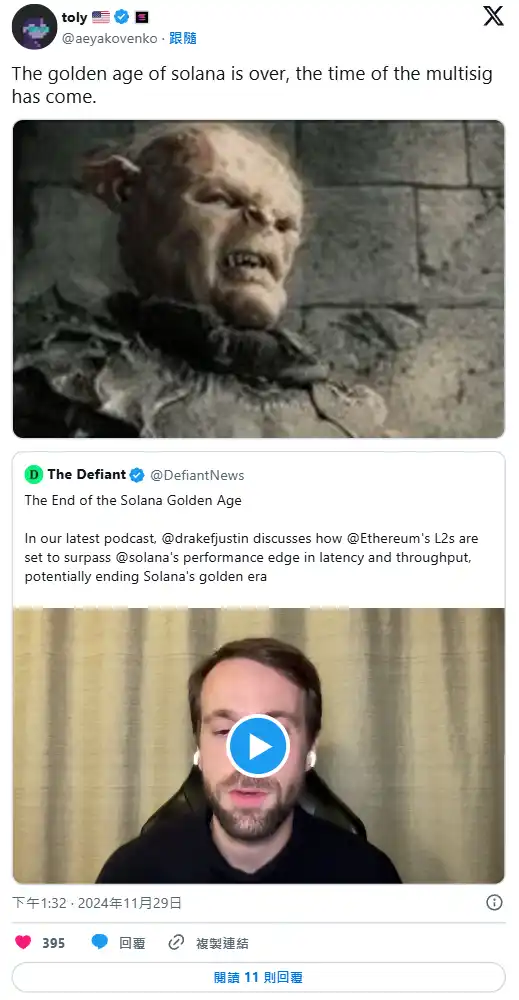
Interestingly, Solana co-founder Anatoly Yakovenko also referenced a tweet from The Defiant and an accompanying image:
"Solana's golden age is over, the era of multi-sigs has come."
This tweet seems to have a sarcastic tone, suggesting that the Ethereum Foundation lacks practical accomplishments and only uses the statement "Ethereum is about to surpass Solana" to motivate users and developers within its ecosystem. (Note: The Ethereum ecosystem places great emphasis on technologies such as multi-signature, account abstraction, etc.)
The Ethereum Foundation Invests Millions of Dollars in zkVMs
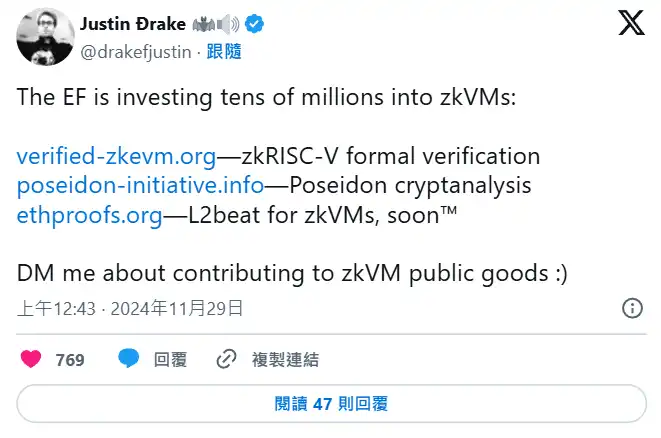
On the other hand, Ethereum Foundation researcher Justin Drake also tweeted today (29) that the Ethereum Foundation is investing tens of millions of dollars in the zkVMs project, including zkRISC-V formal verification, Poseidon cryptanalysis, and L2beat for zkVMs.
You may also like

Ceasefire Overnight Erases War Premium, Three Fault Lines Only One Sealed | Rewire News Morning Brief

Robinhood Secures 'Trump Account': Enabling Millions of Newborns to Access the Stock Market

Afraid to Open the Pandora's Box? Anthropic's Most Powerful Model Ever Dares Not Be Disclosed

Iran Ceasefire Oil Prices: Why Crude Fell in April 2026
Iran ceasefire oil prices fell sharply on April 8, 2026 as traders removed part of the war premium tied to Strait of Hormuz supply disruption.

US-Iran Ceasefire: A Temporary Pause or Prelude to Renewed Conflict? Market Outlook for Oil, Gold, and Bitcoin
April 8, 2026 – A temporary ceasefire between the U.S. and Iran has provided some immediate relief to the global markets, but the fundamental question remains: Will the cessation of hostilities hold, or is this merely a brief reprieve before a resumption of conflict? As the situation unfolds, market observers are closely monitoring how key assets like oil, gold, and Bitcoin will react in the coming weeks. This article explores whether the ceasefire is a sign of lasting peace, assesses the short-term market implications, and delves into the evolving role of Bitcoin in the global financial landscape.

WEEX Market Update: U.S.-Iran Ceasefire Sparks Bitcoin Price Surge
April 8, 2026 – In a significant shift in global geopolitics, U.S. President Donald Trump has announced a temporary two-week ceasefire with Iran, resulting in a notable market reaction across various asset classes. This development comes after discussions between Trump, Pakistani Prime Minister Shahbaz Sharif, and Army Chief General Asim Munir. The announcement is already reverberating through markets, particularly in oil, gold, and cryptocurrencies.
Morning Report | South Korean financial institutions pilot stablecoin payments for foreign users; Morgan Stanley Bitcoin ETF is about to be listed; CME plans to launch AVAX and SUI futures contracts

EigenCloud Founder: AI and Cryptocurrency are Creating the Next Trillion-Dollar Asset Class

From Panic to Pumps: How Bitcoin Traders Are Playing the 2-Week US-Iran Ceasefire
For most people, the two-week US-Iran ceasefire is about geopolitics, oil prices, and whether World War III gets postponed. But for crypto traders glued to their screens late Sunday night, it was something else entirely: the clearest risk-on signal in months.

US-Iran Ceasefire Triggers Oil Plunge, Bitcoin Surge, and Gold Rally
Despite the sharp rally, caution is warranted. The $70,000–$72,000 zone has historically been strong resistance. The ceasefire is only temporary (two weeks), and any breakdown in negotiations could trigger a sell-off toward the $62,000–$65,000 support zone. For now, Bitcoin needs to close decisively above $72,500 to confirm a true breakout; failure to do so within 48–72 hours could lead to a swift retracement.

OpenAI has no "New Deal," a blueprint for AI that refuses to pay.

Wall Street Flash Mob Run? Mega-Cap Stock Plunge, Goldman's Great Escape, Illustrated Guide to Private Credit Crisis

OpenAI Feud: Power, Trust, and the Uncontrollable Boundaries of AGI
「AI Doomsday Cult」 Sends Operatives into the Strait of Hormuz: What Did They Find?
Everyone is waiting for the war to end, but is the oil price signaling a prolonged conflict?
Data Analysis: How Wide is the Liquidity Gap Between Hyperliquid and CME Crude Oil?
After a 40% Reduction in Staff, Twitter's Founder to Give Away $1 Million in Bitcoin

Trade.xyz: Pricing the World? On-Chain Markets Are Becoming the Market
Ceasefire Overnight Erases War Premium, Three Fault Lines Only One Sealed | Rewire News Morning Brief
Robinhood Secures 'Trump Account': Enabling Millions of Newborns to Access the Stock Market
Afraid to Open the Pandora's Box? Anthropic's Most Powerful Model Ever Dares Not Be Disclosed
Iran Ceasefire Oil Prices: Why Crude Fell in April 2026
Iran ceasefire oil prices fell sharply on April 8, 2026 as traders removed part of the war premium tied to Strait of Hormuz supply disruption.
US-Iran Ceasefire: A Temporary Pause or Prelude to Renewed Conflict? Market Outlook for Oil, Gold, and Bitcoin
April 8, 2026 – A temporary ceasefire between the U.S. and Iran has provided some immediate relief to the global markets, but the fundamental question remains: Will the cessation of hostilities hold, or is this merely a brief reprieve before a resumption of conflict? As the situation unfolds, market observers are closely monitoring how key assets like oil, gold, and Bitcoin will react in the coming weeks. This article explores whether the ceasefire is a sign of lasting peace, assesses the short-term market implications, and delves into the evolving role of Bitcoin in the global financial landscape.
WEEX Market Update: U.S.-Iran Ceasefire Sparks Bitcoin Price Surge
April 8, 2026 – In a significant shift in global geopolitics, U.S. President Donald Trump has announced a temporary two-week ceasefire with Iran, resulting in a notable market reaction across various asset classes. This development comes after discussions between Trump, Pakistani Prime Minister Shahbaz Sharif, and Army Chief General Asim Munir. The announcement is already reverberating through markets, particularly in oil, gold, and cryptocurrencies.


 App
App