
 Buy Crypto
- Markets
 Futures
- Spot
- Copy Trade
- Earn
- More
Ethereum in a Bull Market: An Undervalued Blue Chip or a Slowing Giant?

Original Article Title: "Ethereum in a Bull Market: Undervalued Blue Chip or Slow-moving Giant?"
Original Article Author: Frank, PANews
As the bull market transitions into alt season, time seems to be running out for ETH. Since the beginning of this bull cycle in late 2023, ETH's performance has been closely watched. However, it seems that ETH has somewhat underperformed over the past year. Most notably, in terms of price appreciation, from October 2023 to the present, the maximum increase has been 170%, struggling to break through the $4000 mark significantly. On the other hand, during the same period, BTC saw a maximum increase of over 300%, and SOL's surge exceeded 1300%. Many believed that ETH represented an opportunity in the alt season, but with several older altcoins experiencing significant short-term gains recently, ETH's momentum appears to be lacking.
As the flagship public blockchain, is Ethereum objectively undervalued by the market or is it performing as expected? Though old, is it still able to deliver?
On-chain Data Stagnant for a Year
From on-chain data, PANews can clearly observe that Ethereum has not experienced significant growth over the past year, showing a lack of decline but not much growth either.
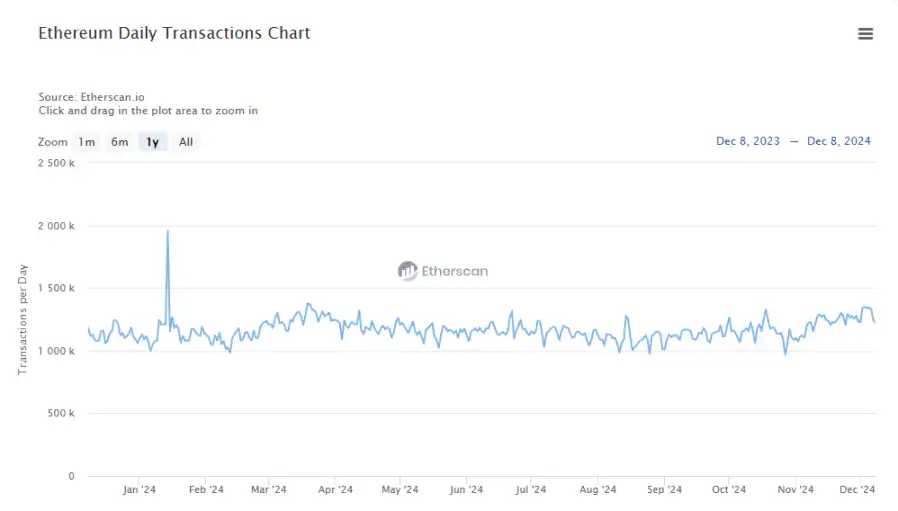
The daily transaction count is a crucial indicator of activity. Looking at the Ethereum daily transaction count chart over the past year resembles an ECG graph, showing stable but slightly fluctuating activity. On December 8, 2023, the total transaction volume on the Ethereum mainnet was 1.18 million transactions, and after a year, on December 8, 2024, this figure was 1.22 million transactions, nearly unchanged. During this year, only in January 2024 did it briefly spike to 1.96 million transactions. The rest of the time, it remained between 1 million and 1.3 million transactions.
The trend of Gas fees more vividly reflects on-chain activity. At the end of 2023 and the beginning of 2024, Ethereum's Gas fees were still relatively high, averaging above 40 Gwei and reaching around 100 Gwei at peak times. With the rise of new public chains like Solana, one can clearly see the reduction in Ethereum's Gas fees on the chart, especially in July to September, dropping to as low as 0.3 Gwei. Even with a recent rebound, it mostly hovers below 20 Gwei. Initially, the Layer 2 solutions surged mainly due to Ethereum's high Gas fees. Now, Ethereum's Gas fees have finally come down, but it seems users have disappeared. Or rather, as users leave, Ethereum truly lowers its fees.
As for active addresses, it also follows a curve pattern similar to the daily average transaction signing. According to data from the Ethereum browser, the daily active Ethereum address count and ERC20 address count have not seen significant growth, and the data level remains similar to the period before the bull market started.
User Flow to L2, Funds Stay on L1
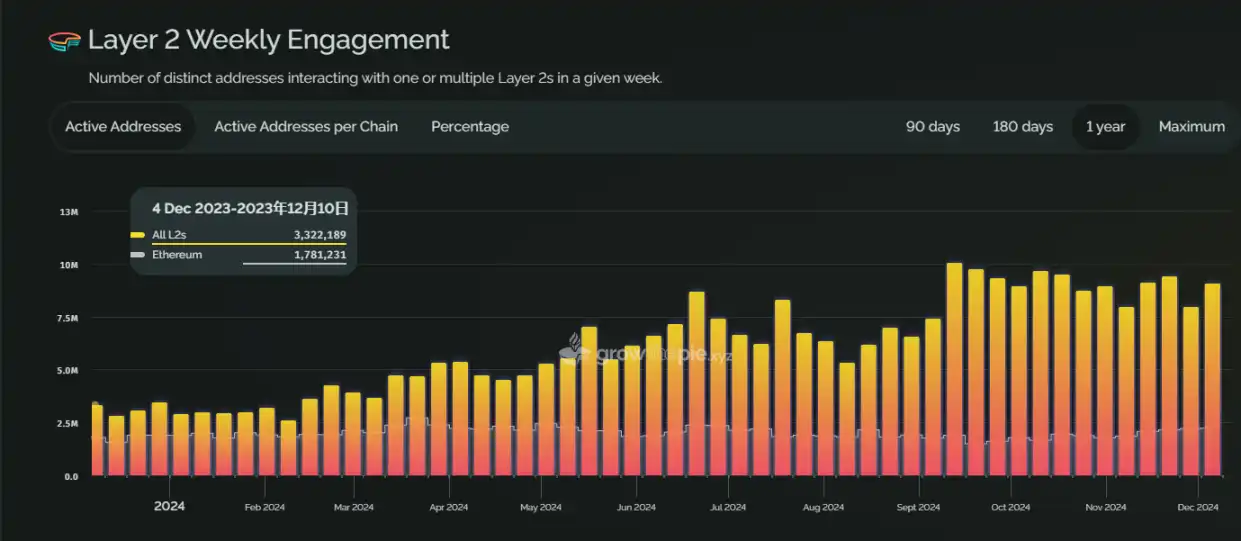
Where did Ethereum's users specifically go? Looking at the weekly on-chain activity data from a year ago, the on-chain active address count of Ethereum accounted for approximately 50% of all Layer2. However, as time has passed, up to the current data, we can see that the active address count on Layer2 is generally on the rise, while the proportion of active addresses on the Ethereum mainnet is around 24% of the overall Layer2.
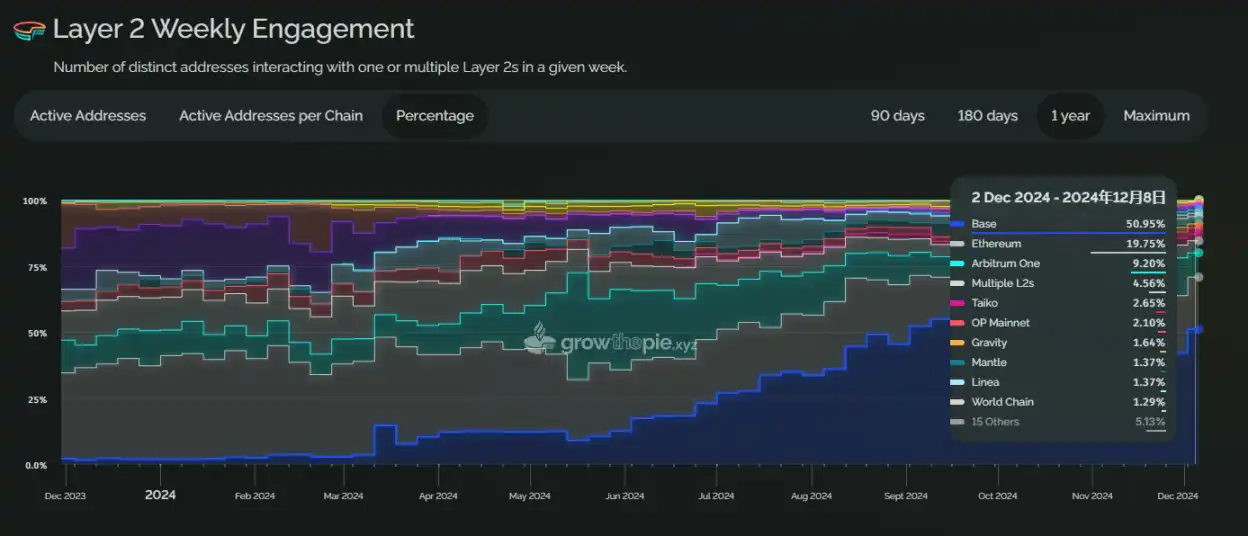
Looking at the performance of each chain separately, in December 2023, the Ethereum mainnet had the highest activity rate, accounting for about 32.48%. By December 2024, the most active chain had changed to Base, with a share rising to 50%, Ethereum mainnet in second place at 19%, and Arbitrum in third at 9.2%.
However, in Total Value Locked (TVL), the Ethereum mainnet still appears to be the first choice for whales. Looking at the total amount of stablecoins locked on-chain, the proportion on the Ethereum mainnet was around 95% in December of last year, slightly down now but still around 91%. Moreover, TVL data has almost been the only data showing a significant increase on the Ethereum mainnet over the past year. In December 2023, the TVL on the Ethereum mainnet was about $28.8 billion, and by December 2024, this data had risen to around $77.5 billion. The growth rate is about 2.69 times, surpassing the growth rate of Ethereum's price. This growth is also related to the price surge during the bull market. In Layer2, Arbitrum and Base are second and third, respectively, in stablecoin TVL.

In terms of revenue, the Ethereum mainnet is also the most profitable chain within the Ethereum ecosystem. Over the past year, Ethereum's revenue share has consistently remained above 80%, reaching 92% as of December 8. Base Chain has become the second-highest revenue-generating chain in the Ethereum ecosystem this year.
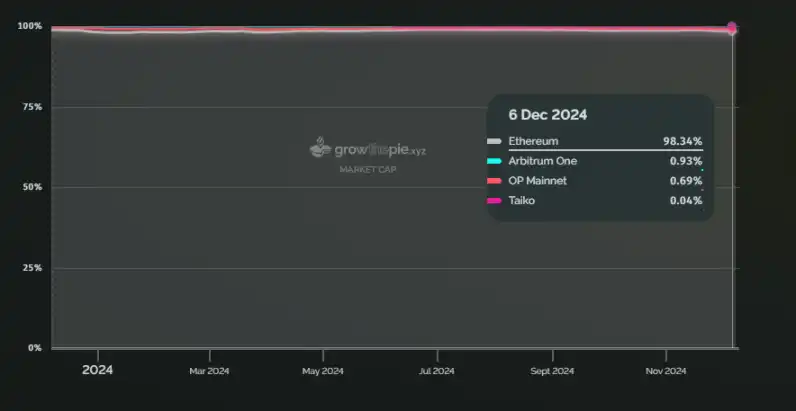
Ethereum's market capitalization has also remained at around 98%, despite a decrease in on-chain activity. The market cap proportion seems to be generally consistent with the TVL proportion. Additionally, looking at the entire crypto market share, Ethereum's market cap proportion has indeed been continuously decreasing over the past year, currently standing at around 13.4%.
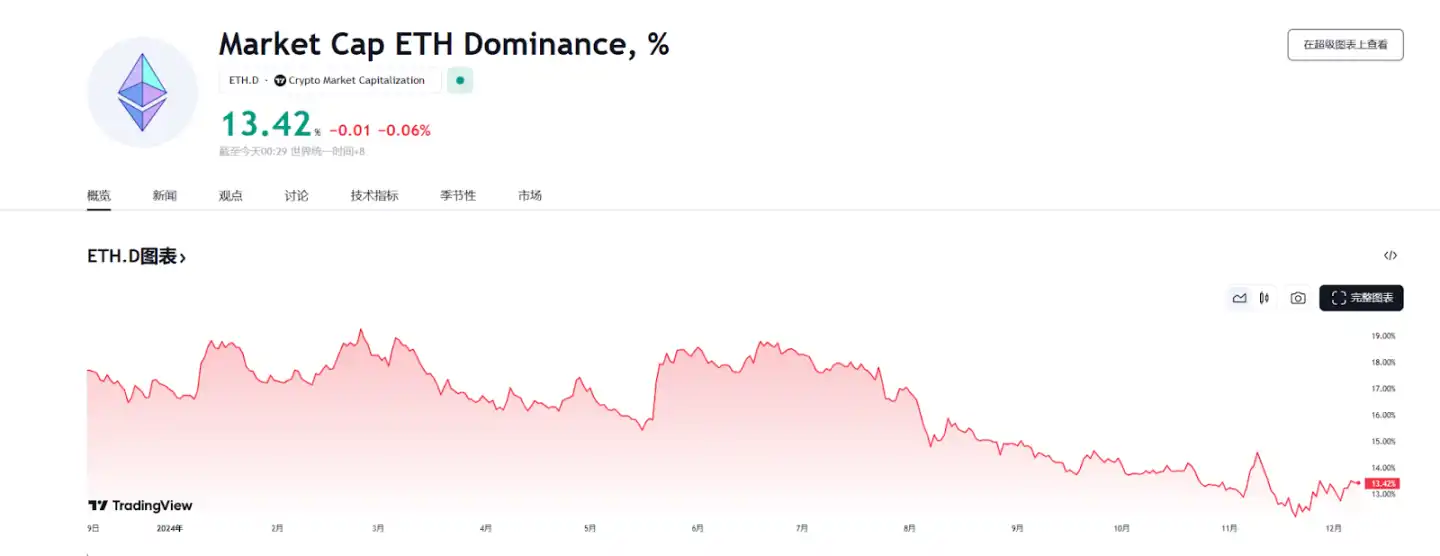
However, considering the growth of TVL, most large funds still choose to keep their funds on the Ethereum mainnet. Comparing the ratio of total TVL to active user count, Ethereum's mainnet has a value of $178,700, Base is around $3,315, and Solana is around $1,972. From this perspective, Ethereum still maintains the highest value per user across the entire network.
Uniswap Exodus Could Spell Greater Concern
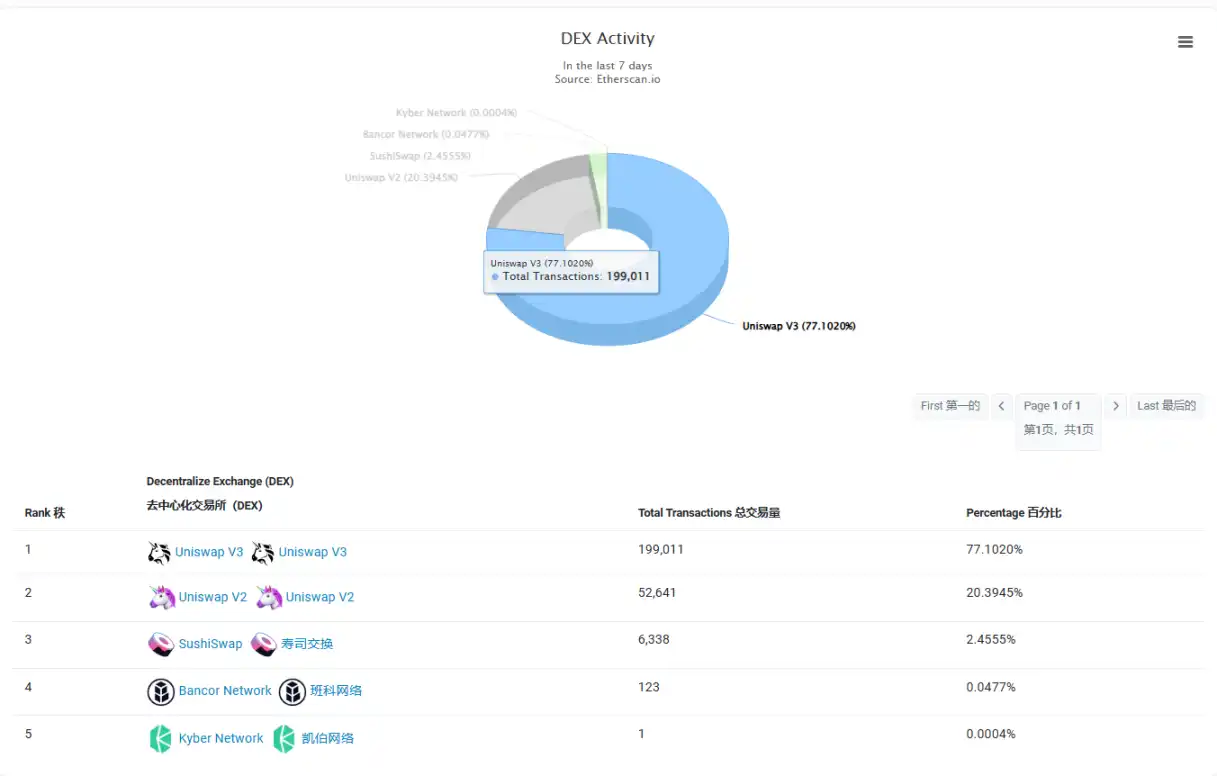
From various data points, Uniswap is currently the undisputed largest application on Ethereum. In terms of DEX activity, Uniswap V2 and V3 together account for over 97% of the transaction volume on the Ethereum mainnet. On Ethereum's burn leaderboard, Uniswap has also consistently held the top position. As of December 9, in the past 30 days, Uniswap burned a total of 6,372 Ether, while Ethereum transfers only burned 4,594 Ether.
Once Uniswap shifts most of its trading activity to its self-built Unichain, Ethereum mainnet's activity and burn count may drop significantly. According to Forbes, as Uniswap transitions to its own chain, Ethereum network validators could lose an estimated $400 million to $500 million in annual revenue. However, more concerning than this economic loss is the threat to Ethereum's fundamental narrative as a deflationary currency. Uniswap's general router is the largest gas fee consumer, accounting for 14.5% of Ethereum's gas fees, equivalent to burning $1.6 billion worth of Ether.
Summarizing the performance of the above indicators, we can draw some key conclusions. Ethereum mainnet's on-chain network activity has not grown in the past year and its share within the entire Ethereum ecosystem is gradually declining. At least, this suggests that new users are mostly opting for other Layer 2 solutions or other blockchains (after all, emerging blockchains like Solana, Sui, Aptos, etc., are showing rapid growth in these metrics).
Therefore, circling back to the initial topic, has Ethereum's fundamental changed significantly? Or is ETH undervalued? Considering the data above, Ethereum mainnet seems to be transforming into a reservoir for whales and institutional funds. Even with a significant decrease in gas fees, Ethereum Mainnet still cannot compete with Layer 2 or other blockchains in terms of transaction fees and speed. Thus, Ethereum mainnet is clearly no longer just a retail investor club and does not have a community size advantage in the current popular MEME and other trends. It is more suited for players with lower frequency requirements and higher asset security demands. From this perspective, we can only say that Ethereum mainnet's ecosystem role is undergoing a transformation, with liquidity and security becoming Ethereum mainnet's final moat.
You may also like

CZ Memoir Released: Reveals a Large Amount of Industry Insider Information, Prompting Intense Rebuttal from Xu Mingxing

a16z: After securities are on the blockchain, why will intermediary institutions be replaced by code?

XRP Tokyo Is Here: What We Learn and What’s Next for XRP Price
Key Takeaways: Ripple’s 2025 XRP Tokyo event highlights a projected $33 trillion on-chain stablecoin volume by 2026. Significant…

Solana’s Future: Navigating the $285M Hack, Rug Pulls, and Milei Libra Scandal
Key Takeaways: Multiple Crises: Solana faces a $285 million hack, allegations of rug pulls, and the Milei Libra…

BTC USD Faces Tension: Markets React to Trump’s Dire Warning
Key Takeaways: Bitcoin’s price drops sharply below $70,000 amid geopolitical tensions, playing off Trump’s dramatic 8 PM ultimatum…
Bitcoin Price Surge: Ceasefire Sparks Optimism Hits $71K
Key Takeaways: After the US-Iran ceasefire announcement, Bitcoin surged beyond $71,000, marking its highest in a month. A…

Ethereum Price Forecast: Record $180 Billion Stablecoin Supply Marks Buyers’ Return
Key Takeaways: Ethereum’s stablecoin supply has surged to a record $180 billion, marking a 150% increase over the…

Emerging Evidence Links Argentina’s Milei to LIBRA Crypto Scandal
Key Takeaways: Evidence unveiled by Argentina’s federal prosecutors links President Javier Milei to the LIBRA token through call…

US Spot Bitcoin ETFs See Surge as BTC Nears $70K; LiquidChain and Layer-3 DeFi Rise
Key Takeaways: U.S. spot Bitcoin ETFs absorbed $471 million in a single day, moving BTC closer to the…

Bitcoin Price Prediction: Decoupling from Tech Stocks, Shaped by Geopolitics and AI Turmoil
Key Takeaways: Bitcoin is decoupling from tech stocks as geopolitical tensions and AI crises reshape the market, currently…

Chaos Labs Departure Leaves Aave Without Risk Management Amidst Governance Conflict
Key Takeaways: Aave, with a $50 billion TVL, is currently operating without a risk manager due to Chaos…

Grayscale Ethereum ETF Staking: A New Catalyst for $5,700?
Key Takeaways: Grayscale’s Ethereum Staking ETF introduces a yield-bearing structure that could significantly reshape investor sentiment. Ethereum’s price…

Polygon Crypto Enhances Finality Through the Giugliano Hardfork
Key Takeaways: Polygon’s Giugliano hardfork is operational on the mainnet, effectively reducing transaction finality by 2 seconds. The…

Senate’s Three-Week Deadline: Ripple XRP and the CLARITY Act’s Critical Moment
Key Takeaways: The Senate Banking Committee’s decision on the CLARITY Act in late April could define XRP’s future…
Solana Foundation Introduces STRIDE for DeFi Security
Key Takeaways: STRIDE is a structured security evaluation program for Solana’s DeFi ecosystem, managed by Asymmetric Research. It…
Trump Iran Doomsday Deadline Revisited: How Will Bitcoin and SPX Respond?
Key Takeaways: The geopolitical tension surrounding the Trump Iran deadline poses significant risks to Bitcoin prices and the…

XRP Crypto Slips to $1.31: Liquidity Challenges and Market Movement
Key Takeaways: XRP has fallen to $1.31, struggling after a rejection at the $1.35 level, showing potential liquidity…
Bitcoin Decoupling from Fed and ETFs in 2026
Key Takeaways: Bitcoin’s correlation with the Global Easing Breadth Index has reversed, showing a significant -0.778 correlation by…
CZ Memoir Released: Reveals a Large Amount of Industry Insider Information, Prompting Intense Rebuttal from Xu Mingxing
a16z: After securities are on the blockchain, why will intermediary institutions be replaced by code?
XRP Tokyo Is Here: What We Learn and What’s Next for XRP Price
Key Takeaways: Ripple’s 2025 XRP Tokyo event highlights a projected $33 trillion on-chain stablecoin volume by 2026. Significant…
Solana’s Future: Navigating the $285M Hack, Rug Pulls, and Milei Libra Scandal
Key Takeaways: Multiple Crises: Solana faces a $285 million hack, allegations of rug pulls, and the Milei Libra…
BTC USD Faces Tension: Markets React to Trump’s Dire Warning
Key Takeaways: Bitcoin’s price drops sharply below $70,000 amid geopolitical tensions, playing off Trump’s dramatic 8 PM ultimatum…
Bitcoin Price Surge: Ceasefire Sparks Optimism Hits $71K
Key Takeaways: After the US-Iran ceasefire announcement, Bitcoin surged beyond $71,000, marking its highest in a month. A…


 App
App