
- Buy Crypto
- Markets
 Futures
- Spot
- Copy Trade
 Earn
Earn- More
Feeling Cold? ETH Daily Burn Hits All-Time Low, Active Address Count Drops to Six-Month Low

Original Article Title: "Is Ethereum Being Left Behind? Daily Burn Rate Hits New Low, 'Disinflationary Asset,' ETH Active Addresses Hit Six-Month Low"
Original Article Author: James, BlockTempo from Dooqu Trending
When Ethereum implemented the London upgrade in August 2021, it introduced EIP-1559, which simplified the transaction fee mechanism and required the network to burn all ETH used to pay the base fee. The design purpose of this mechanism was to reduce inflationary pressure and potentially turn Ethereum into a deflationary asset during periods of high network activity.
Daily ETH Burn Rate Hits Historic Low
However, according to data from The Block, the Ethereum network only burned 53.07 ETH in a single day last Saturday, which, at the current price, is worth only about $10.6 thousand, setting a new historic low.
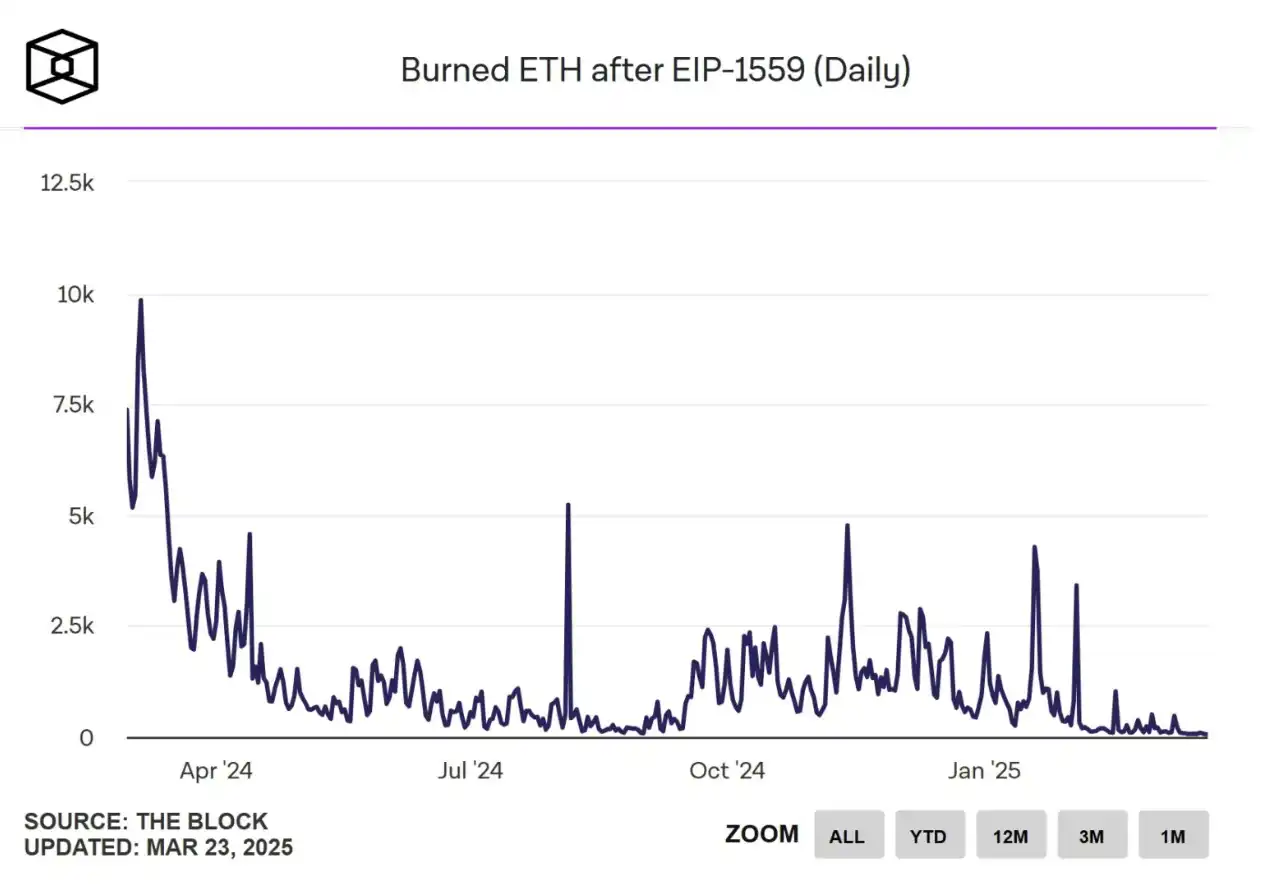
Image Source: The Block
Additionally, according to data from Ultrasound.money, if the past seven days' burn rate is considered, the estimated annual supply growth rate of Ether would be 0.76%.
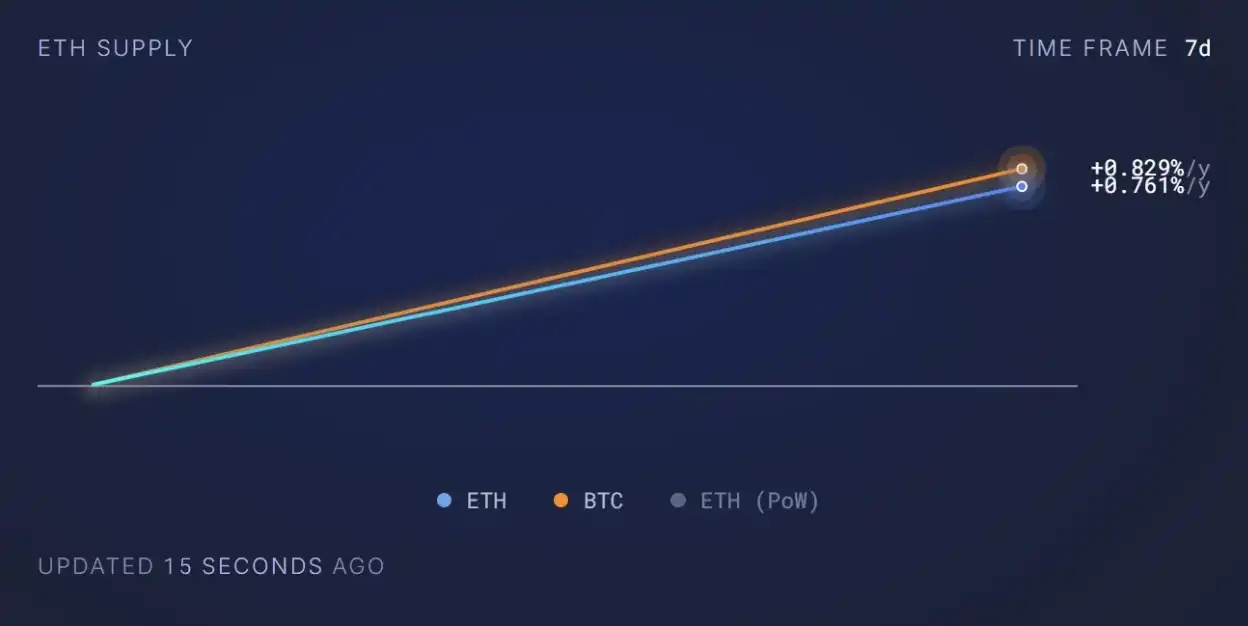
Image Source: Ultrasound.money
This low burn rate corresponds well with the decline in other Ethereum activity indicators, such as the number of active addresses. According to The Block's data, the seven-day moving average of active addresses has recently dropped to its lowest point since October 2024. New address creations, transaction counts, and daily transaction volumes have also seen declines in the past few weeks.
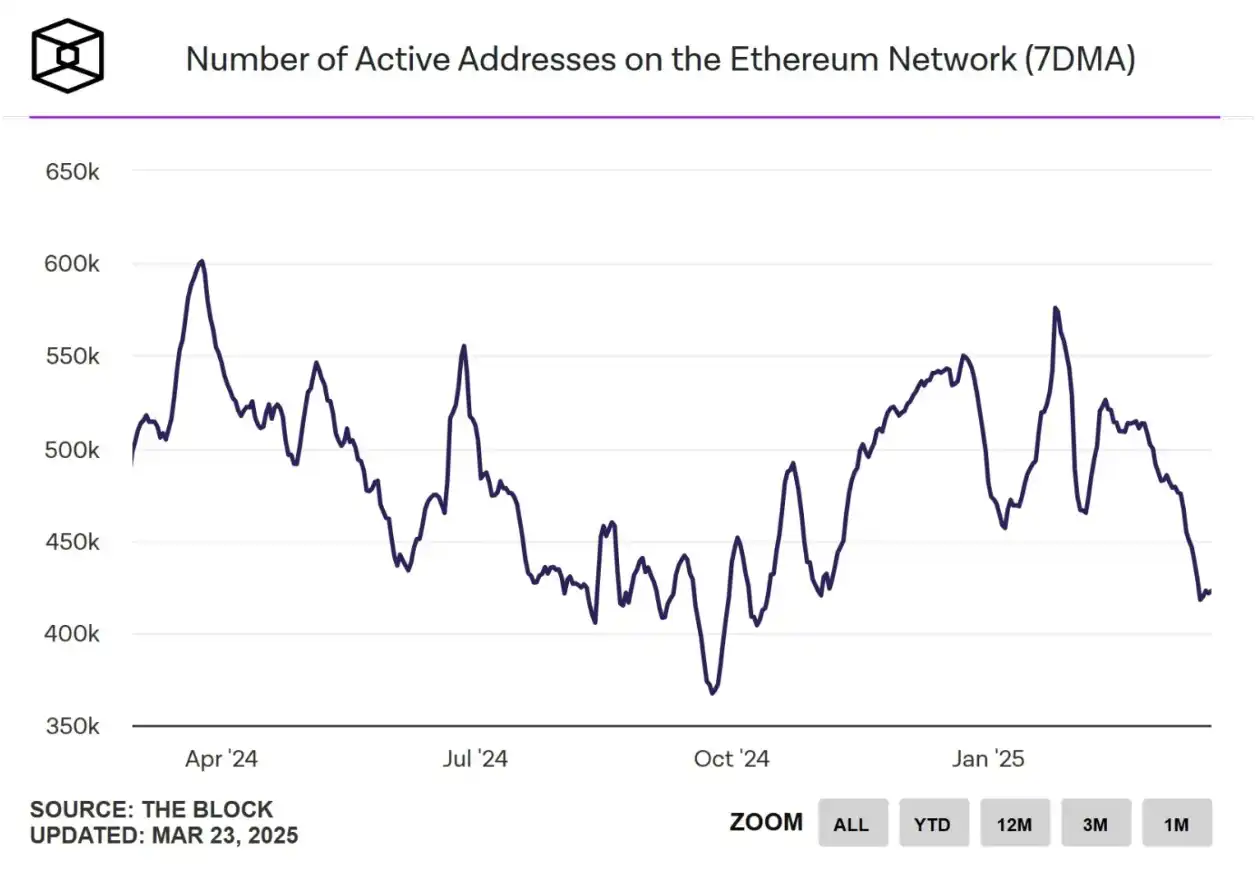
Image Source: The Block
Ethereum Foundation Considers Course Correction
During Ethereum's stagnation, Standard Chartered Bank recently significantly lowered its price forecast for Ethereum in 2025 from the original $10,000 to $4,000. This adjustment was due to the rapid growth of Ethereum's Layer 2 solutions in both number and scale.
In this report, Standard Chartered Bank points out that Ethereum is currently at a crossroads. While its various metrics still dominate the blockchain space, this dominance is gradually waning. Ethereum's proud Layer2 networks, originally intended to improve Ethereum's scalability, are now seen to have only Coinbase's Layer2 network, Base Chain, causing a $500 billion reduction in Ethereum's market cap.
To prevent this trend from continuing, Standard Chartered Bank suggests that the Ethereum Foundation needs to change its business direction, such as implementing taxes on Layer2. Additionally, if the tokenization market can experience significant growth, Ethereum may be able to maintain about an 80% share of security in this field, which could provide some support for Ethereum.
As Ethereum faces a trust crisis, Haseeb Qureshi, Managing Partner at Dragonfly, recently revealed that the Ethereum Foundation is actively responding to community feedback and considering adjusting its operational direction. The leadership is seriously contemplating how to draw lessons from other success stories, particularly Solana's Superteam model, shifting the focus from pure research to promoting project development and investment activities.
You may also like

Most Expensive Rejection: CZ Won the Business Battle But 'Missed the Bus' on $20 Billion in AI

BTC Halving, But Bitcoin Wallet Still Valued at $4 Billion

New York Times: USD1 Has Become the Trump Family's Cryptographic Engine

Can IBIT Really Trigger a Market-Wide Liquidation?

a16z: The "Super Bowl Moment" of Predicting Markets
Cathie Wood's Conversations: Eight Insights on the 2026 Big Ideas

WEEX AI Trading Hackathon 2026: How Top AI Strategies Dominated Real Markets
WEEX AI Trading Hackathon demonstrates that effective trading — whether powered by AI or human judgment — relies on core principles: understanding market structure, maintaining conviction, prioritizing quality over quantity, and managing risk intelligently.
WEEX Ai Trading Hackathon vs. Other AI Trading Competitions: Which Is Better for You?
The AI trading competition landscape offers distinct paths for growth. The WEEX AI Trading Hackathon differentiates itself through its focus on real-market execution and practical viability, positioning it as a key platform for aspiring quantitative traders and strategists.
Is AI Trading Replacing Humans? WEEX Hackathon Reveals the Future of Fintech
The WEEX AI Trading Hackathon reveals that the future of trading is not about AI replacing humans, but about collaboration. AI enhances trading capabilities, while human judgment, ethics, and strategic oversight remain essential.

Key Market Information Discrepancy on February 9th - A Must-See! | Alpha Morning Report

"2.5 Dip" Real Reason: Wall Street Deleveraging Induced Overreaction
Kyle's review of Hyperliquid sparks controversy, Solitude Bank officially opens, what are the overseas crypto communities talking about today?

Cryptocurrency prices in the dumps, but the prediction market is going wild?

Decoding Strategy’s Latest Financial Report: After a $12.4 Billion Loss, How Long Can the Bitcoin Flywheel Keep Spinning?
When earnings reports become electrocardiograms of Bitcoin’s price, Strategy is not merely a company—it’s an experiment testing whether faith can overcome gravity.

Discover How to Participate in Staking
Staking is a digital asset yield product launched by the WEEX platform. By subscribing to Staking products, users can stake their idle digital assets and earn corresponding Staking rewards.

WEEX AI Trading Hackathon Rules & Guidelines
This article explains the rules, requirements, and prize structure for the WEEX AI Trading Hackathon Finals, where finalists compete using AI-driven trading strategies under real market conditions.
From 0 to $1 Million: Five Steps to Outperform the Market Through Wallet Tracking



 App
App