
 Buy Crypto
- Markets
 Futures
- Spot
- Copy Trade
- Earn
- More
Full text of the draft of "U.S. Strategic Bitcoin Reserve": Manage BTC as a permanent national asset

Original source: Bitcoin Policy Institute
Original translation: BitpushNews
On December 17, 2024, the Bitcoin Policy Institute drafted an executive order proposing to establish a strategic Bitcoin reserve under the Trump administration's U.S. Treasury Exchange Stabilization Fund (ESF), which needs to be signed after Trump takes office to take effect.
Bitpush Note: The Bitcoin Policy Institute is a nonpartisan, nonprofit organization dedicated to studying the policy and social impact of Bitcoin and emerging currency networks.
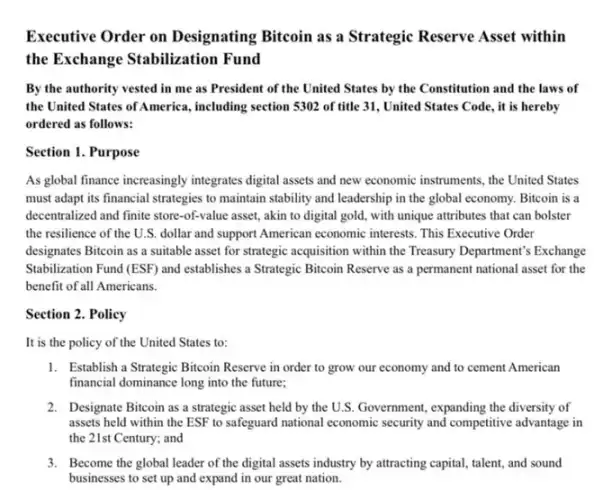
Below is the full text of the Executive Order:
By the authority vested in me by the Constitution and the laws of the United States, including 31 U.S.C. Section 5302, it is hereby ordered as follows:
Section 1. Purpose
As global finance increasingly integrates digital assets and new economic instruments, the United States must adapt its financial strategy to maintain global economic stability and leadership. Bitcoin is a decentralized, finite store of value asset, similar to digital gold, with unique properties that enhance the resiliency of the dollar and support U.S. economic interests.
This Executive Order designates Bitcoin as an asset suitable for strategic acquisition within the Treasury’s Exchange Stabilization Fund (ESF), establishes a strategic Bitcoin reserve, and maintains it as a permanent national asset for the benefit of all Americans.
Section 2. Policy
It is the policy of the United States:
1. Establish a Strategic Bitcoin Reserve to grow our economy and solidify America’s future financial dominance;
2. Designate Bitcoin as a strategic asset held by the U.S. Government, broaden the diversity of assets held by the ESF to protect national economic security and competitive advantage in the 21st century, and promote industry development by attracting capital, talent, and voices;
3. Become a global leader in the digital asset industry, building and expanding businesses across our great nation.
Section 3. Establishment of the SBR and Designation of Bitcoin as a Strategic Reserve Asset
(a) Establishment of a Strategic Bitcoin Reserve
The Strategic Bitcoin Reserve (SBR) is hereby established to be managed by the Secretary of the Treasury and to enhance the diversity of the United States’ reserve assets. To enhance confidence in its mission, the SBR will be subject to regular audits, rigorous security standards, and comprehensive reporting measures to ensure long-term accountability and security.
(b) Consolidation of Government Bitcoin Holding
Not later than 7 days after the date of this order, any bitcoin under the control of any Federal agency, including the United States Marshals Service, shall not be sold, exchanged, auctioned, or otherwise pledged and shall be transferred to the SBR by the head of such Federal agency upon acquisition of legal title to such bitcoin, including upon final, nonappealable judgment in a criminal or civil forfeiture action in favor of the Federal agency.
(c) Designation of Reserve Asset
Bitcoin is hereby designated as a strategic reserve asset suitable for purchase and holding within the ESF. Not later than 60 days after the date of this order, the Secretary of the Treasury is hereby directed to implement a Bitcoin Acquisition Program to acquire and manage Bitcoin within the ESF. The goal of the SBR is to position the United States as the undisputed world leader in Bitcoin holding, innovation, and management, ensuring that U.S. interests, rather than those of foreign competitors, set the standard for global digital asset strategy.
SECTION 4. ACQUISITION AND CUSTODY AGREEMENTS
(a) Acquisition Program
Pursuant to 31 U.S.C. 4 5302, which authorizes the Secretary of the Treasury to “deal with … credit instruments,” the Secretary of the Treasury is hereby directed to appropriate not less than $521 billion from the ESF for the strategic acquisition of Bitcoin for inclusion in the SBR, in a manner consistent with the Secretary’s obligations under law, by purchasing obligations from appropriate counterparties and repaying them in Bitcoin. The Secretary of the Treasury shall work with reputable market participants pursuant to agreements that maximize value and mitigate risk. The initial acquisition program shall be completed not later than 365 days after the date of this order.
(b) Custody and Security Protocols
In order to safeguard the SBR’s bitcoin holdings at all stages, the Secretary of the Treasury shall implement the following phased custody framework. Within 30 days of the date of this order, the Secretary shall confirm that the U.S. Government’s existing relationships with reputable and secure custody service providers are sufficient to ensure immediate, trusted storage solutions for bitcoin within the SBR. The Secretary shall direct that all bitcoin purchases under the acquisition program be securely transferred to such custody service providers.
In parallel, the Secretary shall coordinate with the National Security Agency, the Cybersecurity and Infrastructure Security Agency, the National Institute of Standards and Technology (NIST), and any other agencies requested by the Secretary to develop and implement self-custody protocols (including dedicated hardware, assured software, access controls, geographic distribution, multi-signature controls, and physical security measures) designed to enhance long-term security, reduce reliance on third parties, and maintain full sovereign control over the United States’ bitcoin reserves as a “digital Fort Knox.” The Secretary should ensure that the SBR custody agreement is consistent with ESF audit procedures, rigorous cybersecurity standards, and cryptographic proof of reserve verification to safeguard the integrity of the SBR and the confidence of the American public.
Section 5. Conditions for Sale of the Strategic Bitcoin Reserve
(a) Long-Term Preservation
The SBR should serve as a permanent pillar of America’s financial strength and commitment to the future of the digital economy, in the same enduring spirit that preserved our nation’s gold reserve at Fort North. Bitcoin held in the SBR should not be viewed as a short-term financial instrument or a rainy day fund for day-to-day emergencies, but rather as a generational asset that supports America’s prosperity and security for decades to come. It is the policy of the United States. The Government shall hold (HODL) all Bitcoin acquired in the SBR for at least 25 years after the date of this order.
(b) Strict Limitations on Liquidation
Sales or other divestments of the SBR should be permitted only in the most dire and extraordinary circumstances, which clearly outweigh ordinary financial volatility or geopolitical uncertainty.
(c) Rigorous Approval Process
Before any sale is made, the Secretary of the Treasury shall submit a detailed written decision, accompanied by substantial evidence, demonstrating that the proposed liquidation is in direct response to an extraordinary national economic or security crisis. The decision must be approved by the President of the United States. The Secretary of the Treasury shall not be authorized to sell, pledge, exchange, or otherwise dispose of any portion of the SBR without express authorization.
(d) Transparent and Controlled Execution
In the rare circumstances in which a sale is approved, it should be conducted through the most sensible and tightly controlled methods to minimize market impact and maintain public confidence. Preference should be given to private, staged transactions or other measured methods that ensure that, even in a crisis, the nation's reputation for financial prudence and responsibility remains intact.
Section 6. Reporting and Transparency
(a) Public Reserve Certification
The Secretary of the Treasury shall implement a public reserve certification process using cryptographic certifications. These certifications shall be provided on a quarterly basis to ensure transparency of the ESF’s bitcoin holdings while protecting sensitive security information.
(b) Annual Report
As part of the annual report on the operations of the ESF required by the Gold Reserve Act, the Secretary of the Treasury shall provide detailed information on the status, performance, and strategic advantages of bitcoin within the ESF. The report shall also summarize acquisition strategies, custodial security measures, and impacts on economic stability, subject to considerations of national economic security.
Section 7. Interagency Coordination
The Secretary of the Treasury shall coordinate with the Federal Reserve, the Department of Defense, and other relevant Federal agencies to ensure that the acquisition and management of bitcoin within the ESF is consistent with United States national security, economic stability, and cybersecurity standards.
You may also like

Ray Dalio's new article: The world is entering a war cycle

IOSG: When Fintech Meets Crypto Native: The Next Decade of Digital Finance

They knew in advance that Trump would tweet about a ceasefire, entered with $20k, and exited with $400k.

The biggest bottleneck in DeFi development

CZ Memoir Released: Reveals a Large Amount of Industry Insider Information, Prompting Intense Rebuttal from Xu Mingxing

a16z: After securities are on the blockchain, why will intermediary institutions be replaced by code?

XRP Tokyo Is Here: What We Learn and What’s Next for XRP Price
Key Takeaways: Ripple’s 2025 XRP Tokyo event highlights a projected $33 trillion on-chain stablecoin volume by 2026. Significant…

Solana’s Future: Navigating the $285M Hack, Rug Pulls, and Milei Libra Scandal
Key Takeaways: Multiple Crises: Solana faces a $285 million hack, allegations of rug pulls, and the Milei Libra…

BTC USD Faces Tension: Markets React to Trump’s Dire Warning
Key Takeaways: Bitcoin’s price drops sharply below $70,000 amid geopolitical tensions, playing off Trump’s dramatic 8 PM ultimatum…
Bitcoin Price Surge: Ceasefire Sparks Optimism Hits $71K
Key Takeaways: After the US-Iran ceasefire announcement, Bitcoin surged beyond $71,000, marking its highest in a month. A…

Ethereum Price Forecast: Record $180 Billion Stablecoin Supply Marks Buyers’ Return
Key Takeaways: Ethereum’s stablecoin supply has surged to a record $180 billion, marking a 150% increase over the…

Emerging Evidence Links Argentina’s Milei to LIBRA Crypto Scandal
Key Takeaways: Evidence unveiled by Argentina’s federal prosecutors links President Javier Milei to the LIBRA token through call…

US Spot Bitcoin ETFs See Surge as BTC Nears $70K; LiquidChain and Layer-3 DeFi Rise
Key Takeaways: U.S. spot Bitcoin ETFs absorbed $471 million in a single day, moving BTC closer to the…

Bitcoin Price Prediction: Decoupling from Tech Stocks, Shaped by Geopolitics and AI Turmoil
Key Takeaways: Bitcoin is decoupling from tech stocks as geopolitical tensions and AI crises reshape the market, currently…

Chaos Labs Departure Leaves Aave Without Risk Management Amidst Governance Conflict
Key Takeaways: Aave, with a $50 billion TVL, is currently operating without a risk manager due to Chaos…
Grayscale Ethereum ETF Staking: A New Catalyst for $5,700?
Key Takeaways: Grayscale’s Ethereum Staking ETF introduces a yield-bearing structure that could significantly reshape investor sentiment. Ethereum’s price…

Polygon Crypto Enhances Finality Through the Giugliano Hardfork
Key Takeaways: Polygon’s Giugliano hardfork is operational on the mainnet, effectively reducing transaction finality by 2 seconds. The…

Senate’s Three-Week Deadline: Ripple XRP and the CLARITY Act’s Critical Moment
Key Takeaways: The Senate Banking Committee’s decision on the CLARITY Act in late April could define XRP’s future…


 App
App