
- Buy Crypto
- Markets
 Futures
- Spot
- Copy Trade
 Earn
Earn- More
JELLY Exposes HLP Risk Vulnerability, How Does Hyperliquid Counterattack?

Original Article Title: Hyperliquid Risk Dashboard
Original Author: asxn_r, Crypto Researcher
Original Translation: DyNamic Deep
Editor's Note: The article analyzes the event where a JELLY price surge led to the liquidation of a $4 million USD short position, revealing design flaws in HLP's backstop exposing platform risk. It introduces risk management optimizations through measures such as the HLP Liquidation Reserve, dynamic Unrealized Contract Limit, and asset delisting. It also launches a multi-table dashboard to monitor open interest, liquidity, funding rates, and other metrics in real-time to help validators identify manipulation risks and make asset delisting decisions.
The following is the original content (slightly reorganized for readability):
On March 26, a trader opened a $4 million USD USDC short position through self-trades when the JELLY price was $0.0095. Subsequently, the JELLY price surged over 4x, resulting in the position being liquidated. The platform's backstop, HLP, took over the loss-making position, thus impacting its account value.
Despite the platform employing a dynamic Unrealized Contract Limit formula (based on global liquidity and open interest from major exchanges), this $4 million USD short was within limits and initially permitted. Once the limit was reached, the system automatically prevented new open interest.
The core issue arose post-liquidation: the HLP Liquidation Reserve holding the short position shared collateral with other strategy reserves. This design choice meant that the Auto-Deleveraging (ADL) was not triggered, leaving the platform exposed to further loss risks as the JELLY price continued to rise.
To mitigate this risk, Hyperliquid strengthened risk management through the following key measures:
· HLP Liquidation Reserve: Strictly limit the reserve's share of the HLP's total value, reduce rebalancing frequency, and employ more advanced logic to handle backstop liquidations. ADL will only be triggered when the Liquidation Reserve's loss exceeds a set threshold, not by extracting collateral from other reserves. ADL is not expected to activate under normal market conditions.
· Dynamic Unrealized Contract Limit: The open interest limit will be dynamically adjusted based on market value.
· Asset Delisting: Validators will vote on-chain to delist assets based on a preset threshold.
Following the recent event, ASXN has created the Hyperliquid Risk Metrics Dashboard to provide real-time visibility into position risks and help validators build consensus on asset delisting based on multiple metrics.
Dashboard Structure
Table 1: Perpetual Market Overview
This table provides an overview of key metrics for Hyperliquid's perpetual futures market:
· Open Interest (OI): The total USD value of all outstanding perpetual futures positions.
· Market Cap: The total circulating market capitalization of the underlying asset (price × circulating supply).
· OI/Market Cap Ratio: The open interest divided by the market cap, expressed as a percentage. This ratio helps identify markets on Hyperliquid that may have a disproportionately large open interest relative to the token's circulating supply, posing a manipulation risk. For example, the HLP liquidation treasury inherited a position that exceeded 40% of JELLY's circulation.
· Max Leverage: The maximum leverage allowed for perpetual futures trading.
· 24-Hour Trading Volume: The total trading volume over the past 24 hours, reflecting market activity.
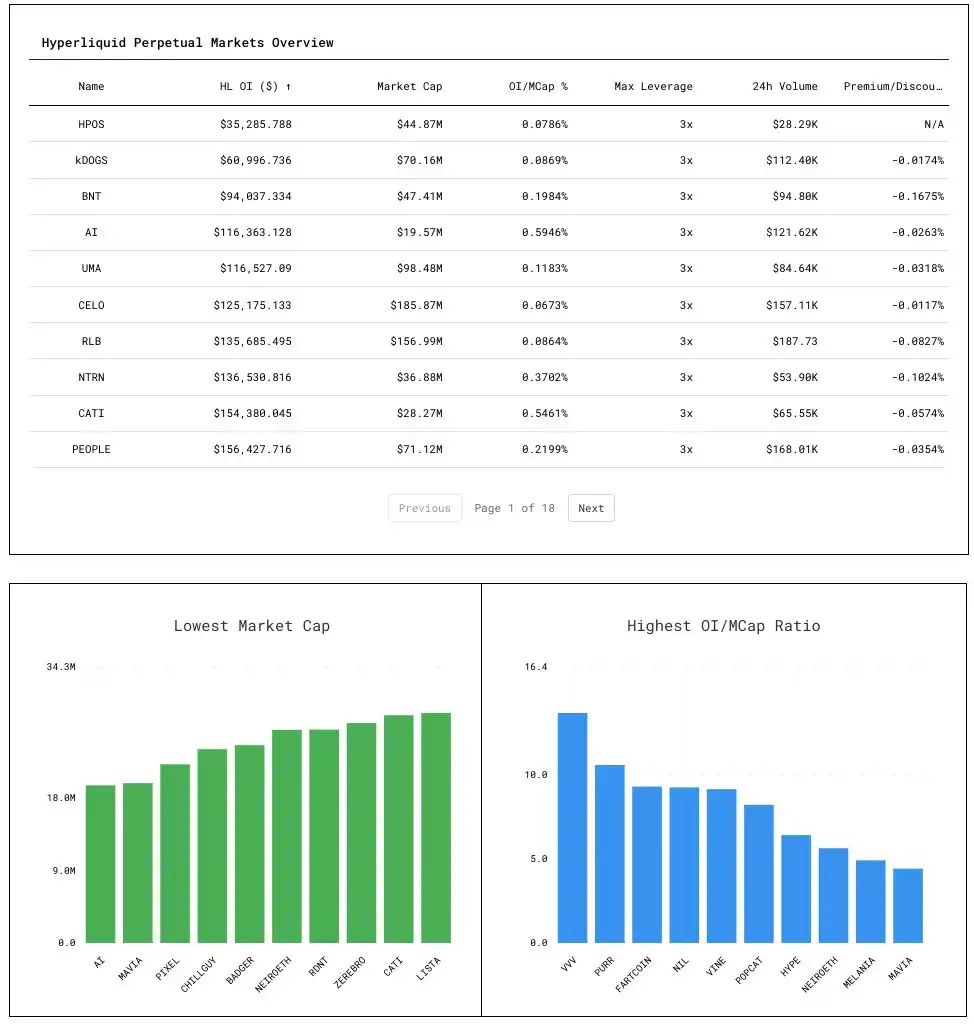
Table 2: Assets Reaching the Hyperliquid OI Cap
This table displays assets that have reached or are close to the maximum permitted open interest cap, along with their market cap and OI/Market Cap ratio percentage.
Markets that reach the open interest cap are no longer allowed to open new positions and can only close existing ones. From a risk perspective, monitoring assets that reach the cap is crucial as it provides real-time feedback on which assets may be exposed to manipulation risks or have already been manipulated.
The JELLY position quickly reached the cap, but due to HLP being the primary counterparty for malicious traders (via liquidation positions), HLP is in a settlement deadlock with the traders.
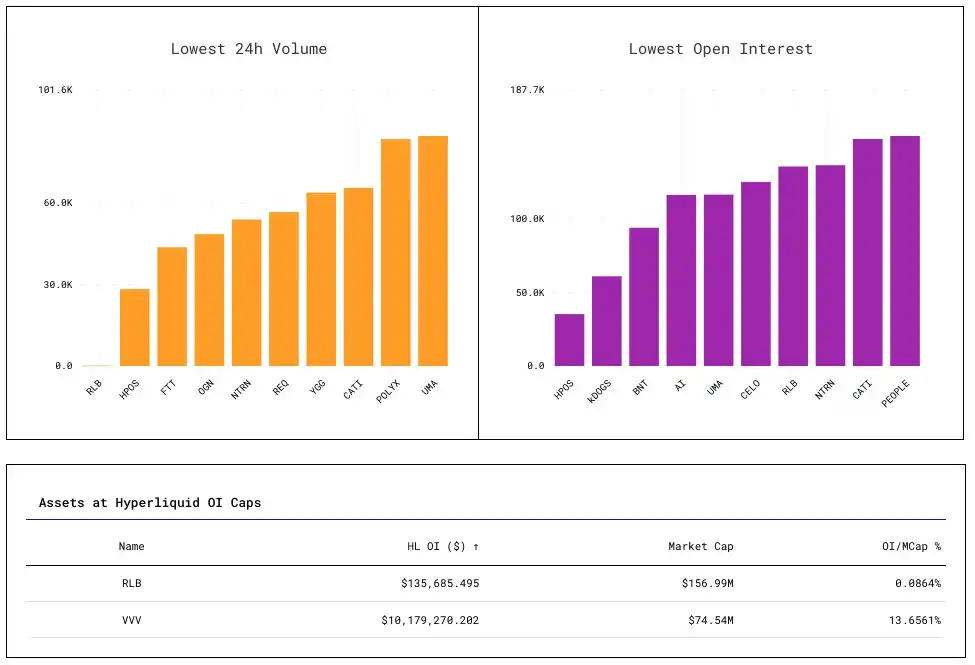
Table 3: Centralized Exchange Liquidity (±2% Order Book Depth)
Measures the cost of moving the price up or down by 2% on major centralized exchanges:
· +2% Depth: The volume of buy orders needed to push the price up by 2%.
· -2% Depth: The volume of sell orders needed to push the price down by 2%.
· Data aggregated from Binance (Spot and Perpetual), Bybit (Spot and Perpetual), Kucoin, and OKX, selecting the market with the deepest liquidity for the ±2% readings.
· The liquidity on centralized exchange order books beyond the best bid/ask price allows us to assess the risk of asset manipulation. Assets with low liquidity enable attackers to move the price with lower capital, making the attack cost-effective.
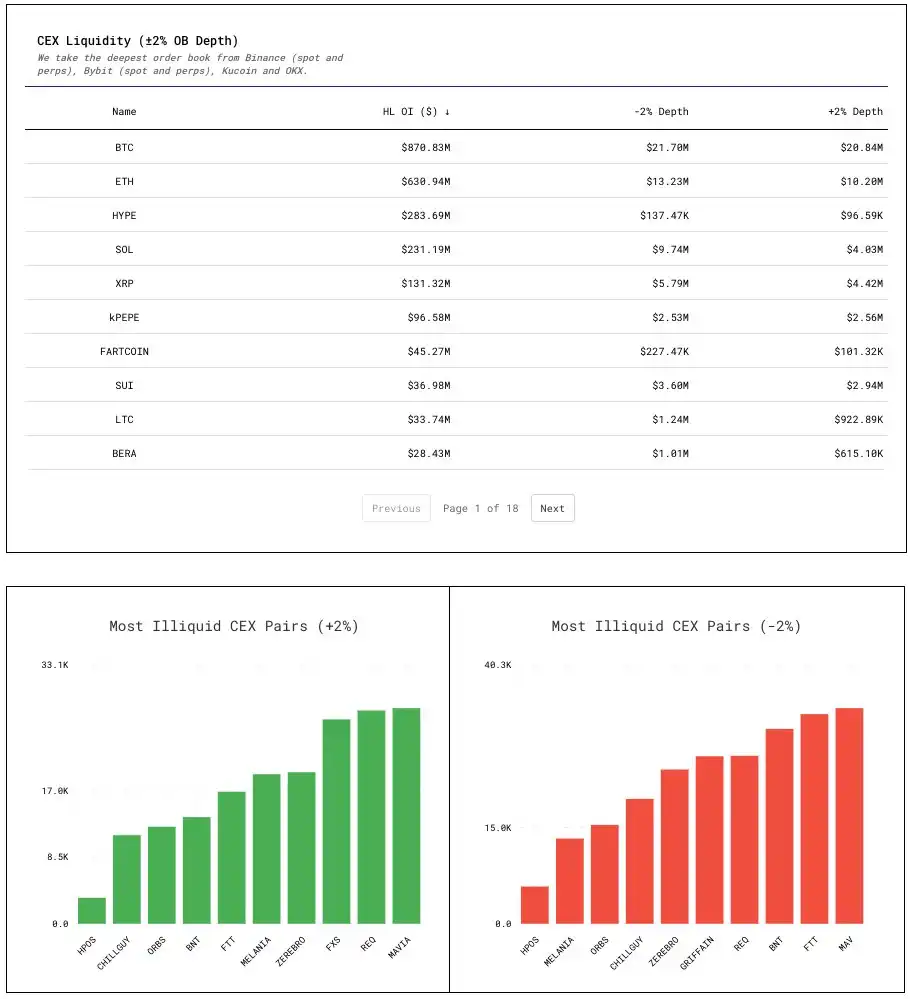
Table 4: Decentralized Exchange Liquidity
Tracking liquidity metrics on various chains:
· Total Reserve: Available liquidity in the DEX pool (in USD), including the USD value of base and quote assets.
· 24-Hour Trading Volume: Total trading activity.
· Buy/Sell Trades: Number of buy/sell trade transactions.
· Traders: Number of unique addresses conducting trades.
· Displays DEX market depth and liquidity.
· As of today, the DEX pools we track cover cosmos, evmos, canto, kava, binance-smart-chain, ethereum, moonriver, harmony-shard-0, moonbeam, energi, polygon-pos, optimistic-ethereum, arbitrum-one, arbitrum-nova, sui, fantom, near-protocol, xdai, milkomeda-cardano, avalanche, base, aptos, polygon-zkevm, solana, ronin, manta-pacific, tomochain, sonic, the-open-network, linea, neon-evm, celo, zksync, opbnb, starknet, and mantle.
· The DEX liquidity table allows us to quickly view token on-chain liquidity and its manipulation risk, as well as identify signs of hoarding by holders.
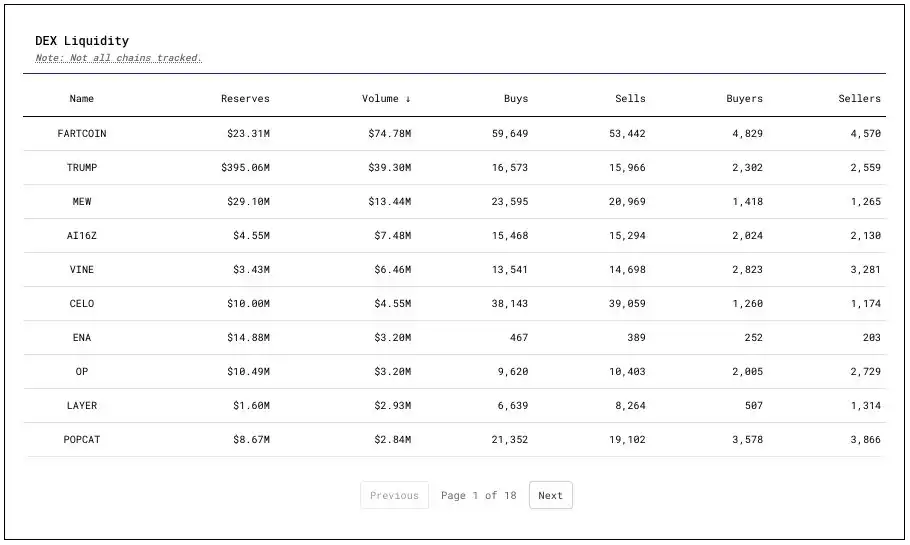
Table 5: Price Impact
By examining the order book depth beyond the best bid/ask price on Hyperliquid, we can understand the price impact. The price impact shows the nominal impact size of market orders (with ETH and BTC at $20,000 and other assets at $6,000) expected to cause a price effect.
For example, Impact Sell Price shows the price the asset would reach if a notional impact scaled market sell occurs.
· Notional Impact Scale: ETH and BTC at $20,000, all other assets at $6,000, based on the Hyperliquid documentation.
· Impact Price (Buy/Sell): The expected price after executing a market order.
· Impact Percentage: The percentage change from the current price. This metric gives us an overview of the liquidity of assets on Hyperliquid, helping to identify assets that are easily manipulated.
· Note: HPOS and RLB are only available in isolated mode, with lower risk. HLP will not be liquidated, and unrealized Profit and Loss (uPnL) cannot be used for cross-margin.
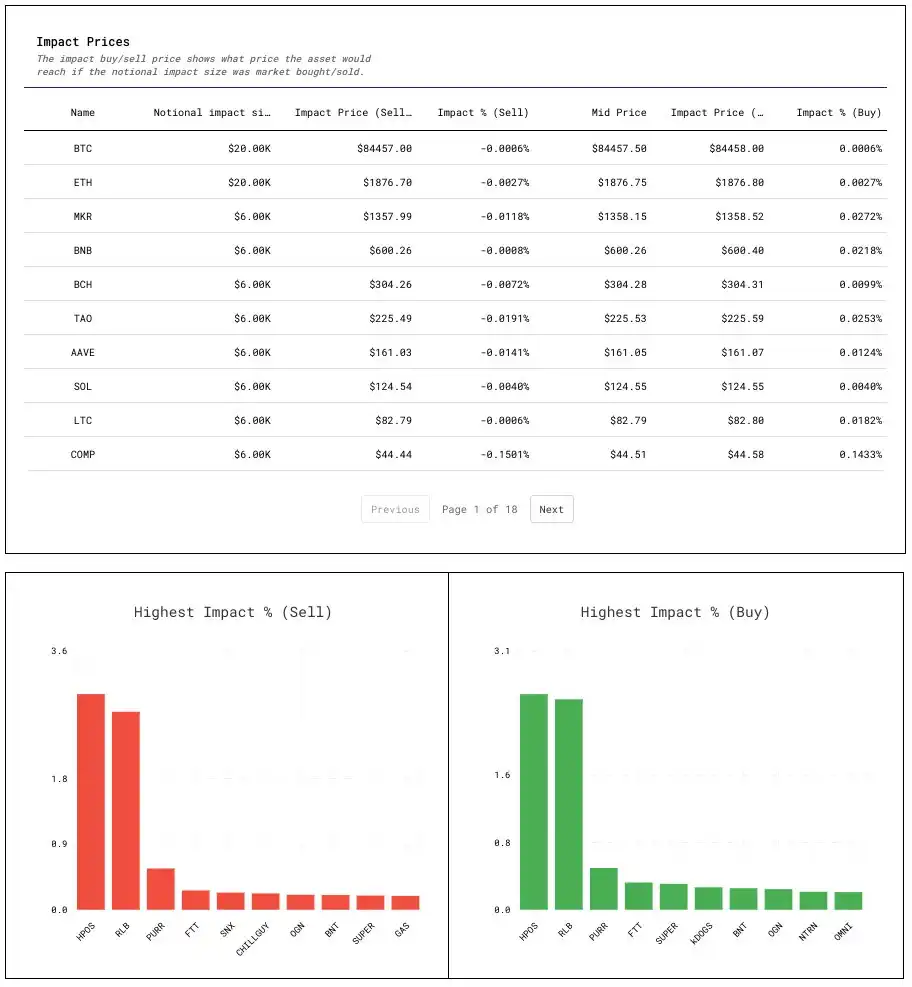
Table 6: Funding Rate Comparison (Annualized)
This table compares the perpetual futures funding rates on Hyperliquid, Bybit, and Binance:
· Notional Open Interest: The total USD value of all open perpetual futures positions on Hyperliquid.
· Funding Rates (HL, Binance, Bybit): The annualized percentage rate traders holding positions need to pay/receive.
· Exchange-HL Arbitrage: The difference in funding rates between the exchange (Binance/Bybit) and Hyperliquid.
· Comparing funding rates with major centralized exchanges allows us to identify potentially manipulable assets. When large positions enter illiquid open interest, funding rates may exhibit anomalies compared to other exchanges.
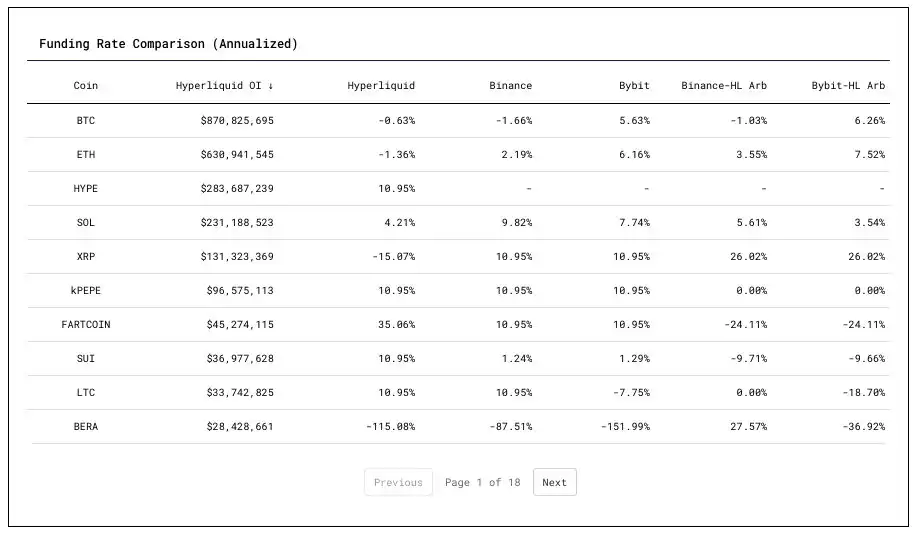
Table 7: HLP Financial Metrics
These metrics analyze the financial performance of HLP and its three sub-treasuries (HLP-A, HLP-B, and Liquidation Treasury), deriving the performance of HLP and each sub-treasury's TVL.
We estimate HLP returns, but due to data granularity constraints, they may slightly differ from actual performance. Based on these estimated returns, we calculate the following indicators:
· Maximum Drawdown: The maximum drawdown faced by depositors due to HLP strategy losses.
· Sharpe Ratio: A measure used to evaluate the risk-adjusted return on investment, reflecting the excess return obtained for assuming additional volatility (risk). A 4% risk-free rate is used here.
· Sortino Ratio: A risk-adjusted measure similar to the Sharpe Ratio, but only penalizing downside volatility (negative returns) rather than total volatility.
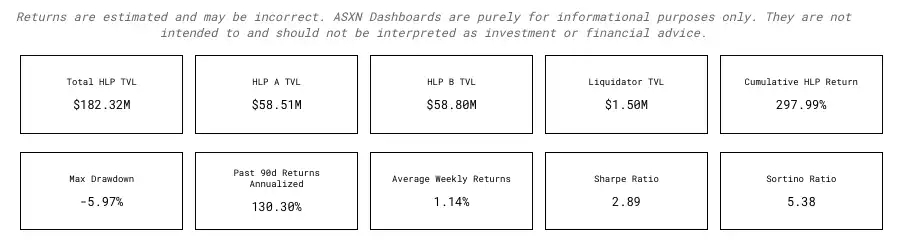
Table 8: HLP Treasury Position
· Display the real-time positions of each HLP treasury as part of the strategy.
· The HLP parent treasury appears to hold idle USDC, while the HLP-A and HLP-B child treasuries have active market-making positions.
· The Liquidation Treasury currently has no position but will have an active position if needed for backstops.
· Real-time monitoring of each treasury position is crucial to act promptly when some positions approach the platform risk limits.
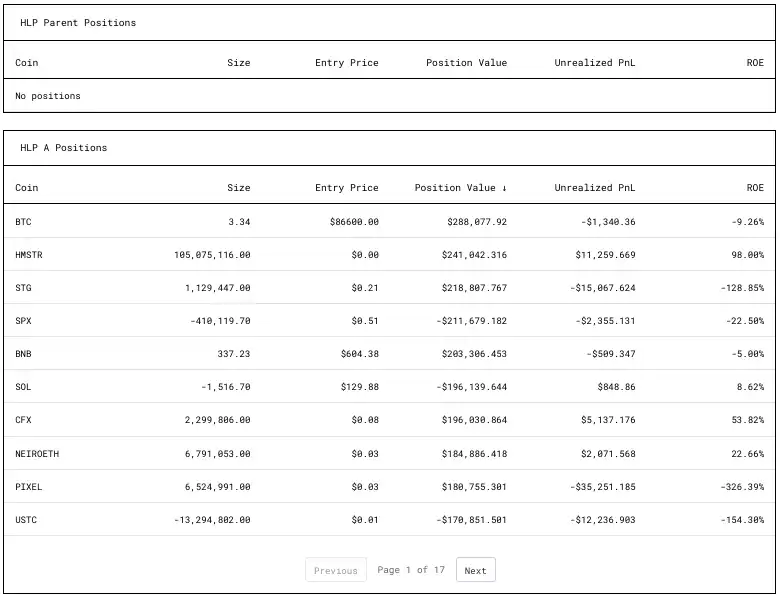
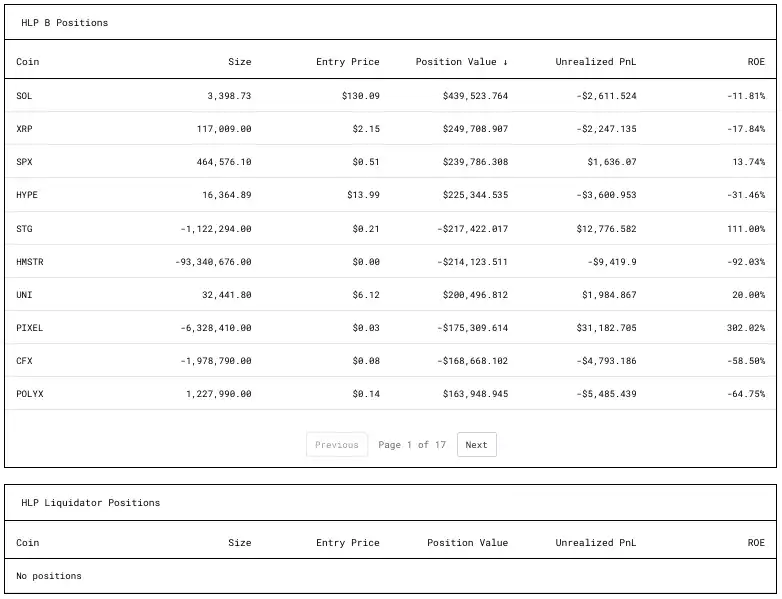
Table 9: HLP Treasury Time Series
Showing the account value and cumulative P&L of each HLP treasury.
· Note: "Total HLP" refers to the sum of HLP-A, HLP-B, Liquidation Treasury, and Parent Treasury.
· We also provide an estimated weekly return for the Total HLP.
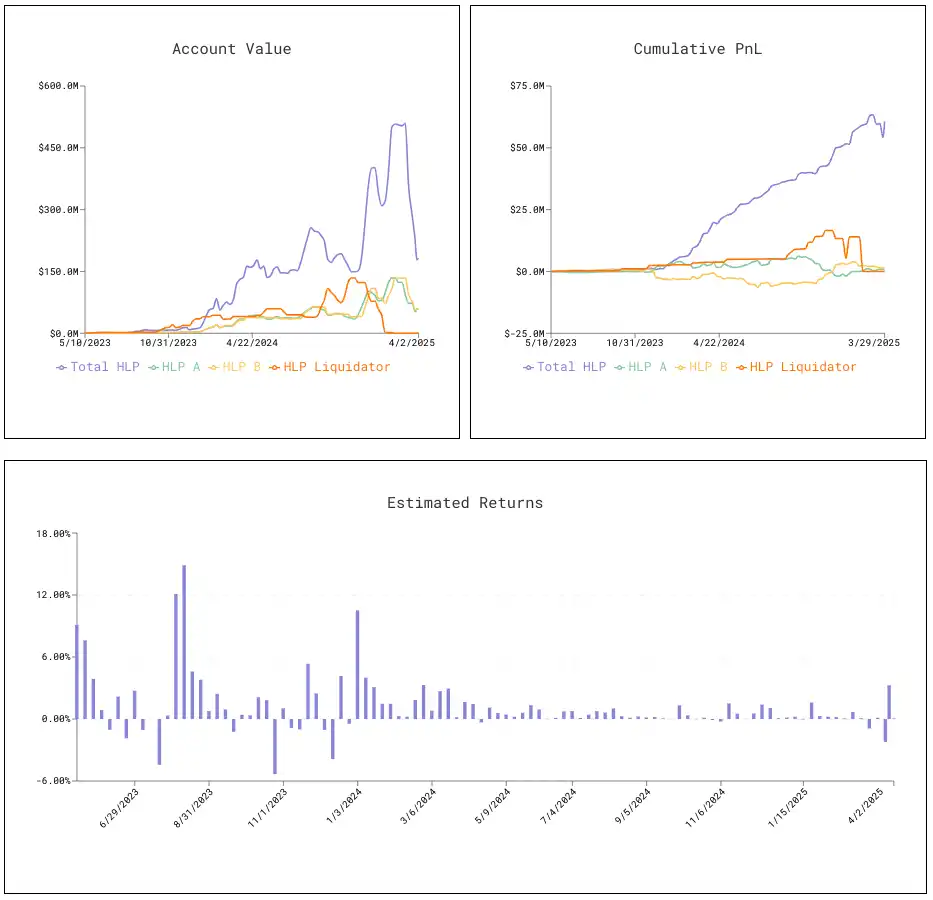
Table 10: HLP Net Position
In the cumulative net position table, we aggregate all HLP child treasury positions, displaying HLP's net exposure to specific positions/assets. It can be sorted by each treasury's maximum nominal position.
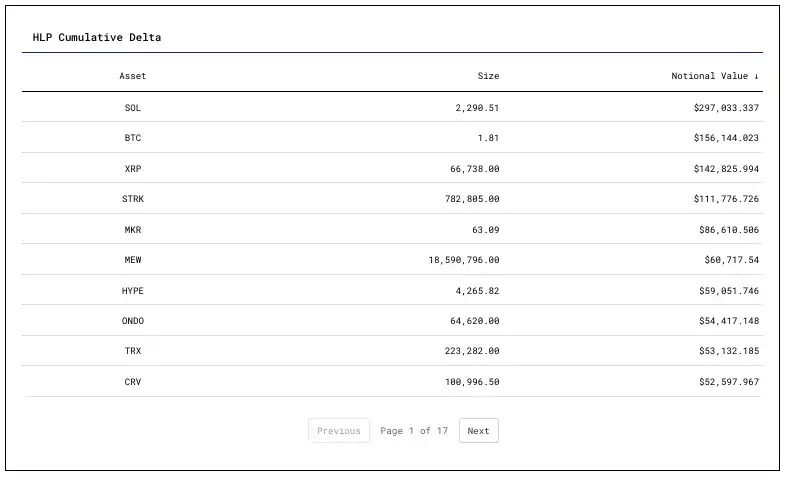
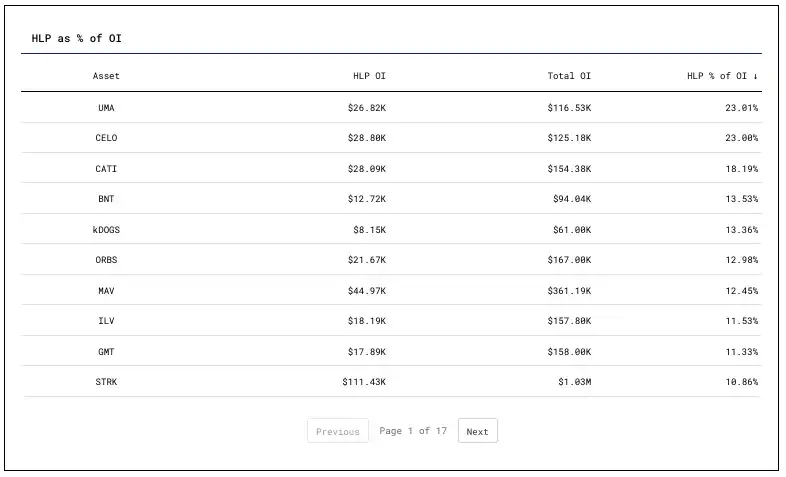
Table 11: HLP Share of Total Open Interest
· Based on HLP's cumulative net position, calculate the HLP position as a percentage of Hyperliquid's total open interest.
· Assets with low demand and external market maker quote likelihood may pose a lower risk. HLP having a high percentage in providing liquidity increases the risk of manipulation by malicious market participants. For example, HLP holds nearly 50% of the open interest on the JELLY market, while manipulators hold the other half.
· Tracking the HLP Ratio of each asset's total open interest can help us identify susceptible assets to manipulation.
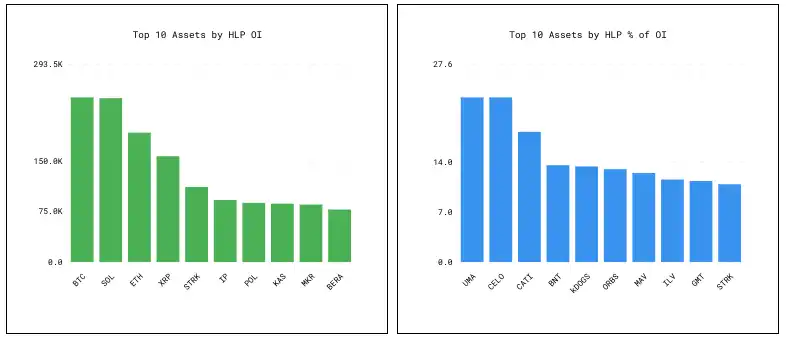
The public dashboard will enable us and Hyperliquid mainnet validators to leverage data-driven metrics to assess asset offboarding and real-time platform risk.
You may also like

February 9th Market Key Intelligence, How Much Did You Miss?

After being questioned by Vitalik, L2s are collectively saying goodbye to the "cheap" era

WEEX AI Trading Hackathon Paris Workshop Reveals: How Retail Crypto Traders Can Outperform Hedge Funds
Witness how WEEX's Paris AI Trading Hackathon revealed AI's edge over human traders. Explore key strategies, live competition results & how to build your own AI trading bot.

U.S. Oil (USOR) Price Prediction 2026–2030
Key Takeaways U.S. Oil (USOR) is a speculative Solana-based crypto project that aims to index the United States…

USOR Surges on Meme Narrative Despite No Real-World Asset Backing
Key Takeaways: USOR, a Solana-based token, has seen a notable surge driven by speculative narratives rather than verifiable…

How to Buy U.S. Oil Reserve (USOR) Cryptocurrency
Key Takeaways U.S. Oil Reserve (USOR) is a Solana-based token primarily traded on decentralized exchanges (DEXs). Claims have…

USOR vs Oil ETFs: Understanding Why the ‘Oil Reserve’ Token Doesn’t Track Crude Prices
Key Takeaways The U.S. Oil Reserve (USOR) token has become noteworthy for its claims, yet it does not…

Trend Research Reduces Ether Holdings After Major Market Turbulence
Key Takeaways: Trend Research has significantly cut down its Ether holdings, moving over 404,000 ETH to exchanges recently.…
Investors Channel $258M into Crypto Startups Despite $2 Trillion Market Sell-Off
Key Takeaways: Investors pumped approximately $258 million into crypto startups in early February, highlighting continued support for blockchain-related…
NBA Star Giannis Antetokounmpo Becomes Shareholder in Prediction Market Kalshi
Key Takeaways: Giannis Antetokounmpo, the NBA’s two-time MVP, invests in the prediction market platform Kalshi as a shareholder.…

Arizona Home Invasion Targets $66 Million in Cryptocurrency: Two Teens Charged
Key Takeaways Two teenagers from California face serious felony charges for allegedly attempting to steal $66 million in…

El Salvador’s Bukele Approval Reaches Record 91.9% Despite Limited Bitcoin Use
Key Takeaways: El Salvador President Nayib Bukele enjoys a record high approval rating of 91.9% from his populace,…

Crypto Price Prediction for February 6: XRP, Dogecoin, and Shiba Inu’s Market Movements
Key Takeaways: The crypto market experienced a notable shift with Bitcoin’s significant surge, impacting altcoins like XRP, Dogecoin,…

China Restricts Unapproved Yuan-Pegged Stablecoins to Maintain Currency Stability
Key Takeaways: China’s central bank and seven government agencies have banned the issuance of yuan-pegged stablecoins abroad without…

Solana Price Prediction: $80 SOL Looks Scary – But Smart Money Just Signaled This Might Be the Bottom
Key Takeaways Despite Solana’s descent to $80, some traders find security as smart money enters the fray, suggesting…

XRP Price Prediction: Major Ledger Upgrade Quietly Activated – Why This Could Be the Most Bullish Signal Yet
Key Takeaways: The activation of the Permissioned Domains amendment on XRPL represents a significant development in XRP’s potential…

Dogecoin Price Prediction: Death Cross Confirmed as DOGE Falls Below $0.10 – Is DOGE Reaching Zero?
Key Takeaways The death cross event signals potential bearish trends for Dogecoin as its price dips under $0.10,…

Stablecoin Inflows Have Doubled to $98B Amid Selling Pressure
Key Takeaways Stablecoin inflows to crypto exchanges have surged to $98 billion, doubling previous levels amidst heightened market…
February 9th Market Key Intelligence, How Much Did You Miss?
After being questioned by Vitalik, L2s are collectively saying goodbye to the "cheap" era
WEEX AI Trading Hackathon Paris Workshop Reveals: How Retail Crypto Traders Can Outperform Hedge Funds
Witness how WEEX's Paris AI Trading Hackathon revealed AI's edge over human traders. Explore key strategies, live competition results & how to build your own AI trading bot.
U.S. Oil (USOR) Price Prediction 2026–2030
Key Takeaways U.S. Oil (USOR) is a speculative Solana-based crypto project that aims to index the United States…
USOR Surges on Meme Narrative Despite No Real-World Asset Backing
Key Takeaways: USOR, a Solana-based token, has seen a notable surge driven by speculative narratives rather than verifiable…
How to Buy U.S. Oil Reserve (USOR) Cryptocurrency
Key Takeaways U.S. Oil Reserve (USOR) is a Solana-based token primarily traded on decentralized exchanges (DEXs). Claims have…


 App
App