
 Buy Crypto
- Markets
 Futures
- Spot
- Copy Trade
- Earn
- More
Rising over 40% against the trend, how to understand the logic behind USUAL’s rise?

Original author: @hmalviya9, founder of dyorcryptoapp
Original translation: Ismay, BlockBeats
Editor's note: More and more competitors have emerged in the stablecoin track. From the beginning of December to now, from listing on Binance to the official announcement of cooperation with BlackRock, Usual has performed well in the market with its innovative economic model and high return potential. Today, USUAL broke through $1.2, setting a new record high. This article deeply analyzes the token economics, profit mechanism and potential risks of $USUAL, aiming to provide readers with a comprehensive understanding to help everyone make informed decisions in the rapidly developing crypto market. Whether considering investment or observing market trends, understanding its core mechanism is key.
The following is the original content:
$USUAL is one of the most important launches of this cycle, and the initial performance is very promising, so should you buy it or ignore it?
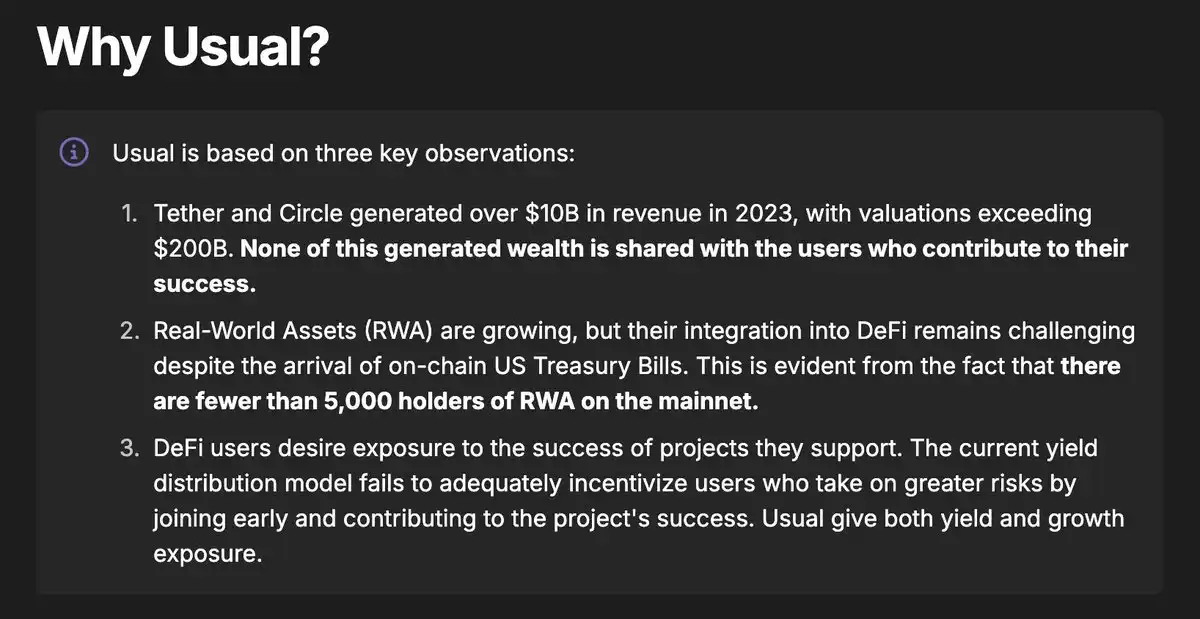
I started paying attention to USUAL a few months ago when I was researching new stablecoins. What makes USUAL unique is its clear story: Tether on chain, distributing income to token holders. Tether has made more than $7.7 billion in profits so far this year, which is almost more than BlackRock.
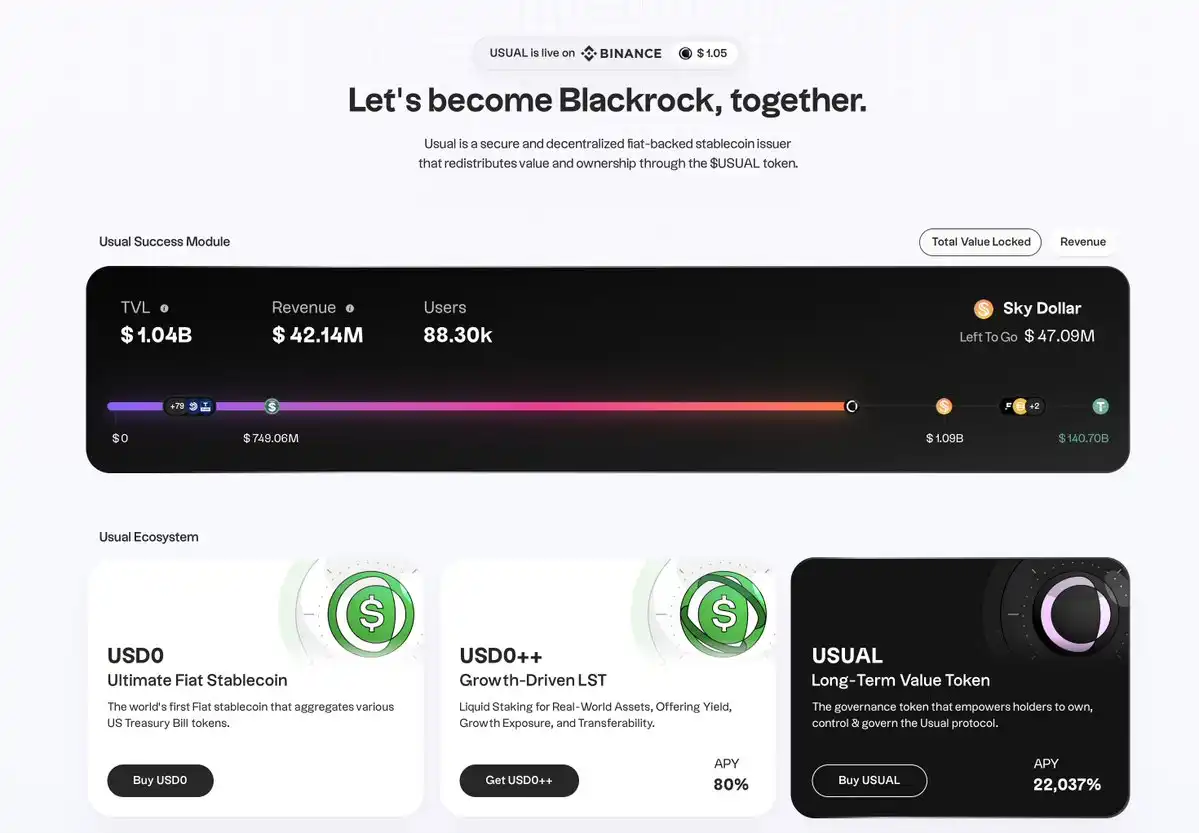
If USUAL can achieve this goal, even just 10% of it will mean $770 million in profits. And the best part is that 90% of the revenue will be distributed to token holders and stakers in the form of $USUAL.
Returns are paid in $USUAL, so every time someone stakes USDO (their stablecoin), $USUAL tokens are constantly issued.
USDO is a stablecoin backed by US Treasuries that generates returns through Treasuries, and these returns are distributed in the form of $USUAL and USDO.
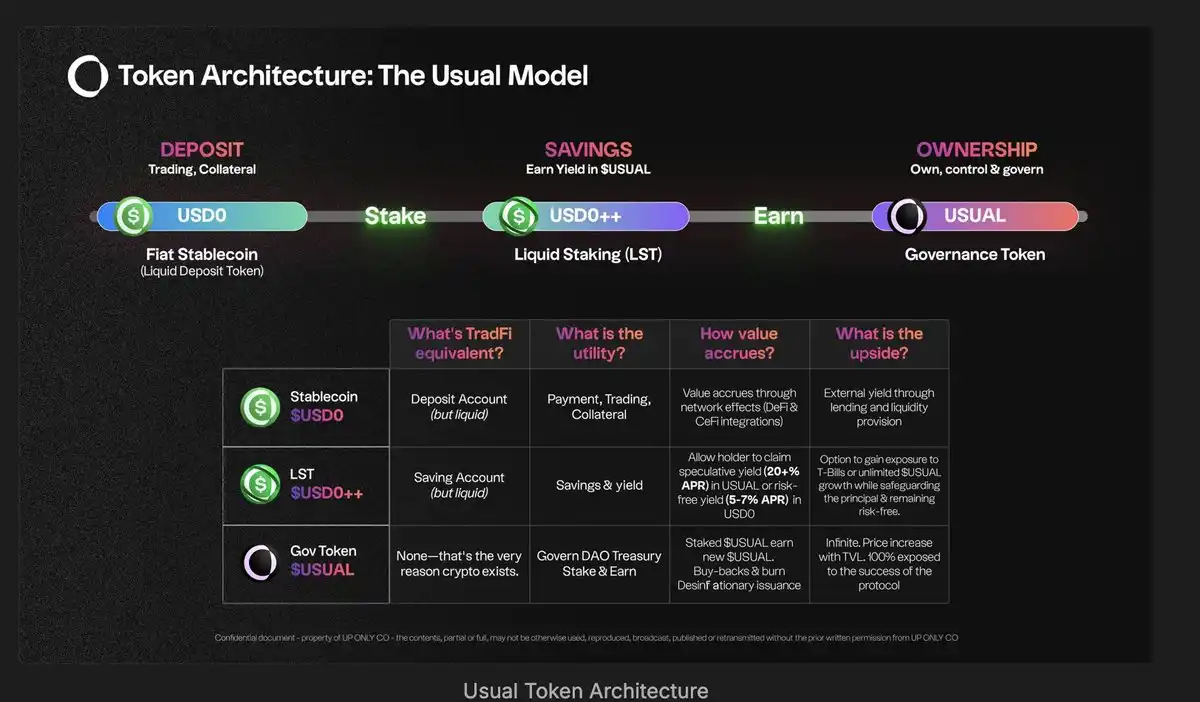
USUAL Money mentioned that when $USUAL's cash flow reaches a certain target, they plan to control the issuance of $USUAL and ensure that the continuous issuance rate is lower than the revenue growth rate. Initially, the issuance will be high, but over time, the issuance will gradually decrease.
USUAL offers two other tokens in addition to the governance and staking token $USUAL.
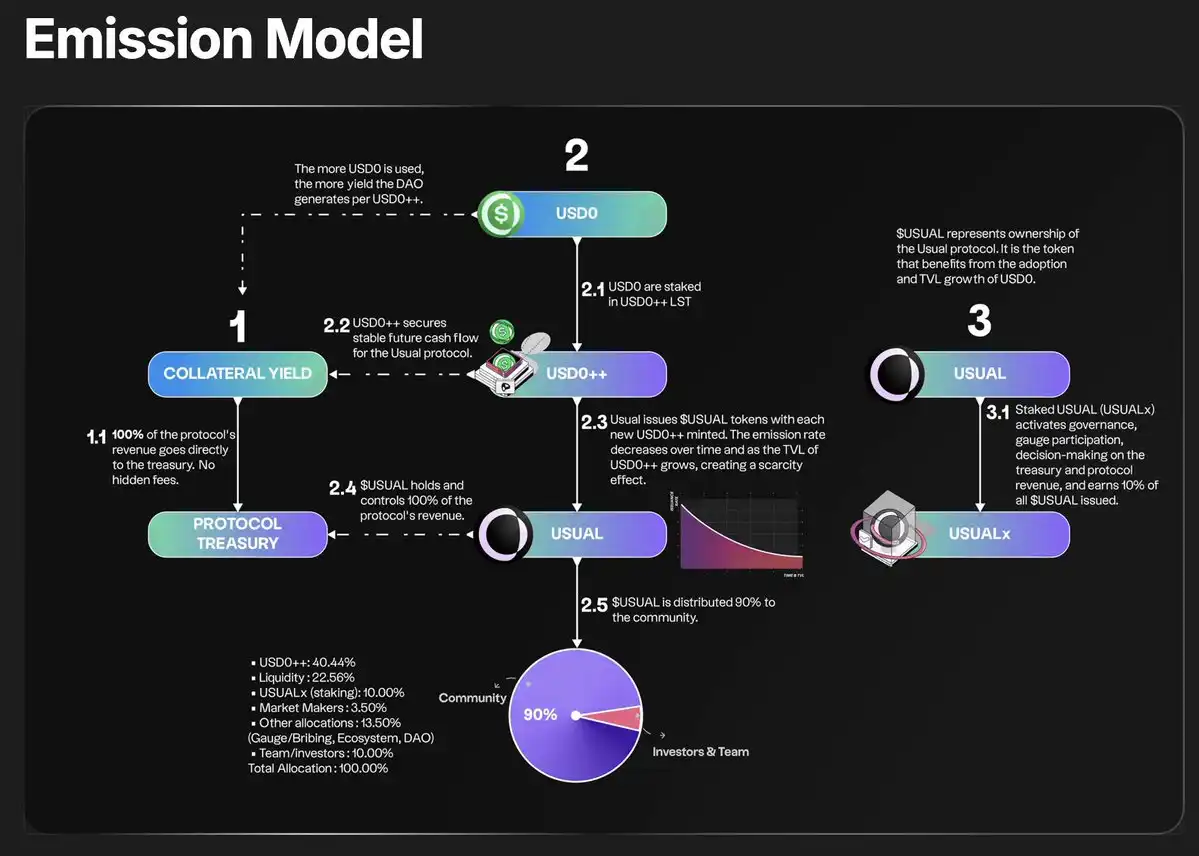
USDO++: This is the liquidity token you get after staking USDO. USDO holders need to stake USDO for 4 years to mint USDO++. USDO++ holders will receive 45% of the $USUAL issuance.
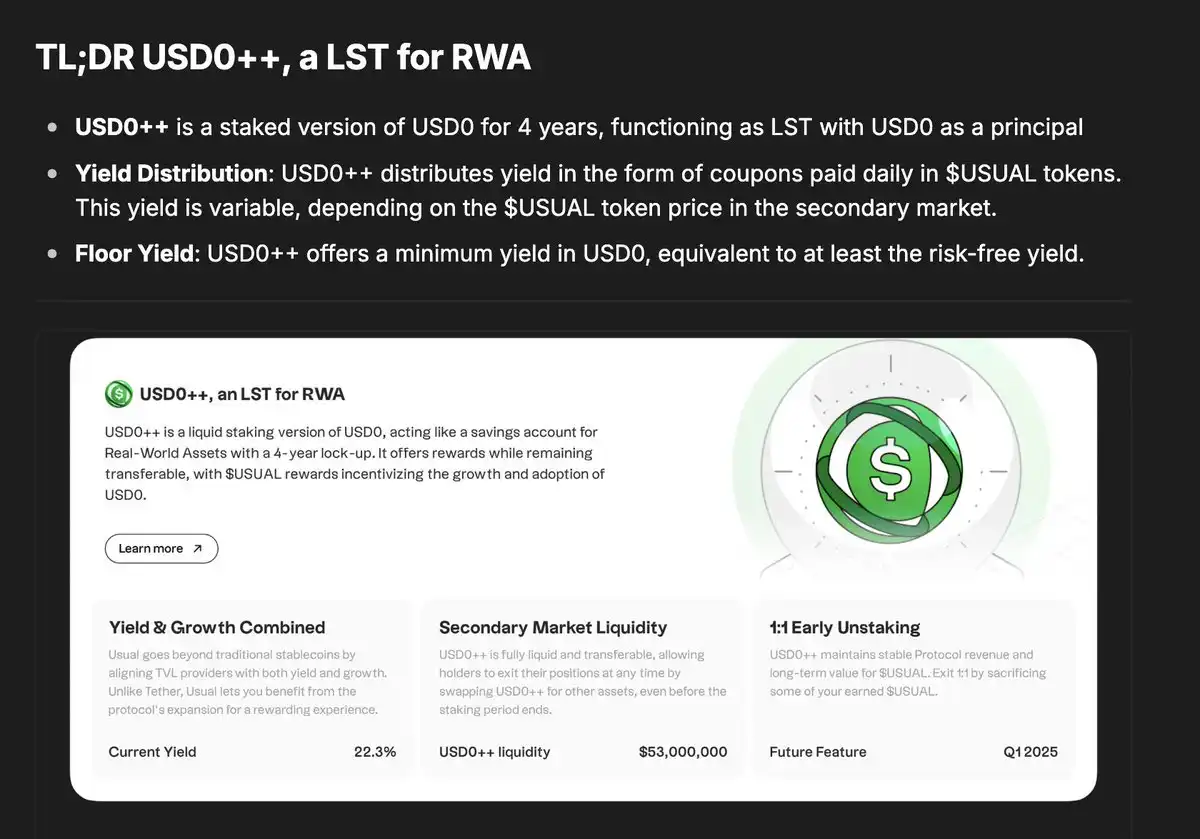
USUAL issues new $USUAL tokens whenever new USDO++ is minted. This is a core part of their flywheel mechanism. The TVL (Total Value Locked) of the protocol also tracks the value of USDO++ minted in the protocol.
The higher the TVL, the more revenue the protocol generates, which will eventually be paid to USDO++ holders in the form of $USUAL tokens.
The issuance rate of $USUAL will decrease as more users adopt it, reducing the number of tokens issued per dollar locked.
This reduction will increase the yield per token, which will naturally drive the price of $USUAL up.
The higher annualized yield (APY) on USDO++ will attract more people to stake USDO. The current APY is around 80%, so we may see TVL rise in the coming days. The current TVL is around $900 million, and 87.47% of USDO has been staked as USDO++.
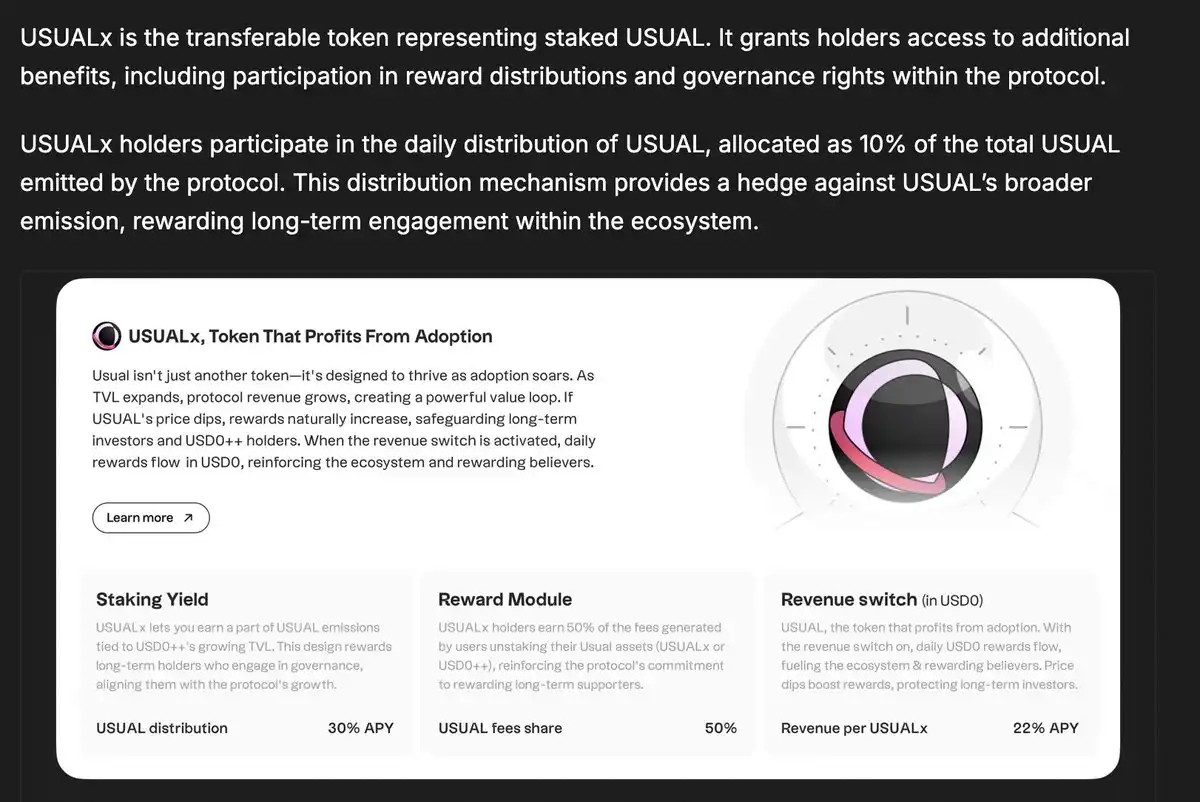
USUAL also has a staking token called USUALx, which provides three forms of yield: USDO rewards from revenue, 10% of $USUAL issuance, and 50% fee share from unlocking modules.
When USDO++ holders decide to unlock before expiration, the protocol will also initiate the destruction mechanism of $USUAL.
They need to destroy a portion of the $USUAL supply to unlock.
As mentioned in the USUAL Money whitepaper, we do face two serious product risks:
The market price of $USUAL (the main reward token) directly affects the benefits in the ecosystem, including rewards and liquidity incentives related to USDO++. If the price drops significantly, it may damage the competitiveness and user attractiveness of the ecosystem. Due to its inflationary nature, there is also a risk of hyperinflation.
To this end, the DAO can mitigate this risk by adjusting the minting rate to regulate the issuance, ensuring economic stability and sustainability.
USDO++: These locked tokens lack a costless arbitrage mechanism to maintain their anchor, which can lead to price volatility. However, this risk has been minimized through strong liquidity in the secondary market, as well as liquidity provision incentives and early redemption mechanisms. In addition, the price floor redemption mechanism limits extreme volatility, ensuring stability and market efficiency.
Overall, as long as the price of $USUAL is attractive, the protocol can attract more demand for USDO and USDO++. The greater the demand for its stablecoins, the more revenue it will ultimately generate, which will be distributed to USDO++ holders, USUALx holders, and other participants.
Currently, USUALx has an annual interest rate of about 28,000%, which may attract initial demand and create early market heat.
However, in the long run, the key lies in how the USDO anchoring mechanism is stabilized and how long $USUAL can continue to attract demand.
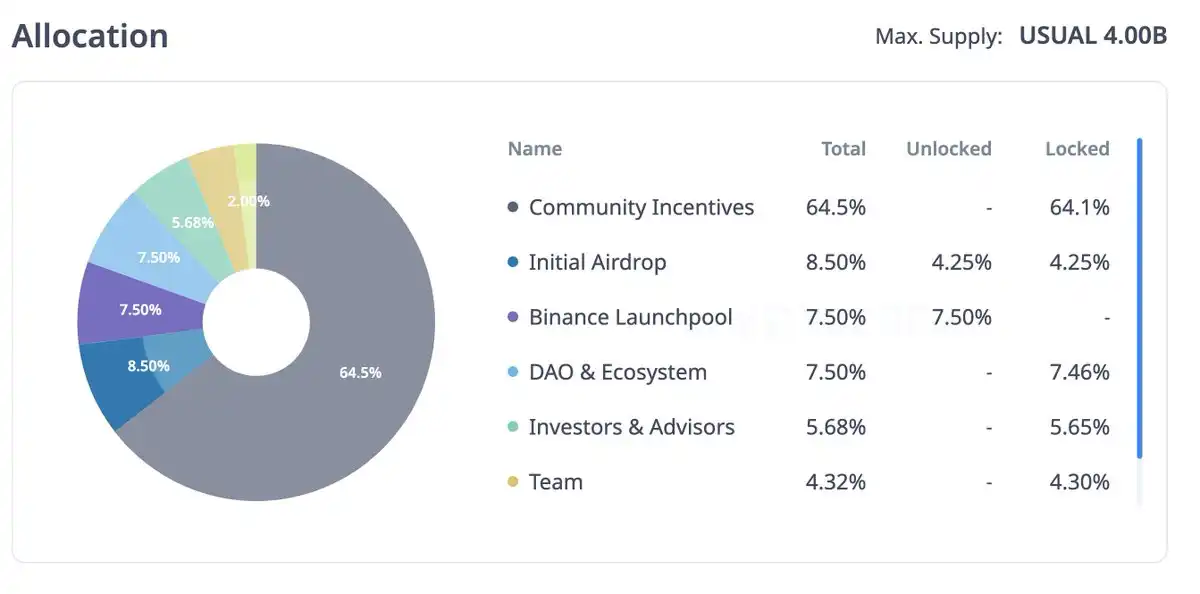
In terms of token economics: approximately 90% of the tokens are allocated to the community, of which approximately 64% are used for inflation rewards, which will adjust the issuance plan based on dynamic demand. Currently, approximately 12.4% of the tokens have entered circulation.
You may also like

Ray Dalio's new article: The world is entering a war cycle

IOSG: When Fintech Meets Crypto Native: The Next Decade of Digital Finance

They knew in advance that Trump would tweet about a ceasefire, entered with $20k, and exited with $400k.

The biggest bottleneck in DeFi development

CZ Memoir Released: Reveals a Large Amount of Industry Insider Information, Prompting Intense Rebuttal from Xu Mingxing

a16z: After securities are on the blockchain, why will intermediary institutions be replaced by code?

XRP Tokyo Is Here: What We Learn and What’s Next for XRP Price
Key Takeaways: Ripple’s 2025 XRP Tokyo event highlights a projected $33 trillion on-chain stablecoin volume by 2026. Significant…

Solana’s Future: Navigating the $285M Hack, Rug Pulls, and Milei Libra Scandal
Key Takeaways: Multiple Crises: Solana faces a $285 million hack, allegations of rug pulls, and the Milei Libra…

BTC USD Faces Tension: Markets React to Trump’s Dire Warning
Key Takeaways: Bitcoin’s price drops sharply below $70,000 amid geopolitical tensions, playing off Trump’s dramatic 8 PM ultimatum…
Bitcoin Price Surge: Ceasefire Sparks Optimism Hits $71K
Key Takeaways: After the US-Iran ceasefire announcement, Bitcoin surged beyond $71,000, marking its highest in a month. A…

Ethereum Price Forecast: Record $180 Billion Stablecoin Supply Marks Buyers’ Return
Key Takeaways: Ethereum’s stablecoin supply has surged to a record $180 billion, marking a 150% increase over the…

Emerging Evidence Links Argentina’s Milei to LIBRA Crypto Scandal
Key Takeaways: Evidence unveiled by Argentina’s federal prosecutors links President Javier Milei to the LIBRA token through call…

US Spot Bitcoin ETFs See Surge as BTC Nears $70K; LiquidChain and Layer-3 DeFi Rise
Key Takeaways: U.S. spot Bitcoin ETFs absorbed $471 million in a single day, moving BTC closer to the…

Bitcoin Price Prediction: Decoupling from Tech Stocks, Shaped by Geopolitics and AI Turmoil
Key Takeaways: Bitcoin is decoupling from tech stocks as geopolitical tensions and AI crises reshape the market, currently…

Chaos Labs Departure Leaves Aave Without Risk Management Amidst Governance Conflict
Key Takeaways: Aave, with a $50 billion TVL, is currently operating without a risk manager due to Chaos…
Grayscale Ethereum ETF Staking: A New Catalyst for $5,700?
Key Takeaways: Grayscale’s Ethereum Staking ETF introduces a yield-bearing structure that could significantly reshape investor sentiment. Ethereum’s price…

Polygon Crypto Enhances Finality Through the Giugliano Hardfork
Key Takeaways: Polygon’s Giugliano hardfork is operational on the mainnet, effectively reducing transaction finality by 2 seconds. The…

Senate’s Three-Week Deadline: Ripple XRP and the CLARITY Act’s Critical Moment
Key Takeaways: The Senate Banking Committee’s decision on the CLARITY Act in late April could define XRP’s future…


 App
App