
- Buy Crypto
- Markets
 Futures
- Spot
- Copy Trade
- Earn
- More
The first stablecoin issuer Circle is quickly plummeting back to its opening price. What is the market worried about?

Original Author: Rubin, Top Influencer in the Knowledge Power List for Economics and Management
Editor's Note: This article is excerpted from a roundtable event on "Penetrating Stablecoins" jointly hosted by Zhihu and BlockBeats. The roundtable has accumulated over 26 million views since its launch, attracting widespread attention from both within and outside the industry. The event aims to present the latest developments, key mechanisms, and future trends of stablecoins to the public in a more intuitive and systematic manner.
Roundtable Link: https://www.zhihu.com/roundtable/stablecoin
The following is the original content:
Circle this quarter seems like a pig flying high on the high-interest rate trend, but the market is worried the wind direction may change:
Narrowing spreads, rising costs, single-profit business, regulatory uncertainty;
With these headwinds, companies flying high may also be prone to quick falls.
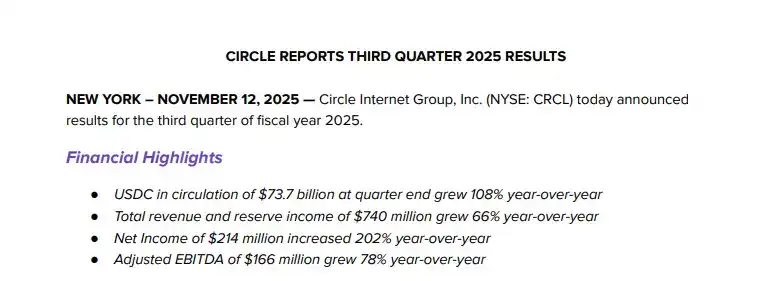
Imagine the stock market as a "marathon-style gamble," where yesterday player Circle rushed through a mid-race aid station (Q3) and achieved a good profit result. However, after investors reviewed the report, they believed that the upcoming slope, player pace, and aid may not be sustainable, leading to selling and causing a price drop.
1) Investors Focus More on the "Future"
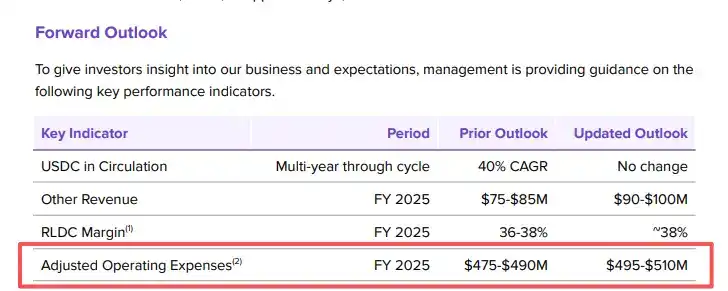
Although Circle significantly exceeded expectations in Q3, it also raised its full-year operating expense forecast ($495–510M). This implies that the company's future profit growth rate may be "eaten up," making it unable to achieve high profits again.
2) Reserve Yield Declining
Companies like Circle, which operate stablecoins, make a significant portion of their earnings through:
Issuing stablecoins, users buying stablecoins, and the company receiving dollars to purchase conservative asset investments such as government bonds/short-term notes
Take the spread without paying interest through this method.
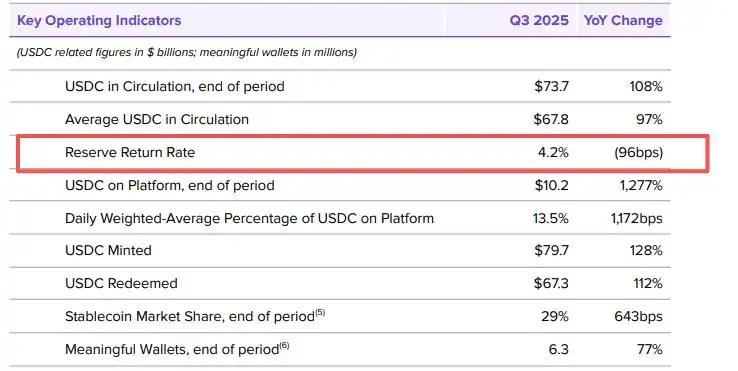
A report shows that although the total amount of reserve income is large, the reserve's simple interest return has decreased by approximately 96 bps.
If market interest rates decline or short-term yields compress, this profit-making method will significantly shrink in the future, directly impacting earnings.
3) Income Highly Relies on "Reserve Income"
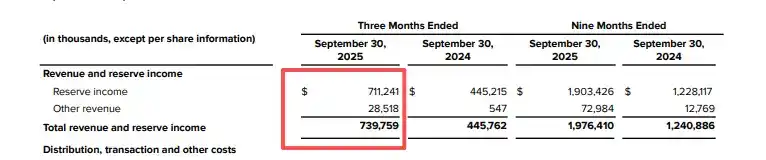
Out of Q3's $740M, the vast majority comes from reserve income ($711M), while "other income" (subscriptions, services, transactions, etc.) is only $29M.
This means that Circle's current business is more like a large treasury that doesn't need to pay interest to users, rather than a traditional SaaS or payment company;
When the market is concerned about narrowing spreads or regulatory impact, this single-income model will be discounted.
4) Regulatory and Policy Risks
Stablecoins are closely related to reserve assets, and any regulation (such as strict rules from the U.S. Congress/regulators on stablecoins) or on reserve assets (such as restrictions on holding government bonds/short-term notes) will affect revenue expectations.
During regulatory uncertainty, investors often demand a higher risk premium, leading to sell-offs and stock price declines.
In fact, Circle is currently in a delicate stage:
Its profit model is sound, its compliance foundation is solid, but the growth story is losing momentum.
Perhaps in the eyes of many traditional investors, it is more like a "dollar fund company," making safe but unimaginative money.
You may also like

Stop Talking About Gold, Bitcoin Is Not a Safe Haven Asset

Aave Founder: What Is the Secret of the DeFi Lending Market?

The Trader's Playbook: 7 Market Cycle Lessons From LALIGA’s 90 Minutes
What do LALIGA matches teach about crypto markets? Learn how consolidation, breakouts, and late-cycle volatility shape disciplined trading decisions.

How Smart Money Tracker Survived Live AI Trading at WEEX AI Hackathon
Discover how WEEX AI Trading Hackathon tested strategies with real capital—no simulations. See how Smart Money Tracker survived flash crashes and leveraged 18x in live markets.

80% Win Rate to 40% Drawdown: An AI Trader's Brutal Recalibration at WEEX AI Wars
Dive into the technical blueprint of an AI trading system built on LLaMA reasoning and multi-agent execution. See how Quantum Quaser uses confidence thresholds & volatility filters at WEEX AI Wars, and learn the key to unlocking 95% win rate trades.

AI Trading Strategy Explained: How a Beginner Tiana Reached the WEEX AI Trading Hackathon Finals
Can AI trading really outperform human emotion? In this exclusive WEEX Hackathon finalist interview, discover how behavioral signal strategies, SOL trend setups, and disciplined AI execution secured a spot in the finals.
When AI Takes Over the 'Shopping Journey,' How Much Time Does PayPal Have Left?

Bloomberg: Aid Turkey Freeze $1 Billion Assets, Tether Remakes Compliance Boundary

Polymarket vs. Kalshi: The Full Meme War Timeline

Consensus Check: What Consensus Was Born at the 2026 First Conference?

Resigned in Less Than a Year of Taking Office, Why Did Yet Another Key Figure at the Ethereum Foundation Depart?

Russian-Ukrainian War Prediction Market Analysis Report

Ethereum Foundation Executive Director Resigns, Coinbase Rating Downgrade: What's the Overseas Crypto Community Talking About Today?

Who's at the CFTC Table? A Rebalancing of American Fintech Discourse

AI Trading vs Human Crypto Traders: $10,000 Live Trading Battle Results in Munich, Germany (WEEX Hackathon 2026)
Discover how AI trading outperformed human traders in WEEX's live Munich showdown. Learn 3 key strategies from the battle and why AI is changing crypto trading.

Elon Musk's X Money vs. Crypto's Synthetic Dollars: Who Wins the Future of Money?
How do Synthetic Dollars work? This guide explains their strategies, benefits over traditional stablecoins like USDT, and risks every crypto trader must know.

The Israeli military is hunting a mole on Polymarket

Q4 $667M Net Loss: Coinbase Earnings Report Foreshadows Challenging 2026 for Crypto Industry?
Stop Talking About Gold, Bitcoin Is Not a Safe Haven Asset
Aave Founder: What Is the Secret of the DeFi Lending Market?
The Trader's Playbook: 7 Market Cycle Lessons From LALIGA’s 90 Minutes
What do LALIGA matches teach about crypto markets? Learn how consolidation, breakouts, and late-cycle volatility shape disciplined trading decisions.
How Smart Money Tracker Survived Live AI Trading at WEEX AI Hackathon
Discover how WEEX AI Trading Hackathon tested strategies with real capital—no simulations. See how Smart Money Tracker survived flash crashes and leveraged 18x in live markets.
80% Win Rate to 40% Drawdown: An AI Trader's Brutal Recalibration at WEEX AI Wars
Dive into the technical blueprint of an AI trading system built on LLaMA reasoning and multi-agent execution. See how Quantum Quaser uses confidence thresholds & volatility filters at WEEX AI Wars, and learn the key to unlocking 95% win rate trades.
AI Trading Strategy Explained: How a Beginner Tiana Reached the WEEX AI Trading Hackathon Finals
Can AI trading really outperform human emotion? In this exclusive WEEX Hackathon finalist interview, discover how behavioral signal strategies, SOL trend setups, and disciplined AI execution secured a spot in the finals.


 App
App