
- Buy Crypto
- Markets
 Futures
- Spot
- Copy Trade
- Earn
- More
The Largest Oil Reserve Release in History: Why Is the Oil Price Still Above 100?

400 Million Barrels. This is the largest-ever release of strategic petroleum reserves carried out at once by the 32 member countries of the International Energy Agency (IEA) in its 50-year history. When IEA announced this decision on March 11, Brent crude closed at $90.42 on that day. Today, 12 days later, the oil price is above $107.
Things started on February 28. After the U.S. and Israel launched a joint strike against Iran, Iran threatened to attack oil tankers passing through the Strait of Hormuz, the world's most critical oil shipping chokepoint, causing almost a standstill. According to IEA data, the current actual transit through the strait is less than 10% of pre-war levels. Brent crude has surged from around $65 pre-war, hitting $119.5 intraday on March 9, representing a nearly 80% increase in two weeks.
In this context, IEA deployed its most potent weapon. The question is, why didn't this weapon work?
The Mathematical Mirage of 400 Million Barrels
400 million barrels may sound like a massive number, but when placed in the context of the Strait of Hormuz's gap, the scale is entirely different.
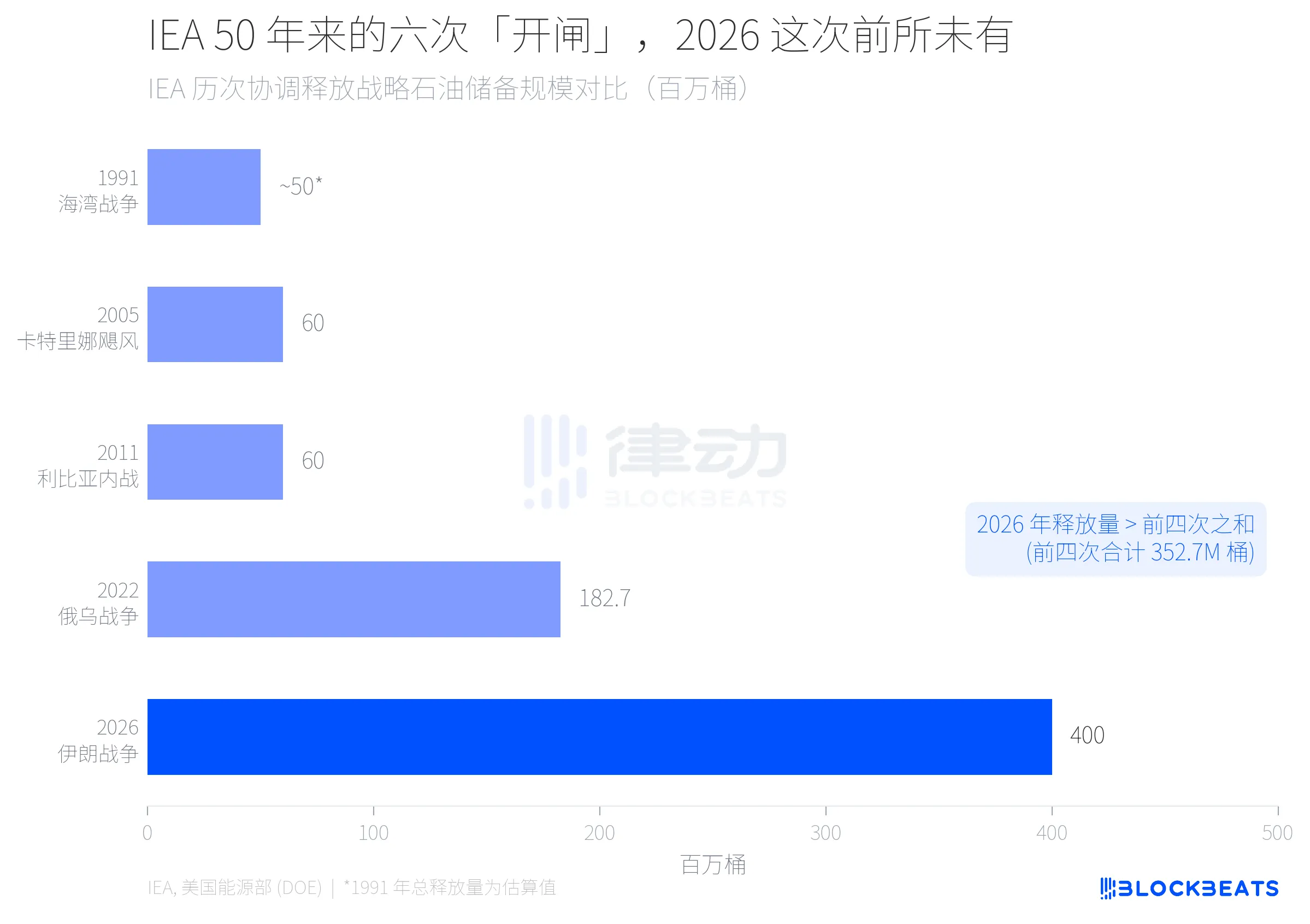
IEA has utilized its strategic reserves five times in its 50-year history, with this being the sixth instance. The total release amounts from the previous four occasions sum up to about 352.7 million barrels (approximately 50 million barrels during the 1991 Gulf War, 60 million barrels for Hurricane Katrina in 2005, 60 million barrels during the 2011 Libyan Civil War, and 182.7 million barrels for the 2022 Russia-Ukraine War). This time, the 400 million barrels released surpass the total of the previous four instances.
However, quantity does not equate to sufficiency.
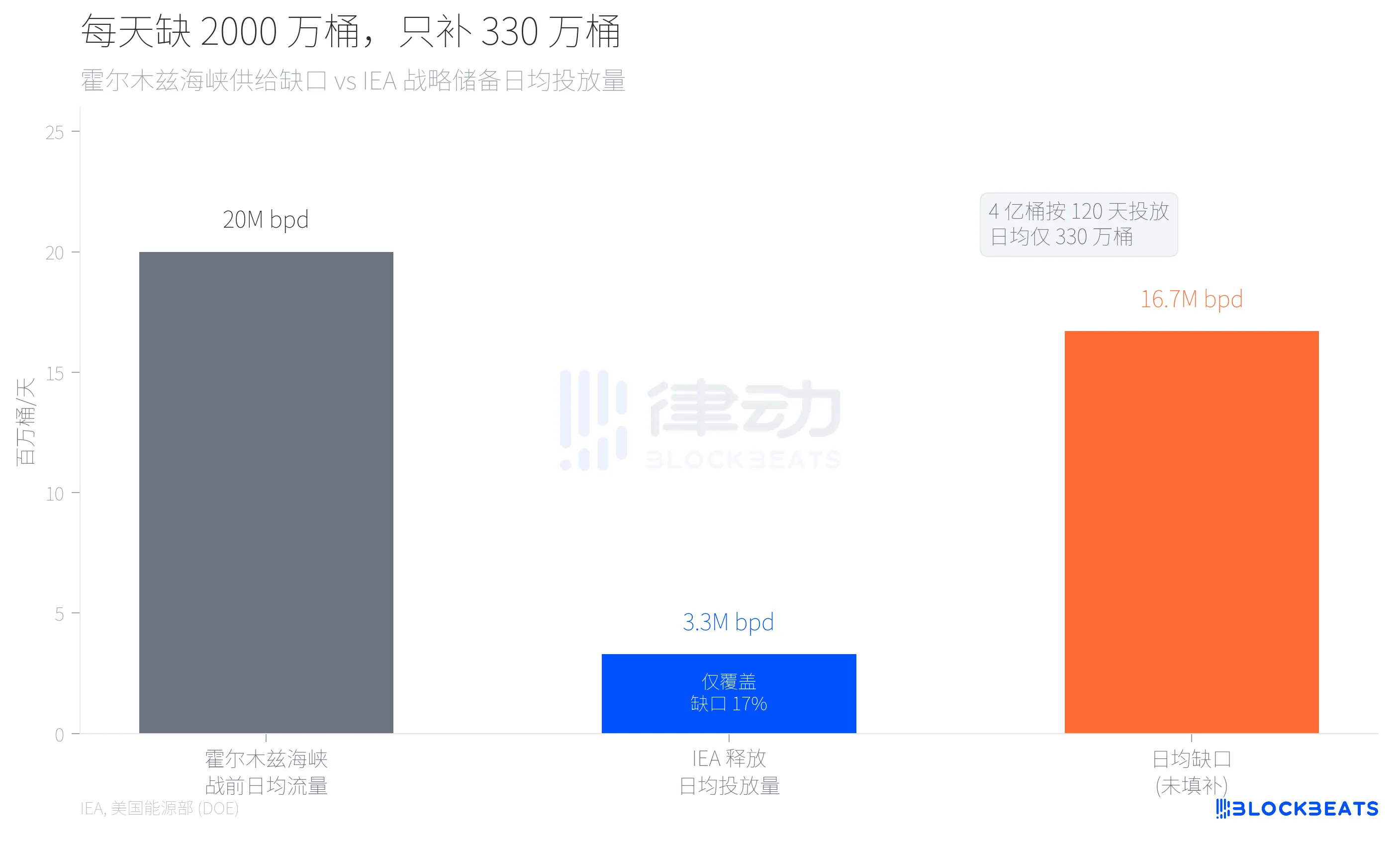
Before the conflict, the daily average flow through the Strait of Hormuz was about 20 million barrels of crude and oil products, accounting for 25% of global seaborne oil trade. As per a U.S. Department of Energy announcement, the U.S.'s 172 million barrels will be released within 120 days. Calculated at this rate, the daily release of the entire 400 million barrels by IEA would be approximately 3.3 million barrels, covering only 17% of the gap. According to a JPMorgan estimate cited by Al Jazeera, the maximum production capacity of IEA member countries is only 1.2 million barrels per day, far from enough to bridge the deficit.
Using a more intuitive calculation: According to the IEA's March report, global daily oil consumption is around 103 million barrels. If all 400 million barrels are poured into the market at once, it would only sustain for less than 4 days.
When Have Past Oil Release Interventions Actually Worked?
The results of the IEA's 50-year, five-time reserve releases are clearly divided into two categories.
In 1991 during the Gulf War, the IEA's announcement of the release led to an immediate oil price drop of around 20%, with a subsequent one-week drop of one-third. After Hurricane Katrina in 2005, the market also quickly stabilized. These two instances shared a common factor: the source of the supply disruption was being repaired. The start of airstrikes in the Gulf War signaled a potential recovery of the Kuwaiti oil fields, while Hurricane Katrina had passed, and refineries were gradually restarting.
A counterexample is seen in 2022. Following the Russia-Ukraine conflict, the IEA released 182.7 million barrels, but rather than falling, Brent crude oil prices surged upon the announcement, initially spiking to $113 before slowly receding over the next few months. The reason was simple: there was no immediate prospect of Russia's supply disruption being resolved.
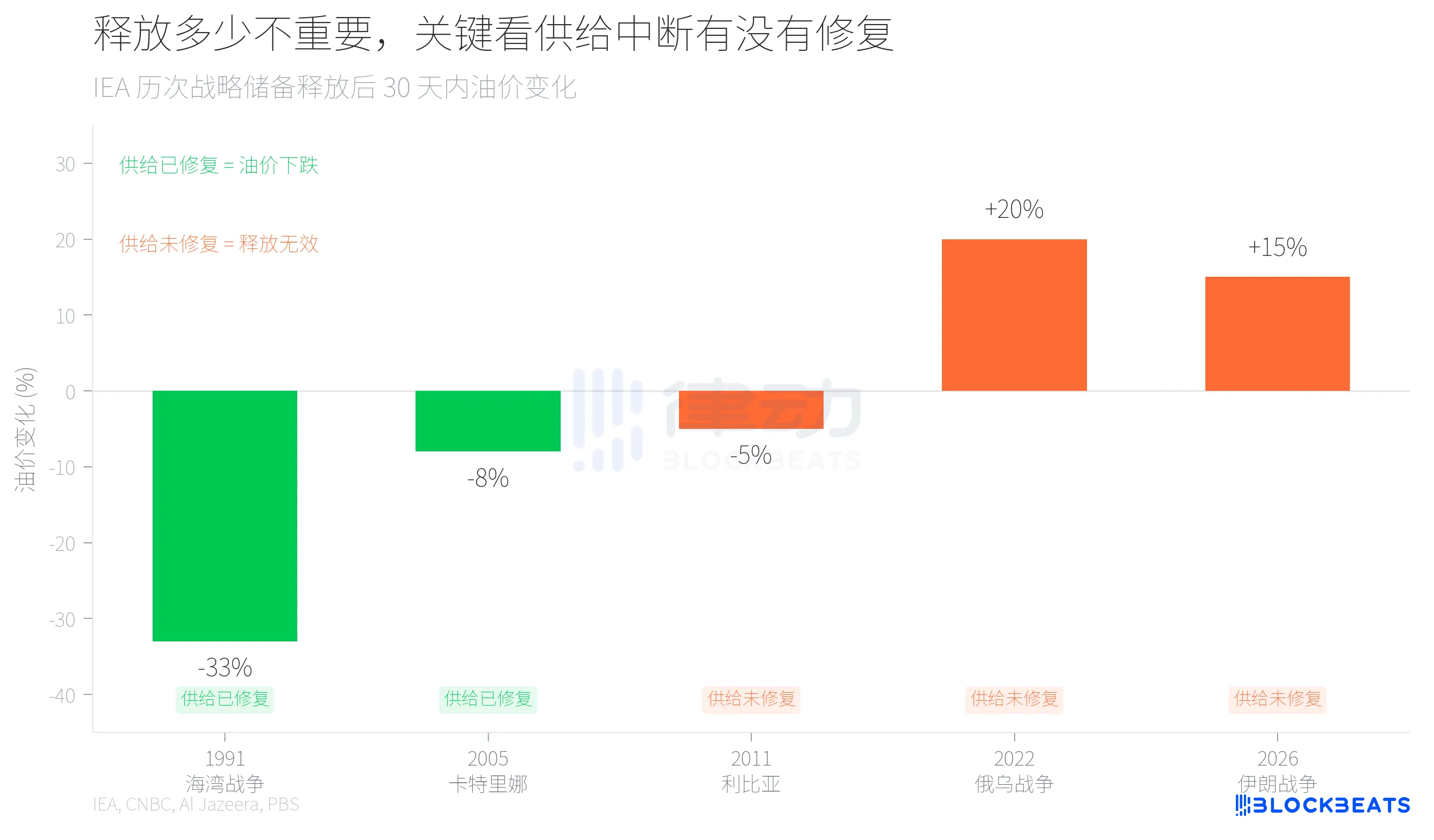
The situation in 2026 is more akin to 2022 than 1991. The Strait of Hormuz remains semi-blocked, with no ceasefire in sight in Iran. According to an analysis by Stanford University researcher Maksim Sonin cited by Al Jazeera, "This is not a panacea; market trading is based on expectations, and current expectations lean towards concerns." University of Massachusetts Amherst economist Gregor Semieniuk more directly points out, "The release can only buy temporary respite, and once the release is over, the firepower is gone."
What determines the oil price response is not how many barrels are released, but whether the source of the supply disruption has been eliminated. Reserve releases are essentially not about "refueling" but about "buying time," using limited ammunition to secure negotiation space and allocate flexibility for alternative routes. If time is bought but the disruption source remains unresolved, the price will rise.
How Much Ammunition Is Left in the Arsenal?
This raises a more long-term question: after repeated episodes of "buying time," is the ammunition depot itself still sufficient?
The U.S. Strategic Petroleum Reserve (SPR) is the world's largest government emergency oil stockpile. According to data from the U.S. Energy Information Administration (EIA), the SPR peaked at 727 million barrels by the end of 2010. In 2022, the Biden administration, in response to the Russia-Ukraine conflict and surging oil prices, released about 180 million barrels, bringing the SPR down to 347 million barrels by June 2023, its lowest level since 1983. After over two years of replenishment, it only recovered to around 415 million barrels by March 2026.
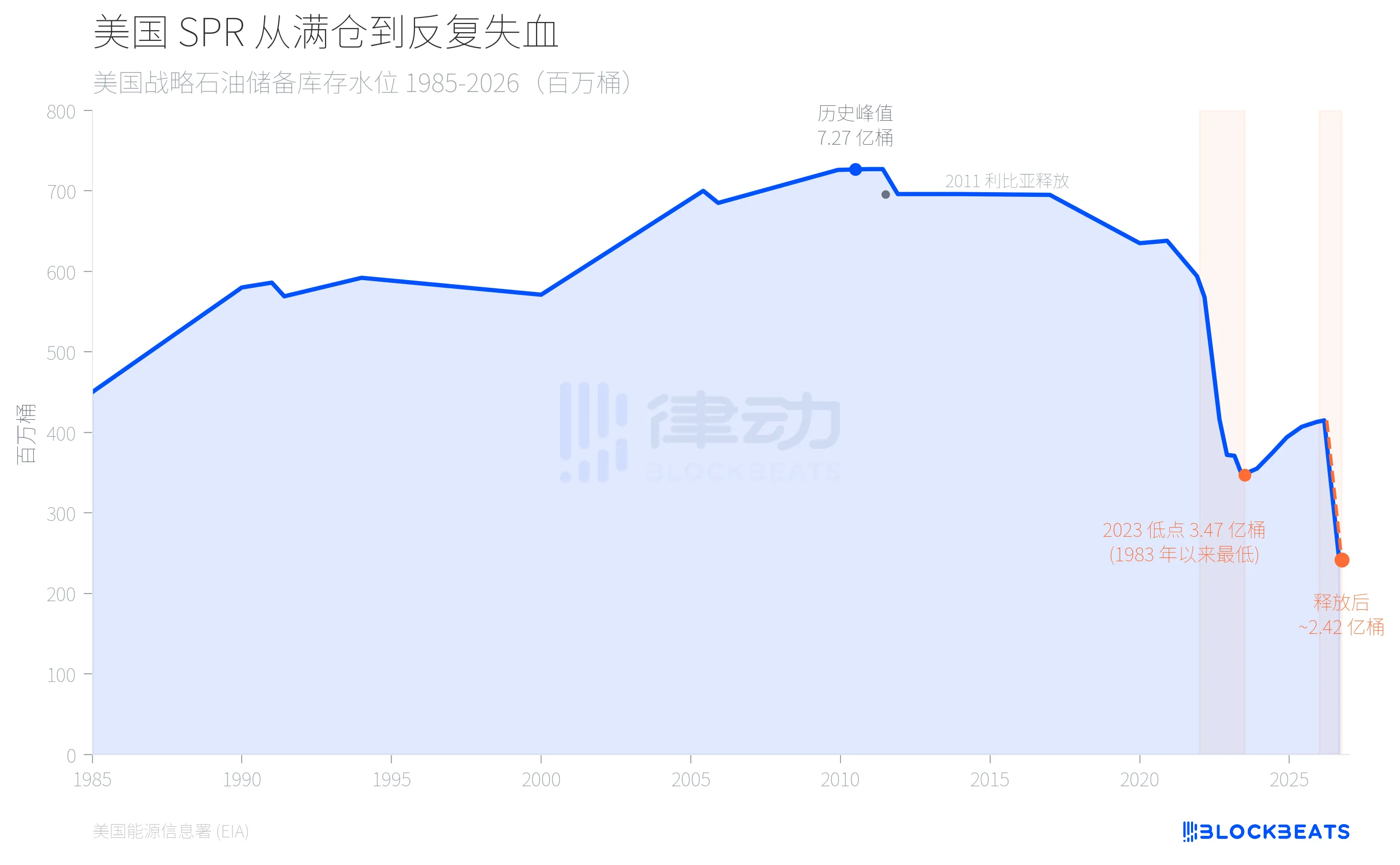
Now, out of this 415 million barrels, another 172 million barrels are about to be released. After the planned release, the SPR will drop to around 242 million barrels, back to the level at the beginning of the mid-1980s when the reserve was established. The U.S. Department of Energy has committed to replenishing about 200 million barrels within a year after the release, but it took over two years in the last round of replenishment to climb from 347 million barrels to 415 million barrels, indicating that the replenishment speed significantly lags behind the depletion speed.
It's not just the U.S. The 32 IEA member countries collectively held about 1.2 billion barrels of public emergency reserves before this release, and this 400 million barrels directly cut off one-third of that.
If the next supply crisis arrives before the SPR is replenished, will the global "last resort arsenal" be sufficient? This question currently has no answer. And it's precisely because the market has seen this issue that it is unwilling to let oil prices drop.
You may also like
Asia's Next Great Dog Coin Debuts at the Weex AI Trading Hackathon
A BNB Chain meme token inspired by the Shih Tzu dog, blending community culture, creativity, and long‑term loyalty in Web3.
Fluxor: Connecting Global Builders With the WEEX AI Trading Hackathon
A hackathon platform connecting builders and creators to collaborative opportunities and innovation in Web3, enabling AI-oriented developers to experiment and create at scale.
The growth of AI-driven tools and community collaboration in Web3 has created new opportunities for developers worldwide. As a community partner and sponsor of the WEEX AI Trading Hackathon, Fluxor's mission to unify hackathon experiences and foster creative partnerships aligns with this spirit of collective innovation.

Houthi Deadline Countdown Begins | Rewire News Morning Brief

Middle East Conflict Escalation and Rate Hike Expectation Trigger Worst Gold Sell-Off in 43 Years

AI Agent Can't Kill SaaS

This viral Beijing high school teacher, Jiang Xueqin, predicted America's downfall in advance

Interview with Bill, Head of Bitget AI: In the AI Trading Era, How Far Are We from "Earning While Lying Down"?
Meme Culture, Community Energy, and the WEEX AI Trading Hackathon
A community-driven meme token built around one of the internet's most recognizable characters.
RGAI: Exploring AI Agent Trading and Advancing the WEEX AI Trading Hackathon
A Solana-based AI agent project connecting automated trading strategies with on-chain token dynamics in AI-driven Web3 markets.
ForeGate: Bringing Decentralized Forecasting to the WEEX AI Trading Hackathon
A decentralized prediction market platform enabling users and builders to gauge probabilities and make informed decisions around future events in AI-enhanced Web3 environments.
Apello: Automating Web3 Community Management and Partnering with the WEEX AI Trading Hackathon
A community toolkit enabling builders to streamline engagement and participation as Web3 ecosystems evolve with AI and decentralized innovation. As a community partner and sponsor of the WEEX AI Trading Hackathon, Apello reflects the growing fusion of community-driven participation and technical creativity in the Web3 space. The platform's commitment to empowering community interaction and meaningful engagement aligns with this shared vision of innovation.
RootData: Delivering Structured Web3 Intelligence and Sparking the WEEX AI Trading Hackathon
A Web3 data platform enabling investors and builders to uncover market insights and informed decision-making in AI-powered trading.
As a community partner and sponsor of the WEEX AI Trading Hackathonm RootData has a shared focus on transparency, data integrity, and insight-driven innovation across AI trading and market research.
Firecrew: Elevating Trader Skill and Amplifying the WEEX AI Trading Hackathon
A trading education and community platform helping individuals build disciplined strategies and risk control that pair with AI-driven innovation.
CrazyLiveDAO: Building an AI Trading Education DAO in Step with the WEEX AI Trading Hackathon
A Solana-based DAO and membership community combining AI agents, live trading education, and Web3 tools for global Chinese investors.
Mome: Blending AI, Memes, and Creator-First Tokens, and Driving the WEEX AI Trading Hackathon
An AI-driven BNB Chain platform that lets creators launch meme tokens powered by viral video content and community ownership.
Matchain: Building AI-Powered Identity and Empowering the Weex AI Trading Hackathon
An AI-native Layer 2 that brings user-owned identity, data, and agents onchain for the next wave of trading innovation.
Cryptoracle: Decoding Market Behavior and Fueling the WEEX AI Trading Hackathon
An AI-native data and analytics platform turning crypto community behavior into actionable trading intelligence.
EveryX: Powering Outcome Trading and Championing the WEEX AI Trading Hackathon
A next‑generation prediction market where traders speculate on real‑world outcomes with crypto‑settled, PVP markets and AI‑driven insights.
Asia's Next Great Dog Coin Debuts at the Weex AI Trading Hackathon
A BNB Chain meme token inspired by the Shih Tzu dog, blending community culture, creativity, and long‑term loyalty in Web3.
Fluxor: Connecting Global Builders With the WEEX AI Trading Hackathon
A hackathon platform connecting builders and creators to collaborative opportunities and innovation in Web3, enabling AI-oriented developers to experiment and create at scale.
The growth of AI-driven tools and community collaboration in Web3 has created new opportunities for developers worldwide. As a community partner and sponsor of the WEEX AI Trading Hackathon, Fluxor's mission to unify hackathon experiences and foster creative partnerships aligns with this spirit of collective innovation.


 App
App