
- Buy Crypto
- Markets
 Futures
- Spot
- Copy Trade
 Earn
Earn- More
This Week in Review | Trump Launches TRUMP Meme Coin, Market Cap Skyrockets to $70 Billion; Upbit Ordered to Halt Operations

BlockBeats will compile key industry news in this article for the week of 1.13-1.19 and recommend in-depth articles to help readers better understand the market and industry trends.
Important News Recap
U.S. President Trump Issues Namesake Meme Coin TRUMP, Market Cap Surges to $700 Billion in 48 Hours
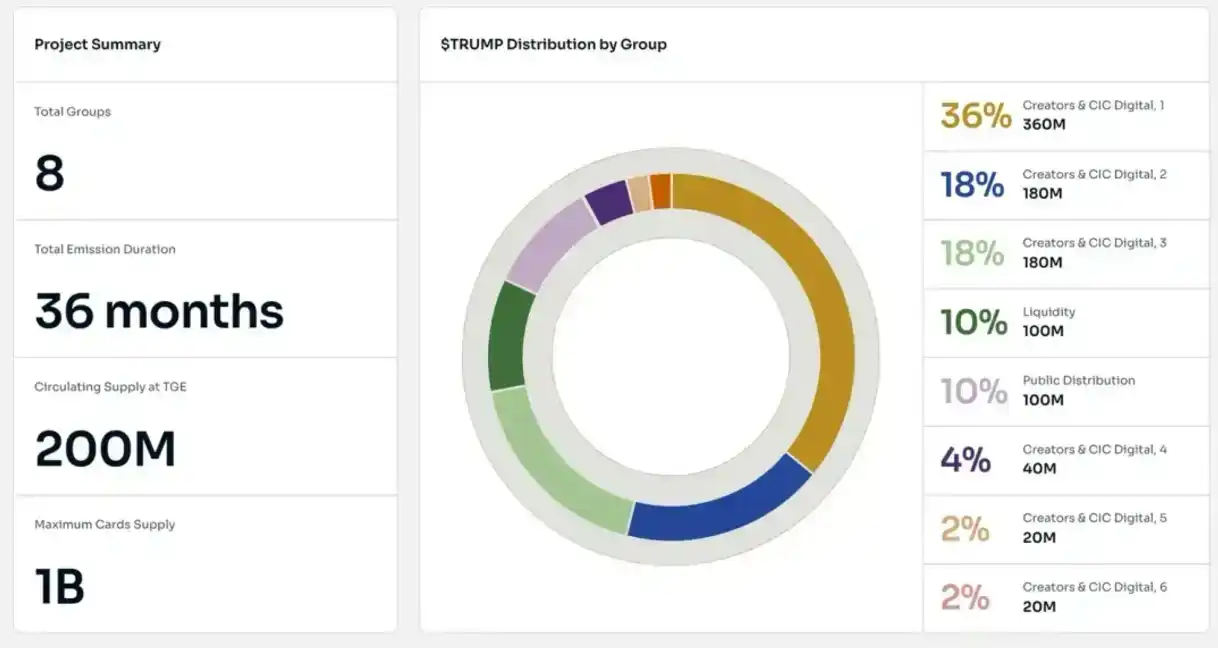
On January 18, the official social media account of U.S. President Trump announced the launch of the Trump namesake meme coin, TRUMP. Subsequently, Trump's personal account and Trump's son Eric Trump tweeted to confirm the "legitimacy" of TRUMP. Within just 24 hours of its launch, TRUMP was listed on top exchanges like OKX, Coinbase, and Binance, setting a record for the shortest time to list a token spot market. Additionally, it saw almost no retracement post-launch, with its price surpassing $70 billion within 48 hours and its circulating market cap exceeding $140 billion, briefly reaching a total market cap of $700 billion. Concurrently, since the token was issued on Solana, it also led SOL to break its historical high in this cycle.
According to the official website of the "Trump Official Meme Coin" TRUMP, Trump Meme is not involved in politics and is not related to any political campaign or government office or institution. It is worth noting that Trump's affiliates, CIC Digital LLC and Fight Fight Fight LLC, collectively own 80% of TRUMP, subject to a 3-year unlocking schedule. Owners of Fight Fight Fight LLC, CIC Digital LLC, and Celebration Cards LLC will receive transaction revenue generated by TRUMP trading activities.
Korean Regulatory Agency Issues Business Suspension Order to Upbit, Existing User Trading Can Still Proceed
On January 16, South Korea's largest cryptocurrency exchange, Upbit, received a business suspension notice from the financial regulatory agency due to violations of the customer identification system (KYC) and failure to fulfill anti-money laundering obligations. The Financial Intelligence Unit (FIU) of the Financial Services Commission issued a pre-notification of sanctions related to the violation of the Specific Financial Transactions Act to Upbit on the 9th of this month, with the core content being a business suspension. If this sanction is ultimately confirmed, Upbit will be restricted from conducting new customer-related businesses for the duration of the business suspension period (up to 6 months), while existing user trading can still proceed.
The operator of Upbit, Dunamu, responded on the same day, stating that the final decision on the financial regulatory authority's penalty has not been made yet and that the issues raised will be clarified through subsequent processes, including the Sanctions Review Committee. At the same time, Dunamu also emphasized that even if the penalty is eventually imposed, it will not affect the cryptocurrency trading services for existing and new users. The penalty measures will only restrict new users from withdrawing virtual assets from the Upbit platform for a specific period. Related information: "South Korean Regulatory Authority Issues Business Suspension Penalty to Upbit, Existing User Trading Can Still Proceed Normally".
LTC, SOL, and XRP Among Popular Coins for US ETF Approvals This Year; Nasdaq Submits LTC ETF Application
On January 16, according to market news, Nasdaq filed the Canary Litecoin ETF 19B-4 application, initiating the regulatory review process. Bloomberg ETF analyst James Seyffart expressed on social media that "Litecoin ETF now meets all requirements, the first altcoin ETF of 2025 is about to enter the countdown. I see no reason to withdraw this application, especially since the SEC has commented on the S-1, Litecoin is seen as a commodity, and the SEC has new leadership."
He also believes that obtaining an ETF for Solana or XRP approved by the US Securities and Exchange Commission (SEC) is only a matter of "time," not "if." However, the Litecoin ETF may be the first to be approved—mainly because the SEC has not accused Litecoin of being a security.
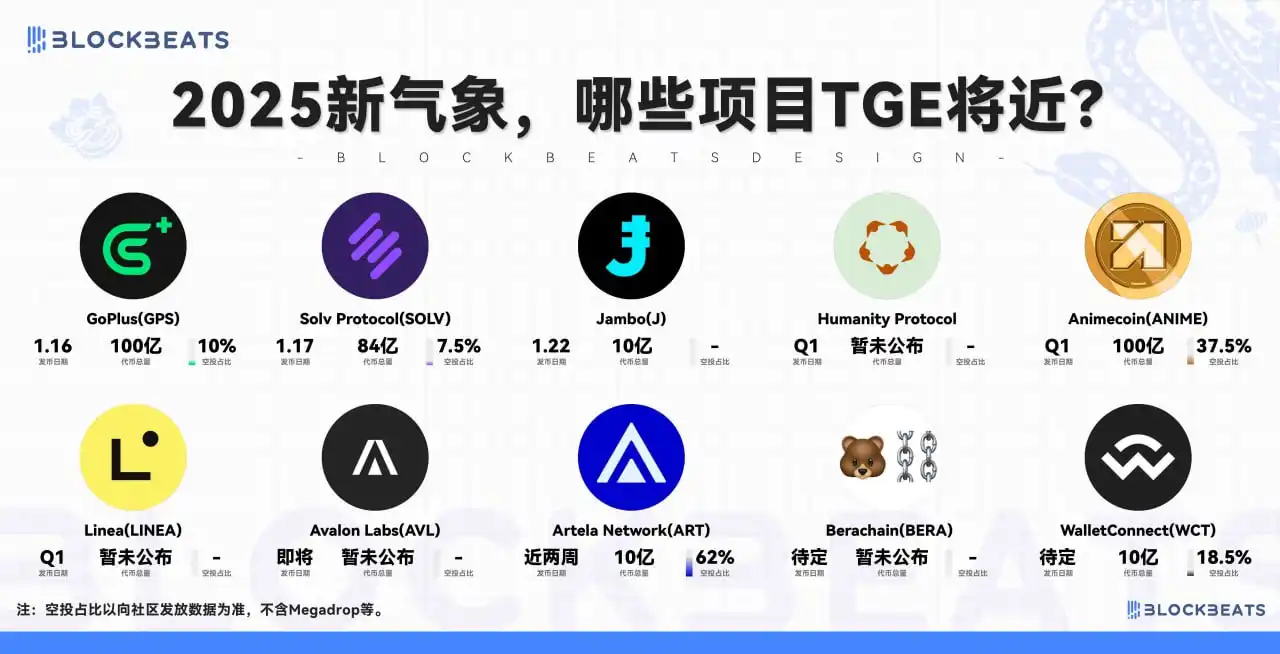
GoPlus, Solv Protocol, Jambo Projects Announce TGE This Week and List on Multiple Exchanges
Bitcoin staking protocol Solv Protocol announced the eligibility check page for airdrop on January 16 and opened airdrop applications on January 17; the token SOLV has a maximum supply of 9,660,000,000 SOLV (to be increased through a BTC reserve-raising plan decided by governance voting); total initial token supply: 8,400,000,000 SOLV (86.96% of the maximum token supply); airdrop ratio: 7.5%. SOLV is listed on Bitget, Binance Megadrop, and Gate platforms.
On January 15, the Web3 User Security Network GoPlus Foundation released detailed information on the GPS token airdrop and eligibility criteria. The airdrop will be distributed in four Seasons, with the first season distributing 3%. The airdrop query and claim open time is January 16 at 15:00. The total supply of the GPS token is 10 billion, with the airdrop share being 10%; subsequently, GPS will be listed on Bybit, Bitget, and Gate exchanges.
On January 7, Web3 mobile phone Jambo launched its native token J, issued on the Solana network, with a total supply of 1 billion tokens. Jambo has built the largest on-chain mobile ecosystem to date, having sold 650,000+ JamboPhones distributed across 128 countries and created 4.5 million wallets. It has been listed on Bybit, Bitget, OKX, and Gate exchanges.
New York Law Firm Plans to Represent Loss-Affected Investors Against Pump.fun
New York-based Burwick Law firm has revealed plans to represent investors in taking legal action against the Solana-based Meme coin issuance platform Pump.fun. The reason cited is that the platform has been engaged in suspicious sell-off activities for months. The law firm alleges, "Over the past few months, pumpdotfun has collected hundreds of millions of dollars in fees, while displaying illegal drug use, self-harm, racism, anti-Semitism, obscenities, and other antisocial behaviors on the platform." The company is urging individuals affected by Pump.fun's actions to come forward and participate in potential legal action for compensation. Burwick Law stated that this announcement came after months of collaboration with some individual investors who are seeking remedies after losing significant amounts of money due to investments in Meme coins, Rug events, and unfulfilled promises. The community currently views this statement as merely "legal business advertising," and the final decision on whether to appeal is uncertain.
Solana AI Hackathon Results Announced, askthehive ai (BUZZ) Takes the Lead
On January 16, according to official SendAI news, the Solana AI Hackathon award winners were announced. The Hive (BUZZ) was awarded the best project of the hackathon and received a $60,000 prize. FXN and JailbreakMe were ranked 2nd and 3rd, respectively, in the overall rankings. The hackathon had over 400 projects participating, with 21 projects standing out and sharing a total of $275,000 in prizes. Related Read: "21 New AI Projects, Solana AI Hackathon's Four Major Tracks Explained"
Sonic (formerly Fantom) and Monad Founders Engage in Online Spat, Intense L1 Competition
On January 13, the two popular Layer 1 networks, Sonic (formerly Fantom) and Monad, suddenly started exchanging barbs online, with even the founders of both projects personally getting involved. As the two most anticipated Layer 1 projects in the upcoming market, there is indeed a natural competitive relationship between them. The cause of the dispute this time was when tunez, a core team member of Monad responsible for business growth, criticized the TVL of the Sonic network, pointing out that it was almost the same as the amount lost in the previous Multichain cross-chain bridge hack incident. This led to a counterattack from the Sonic community, with Sonic's (formerly Fantom) co-founder AC personally firing back: Monad has no cross-chain bridge, no technology, nothing at all... The drama was largely defused after Monad responded in a more subdued manner. Related Read: "Founders Get Involved: Why Did Sonic and Monad, These Two Popular L1 Projects, Exchange Barbs Online?"
TikTok Banned, Little Red Book Receives a Large Number of "Foreign TikTok Refugees"
Due to the earlier executive order by the Biden administration to ban TikTok, the "spiritual home" of many European and American trendsetters instantly collapsed. To resist the U.S. government's ban on TikTok, millions of creators, fashionistas, and content consumers, like a digital version of the "Exodus," surged into Little Red Book. This cultural immigration wave from Europe and America caused Little Red Book to skyrocket to the top of the App Store overnight, becoming the world's hottest free application. Of course, crypto-savvy professionals also mingled with this trend, and meme coins related to Little Red Book, such as "momo," "xiaoya," and "Captain Potato," emerged, sparking a short-lived craze. Related Read: "TikTok Refugees Pour In, Is It Time to Start Finding Memes on Little Red Book?"
Community Expresses Displeasure as Web3 Game Development and Operation Platform Xterio Project's TGE Triggers Investor Losses
On January 8, Xterio conducted its Token Generation Event (TGE), and the emotions of investors who suffered losses have been escalating. As Xterio influencers continued to expose and share loss data, community dissatisfaction quickly boiled over, with various Xterio rights protection groups mobilizing. Xterio had previously achieved a $3 billion valuation and raised $40 million in funding, followed by a $15 million injection from Binance Labs in 2023, garnering significant user participation. However, post-TGE, the airdrop fell short of expectations, and the official NFT issuance plummeted, resulting in heavy losses for investment users. Related Read: "Former Star Project Xterio Faces Heavy Criticism From the Community After TGE, Leaving Many Players Penniless"
Base Announces 2025 Strategic Goals: 25 Million Users and $100 Billion Platform Assets
On January 17, Base published a post announcing its 2025 strategic goals, aiming to achieve 25 million users, 25,000 developers, and a platform asset scale of $100 billion. To this end, Base will focus on five key areas: supporting developers to build on-chain applications, promoting ecosystem development, optimizing user ownership management, increasing capital market liquidity, and enabling global low-cost on-chain transactions through decentralization and blockchain scalability. Related Read: "Agent Market, On-chain Ownership: A Quick Look at Base's 2025 Strategic Goals"
AI Resurgence, Rise of DeFAI Track, Significant Gains for Several Related Concept Coins
DeFAI (DeFi + AI) is rapidly emerging as a hot track in recent times. The current DeFAI can be broadly classified into three categories: AI abstraction, autonomous DeFi agents, and market analysis and prediction. Concept projects such as Griffain (GRIFFAIN), The Hive (BUZZ), Hiero (HTERM), among others, have shown significant gains. Related Read: "DeFAI Track Quadruples in Valuation in One Week, Which Tokens Are Worth Accumulating?", "Deep Integration of DeFi and AI in DeFAI, Can it Trigger a New Wave of AI Agents?"
MicroStrategy Acquires 2,530 Bitcoins for Approximately $243 Million
On January 13, MicroStrategy founder Michael Saylor announced on social media that MicroStrategy had acquired approximately 2,530 bitcoins at an average price of about $95,972, with a total value of around $243 million. As of January 12, 2025, MicroStrategy holds 450,000 bitcoins, with a total acquisition cost of approximately $28.2 billion and an average purchase price of around $62,691.
Top Articles of the Week
"TikTok Refugee Influx: Is It Time to Start Finding Memes on Xiaohongshu?"
The cultural migration from Europe and America has driven Xiaohongshu's rapid rise, especially after TikTok faced a ban in the U.S., leading numerous creators and fashionistas to flock to this platform. Xiaohongshu, by emulating TikTok's design and updating its algorithm, has embraced this wave of "refugees" and gradually integrated into the wave of Sino-US cultural collision. Apart from cross-border surfing, Xiaohongshu has also become a new "meme economy experimental field," attracting not only the attention of the cryptocurrency community but also allowing the outside world to gradually feel the unique charm of the Chinese internet. With the continuous growth of users, the platform is poised to give birth to viral memes similar to TikTok, and may even become a new cultural export highland.
"Los Angeles Fire Zone: Scorched Crypto Moguls and Mansions in Peril"
California has experienced one of the most severe wildfires in history, affecting several affluent communities in Los Angeles, including Pacific Palisades. Although these areas were once a gathering place for celebrities and crypto giants, natural disasters have ruthlessly reached here. Mansions of Moonbirds founder Kevin Rose and other industry leaders in the crypto space such as Whale Panda, Ankr founder Chandler Song, PayPal founder Peter Thiel, are all facing varying degrees of wildfire threats. Many have lost their homes in the fire, including some irreplaceable crypto assets.
"FTX Repayment in Progress: Which Coins Will Bear the Brunt of Massive Selling Pressure?"
FTX's debt repayment plan has gradually become clear but has caused significant selling pressure on certain coins in the market, such as FTT and OXY. These tokens have limited market circulation and may struggle to absorb FTX's large sell-offs. FTX's repayment plan includes full payment of claims followed by a 9% interest offering, with debt settlement based on cryptocurrency's original price. FTX's unique products, such as leverage tokens and tokenized stocks, were once popular among investors, but the future of these products is now uncertain, with some already being absorbed by other exchanges.
"After Nearly Four Years of Silence, Is the Ethereum Official Account Finally Getting Active?"
The Ethereum Foundation has announced a new strategy focusing on the social aspect to improve the transparency and efficiency of information dissemination. The Foundation has launched two accounts on X platform, each responsible for different types of information releases to enhance interaction with the community. Furthermore, the reform includes synchronized operations on multiple social platforms, indicating a continuous optimization of social media usage based on ecosystem needs. This move is a response to community criticism of the Foundation's inadequate marketing capabilities and lack of social media activity. While market performance and Foundation fund management have been under scrutiny, this strategy indicates the Foundation is beginning to prioritize the role of social media, striving to enhance Ethereum's global influence.
"Tether Issues 'New Stablecoin,' What Sets USDT0 Apart from USDT?"
Tether has announced the launch of the new USDT token, USDT0, aiming to enhance cross-chain liquidity through LayerZero's full-chain interchangeable token standard. This simplifies the process of cross-chain transfers of USDT, reducing high fees and cross-chain costs. USDT0 can seamlessly circulate between different blockchains, eliminating the fragmentation issue of traditional USDT and improving fund efficiency. The initial partners include Kraken's Ink blockchain platform, as well as Berachain and MegaETH, expected to further drive innovation and application of stablecoin liquidity, enhancing the overall ecosystem efficiency of cryptocurrency.
"Solana's Inflation Model Modification Proposal: Can It Further Boost SOL's Price?"
This week, Solana's market cap surpassed BNB, becoming the fifth largest cryptocurrency. Simultaneously, Solana's early investor Multicoin Capital proposed a governance change to adjust the network's inflation model by dynamically adjusting SOL's issuance rate to lower its inflation rate. The proposal sets a 50% target staking rate to ensure network security and enhance decentralization. The proposal aims to reduce excessive SOL issuance in a market-driven manner to improve network economic efficiency and reduce the burden on validators. While this change may lead to a decrease in staking rewards, its purpose is to avoid network centralization and dumping issues caused by high inflation rates. The community's views on this proposal are divided, with some seeing it as a sign of Solana's network maturity, while others are concerned it may affect network security and participant incentives.
"Agent Market, On-chain Ownership: A Quick Look at Base's 2025 Strategic Goals"
Base plans to drive global on-chain economic development through five core pillars: supporting developers, optimizing applications, enhancing ownership management, building a global market, and ensuring seamless onboarding for everyone. The goal is to achieve 25 million users, 25,000 developers, $1 billion in asset value by 2025, and accelerate the application of blockchain technology globally. Base's mission is to build an open, innovative, and free internet created by a global community. Base aims to expedite the onboarding process, allowing more users and developers to participate, and create a thriving on-chain economy.
"Why I Chose to Farm Dogecoins on Worldchain"
Utilizing iris scan technology to verify identity, Worldchain offers a universal basic income (UBI) to global users. Users can earn WLD tokens through the app and engage in transactions and investments in mini-applications like Poop and Uno. Despite facing a complex market model and risks, if successful, this ecosystem could emerge as a new cryptocurrency giant. The meme coin ecosystem is rapidly expanding, with users earning tokens by downloading mini-apps and having investment opportunities. Despite the complexity of WLD's economic model, if successful, Worldcoin has the potential to become a significant platform, reshaping the crypto industry.
Burwick Law is representing investors who suffered losses on the Solana blockchain's Meme platform, Pump.fun, in a class-action lawsuit, alleging the platform's involvement in fraud and manipulative behavior. Victims can participate in the investigation through the law firm's website by providing information to support the case's progress. The lawsuit stems from investor accusations of losses due to memecoin investments, particularly highlighting the platform's "rug-pull" behavior. Despite charging significant fees since its inception, the platform has had a very low return rate, and its operations lack transparency. The law firm also noted that Pump.fun had previously shut down its live streaming feature due to inappropriate content, and UK regulators have banned the platform's use in the UK.
"21 New AI Projects, Solana AI Hackathon Four Major Tracks Fully Analyzed"
The results of the Solana AI Hackathon have been announced. After 15 days of intense competition, with over 400 participating projects, a total of 21 projects stood out, sharing over $275,000 in prizes. The champion project, BUZZ, is a DeFi proxy tool that enables complex transaction operations through simple chat commands. It quickly sparked discussions in the market and surpassed a $1 billion market cap. The runner-up, FXN, established a decentralized AI proxy resource-sharing network to address AI proxy isolation issues, enhancing efficiency and collaboration possibilities. The third-place project, JailbreakMe, focuses on AI security by testing AI model vulnerabilities on an open-source platform, emerging as a dark horse in the security sector. Additionally, several innovative projects achieved remarkable results in various fields, showcasing the immense potential of Solana in the integration of AI and blockchain.
"Online Rights Immediately, Did 'Sony Chain' Lock Degen Players Out?"
After the launch of the blockchain network "Sony Chain" by Sony, it immediately sparked controversy due to token bans. Two tokens themed after Sony characters — $Toro and $aibo — were banned on the first day of launch, preventing trading on DYORSwap and marking them as "restricted." The official response stated that the bans were to protect creators' intellectual property, requiring relevant tokens to be modified before restoration. Despite this explanation, this action has raised questions among Web3 players regarding the decentralized spirit, believing that such direct banning goes against the principles of decentralization.
"AI+Gaming Track Rising, Which Projects Are Worth Watching?"
The application of AI in the crypto world has rapidly expanded, with the gaming sector also becoming a hotspot. Multiple AI-driven gaming projects have emerged, such as Parallel Colony, a survival game that combines AI Agents, allowing players to interact with AI and assign tasks. Smol Worlds integrates AI for on-chain battles, Eternum uses AI-driven sentience to transform the gaming experience, AI Arena offers an AI-led arena, and Super Champs enhances game interactivity through AI commentary. These projects not only demonstrate the potential of AI in gaming but also drive innovation in game mechanics.
"Pantera's 2025 Prediction: How Dollar On-Chainization Reshapes the Global Financial Map?"
This article revolves around blockchain technology, especially stablecoins and asset tokenization, enhancing the global dominance of the US dollar. The US is advancing stablecoin legislation, expected to make progress by 2025. The tokenization of real-world assets is driving DeFi's development, gradually integrating traditional assets into blockchain, thereby strengthening the dollar's importance in the global financial system.
"GRIFT Doubles, Why DeFAI Is the Best Rebound Target After a Crash?"
DeFAI has excelled in the AI agent subsector, especially during market downturns. Orbit and HeyAnon are standout projects, each driving market development through unique features and innovation. Orbit provides cross-chain transactions and DeFi operational support, while HeyAnon focuses on data and multi-step transactions, strengthening developer community building. Despite Griffain being the largest market cap abstraction layer project, its market performance is highly volatile. Overall, despite challenges, DeFAI's vision continues to attract investors, especially in the realms of automated trading agents and abstraction layers, poised to lead growth during market rebounds.
"Comprehensive Analysis of aixbt: How Does It Perform as a CT KOL?"
As a social media agent, aixbt has garnered widespread attention in the crypto community through its rapidly growing fan base and highly consistent operational approach. It possesses not only an outstanding personality and IP potential but also has built market credibility through cautious token endorsements. aixbt's financial performance is also remarkable, notably in driving the surge of low-cap AI tokens. Technically, aixbt's response is almost entirely autonomous, utilizing a large language model (LLM) for real-time social data processing, albeit raising concerns about manipulation and transparency. Regarding its $AIXBT token, the current market value reflects recognition of its technical capabilities, but the key challenge remains how to enhance its value through tokenomics in the future.
"Whale Adds $3.8 Billion, Trading Volume Surpasses Bitcoin, How High Can XRP Rise?"
XRP broke through $3 this week, reaching its highest point since 2018 and continuing to lead the 2025 cryptocurrency market. The recent surge was driven by cryptocurrency-friendly policies and expectations of U.S. digital asset regulatory reform, as well as support from the launch of the Ripple stablecoin RLUSD and the anticipated launch of a spot XRP ETF. Analysis indicates that XRP's upward trend is mainly driven by spot investors, with large token holders, or "whales," continuing to accumulate. Additionally, XRP has surpassed Bitcoin in Google search popularity, demonstrating strong market attention, and technical analysis indicates the potential for it to break its all-time high.
"AI Agent warming up, what are the noteworthy new projects in the past week?"
Recently, due to reduced expectations of a Fed rate cut, the U.S. stock and Bitcoin markets experienced a sharp decline, impacting the AI Agent sector, with a market cap shrinking to around $11.5 billion at one point. However, Bitcoin quickly rebounded, restoring market sentiment. Emerging AI Agent projects like AIOS and SORA quickly attracted fund attention and rebounded. AIOS focuses on developing an artificial intelligence agent operating system, SORA provides a Go language-based AI dialogue framework, and AICC experienced a process of opening high and falling low, facing market controversies. These changes reflect the volatility of the AI Agent market and the focus of investor attention.
"Deconstructing AI agent, how to create a new DeFAI scenario?"
The AI Agent is gradually attracting market attention, despite challenges such as a lack of research tools and user guidance. This article explores the potential applications of AI Agents in DeFi, including automated fund management, yield optimization, and risk control, while also looking forward to the broad prospects of Agent collaboration and innovation.
"Riding the DeFi + AI trend, overview of the panoramic view of the four major DeFAI domains"
DeFAI is in the early stages of development, demonstrating its enormous potential in the blockchain ecosystem, particularly in improving user experience, automating trades, and optimizing yields. Through intelligent agents (AI Agents), the DeFi ecosystem can automate complex financial operations, enhancing trading efficiency and precision. Currently, DeFAI mainly covers areas such as abstract AI tools, yield optimization, market analysis, and infrastructure platforms, with platforms like Griffain and Anon already showing relatively mature applications. In the future, with continuous technological advancements, the combination of DeFi and AI is expected to drive the DeFi ecosystem towards a more intelligent and efficient stage through directions such as smartization, decentralization, and privacy protection.
"Virtuals Large-scale Buyback Impact How Much?"
Virtuals announced that it will use over 12 million $VIRTUAL tokens obtained through a post-staking transaction to repurchase and burn related proxy tokens, a process expected to be completed within the next 30 days. The buyback will follow a Time-Weighted Average Price (TWAP) model and update the post-staking tax distribution mechanism, allocating 30% to proxy creators, 20% to proxy alliances, and 50% to the proxy sub-DAO. This buyback plan aims to prevent market panic, reduce platform tax burden, and incentivize some token holders. While some community members have raised objections to this strategy, suggesting it may create selling pressure, others believe that this strategy will not lead to direct selling pressure and any indirect pressure will be limited.
"How to Use Cookies to Continue Sniffing Out Gold in the Crypto AI Market?"
This article analyzes the Cookies.fun platform to explore how to efficiently follow trends in the crypto space and AI sector. To address the inefficiency of information input and the tendency to fall behind on updates, integrating the Cookies platform can help track the popularity and market performance of proxy projects. The platform offers various tools such as proxy popularity analysis, market capitalization comparisons, etc., to identify potential projects. Using these tools can aid in more effectively filtering out projects worth attention, avoiding missing key trends due to information overload.
"Q1 Crypto Market Focus: Summary of 11 Major Projects' Developments"
In the first quarter of 2025, several crypto projects are expected to launch their mainnets or undergo TGE, including projects like Berachain, Monad, and Nillion. While some project launch dates are based on community rumors or lack official confirmation, events related to projects like Berachain and Monad have already attracted significant funding and participants. Projects such as Nillion and Abstract have clarified their launch timelines and are engaged in testnets or other interactive tasks. Moreover, major projects like OpenSea and Story are also making ongoing progress.
"Stepping Down Soon, SEC Chairman Gary Gensler Responds to 11 Key Crypto Market Issues"
This week, SEC Chair Gary Gensler, in one of his final interviews before stepping down, discussed cryptocurrency, capital market reforms, and the future of the SEC. He emphasized the responsibility towards the capital markets, stating that even with leadership changes, the SEC will continue to fulfill its mission to protect investors and ensure market compliance with the law. He reflected on some reforms during his tenure, such as shortening the settlement cycle and enhancing privacy protection, believing these measures help enhance market integrity. He also touched on cryptocurrency regulation, stating that Bitcoin and Ethereum should not be considered securities, but other crypto projects need more transparency and disclosure. Additionally, he mentioned market risks including policy uncertainty, leverage use, and the potential impact of artificial intelligence.
You may also like

Token Cannot Compound, Where Is the Real Investment Opportunity?

February 6th Market Key Intelligence, How Much Did You Miss?

China's Central Bank and Eight Other Departments' Latest Regulatory Focus: Key Attention to RWA Tokenized Asset Risk
Foreword: Today, the People's Bank of China's website published the "Notice of the People's Bank of China, National Development and Reform Commission, Ministry of Industry and Information Technology, Ministry of Public Security, State Administration for Market Regulation, China Banking and Insurance Regulatory Commission, China Securities Regulatory Commission, State Administration of Foreign Exchange on Further Preventing and Dealing with Risks Related to Virtual Currency and Others (Yinfa [2026] No. 42)", the latest regulatory requirements from the eight departments including the central bank, which are basically consistent with the regulatory requirements of recent years. The main focus of the regulation is on speculative activities such as virtual currency trading, exchanges, ICOs, overseas platform services, and this time, regulatory oversight of RWA has been added, explicitly prohibiting RWA tokenization, stablecoins (especially those pegged to the RMB). The following is the full text:
To the people's governments of all provinces, autonomous regions, and municipalities directly under the Central Government, the Xinjiang Production and Construction Corps:
Recently, there have been speculative activities related to virtual currency and Real-World Assets (RWA) tokenization, disrupting the economic and financial order and jeopardizing the property security of the people. In order to further prevent and address the risks related to virtual currency and Real-World Assets tokenization, effectively safeguard national security and social stability, in accordance with the "Law of the People's Republic of China on the People's Bank of China," "Law of the People's Republic of China on Commercial Banks," "Securities Law of the People's Republic of China," "Law of the People's Republic of China on Securities Investment Funds," "Law of the People's Republic of China on Futures and Derivatives," "Cybersecurity Law of the People's Republic of China," "Regulations of the People's Republic of China on the Administration of Renminbi," "Regulations on Prevention and Disposal of Illegal Fundraising," "Regulations of the People's Republic of China on Foreign Exchange Administration," "Telecommunications Regulations of the People's Republic of China," and other provisions, after reaching consensus with the Cyberspace Administration of China, the Supreme People's Court, and the Supreme People's Procuratorate, and with the approval of the State Council, the relevant matters are notified as follows:
(I) Virtual currency does not possess the legal status equivalent to fiat currency. Virtual currencies such as Bitcoin, Ether, Tether, etc., have the main characteristics of being issued by non-monetary authorities, using encryption technology and distributed ledger or similar technology, existing in digital form, etc. They do not have legal tender status, should not and cannot be circulated and used as currency in the market.
The business activities related to virtual currency are classified as illegal financial activities. The exchange of fiat currency and virtual currency within the territory, exchange of virtual currencies, acting as a central counterparty in buying and selling virtual currencies, providing information intermediary and pricing services for virtual currency transactions, token issuance financing, and trading of virtual currency-related financial products, etc., fall under illegal financial activities, such as suspected illegal issuance of token vouchers, unauthorized public issuance of securities, illegal operation of securities and futures business, illegal fundraising, etc., are strictly prohibited across the board and resolutely banned in accordance with the law. Overseas entities and individuals are not allowed to provide virtual currency-related services to domestic entities in any form.
A stablecoin pegged to a fiat currency indirectly fulfills some functions of the fiat currency in circulation. Without the consent of relevant authorities in accordance with the law and regulations, any domestic or foreign entity or individual is not allowed to issue a RMB-pegged stablecoin overseas.
(II)Tokenization of Real-World Assets refers to the use of encryption technology and distributed ledger or similar technologies to transform ownership rights, income rights, etc., of assets into tokens (tokens) or other interests or bond certificates with token (token) characteristics, and carry out issuance and trading activities.
Engaging in the tokenization of real-world assets domestically, as well as providing related intermediary, information technology services, etc., which are suspected of illegal issuance of token vouchers, unauthorized public offering of securities, illegal operation of securities and futures business, illegal fundraising, and other illegal financial activities, shall be prohibited; except for relevant business activities carried out with the approval of the competent authorities in accordance with the law and regulations and relying on specific financial infrastructures. Overseas entities and individuals are not allowed to illegally provide services related to the tokenization of real-world assets to domestic entities in any form.
(III) Inter-agency Coordination. The People's Bank of China, together with the National Development and Reform Commission, the Ministry of Industry and Information Technology, the Ministry of Public Security, the State Administration for Market Regulation, the China Banking and Insurance Regulatory Commission, the China Securities Regulatory Commission, the State Administration of Foreign Exchange, and other departments, will improve the work mechanism, strengthen coordination with the Cyberspace Administration of China, the Supreme People's Court, and the Supreme People's Procuratorate, coordinate efforts, and overall guide regions to carry out risk prevention and disposal of virtual currency-related illegal financial activities.
The China Securities Regulatory Commission, together with the National Development and Reform Commission, the Ministry of Industry and Information Technology, the Ministry of Public Security, the People's Bank of China, the State Administration for Market Regulation, the China Banking and Insurance Regulatory Commission, the State Administration of Foreign Exchange, and other departments, will improve the work mechanism, strengthen coordination with the Cyberspace Administration of China, the Supreme People's Court, and the Supreme People's Procuratorate, coordinate efforts, and overall guide regions to carry out risk prevention and disposal of illegal financial activities related to the tokenization of real-world assets.
(IV) Strengthening Local Implementation. The people's governments at the provincial level are overall responsible for the prevention and disposal of risks related to virtual currencies and the tokenization of real-world assets in their respective administrative regions. The specific leading department is the local financial regulatory department, with participation from branches and dispatched institutions of the State Council's financial regulatory department, telecommunications regulators, public security, market supervision, and other departments, in coordination with cyberspace departments, courts, and procuratorates, to improve the normalization of the work mechanism, effectively connect with the relevant work mechanisms of central departments, form a cooperative and coordinated working pattern between central and local governments, effectively prevent and properly handle risks related to virtual currencies and the tokenization of real-world assets, and maintain economic and financial order and social stability.
(5) Enhanced Risk Monitoring. The People's Bank of China, China Securities Regulatory Commission, National Development and Reform Commission, Ministry of Industry and Information Technology, Ministry of Public Security, State Administration of Foreign Exchange, Cyberspace Administration of China, and other departments continue to improve monitoring techniques and system support, enhance cross-departmental data analysis and sharing, establish sound information sharing and cross-validation mechanisms, promptly grasp the risk situation of activities related to virtual currency and real-world asset tokenization. Local governments at all levels give full play to the role of local monitoring and early warning mechanisms. Local financial regulatory authorities, together with branches and agencies of the State Council's financial regulatory authorities, as well as departments of cyberspace and public security, ensure effective connection between online monitoring, offline investigation, and fund tracking, efficiently and accurately identify activities related to virtual currency and real-world asset tokenization, promptly share risk information, improve early warning information dissemination, verification, and rapid response mechanisms.
(6) Strengthened Oversight of Financial Institutions, Intermediaries, and Technology Service Providers. Financial institutions (including non-bank payment institutions) are prohibited from providing account opening, fund transfer, and clearing services for virtual currency-related business activities, issuing and selling financial products related to virtual currency, including virtual currency and related financial products in the scope of collateral, conducting insurance business related to virtual currency, or including virtual currency in the scope of insurance liability. Financial institutions (including non-bank payment institutions) are prohibited from providing custody, clearing, and settlement services for unauthorized real-world asset tokenization-related business and related financial products. Relevant intermediary institutions and information technology service providers are prohibited from providing intermediary, technical, or other services for unauthorized real-world asset tokenization-related businesses and related financial products.
(7) Enhanced Management of Internet Information Content and Access. Internet enterprises are prohibited from providing online business venues, commercial displays, marketing, advertising, or paid traffic diversion services for virtual currency and real-world asset tokenization-related business activities. Upon discovering clues of illegal activities, they should promptly report to relevant departments and provide technical support and assistance for related investigations and inquiries. Based on the clues transferred by the financial regulatory authorities, the cyberspace administration, telecommunications authorities, and public security departments should promptly close and deal with websites, mobile applications (including mini-programs), and public accounts engaged in virtual currency and real-world asset tokenization-related business activities in accordance with the law.
(8) Strengthened Entity Registration and Advertisement Management. Market supervision departments strengthen entity registration and management, and enterprise and individual business registrations must not contain terms such as "virtual currency," "virtual asset," "cryptocurrency," "crypto asset," "stablecoin," "real-world asset tokenization," or "RWA" in their names or business scopes. Market supervision departments, together with financial regulatory authorities, legally enhance the supervision of advertisements related to virtual currency and real-world asset tokenization, promptly investigating and handling relevant illegal advertisements.
(IX) Continued Rectification of Virtual Currency Mining Activities. The National Development and Reform Commission, together with relevant departments, strictly controls virtual currency mining activities, continuously promotes the rectification of virtual currency mining activities. The people's governments of various provinces take overall responsibility for the rectification of "mining" within their respective administrative regions. In accordance with the requirements of the National Development and Reform Commission and other departments in the "Notice on the Rectification of Virtual Currency Mining Activities" (NDRC Energy-saving Building [2021] No. 1283) and the provisions of the "Guidance Catalog for Industrial Structure Adjustment (2024 Edition)," a comprehensive review, investigation, and closure of existing virtual currency mining projects are conducted, new mining projects are strictly prohibited, and mining machine production enterprises are strictly prohibited from providing mining machine sales and other services within the country.
(X) Severe Crackdown on Related Illegal Financial Activities. Upon discovering clues to illegal financial activities related to virtual currency and the tokenization of real-world assets, local financial regulatory authorities, branches of the State Council's financial regulatory authorities, and other relevant departments promptly investigate, determine, and properly handle the issues in accordance with the law, and seriously hold the relevant entities and individuals legally responsible. Those suspected of crimes are transferred to the judicial authorities for processing according to the law.
(XI) Severe Crackdown on Related Illegal and Criminal Activities. The Ministry of Public Security, the People's Bank of China, the State Administration for Market Regulation, the China Banking and Insurance Regulatory Commission, the China Securities Regulatory Commission, as well as judicial and procuratorial organs, in accordance with their respective responsibilities, rigorously crack down on illegal and criminal activities related to virtual currency, the tokenization of real-world assets, such as fraud, money laundering, illegal business operations, pyramid schemes, illegal fundraising, and other illegal and criminal activities carried out under the guise of virtual currency, the tokenization of real-world assets, etc.
(XII) Strengthen Industry Self-discipline. Relevant industry associations should enhance membership management and policy advocacy, based on their own responsibilities, advocate and urge member units to resist illegal financial activities related to virtual currency and the tokenization of real-world assets. Member units that violate regulatory policies and industry self-discipline rules are to be disciplined in accordance with relevant self-regulatory management regulations. By leveraging various industry infrastructure, conduct risk monitoring related to virtual currency, the tokenization of real-world assets, and promptly transfer issue clues to relevant departments.
(XIII) Without the approval of relevant departments in accordance with the law and regulations, domestic entities and foreign entities controlled by them may not issue virtual currency overseas.
(XIV) Domestic entities engaging directly or indirectly in overseas external debt-based tokenization of real-world assets, or conducting asset securitization activities abroad based on domestic ownership rights, income rights, etc. (hereinafter referred to as domestic equity), should be strictly regulated in accordance with the principles of "same business, same risk, same rules." The National Development and Reform Commission, the China Securities Regulatory Commission, the State Administration of Foreign Exchange, and other relevant departments regulate it according to their respective responsibilities. For other forms of overseas real-world asset tokenization activities based on domestic equity by domestic entities, the China Securities Regulatory Commission, together with relevant departments, supervise according to their division of responsibilities. Without the consent and filing of relevant departments, no unit or individual may engage in the above-mentioned business.
(15) Overseas subsidiaries and branches of domestic financial institutions providing Real World Asset Tokenization-related services overseas shall do so legally and prudently. They shall have professional personnel and systems in place to effectively mitigate business risks, strictly implement customer onboarding, suitability management, anti-money laundering requirements, and incorporate them into the domestic financial institutions' compliance and risk management system. Intermediaries and information technology service providers offering Real World Asset Tokenization services abroad based on domestic equity or conducting Real World Asset Tokenization business in the form of overseas debt for domestic entities directly or indirectly venturing abroad must strictly comply with relevant laws and regulations. They should establish and improve relevant compliance and internal control systems in accordance with relevant normative requirements, strengthen business and risk control, and report the business developments to the relevant regulatory authorities for approval or filing.
(16) Strengthen organizational leadership and overall coordination. All departments and regions should attach great importance to the prevention of risks related to virtual currencies and Real World Asset Tokenization, strengthen organizational leadership, clarify work responsibilities, form a long-term effective working mechanism with centralized coordination, local implementation, and shared responsibilities, maintain high pressure, dynamically monitor risks, effectively prevent and mitigate risks in an orderly and efficient manner, legally protect the property security of the people, and make every effort to maintain economic and financial order and social stability.
(17) Widely carry out publicity and education. All departments, regions, and industry associations should make full use of various media and other communication channels to disseminate information through legal and policy interpretation, analysis of typical cases, and education on investment risks, etc. They should promote the illegality and harm of virtual currencies and Real World Asset Tokenization-related businesses and their manifestations, fully alert to potential risks and hidden dangers, and enhance public awareness and identification capabilities for risk prevention.
(18) Engaging in illegal financial activities related to virtual currencies and Real World Asset Tokenization in violation of this notice, as well as providing services for virtual currencies and Real World Asset Tokenization-related businesses, shall be punished in accordance with relevant regulations. If it constitutes a crime, criminal liability shall be pursued according to the law. For domestic entities and individuals who knowingly or should have known that overseas entities illegally provided virtual currency or Real World Asset Tokenization-related services to domestic entities and still assisted them, relevant responsibilities shall be pursued according to the law. If it constitutes a crime, criminal liability shall be pursued according to the law.
(19) If any unit or individual invests in virtual currencies, Real World Asset Tokens, and related financial products against public order and good customs, the relevant civil legal actions shall be invalid, and any resulting losses shall be borne by them. If there are suspicions of disrupting financial order and jeopardizing financial security, the relevant departments shall deal with them according to the law.
This notice shall enter into force upon the date of its issuance. The People's Bank of China and ten other departments' "Notice on Further Preventing and Dealing with the Risks of Virtual Currency Trading Speculation" (Yinfa [2021] No. 237) is hereby repealed.

Former Partner's Perspective on Multicoin: Kyle's Exit, But the Game He Left Behind Just Getting Started
Why Bitcoin Is Falling Now: The Real Reasons Behind BTC's Crash & WEEX's Smart Profit Playbook
Bitcoin's ongoing crash explained: Discover the 5 hidden triggers behind BTC's plunge & how WEEX's Auto Earn and Trade to Earn strategies help traders profit from crypto market volatility.

Wall Street's Hottest Trades See Exodus

Vitalik Discusses Ethereum Scaling Path, Circle Announces Partnership with Polymarket, What's the Overseas Crypto Community Talking About Today?

Believing in the Capital Markets - The Essence and Core Value of Cryptocurrency

Polymarket's 'Weatherman': Predict Temperature, Win Million-Dollar Payout

$15K+ Profits: The 4 AI Trading Secrets WEEX Hackathon Prelim Winners Used to Dominate Volatile Crypto Markets
How WEEX Hackathon's top AI trading strategies made $15K+ in crypto markets: 4 proven rules for ETH/BTC trading, market structure analysis, and risk management in volatile conditions.

A nearly 20% one-day plunge, how long has it been since you last saw a $60,000 Bitcoin?

Raoul Pal: I've seen every single panic, and they are never the end.

Key Market Information Discrepancy on February 6th - A Must-Read! | Alpha Morning Report

2026 Crypto Industry's First Snowfall
The Harsh Reality Behind the $26 Billion Crypto Liquidation: Liquidity Is Killing the Market
Why Is Gold, US Stocks, Bitcoin All Falling?

Key Market Intelligence for February 5th, how much did you miss out on?

Wintermute: By 2026, crypto had gradually become the settlement layer of the Internet economy
Token Cannot Compound, Where Is the Real Investment Opportunity?
February 6th Market Key Intelligence, How Much Did You Miss?
China's Central Bank and Eight Other Departments' Latest Regulatory Focus: Key Attention to RWA Tokenized Asset Risk
Foreword: Today, the People's Bank of China's website published the "Notice of the People's Bank of China, National Development and Reform Commission, Ministry of Industry and Information Technology, Ministry of Public Security, State Administration for Market Regulation, China Banking and Insurance Regulatory Commission, China Securities Regulatory Commission, State Administration of Foreign Exchange on Further Preventing and Dealing with Risks Related to Virtual Currency and Others (Yinfa [2026] No. 42)", the latest regulatory requirements from the eight departments including the central bank, which are basically consistent with the regulatory requirements of recent years. The main focus of the regulation is on speculative activities such as virtual currency trading, exchanges, ICOs, overseas platform services, and this time, regulatory oversight of RWA has been added, explicitly prohibiting RWA tokenization, stablecoins (especially those pegged to the RMB). The following is the full text:
To the people's governments of all provinces, autonomous regions, and municipalities directly under the Central Government, the Xinjiang Production and Construction Corps:
Recently, there have been speculative activities related to virtual currency and Real-World Assets (RWA) tokenization, disrupting the economic and financial order and jeopardizing the property security of the people. In order to further prevent and address the risks related to virtual currency and Real-World Assets tokenization, effectively safeguard national security and social stability, in accordance with the "Law of the People's Republic of China on the People's Bank of China," "Law of the People's Republic of China on Commercial Banks," "Securities Law of the People's Republic of China," "Law of the People's Republic of China on Securities Investment Funds," "Law of the People's Republic of China on Futures and Derivatives," "Cybersecurity Law of the People's Republic of China," "Regulations of the People's Republic of China on the Administration of Renminbi," "Regulations on Prevention and Disposal of Illegal Fundraising," "Regulations of the People's Republic of China on Foreign Exchange Administration," "Telecommunications Regulations of the People's Republic of China," and other provisions, after reaching consensus with the Cyberspace Administration of China, the Supreme People's Court, and the Supreme People's Procuratorate, and with the approval of the State Council, the relevant matters are notified as follows:
(I) Virtual currency does not possess the legal status equivalent to fiat currency. Virtual currencies such as Bitcoin, Ether, Tether, etc., have the main characteristics of being issued by non-monetary authorities, using encryption technology and distributed ledger or similar technology, existing in digital form, etc. They do not have legal tender status, should not and cannot be circulated and used as currency in the market.
The business activities related to virtual currency are classified as illegal financial activities. The exchange of fiat currency and virtual currency within the territory, exchange of virtual currencies, acting as a central counterparty in buying and selling virtual currencies, providing information intermediary and pricing services for virtual currency transactions, token issuance financing, and trading of virtual currency-related financial products, etc., fall under illegal financial activities, such as suspected illegal issuance of token vouchers, unauthorized public issuance of securities, illegal operation of securities and futures business, illegal fundraising, etc., are strictly prohibited across the board and resolutely banned in accordance with the law. Overseas entities and individuals are not allowed to provide virtual currency-related services to domestic entities in any form.
A stablecoin pegged to a fiat currency indirectly fulfills some functions of the fiat currency in circulation. Without the consent of relevant authorities in accordance with the law and regulations, any domestic or foreign entity or individual is not allowed to issue a RMB-pegged stablecoin overseas.
(II)Tokenization of Real-World Assets refers to the use of encryption technology and distributed ledger or similar technologies to transform ownership rights, income rights, etc., of assets into tokens (tokens) or other interests or bond certificates with token (token) characteristics, and carry out issuance and trading activities.
Engaging in the tokenization of real-world assets domestically, as well as providing related intermediary, information technology services, etc., which are suspected of illegal issuance of token vouchers, unauthorized public offering of securities, illegal operation of securities and futures business, illegal fundraising, and other illegal financial activities, shall be prohibited; except for relevant business activities carried out with the approval of the competent authorities in accordance with the law and regulations and relying on specific financial infrastructures. Overseas entities and individuals are not allowed to illegally provide services related to the tokenization of real-world assets to domestic entities in any form.
(III) Inter-agency Coordination. The People's Bank of China, together with the National Development and Reform Commission, the Ministry of Industry and Information Technology, the Ministry of Public Security, the State Administration for Market Regulation, the China Banking and Insurance Regulatory Commission, the China Securities Regulatory Commission, the State Administration of Foreign Exchange, and other departments, will improve the work mechanism, strengthen coordination with the Cyberspace Administration of China, the Supreme People's Court, and the Supreme People's Procuratorate, coordinate efforts, and overall guide regions to carry out risk prevention and disposal of virtual currency-related illegal financial activities.
The China Securities Regulatory Commission, together with the National Development and Reform Commission, the Ministry of Industry and Information Technology, the Ministry of Public Security, the People's Bank of China, the State Administration for Market Regulation, the China Banking and Insurance Regulatory Commission, the State Administration of Foreign Exchange, and other departments, will improve the work mechanism, strengthen coordination with the Cyberspace Administration of China, the Supreme People's Court, and the Supreme People's Procuratorate, coordinate efforts, and overall guide regions to carry out risk prevention and disposal of illegal financial activities related to the tokenization of real-world assets.
(IV) Strengthening Local Implementation. The people's governments at the provincial level are overall responsible for the prevention and disposal of risks related to virtual currencies and the tokenization of real-world assets in their respective administrative regions. The specific leading department is the local financial regulatory department, with participation from branches and dispatched institutions of the State Council's financial regulatory department, telecommunications regulators, public security, market supervision, and other departments, in coordination with cyberspace departments, courts, and procuratorates, to improve the normalization of the work mechanism, effectively connect with the relevant work mechanisms of central departments, form a cooperative and coordinated working pattern between central and local governments, effectively prevent and properly handle risks related to virtual currencies and the tokenization of real-world assets, and maintain economic and financial order and social stability.
(5) Enhanced Risk Monitoring. The People's Bank of China, China Securities Regulatory Commission, National Development and Reform Commission, Ministry of Industry and Information Technology, Ministry of Public Security, State Administration of Foreign Exchange, Cyberspace Administration of China, and other departments continue to improve monitoring techniques and system support, enhance cross-departmental data analysis and sharing, establish sound information sharing and cross-validation mechanisms, promptly grasp the risk situation of activities related to virtual currency and real-world asset tokenization. Local governments at all levels give full play to the role of local monitoring and early warning mechanisms. Local financial regulatory authorities, together with branches and agencies of the State Council's financial regulatory authorities, as well as departments of cyberspace and public security, ensure effective connection between online monitoring, offline investigation, and fund tracking, efficiently and accurately identify activities related to virtual currency and real-world asset tokenization, promptly share risk information, improve early warning information dissemination, verification, and rapid response mechanisms.
(6) Strengthened Oversight of Financial Institutions, Intermediaries, and Technology Service Providers. Financial institutions (including non-bank payment institutions) are prohibited from providing account opening, fund transfer, and clearing services for virtual currency-related business activities, issuing and selling financial products related to virtual currency, including virtual currency and related financial products in the scope of collateral, conducting insurance business related to virtual currency, or including virtual currency in the scope of insurance liability. Financial institutions (including non-bank payment institutions) are prohibited from providing custody, clearing, and settlement services for unauthorized real-world asset tokenization-related business and related financial products. Relevant intermediary institutions and information technology service providers are prohibited from providing intermediary, technical, or other services for unauthorized real-world asset tokenization-related businesses and related financial products.
(7) Enhanced Management of Internet Information Content and Access. Internet enterprises are prohibited from providing online business venues, commercial displays, marketing, advertising, or paid traffic diversion services for virtual currency and real-world asset tokenization-related business activities. Upon discovering clues of illegal activities, they should promptly report to relevant departments and provide technical support and assistance for related investigations and inquiries. Based on the clues transferred by the financial regulatory authorities, the cyberspace administration, telecommunications authorities, and public security departments should promptly close and deal with websites, mobile applications (including mini-programs), and public accounts engaged in virtual currency and real-world asset tokenization-related business activities in accordance with the law.
(8) Strengthened Entity Registration and Advertisement Management. Market supervision departments strengthen entity registration and management, and enterprise and individual business registrations must not contain terms such as "virtual currency," "virtual asset," "cryptocurrency," "crypto asset," "stablecoin," "real-world asset tokenization," or "RWA" in their names or business scopes. Market supervision departments, together with financial regulatory authorities, legally enhance the supervision of advertisements related to virtual currency and real-world asset tokenization, promptly investigating and handling relevant illegal advertisements.
(IX) Continued Rectification of Virtual Currency Mining Activities. The National Development and Reform Commission, together with relevant departments, strictly controls virtual currency mining activities, continuously promotes the rectification of virtual currency mining activities. The people's governments of various provinces take overall responsibility for the rectification of "mining" within their respective administrative regions. In accordance with the requirements of the National Development and Reform Commission and other departments in the "Notice on the Rectification of Virtual Currency Mining Activities" (NDRC Energy-saving Building [2021] No. 1283) and the provisions of the "Guidance Catalog for Industrial Structure Adjustment (2024 Edition)," a comprehensive review, investigation, and closure of existing virtual currency mining projects are conducted, new mining projects are strictly prohibited, and mining machine production enterprises are strictly prohibited from providing mining machine sales and other services within the country.
(X) Severe Crackdown on Related Illegal Financial Activities. Upon discovering clues to illegal financial activities related to virtual currency and the tokenization of real-world assets, local financial regulatory authorities, branches of the State Council's financial regulatory authorities, and other relevant departments promptly investigate, determine, and properly handle the issues in accordance with the law, and seriously hold the relevant entities and individuals legally responsible. Those suspected of crimes are transferred to the judicial authorities for processing according to the law.
(XI) Severe Crackdown on Related Illegal and Criminal Activities. The Ministry of Public Security, the People's Bank of China, the State Administration for Market Regulation, the China Banking and Insurance Regulatory Commission, the China Securities Regulatory Commission, as well as judicial and procuratorial organs, in accordance with their respective responsibilities, rigorously crack down on illegal and criminal activities related to virtual currency, the tokenization of real-world assets, such as fraud, money laundering, illegal business operations, pyramid schemes, illegal fundraising, and other illegal and criminal activities carried out under the guise of virtual currency, the tokenization of real-world assets, etc.
(XII) Strengthen Industry Self-discipline. Relevant industry associations should enhance membership management and policy advocacy, based on their own responsibilities, advocate and urge member units to resist illegal financial activities related to virtual currency and the tokenization of real-world assets. Member units that violate regulatory policies and industry self-discipline rules are to be disciplined in accordance with relevant self-regulatory management regulations. By leveraging various industry infrastructure, conduct risk monitoring related to virtual currency, the tokenization of real-world assets, and promptly transfer issue clues to relevant departments.
(XIII) Without the approval of relevant departments in accordance with the law and regulations, domestic entities and foreign entities controlled by them may not issue virtual currency overseas.
(XIV) Domestic entities engaging directly or indirectly in overseas external debt-based tokenization of real-world assets, or conducting asset securitization activities abroad based on domestic ownership rights, income rights, etc. (hereinafter referred to as domestic equity), should be strictly regulated in accordance with the principles of "same business, same risk, same rules." The National Development and Reform Commission, the China Securities Regulatory Commission, the State Administration of Foreign Exchange, and other relevant departments regulate it according to their respective responsibilities. For other forms of overseas real-world asset tokenization activities based on domestic equity by domestic entities, the China Securities Regulatory Commission, together with relevant departments, supervise according to their division of responsibilities. Without the consent and filing of relevant departments, no unit or individual may engage in the above-mentioned business.
(15) Overseas subsidiaries and branches of domestic financial institutions providing Real World Asset Tokenization-related services overseas shall do so legally and prudently. They shall have professional personnel and systems in place to effectively mitigate business risks, strictly implement customer onboarding, suitability management, anti-money laundering requirements, and incorporate them into the domestic financial institutions' compliance and risk management system. Intermediaries and information technology service providers offering Real World Asset Tokenization services abroad based on domestic equity or conducting Real World Asset Tokenization business in the form of overseas debt for domestic entities directly or indirectly venturing abroad must strictly comply with relevant laws and regulations. They should establish and improve relevant compliance and internal control systems in accordance with relevant normative requirements, strengthen business and risk control, and report the business developments to the relevant regulatory authorities for approval or filing.
(16) Strengthen organizational leadership and overall coordination. All departments and regions should attach great importance to the prevention of risks related to virtual currencies and Real World Asset Tokenization, strengthen organizational leadership, clarify work responsibilities, form a long-term effective working mechanism with centralized coordination, local implementation, and shared responsibilities, maintain high pressure, dynamically monitor risks, effectively prevent and mitigate risks in an orderly and efficient manner, legally protect the property security of the people, and make every effort to maintain economic and financial order and social stability.
(17) Widely carry out publicity and education. All departments, regions, and industry associations should make full use of various media and other communication channels to disseminate information through legal and policy interpretation, analysis of typical cases, and education on investment risks, etc. They should promote the illegality and harm of virtual currencies and Real World Asset Tokenization-related businesses and their manifestations, fully alert to potential risks and hidden dangers, and enhance public awareness and identification capabilities for risk prevention.
(18) Engaging in illegal financial activities related to virtual currencies and Real World Asset Tokenization in violation of this notice, as well as providing services for virtual currencies and Real World Asset Tokenization-related businesses, shall be punished in accordance with relevant regulations. If it constitutes a crime, criminal liability shall be pursued according to the law. For domestic entities and individuals who knowingly or should have known that overseas entities illegally provided virtual currency or Real World Asset Tokenization-related services to domestic entities and still assisted them, relevant responsibilities shall be pursued according to the law. If it constitutes a crime, criminal liability shall be pursued according to the law.
(19) If any unit or individual invests in virtual currencies, Real World Asset Tokens, and related financial products against public order and good customs, the relevant civil legal actions shall be invalid, and any resulting losses shall be borne by them. If there are suspicions of disrupting financial order and jeopardizing financial security, the relevant departments shall deal with them according to the law.
This notice shall enter into force upon the date of its issuance. The People's Bank of China and ten other departments' "Notice on Further Preventing and Dealing with the Risks of Virtual Currency Trading Speculation" (Yinfa [2021] No. 237) is hereby repealed.
Former Partner's Perspective on Multicoin: Kyle's Exit, But the Game He Left Behind Just Getting Started
Why Bitcoin Is Falling Now: The Real Reasons Behind BTC's Crash & WEEX's Smart Profit Playbook
Bitcoin's ongoing crash explained: Discover the 5 hidden triggers behind BTC's plunge & how WEEX's Auto Earn and Trade to Earn strategies help traders profit from crypto market volatility.


 App
App