
- Buy Crypto
- Markets
 Futures
- Spot
- Copy Trade
 Earn
Earn- More
Vitalik's Latest Speech: Ethereum L1 Scalability Essential, Serving Key Functions

Original Title: "Vitalik's Latest Speech Overview: Building Ethereum L1 as the Core of the 'World Computer'"
Original Author: KarenZ, Foresight News
On April 9, at the "2025 Hong Kong Web3 Carnival" ETHAsia 2025 event, Ethereum co-founder Vitalik Buterin delivered a keynote speech titled "The Future of Ethereum L1." The speech revolved around key topics such as scalability improvements to Ethereum L1, future plans and technical upgrades, the collaborative development of L1 and L2, and the impact of account abstraction on user experience.
Vitalik first analyzed the current state of Ethereum. Currently, L1's throughput is 15 transactions per second (15 TPS). The gas limit has recently been increased to 36 million, representing about a 6x increase over the past 10 years. Meanwhile, L2's throughput has reached around 250 TPS, showcasing significant scalability progress.
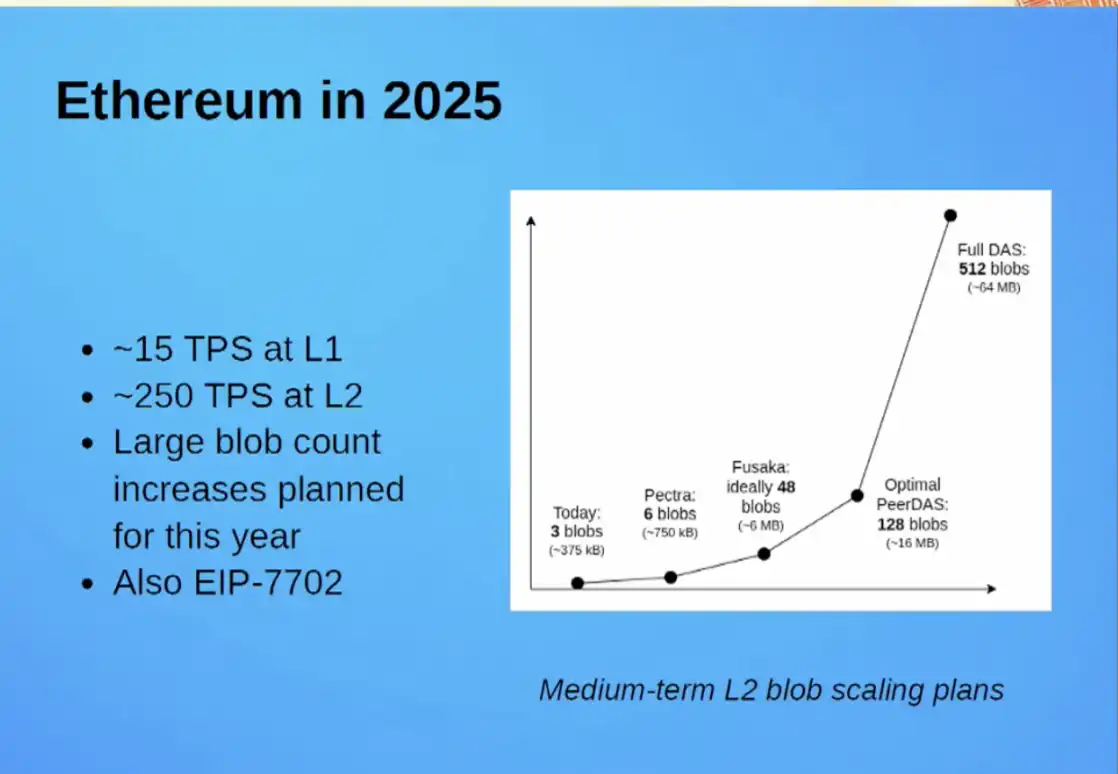
The upcoming Pectra upgrade will increase the Blob count from 3 to 6. Currently, 3 Blobs are approximately 375kb, generating 375kb of data every 12 seconds, roughly 20kb per second, corresponding to TPS of about 250; if the Blob count is increased to 6, TPS is expected to rise to 500. However, the expansion of Blob capacity largely depends on the Fusaka upgrade scheduled for the third or fourth quarter of this year. In an ideal scenario, the Fusaka upgrade could raise the Blob capacity to 48; if DAS is fully implemented, Blob capacity could reach 512, potentially allowing Ethereum L2's TPS to increase to tens of thousands.
Additionally, EIP-7702 has made significant progress, which is essentially the first step in abstracting accounts, giving accounts higher intelligence and security.
Of course, the extension of Ethereum L1 is equally crucial. Even if users widely adopt L2 in the future, L1 will still need to fulfill many key functions. Particularly when L2 experiences failures, L1 needs to provide corresponding remedies or support users in large-scale exit operations.
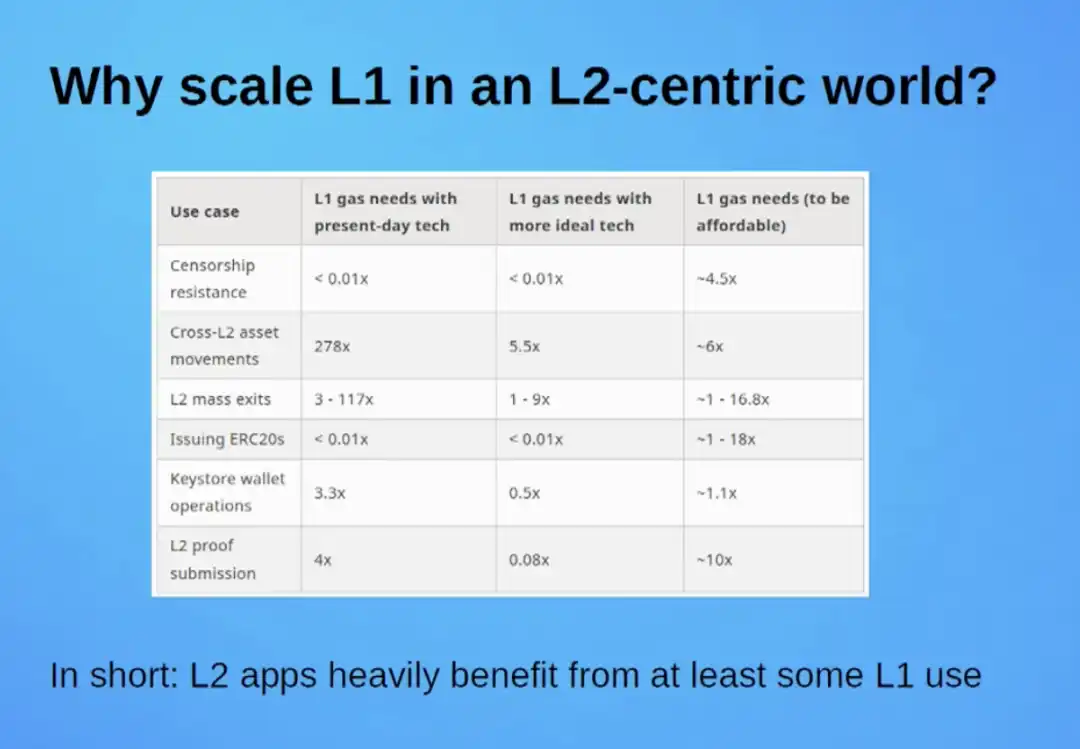
This means that despite the rapid development of L2, enhancing L1's scalability remains crucial to achieve censorship resistance and cross-L2 asset transfers. So, what changes will expanding L1 further bring?
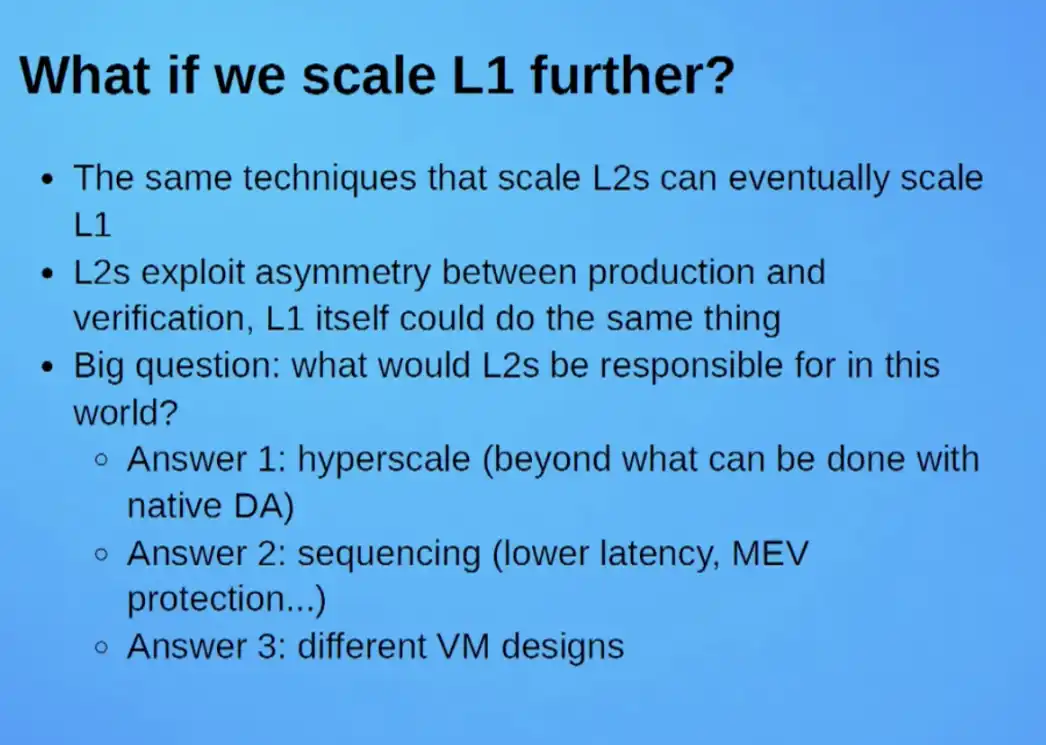
Extension technologies applied to L2 can also be used for L1 scalability in the future; L2 leverages the asymmetry between production and verification, a concept that L1 can also benefit from; in such a world, what responsibilities will L2 take on? 1. Hyperscale (beyond the level achievable by native DA); 2. Orderliness (lower latency, MEV protection, etc.); 3. Different virtual machine (VM) designs.
In other words, L1 can learn from L2's scaling solutions, while L2 continues to focus on processing transactions at hyperscale and experimenting with new technologies.
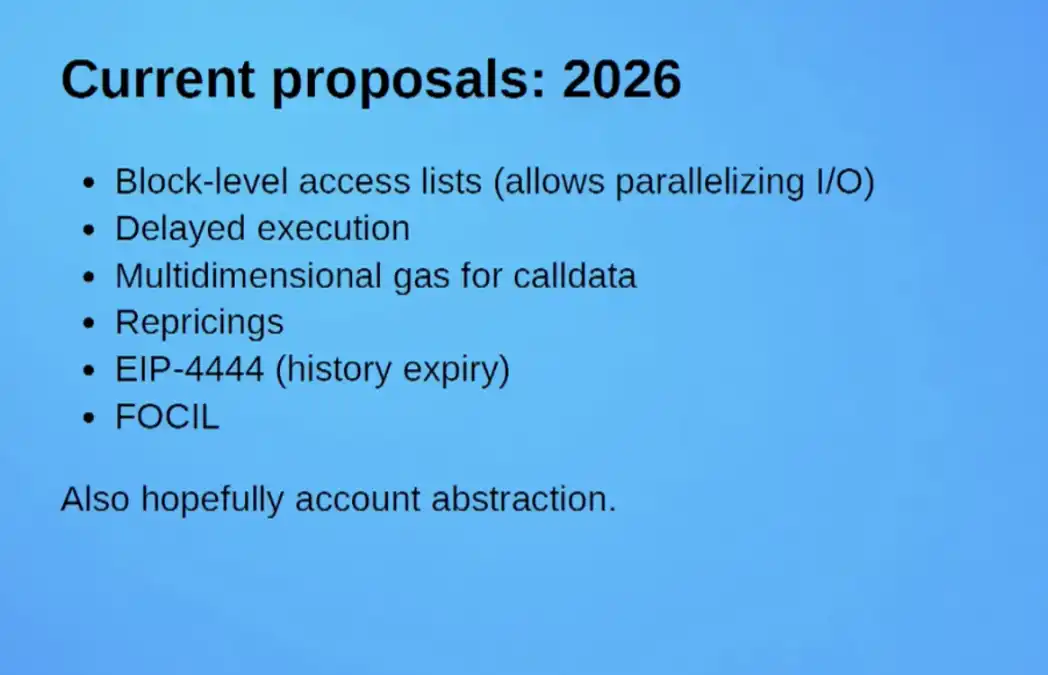
Vitalik expressed that in the short-term roadmap, a series of proposals are expected to be gradually implemented by 2026. Through these proposals, Ethereum is poised to significantly increase the Gas limit and achieve this goal securely while ensuring that node decentralization is not compromised.
Regarding the 2026 plan, some of the proposed initiatives include:
Block-level access lists (allowing I/O parallelization); delayed execution; multi-dimensional calldata Gas; repricing; EIP-4444 (historical data expiry): no longer requiring every Ethereum node to store Ethereum historical records, instead using a peer-to-peer network and distributing historical data in a more decentralized manner; FOCIL.
Vitalik also outlined numerous benefits that account abstraction can bring, including enhanced security and user experience; quantum attack resistance; Paymaster: allowing others to pay Gas fees for you or pay Gas fees with tokens other than ETH; support for smart contract wallets' native use; L1 lead, L1 follow.
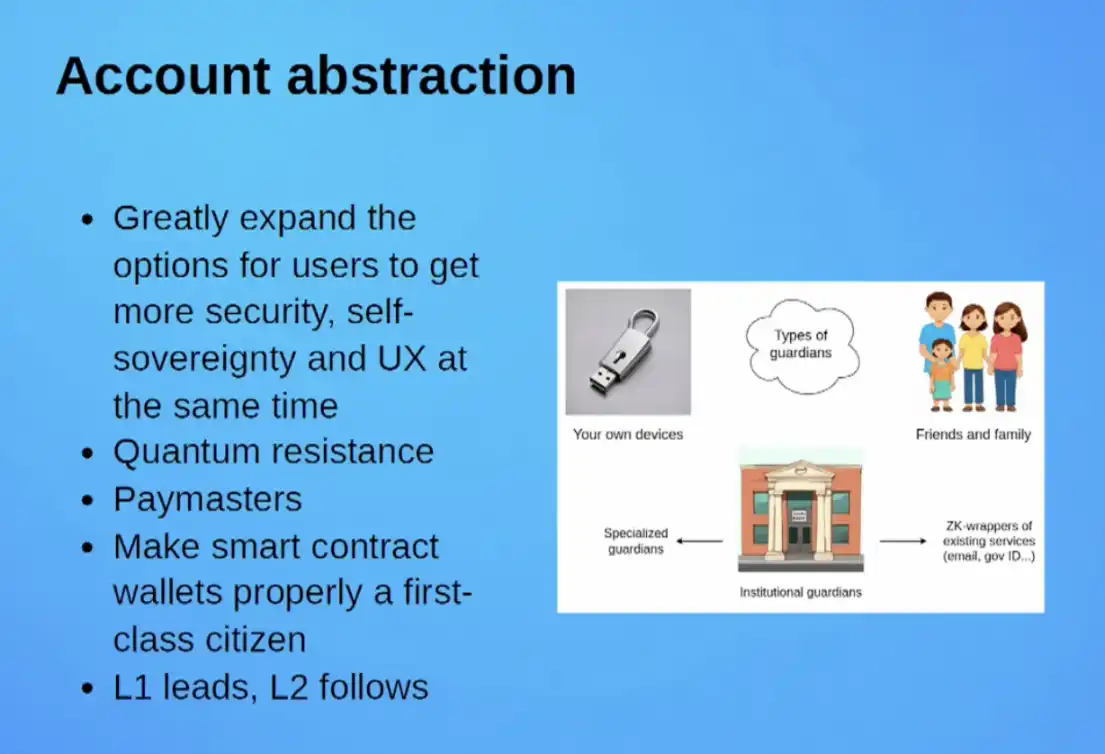
Furthermore, through technologies like Social Recovery and Guardians, Ethereum will provide more decentralized identity verification and asset control solutions.
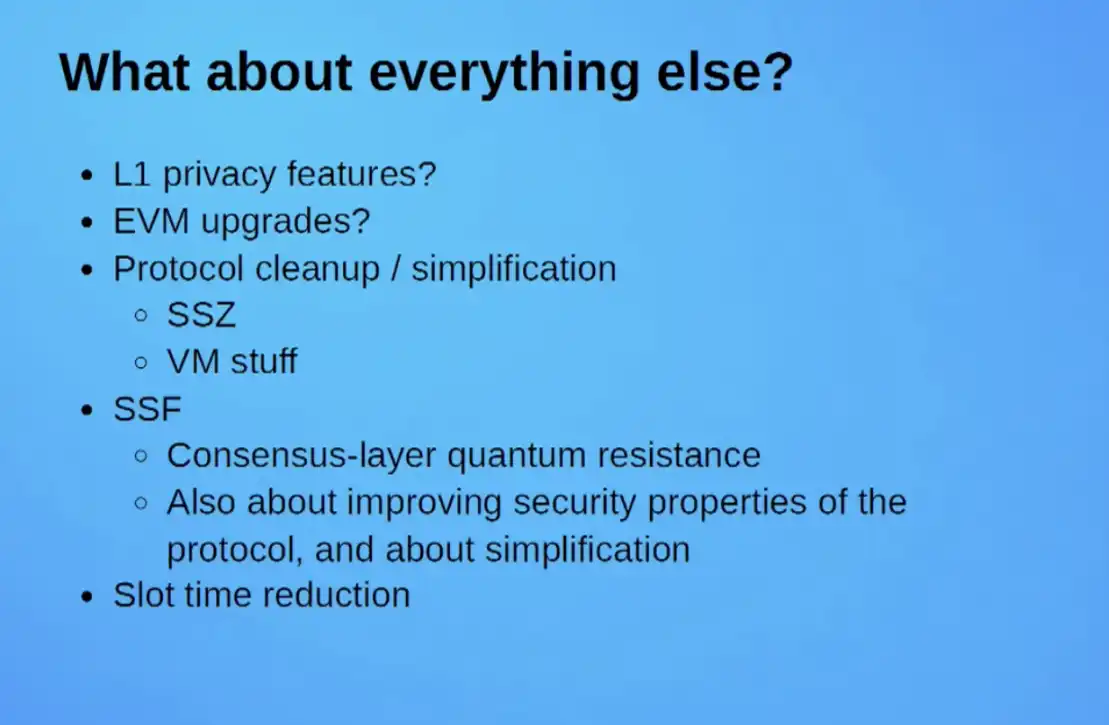
In other aspects, Ethereum is actively exploring L1 privacy enhancement, EVM upgrades, protocol cleanup/simplification, consensus layer quantum resistance improvement, protocol security properties and simplification optimizations, as well as Slot time reduction.
Overall, we need to improve L1, enhance L2, consider Ethereum's diversified development path, including AI-based approaches, improve the application layer, to truly drive the development of the Ethereum ecosystem. Ethereum is striving to be well-prepared for mainstream large-scale applications, with the ultimate goal of making Ethereum L1 the core of the "world computer," supporting a diverse range of applications with high security and efficiency.
You may also like

February 9th Market Key Intelligence, How Much Did You Miss?

After being questioned by Vitalik, L2s are collectively saying goodbye to the "cheap" era

WEEX AI Trading Hackathon Paris Workshop Reveals: How Retail Crypto Traders Can Outperform Hedge Funds
Witness how WEEX's Paris AI Trading Hackathon revealed AI's edge over human traders. Explore key strategies, live competition results & how to build your own AI trading bot.

U.S. Oil (USOR) Price Prediction 2026–2030
Key Takeaways U.S. Oil (USOR) is a speculative Solana-based crypto project that aims to index the United States…

USOR Surges on Meme Narrative Despite No Real-World Asset Backing
Key Takeaways: USOR, a Solana-based token, has seen a notable surge driven by speculative narratives rather than verifiable…

How to Buy U.S. Oil Reserve (USOR) Cryptocurrency
Key Takeaways U.S. Oil Reserve (USOR) is a Solana-based token primarily traded on decentralized exchanges (DEXs). Claims have…

USOR vs Oil ETFs: Understanding Why the ‘Oil Reserve’ Token Doesn’t Track Crude Prices
Key Takeaways The U.S. Oil Reserve (USOR) token has become noteworthy for its claims, yet it does not…

Trend Research Reduces Ether Holdings After Major Market Turbulence
Key Takeaways: Trend Research has significantly cut down its Ether holdings, moving over 404,000 ETH to exchanges recently.…
Investors Channel $258M into Crypto Startups Despite $2 Trillion Market Sell-Off
Key Takeaways: Investors pumped approximately $258 million into crypto startups in early February, highlighting continued support for blockchain-related…
NBA Star Giannis Antetokounmpo Becomes Shareholder in Prediction Market Kalshi
Key Takeaways: Giannis Antetokounmpo, the NBA’s two-time MVP, invests in the prediction market platform Kalshi as a shareholder.…

Arizona Home Invasion Targets $66 Million in Cryptocurrency: Two Teens Charged
Key Takeaways Two teenagers from California face serious felony charges for allegedly attempting to steal $66 million in…

El Salvador’s Bukele Approval Reaches Record 91.9% Despite Limited Bitcoin Use
Key Takeaways: El Salvador President Nayib Bukele enjoys a record high approval rating of 91.9% from his populace,…

Crypto Price Prediction for February 6: XRP, Dogecoin, and Shiba Inu’s Market Movements
Key Takeaways: The crypto market experienced a notable shift with Bitcoin’s significant surge, impacting altcoins like XRP, Dogecoin,…

China Restricts Unapproved Yuan-Pegged Stablecoins to Maintain Currency Stability
Key Takeaways: China’s central bank and seven government agencies have banned the issuance of yuan-pegged stablecoins abroad without…

Solana Price Prediction: $80 SOL Looks Scary – But Smart Money Just Signaled This Might Be the Bottom
Key Takeaways Despite Solana’s descent to $80, some traders find security as smart money enters the fray, suggesting…

XRP Price Prediction: Major Ledger Upgrade Quietly Activated – Why This Could Be the Most Bullish Signal Yet
Key Takeaways: The activation of the Permissioned Domains amendment on XRPL represents a significant development in XRP’s potential…

Dogecoin Price Prediction: Death Cross Confirmed as DOGE Falls Below $0.10 – Is DOGE Reaching Zero?
Key Takeaways The death cross event signals potential bearish trends for Dogecoin as its price dips under $0.10,…

Stablecoin Inflows Have Doubled to $98B Amid Selling Pressure
Key Takeaways Stablecoin inflows to crypto exchanges have surged to $98 billion, doubling previous levels amidst heightened market…
February 9th Market Key Intelligence, How Much Did You Miss?
After being questioned by Vitalik, L2s are collectively saying goodbye to the "cheap" era
WEEX AI Trading Hackathon Paris Workshop Reveals: How Retail Crypto Traders Can Outperform Hedge Funds
Witness how WEEX's Paris AI Trading Hackathon revealed AI's edge over human traders. Explore key strategies, live competition results & how to build your own AI trading bot.
U.S. Oil (USOR) Price Prediction 2026–2030
Key Takeaways U.S. Oil (USOR) is a speculative Solana-based crypto project that aims to index the United States…
USOR Surges on Meme Narrative Despite No Real-World Asset Backing
Key Takeaways: USOR, a Solana-based token, has seen a notable surge driven by speculative narratives rather than verifiable…
How to Buy U.S. Oil Reserve (USOR) Cryptocurrency
Key Takeaways U.S. Oil Reserve (USOR) is a Solana-based token primarily traded on decentralized exchanges (DEXs). Claims have…


 App
App