
- Buy Crypto
- Markets
 Futures
- Spot
- Copy Trade
 Earn
Earn- More
Wall Street's Securities On-Chain Game: The Hidden Capital Race in the RWA Track

Original Article Title: "Wall Street's Securities On-Chain Game: Secret Capital Competition in the RWA Track"
Original Article Author: Ac-Core, YBB Capital Research
1. Introduction: Can RWAs Become the Next Market Inflection Point
With the launch of a Bitcoin spot ETF, the crypto space is experiencing a new turning point. The policy direction during the Trump administration laid the foundation for this field, and now with traditional financial giants like BlackRock entering the scene, it has further accelerated the development of the RWA (Real World Asset) track. More and more financial institutions are exploring how to conduct on-chain trading and management of traditional assets such as stocks and bonds through blockchain technology, a trend that is reshaping the financial market landscape.
The recent initiatives launched by Ondo Finance, such as Ondo Global Markets and Ondo Chain, mark the gradual mainstreaming of the RWA track. This transformation has also sparked a new round of Wall Street's game, quietly altering the rules of the crypto market and traditional finance.
2. Differentiation and Commonalities of RWA Track Projects
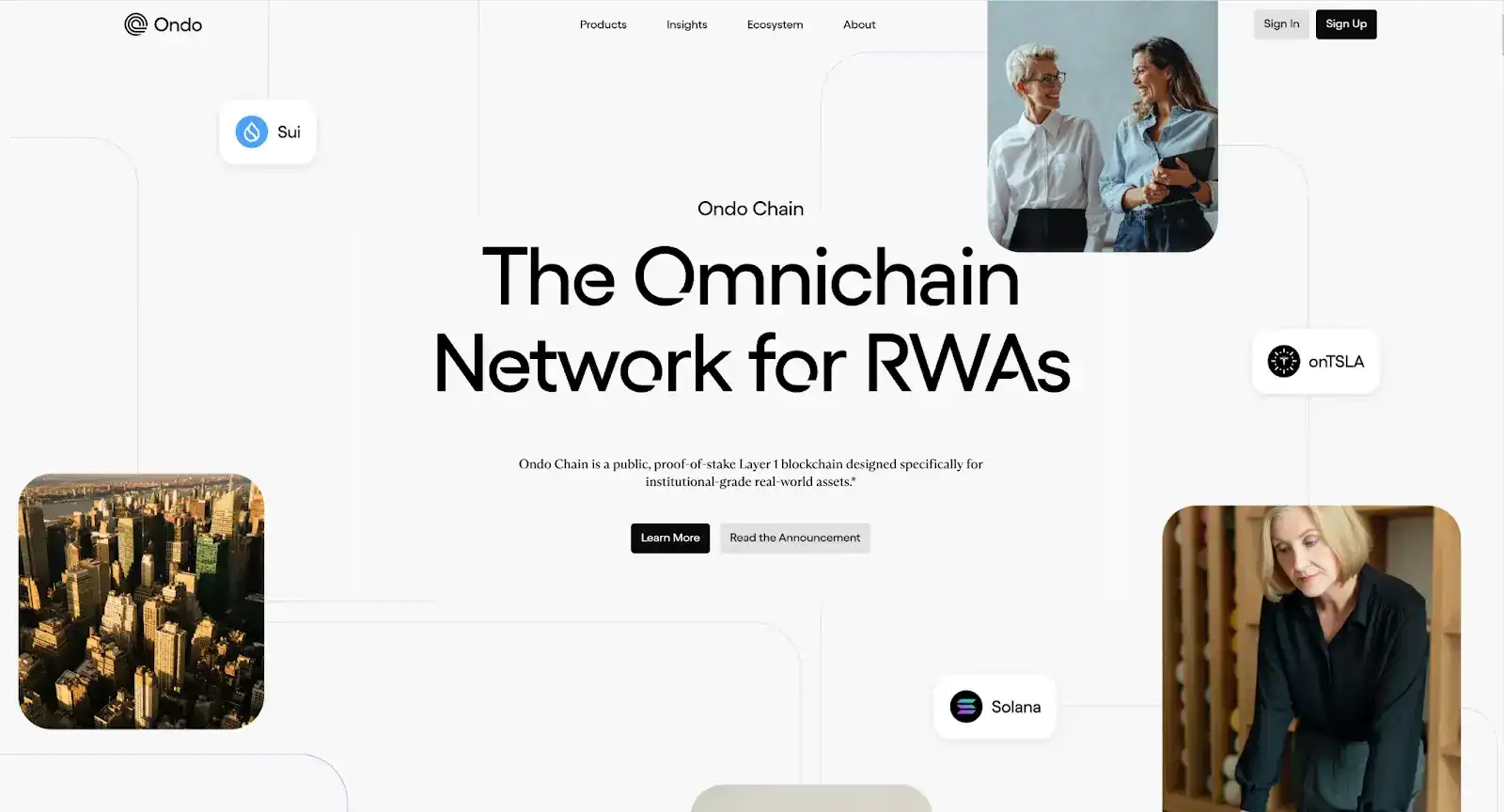
Image Source: Ondo official website
2.1 Represented Project Leveraging BlackRock: Ondo Finance
Recently, Ondo Finance has been making frequent moves. On February 5, they launched the Ondo Global Markets platform, primarily providing blockchain integration services for stocks, bonds, and ETFs. Following this, Ondo Finance announced their new Layer 1 public chain, Ondo Chain, aimed at building a more robust financial infrastructure to drive the tokenization of RWAs.
Ondo Chain serves as the underlying infrastructure of Ondo Global Markets (Ondo GM), focusing on realizing the tokenization of RWAs and integrating them with blockchain. Ondo Chain enables global investors to access U.S.-listed securities (such as stocks, bonds, ETFs) through the blockchain platform, breaking geographical barriers and providing 24/7 uninterrupted trading services.
The Ondo Chain has introduced a solution that embeds institutional-grade compliance into a public chain architecture. Through innovative means such as a permissioned validation node mechanism and a native cross-chain protocol, it aims to overcome the pain points of existing Real World Assets (RWA) on-chain in both technical and institutional aspects. By using traditional financial assets as collateral to ensure network security, Ondo Chain also achieves interoperability with traditional clearing systems to further bridge on-chain and off-chain liquidity.
2.2 Competitive Advantage and Limitation of Ondo Finance in the Same Track Projects
This point is related to both its unique architectural design and strong institutional resources, reflecting the power dynamics and interests between blockchain and traditional finance.
· Competitive Advantage
By partnering with top financial institutions such as BlackRock, it has built a blockchain financial infrastructure capable of supporting the large-scale tokenization of real-world assets, ensuring a balance between compliance and decentralization.
1. Tokenization and Free Transfer of RWA: By pairing assets such as stocks, bonds, ETFs, etc., 1:1 with tokens, investors can freely transfer these tokenized assets outside the United States and integrate them with DeFi to participate in financial activities such as borrowing and yield generation.
2. Integration of Openness and Compliance: Ondo Chain combines the openness of public blockchain with the compliance of permissioned chains. Validators undergo permissioned audits to ensure compliance, while any developer and user can issue tokens and develop applications on the chain to ensure innovation.
3. Institutional Participation and Ecosystem Development: Ondo Chain's design advisory team includes financial institutions such as Franklin Templeton, Wellington Management, WisdomTree, driving its institutional application in TradFi and DeFi fields.
4. Oracle Mechanism and Data Security: The built-in oracle system ensures the accuracy and real-time nature of on-chain data, reducing data manipulation risks. This design enhances the credibility of key data such as asset prices, interest rates, and market indices.
5. Cross-Chain Functionality and Security: By utilizing the Ondo Bridge for cross-chain asset transfers, it provides security for the decentralized validation network (DVN) and supports institutional asset and liquidity management to accommodate large transactions.
· Limitation
Heavy reliance on institutions limits the participation of ordinary users and the decentralized community, and the high degree of centralization means that the majority of power remains in the hands of a few institutions.
1. High Reliance on Institutions, Lack of Community-Driven Initiative
The architecture of Ondo Finance heavily relies on the participation of traditional financial institutions, with the credibility and liquidity of its tokenized assets primarily derived from the endorsement of these institutions. While this model ensures the quality and compliance of tokenized assets, it also brings forth a core issue: its ecosystem is primarily designed for institutions, with low engagement from regular users. Compared to fully decentralized RWA projects, Ondo is more like an extension of the traditional financial world, where the circulation and trading of tokenized assets mostly occur between institutions, diminishing the influence of ordinary investors and the decentralized community.
2. Power Distribution Issue Under Centralized Control
Although Ondo Chain retains some degree of openness, its validators are permissioned, meaning core power is concentrated in the hands of a few institutions. This contrasts sharply with some fully decentralized RWA projects that emphasize any participant can become a crucial node in the network. Ondo's design somewhat reflects the power structure of traditional finance, where most control still resides in the hands of a few large financial institutions. This concentration of power may potentially lead to conflicts in future governance and resource allocation, especially when conflicts arise between token holders and institutional interests.
3. Innovation Speed May Be Constrained by Compliance and Traditional Institutions
Due to Ondo Finance's core pillars of compliance and institutional involvement, its innovation speed may also be limited. In comparison to fully decentralized projects, when introducing new financial products or technologies, Ondo may need to undergo complex compliance processes and institutional approval. This may pose a risk of delayed response in the fast-paced crypto space, particularly when competing with more agile DeFi projects. Its compliance and institution-oriented architecture could become a burden when striving for innovation.
III. Realistic Obstacles Faced by RWA Projects
Although blockchain technology provides the technical foundation for on-chain RWA, current public chains still struggle to meet the needs of traditional finance in high-frequency trading, real-time settlements, etc. Additionally, the fragmentation and security issues in cross-chain ecosystems further exacerbate the difficulty for institutions to deploy RWA. The application of RWA in decentralized finance (DeFi) faces several realistic obstacles:
Firstly, the trust and consistency between assets and on-chain data pose a core challenge for on-chain RWA. The key to on-chain RWA lies in ensuring the consistency between real-world assets and on-chain data. For instance, after tokenizing a real estate property, the ownership, value, and other information recorded on-chain must fully match the legal documents and status of the asset in the real world. However, this involves two key issues: the authenticity of on-chain data, i.e., how to ensure the credibility and tamper resistance of on-chain data sources; and data synchronization updates, i.e., how to ensure that on-chain information can dynamically reflect changes in the real-world asset status. Addressing these issues typically requires the introduction of trusted third parties or authoritative institutions (such as governments or certifying bodies), but this conflicts with the decentralized nature of blockchain, and the trust issue remains a core challenge that on-chain RWA finds hard to avoid.
Insufficient network security is also a significant issue. The security of a blockchain network usually relies on the native token's economic incentive mechanism. However, RWA's volatility is typically lower than that of cryptocurrencies, especially during market downturns, which may lead to a decrease in network security. Furthermore, the complexity of RWAs requires higher security standards, and existing blockchain systems may not fully meet these requirements.
The compatibility issues between RWA and DeFi architecture have not been resolved. The original design of DeFi was to serve crypto-native assets, not traditional securities. On-chain RWA involves complex financial behaviors (such as stock splits and dividend distributions), which are challenging to manage effectively through existing DeFi systems. Of particular importance, oracle systems have significant shortcomings in handling real-time and secure large-scale traditional financial data.
Increasing the difficulty of on-chain RWAs is the additional challenge of cross-chain liquidity dispersion and security issues. The cross-chain issuance of RWA leads to liquidity dispersion, increasing asset management complexity. While cross-chain bridging mechanisms provide solutions, they also introduce new security risks, such as double-spending attacks and protocol vulnerabilities.
Institutional regulatory and compliance issues are the most significant non-technical barriers to on-chain RWAs. Many regulated financial institutions are unable to transact on public blockchains due to reasons such as anonymity, lack of compliance frameworks, and differences in global regulatory standards. Compliance requirements such as KYC and anti-money laundering further increase the complexity of on-chain RWAs, to some extent restricting capital inflows.
Market-side liquidity and institutional participation restrictions also hinder the development of RWAs. Currently, the overall market value of RWAs is mainly concentrated in low-risk assets (such as government bonds and funds), with slow progress in on-chaining large asset classes such as stocks and real estate. RWA's liquidity still depends on crypto-native protocols, and the overall market is still in the early stages of development.
Finally, the conflict between DeFi and traditional financial trust mechanisms is also a challenge that on-chain RWAs must address. DeFi relies on code and cryptography to build trust, while traditional finance relies on legal contracts and centralized institutions. This difference in trust mechanisms has led traditional financial institutions to be cautious about blockchain technology, especially in custody, risk control, and other key areas.
Although blockchain technology provides the potential for on-chain RWAs, there are still many challenges in practical applications. From data consistency, network security, compatibility, liquidity, and compliance to the matching of technological and economic models and the conflict of trust mechanisms, these issues need to be gradually addressed in development to drive widespread RWA adoption in DeFi.
IV. If RWA succeeds, Ondo Chain may become a redistributor of power in the "Wall Street Game," reshaping the power dynamics of the old and new financial systems.
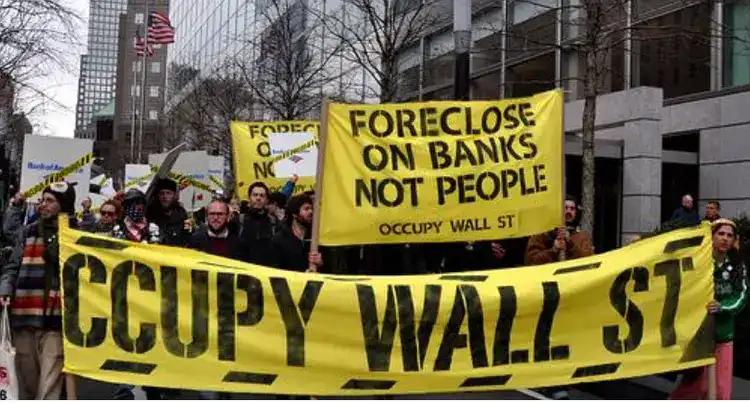
Image Source: Occupy Wall Street
When analyzing the core Wall Street interests behind the Ondo Chain, I believe it is necessary to look beyond the phenomenon of blockchain and real asset tokenization and focus on the financial operational logic and the driving factors behind interests. As mentioned earlier, the most critical non-technical challenge of RWAs lies in achieving compliance, which ultimately relies on the recognition of powerful centralized regulatory bodies.
The world's largest asset management company, BlackRock, after successfully advancing a Bitcoin ETF, has engaged in RWA investment and development. This fundamentally represents the initial effort to reallocate power between the traditional financial system and the emerging decentralized blockchain-based technology. This struggle is not merely a competition of technological innovation or financial creativity but rather a battle for global financial rule-making authority, capital control, and the future wealth distribution mechanism.
Despite the hope that blockchain technology brings decentralization, faced with highly centralized capital and power, Wall Street is attempting to incorporate this technological revolution under its control. Through new forms of market manipulation and asset securitization, it seeks to maintain its dominant position in the global financial system.
4.1 Rebalancing of Global Financial System Power
Wall Street has long dominated the global financial system, controlling key nodes of fund flows, asset management, and financial services. Traditional financial institutions have achieved control over global capital by monopolizing financial infrastructure (banks, stock exchanges, clearing systems, etc.). However, the rise of blockchain technology has disrupted this status quo:
Decentralized Finance (DeFi) has weakened Wall Street's long-standing control over traditional financial infrastructure through disintermediation. DeFi allows key functions such as capital flows and asset management to operate on decentralized platforms. Users can engage in asset management, lending, trading, etc., directly on the blockchain without banks or investment banks as intermediaries. But for Wall Street, this poses a significant threat as this power shift could mean losing dominance over the global financial system.
4.2 Asset Tokenization: Who Can Control the New Financial Infrastructure
While platforms like Ondo Chain are driving RWA tokenization to enhance asset liquidity, behind this effort lies a struggle for control over the new financial infrastructure. Blockchain networks are candidates for the new generation of global financial infrastructure, and whoever can lead this infrastructure will likely dominate the connection of real-world assets to the blockchain in the future.
The interest of Wall Street is reflected in the intent to control these decentralized networks. They may not directly oppose blockchain but rather seek to control these emerging blockchain platforms through investment, acquisitions, or partnerships, leading to a reemergence of capital centralization. Although blockchain aims to be decentralized, a significant amount of capital and liquidity can still be concentrated in a few large financial institutions or hedge funds. This ultimately results in key resources on blockchain platforms (liquidity, protocol governance rights, etc.) reverting to the hands of a few players, causing a decentralized asset market to be heavily influenced by centralized powerful forces.
4.3 Regulatory Arbitrage and Extralegal Power
As of February 6, according to a report by Cointelegraph, JPMorgan's latest institutional trader survey on electronic trading shows that 29% of institutional traders are already or will soon be engaged in cryptocurrency trading, a 7 percentage point increase from last year.
Arbitrage has always been a trading strategy that Wall Street elites excel at. Faced with the uncertain regulatory environment due to the decentralized nature of blockchain, future Wall Street institutions may exploit regulatory disparities across different countries and regions by establishing operational entities in jurisdictions with more lenient regulations to evade stricter oversight. For example:
In projects like Ondo Chain, the tokenization of certain RWAs may circumvent traditional securities or financial market regulations. By manipulating asset flows and capital structures across different regulatory environments, further control over emerging markets is strengthened. It is not ruled out that this "gray area" operation is one of the means by which Wall Street gains higher returns through blockchain.
4.4 Market Liquidity and Price Manipulation: The Struggle for Tacit Dominance
Liquidity is at the core of market manipulation, achieving implicit price manipulation in seemingly "decentralized" markets. Ondo Chain provides global investors with new investment opportunities through the tokenization of RWAs, but its liquidity and trade depth still heavily rely on large capital injections. Liquidity control will continue to be a key weapon for Wall Street players. Even in a blockchain decentralized environment, institutions with more capital, trading technology, and market insights can still dominate market trends.
4.5 RWA Hedge Funds: Restructuring the Asset Securitization Game
Throughout history, Wall Street has achieved significant gains through asset securitization (such as subprime mortgage securitization). Blockchain-based RWA tokenization provides an opportunity for a new generation of asset securitization. For example, Wall Street can issue new financial products attracting global investors through the tokenization of asset portfolios. These products can be based on RWAs, such as real estate trust fund tokens, corporate bond tokens, providing more options to the market.
The derivatives market may also see expansion through blockchain. Wall Street can design complex financial instruments (such as options, futures, swaps) and once again package risk to sell to global investors. The game of risk transfer and profit-taking will continue to play out in the era of RWA tokenization.
Five, The Advanced Road of the Crypto World, Industry Development Forced to Hit the Accelerator
Using Bitcoin as an example, we analyze ETF trading of crypto assets, Trump-related events, and future RWAs, all of which have accelerated the industry's development to varying degrees, resulting in increased industry profitability challenges. These factors impact the crypto industry through complex market dynamics, regulatory pressure, and the gradual penetration of the traditional financial ecosystem.
5.1 Market Maturation Due to ETF Introduction
The launch of ETFs signifies the gradual acceptance of the crypto industry by mainstream financial institutions and investors, but it may not necessarily be advantageous for the overall growth of the crypto industry, similar to how gold saw a long-term uptrend through ETFs:
· Decrease in market liquidity and volatility
The introduction of ETFs means that crypto assets are entering the traditional financial market, attracting more conservative institutional investment styles, and the introduction of more financial derivatives has also led to a decrease in crypto asset volatility. For traders who rely on high volatility (such as retail traders and crypto hedge funds), this means reduced arbitrage and high-frequency trading opportunities, thereby reducing profit margins.
· Concentration of fund flows
ETFs make the flow of funds in the crypto market more concentrated, mainly focusing on a few large assets like Bitcoin. This may lead to liquidity drying up and price drops for small to mid-cap crypto assets, affecting the development opportunities of more small projects. As a result, the profit opportunities for more emerging projects decrease, leading to an overall increase in industry profitability challenges.
· Competitive pressure from traditional finance
The launch of ETFs means that crypto assets are becoming financialized, bringing greater market transparency and competition. This also means that the crypto industry must compete more fiercely with traditional financial instruments such as stocks, bonds, and commodities, diverting attention and funds from investors.
5.2 Market Uncertainty Due to the Trump Effect
Actions of political figures like Trump may affect the crypto market through their policies, regulatory attitudes, and international relations, increasing industry uncertainty and complexity:
· Increased policy uncertainty
Trump's policy positions and governing style are often filled with uncertainty, especially when it comes to matters of the economy and financial regulation. The regulatory policies that he and his administration may implement during his term, such as crackdowns on digital currencies or regulatory relaxations, will directly affect market sentiment, increasing the instability of the crypto market. This uncertainty will expose the crypto industry to greater policy risks, affecting the stability of long-term profitability.
· Strengthening of Anti-Money Laundering (AML) and Know Your Customer (KYC) Requirements
Due to the possibility of future stricter AML and KYC regulations by politicians such as Trump, exchanges and crypto projects will face higher compliance costs. This will significantly increase operational costs, squeeze profit margins, especially for crypto companies lacking compliance expertise.
· President-Themed Coin "TRUMP" Leading to Market "Siphoning Effect"
High volatility attracts speculative funds, and "TRUMP" has a natural marketing effect, able to attract a large amount of funds to concentrate in this single asset. The limited liquidity and capital in the market are easily "siphoned" by meme coins, creating a "capital concentration effect," but as the price later falls, it is also challenging to redistribute liquidity.
5.3 Development of Real World Assets (RWA) Will Bring Traditional Finance Integration
The development of RWA in the crypto space represents a trend of gradual integration of crypto markets with traditional financial assets, but this integration also brings increased profitability challenges:
· Introduction of Traditional Finance's Cost Structure and Competition
When RWA projects are scaled on-chain, traditional financial assets such as bonds, stocks, real estate, etc., will compete with crypto assets in the same ecosystem. The maturity, cost efficiency, and low-risk characteristics of traditional financial products will attract a large number of institutional investors, meaning that crypto assets need to compete with these mature financial products.
· Contradiction Between Decentralization and Compliance
The on-chain implementation of RWA involves complex regulatory requirements, especially in terms of compliance and legal responsibilities. Compared to current decentralized crypto assets, the introduction of RWA may force more crypto projects to move towards compliance, causing more projects to exit the market due to being unable to meet regulatory requirements, thereby reducing profit opportunities.
· Fund Influx Towards Low-Risk Assets
The on-chain representation of real-world assets, such as government bonds, corporate bonds, etc., will attract a large number of conservative investors to the on-chain market. As more funds flow into low-risk RWAs, high-risk, high-return projects in the crypto market (such as DeFi protocols or emerging tokens) may lose some fund support. This phenomenon of fund migration to low-risk assets will further squeeze the profit margin of the crypto market.
VI. Conclusion: Is RWA a Narrative Bubble or a Market Game Changer?
In conclusion, ETFs, the Trump Effect, and the rise of RWA in the future will increase the profitability challenges of the crypto industry through different avenues and intensities. ETFs bring market maturity and institutionalization, reducing market volatility and high-profit opportunities; Trump's policies may increase market uncertainty, bringing policy risks to the industry; and the introduction of RWA means that the crypto market will compete with the traditional financial market. In this continuously evolving process, as crypto assets become more "mainstream," the market becomes more "bottlenecked," leading to more severe challenges in the future crypto market.
So is RWA really a "Narrative Bubble" or a "Market Disruption," depending on the maturity of its technical foundation, market demand, and implementation path. If we only look at the progress and challenges in the current early stage, RWA has a certain element of a "Narrative Bubble." However, with the deep involvement of reputable institutions, RWA is expected to become a new catalyst for a market disruption in the crypto space.
This article is contributed content and does not represent the views of BlockBeats.
You may also like

Token Cannot Compound, Where Is the Real Investment Opportunity?

February 6th Market Key Intelligence, How Much Did You Miss?

China's Central Bank and Eight Other Departments' Latest Regulatory Focus: Key Attention to RWA Tokenized Asset Risk
Foreword: Today, the People's Bank of China's website published the "Notice of the People's Bank of China, National Development and Reform Commission, Ministry of Industry and Information Technology, Ministry of Public Security, State Administration for Market Regulation, China Banking and Insurance Regulatory Commission, China Securities Regulatory Commission, State Administration of Foreign Exchange on Further Preventing and Dealing with Risks Related to Virtual Currency and Others (Yinfa [2026] No. 42)", the latest regulatory requirements from the eight departments including the central bank, which are basically consistent with the regulatory requirements of recent years. The main focus of the regulation is on speculative activities such as virtual currency trading, exchanges, ICOs, overseas platform services, and this time, regulatory oversight of RWA has been added, explicitly prohibiting RWA tokenization, stablecoins (especially those pegged to the RMB). The following is the full text:
To the people's governments of all provinces, autonomous regions, and municipalities directly under the Central Government, the Xinjiang Production and Construction Corps:
Recently, there have been speculative activities related to virtual currency and Real-World Assets (RWA) tokenization, disrupting the economic and financial order and jeopardizing the property security of the people. In order to further prevent and address the risks related to virtual currency and Real-World Assets tokenization, effectively safeguard national security and social stability, in accordance with the "Law of the People's Republic of China on the People's Bank of China," "Law of the People's Republic of China on Commercial Banks," "Securities Law of the People's Republic of China," "Law of the People's Republic of China on Securities Investment Funds," "Law of the People's Republic of China on Futures and Derivatives," "Cybersecurity Law of the People's Republic of China," "Regulations of the People's Republic of China on the Administration of Renminbi," "Regulations on Prevention and Disposal of Illegal Fundraising," "Regulations of the People's Republic of China on Foreign Exchange Administration," "Telecommunications Regulations of the People's Republic of China," and other provisions, after reaching consensus with the Cyberspace Administration of China, the Supreme People's Court, and the Supreme People's Procuratorate, and with the approval of the State Council, the relevant matters are notified as follows:
(I) Virtual currency does not possess the legal status equivalent to fiat currency. Virtual currencies such as Bitcoin, Ether, Tether, etc., have the main characteristics of being issued by non-monetary authorities, using encryption technology and distributed ledger or similar technology, existing in digital form, etc. They do not have legal tender status, should not and cannot be circulated and used as currency in the market.
The business activities related to virtual currency are classified as illegal financial activities. The exchange of fiat currency and virtual currency within the territory, exchange of virtual currencies, acting as a central counterparty in buying and selling virtual currencies, providing information intermediary and pricing services for virtual currency transactions, token issuance financing, and trading of virtual currency-related financial products, etc., fall under illegal financial activities, such as suspected illegal issuance of token vouchers, unauthorized public issuance of securities, illegal operation of securities and futures business, illegal fundraising, etc., are strictly prohibited across the board and resolutely banned in accordance with the law. Overseas entities and individuals are not allowed to provide virtual currency-related services to domestic entities in any form.
A stablecoin pegged to a fiat currency indirectly fulfills some functions of the fiat currency in circulation. Without the consent of relevant authorities in accordance with the law and regulations, any domestic or foreign entity or individual is not allowed to issue a RMB-pegged stablecoin overseas.
(II)Tokenization of Real-World Assets refers to the use of encryption technology and distributed ledger or similar technologies to transform ownership rights, income rights, etc., of assets into tokens (tokens) or other interests or bond certificates with token (token) characteristics, and carry out issuance and trading activities.
Engaging in the tokenization of real-world assets domestically, as well as providing related intermediary, information technology services, etc., which are suspected of illegal issuance of token vouchers, unauthorized public offering of securities, illegal operation of securities and futures business, illegal fundraising, and other illegal financial activities, shall be prohibited; except for relevant business activities carried out with the approval of the competent authorities in accordance with the law and regulations and relying on specific financial infrastructures. Overseas entities and individuals are not allowed to illegally provide services related to the tokenization of real-world assets to domestic entities in any form.
(III) Inter-agency Coordination. The People's Bank of China, together with the National Development and Reform Commission, the Ministry of Industry and Information Technology, the Ministry of Public Security, the State Administration for Market Regulation, the China Banking and Insurance Regulatory Commission, the China Securities Regulatory Commission, the State Administration of Foreign Exchange, and other departments, will improve the work mechanism, strengthen coordination with the Cyberspace Administration of China, the Supreme People's Court, and the Supreme People's Procuratorate, coordinate efforts, and overall guide regions to carry out risk prevention and disposal of virtual currency-related illegal financial activities.
The China Securities Regulatory Commission, together with the National Development and Reform Commission, the Ministry of Industry and Information Technology, the Ministry of Public Security, the People's Bank of China, the State Administration for Market Regulation, the China Banking and Insurance Regulatory Commission, the State Administration of Foreign Exchange, and other departments, will improve the work mechanism, strengthen coordination with the Cyberspace Administration of China, the Supreme People's Court, and the Supreme People's Procuratorate, coordinate efforts, and overall guide regions to carry out risk prevention and disposal of illegal financial activities related to the tokenization of real-world assets.
(IV) Strengthening Local Implementation. The people's governments at the provincial level are overall responsible for the prevention and disposal of risks related to virtual currencies and the tokenization of real-world assets in their respective administrative regions. The specific leading department is the local financial regulatory department, with participation from branches and dispatched institutions of the State Council's financial regulatory department, telecommunications regulators, public security, market supervision, and other departments, in coordination with cyberspace departments, courts, and procuratorates, to improve the normalization of the work mechanism, effectively connect with the relevant work mechanisms of central departments, form a cooperative and coordinated working pattern between central and local governments, effectively prevent and properly handle risks related to virtual currencies and the tokenization of real-world assets, and maintain economic and financial order and social stability.
(5) Enhanced Risk Monitoring. The People's Bank of China, China Securities Regulatory Commission, National Development and Reform Commission, Ministry of Industry and Information Technology, Ministry of Public Security, State Administration of Foreign Exchange, Cyberspace Administration of China, and other departments continue to improve monitoring techniques and system support, enhance cross-departmental data analysis and sharing, establish sound information sharing and cross-validation mechanisms, promptly grasp the risk situation of activities related to virtual currency and real-world asset tokenization. Local governments at all levels give full play to the role of local monitoring and early warning mechanisms. Local financial regulatory authorities, together with branches and agencies of the State Council's financial regulatory authorities, as well as departments of cyberspace and public security, ensure effective connection between online monitoring, offline investigation, and fund tracking, efficiently and accurately identify activities related to virtual currency and real-world asset tokenization, promptly share risk information, improve early warning information dissemination, verification, and rapid response mechanisms.
(6) Strengthened Oversight of Financial Institutions, Intermediaries, and Technology Service Providers. Financial institutions (including non-bank payment institutions) are prohibited from providing account opening, fund transfer, and clearing services for virtual currency-related business activities, issuing and selling financial products related to virtual currency, including virtual currency and related financial products in the scope of collateral, conducting insurance business related to virtual currency, or including virtual currency in the scope of insurance liability. Financial institutions (including non-bank payment institutions) are prohibited from providing custody, clearing, and settlement services for unauthorized real-world asset tokenization-related business and related financial products. Relevant intermediary institutions and information technology service providers are prohibited from providing intermediary, technical, or other services for unauthorized real-world asset tokenization-related businesses and related financial products.
(7) Enhanced Management of Internet Information Content and Access. Internet enterprises are prohibited from providing online business venues, commercial displays, marketing, advertising, or paid traffic diversion services for virtual currency and real-world asset tokenization-related business activities. Upon discovering clues of illegal activities, they should promptly report to relevant departments and provide technical support and assistance for related investigations and inquiries. Based on the clues transferred by the financial regulatory authorities, the cyberspace administration, telecommunications authorities, and public security departments should promptly close and deal with websites, mobile applications (including mini-programs), and public accounts engaged in virtual currency and real-world asset tokenization-related business activities in accordance with the law.
(8) Strengthened Entity Registration and Advertisement Management. Market supervision departments strengthen entity registration and management, and enterprise and individual business registrations must not contain terms such as "virtual currency," "virtual asset," "cryptocurrency," "crypto asset," "stablecoin," "real-world asset tokenization," or "RWA" in their names or business scopes. Market supervision departments, together with financial regulatory authorities, legally enhance the supervision of advertisements related to virtual currency and real-world asset tokenization, promptly investigating and handling relevant illegal advertisements.
(IX) Continued Rectification of Virtual Currency Mining Activities. The National Development and Reform Commission, together with relevant departments, strictly controls virtual currency mining activities, continuously promotes the rectification of virtual currency mining activities. The people's governments of various provinces take overall responsibility for the rectification of "mining" within their respective administrative regions. In accordance with the requirements of the National Development and Reform Commission and other departments in the "Notice on the Rectification of Virtual Currency Mining Activities" (NDRC Energy-saving Building [2021] No. 1283) and the provisions of the "Guidance Catalog for Industrial Structure Adjustment (2024 Edition)," a comprehensive review, investigation, and closure of existing virtual currency mining projects are conducted, new mining projects are strictly prohibited, and mining machine production enterprises are strictly prohibited from providing mining machine sales and other services within the country.
(X) Severe Crackdown on Related Illegal Financial Activities. Upon discovering clues to illegal financial activities related to virtual currency and the tokenization of real-world assets, local financial regulatory authorities, branches of the State Council's financial regulatory authorities, and other relevant departments promptly investigate, determine, and properly handle the issues in accordance with the law, and seriously hold the relevant entities and individuals legally responsible. Those suspected of crimes are transferred to the judicial authorities for processing according to the law.
(XI) Severe Crackdown on Related Illegal and Criminal Activities. The Ministry of Public Security, the People's Bank of China, the State Administration for Market Regulation, the China Banking and Insurance Regulatory Commission, the China Securities Regulatory Commission, as well as judicial and procuratorial organs, in accordance with their respective responsibilities, rigorously crack down on illegal and criminal activities related to virtual currency, the tokenization of real-world assets, such as fraud, money laundering, illegal business operations, pyramid schemes, illegal fundraising, and other illegal and criminal activities carried out under the guise of virtual currency, the tokenization of real-world assets, etc.
(XII) Strengthen Industry Self-discipline. Relevant industry associations should enhance membership management and policy advocacy, based on their own responsibilities, advocate and urge member units to resist illegal financial activities related to virtual currency and the tokenization of real-world assets. Member units that violate regulatory policies and industry self-discipline rules are to be disciplined in accordance with relevant self-regulatory management regulations. By leveraging various industry infrastructure, conduct risk monitoring related to virtual currency, the tokenization of real-world assets, and promptly transfer issue clues to relevant departments.
(XIII) Without the approval of relevant departments in accordance with the law and regulations, domestic entities and foreign entities controlled by them may not issue virtual currency overseas.
(XIV) Domestic entities engaging directly or indirectly in overseas external debt-based tokenization of real-world assets, or conducting asset securitization activities abroad based on domestic ownership rights, income rights, etc. (hereinafter referred to as domestic equity), should be strictly regulated in accordance with the principles of "same business, same risk, same rules." The National Development and Reform Commission, the China Securities Regulatory Commission, the State Administration of Foreign Exchange, and other relevant departments regulate it according to their respective responsibilities. For other forms of overseas real-world asset tokenization activities based on domestic equity by domestic entities, the China Securities Regulatory Commission, together with relevant departments, supervise according to their division of responsibilities. Without the consent and filing of relevant departments, no unit or individual may engage in the above-mentioned business.
(15) Overseas subsidiaries and branches of domestic financial institutions providing Real World Asset Tokenization-related services overseas shall do so legally and prudently. They shall have professional personnel and systems in place to effectively mitigate business risks, strictly implement customer onboarding, suitability management, anti-money laundering requirements, and incorporate them into the domestic financial institutions' compliance and risk management system. Intermediaries and information technology service providers offering Real World Asset Tokenization services abroad based on domestic equity or conducting Real World Asset Tokenization business in the form of overseas debt for domestic entities directly or indirectly venturing abroad must strictly comply with relevant laws and regulations. They should establish and improve relevant compliance and internal control systems in accordance with relevant normative requirements, strengthen business and risk control, and report the business developments to the relevant regulatory authorities for approval or filing.
(16) Strengthen organizational leadership and overall coordination. All departments and regions should attach great importance to the prevention of risks related to virtual currencies and Real World Asset Tokenization, strengthen organizational leadership, clarify work responsibilities, form a long-term effective working mechanism with centralized coordination, local implementation, and shared responsibilities, maintain high pressure, dynamically monitor risks, effectively prevent and mitigate risks in an orderly and efficient manner, legally protect the property security of the people, and make every effort to maintain economic and financial order and social stability.
(17) Widely carry out publicity and education. All departments, regions, and industry associations should make full use of various media and other communication channels to disseminate information through legal and policy interpretation, analysis of typical cases, and education on investment risks, etc. They should promote the illegality and harm of virtual currencies and Real World Asset Tokenization-related businesses and their manifestations, fully alert to potential risks and hidden dangers, and enhance public awareness and identification capabilities for risk prevention.
(18) Engaging in illegal financial activities related to virtual currencies and Real World Asset Tokenization in violation of this notice, as well as providing services for virtual currencies and Real World Asset Tokenization-related businesses, shall be punished in accordance with relevant regulations. If it constitutes a crime, criminal liability shall be pursued according to the law. For domestic entities and individuals who knowingly or should have known that overseas entities illegally provided virtual currency or Real World Asset Tokenization-related services to domestic entities and still assisted them, relevant responsibilities shall be pursued according to the law. If it constitutes a crime, criminal liability shall be pursued according to the law.
(19) If any unit or individual invests in virtual currencies, Real World Asset Tokens, and related financial products against public order and good customs, the relevant civil legal actions shall be invalid, and any resulting losses shall be borne by them. If there are suspicions of disrupting financial order and jeopardizing financial security, the relevant departments shall deal with them according to the law.
This notice shall enter into force upon the date of its issuance. The People's Bank of China and ten other departments' "Notice on Further Preventing and Dealing with the Risks of Virtual Currency Trading Speculation" (Yinfa [2021] No. 237) is hereby repealed.

Former Partner's Perspective on Multicoin: Kyle's Exit, But the Game He Left Behind Just Getting Started

Why Bitcoin Is Falling Now: The Real Reasons Behind BTC's Crash & WEEX's Smart Profit Playbook
Bitcoin's ongoing crash explained: Discover the 5 hidden triggers behind BTC's plunge & how WEEX's Auto Earn and Trade to Earn strategies help traders profit from crypto market volatility.

Wall Street's Hottest Trades See Exodus

Vitalik Discusses Ethereum Scaling Path, Circle Announces Partnership with Polymarket, What's the Overseas Crypto Community Talking About Today?

Believing in the Capital Markets - The Essence and Core Value of Cryptocurrency

Polymarket's 'Weatherman': Predict Temperature, Win Million-Dollar Payout

$15K+ Profits: The 4 AI Trading Secrets WEEX Hackathon Prelim Winners Used to Dominate Volatile Crypto Markets
How WEEX Hackathon's top AI trading strategies made $15K+ in crypto markets: 4 proven rules for ETH/BTC trading, market structure analysis, and risk management in volatile conditions.

A nearly 20% one-day plunge, how long has it been since you last saw a $60,000 Bitcoin?

Raoul Pal: I've seen every single panic, and they are never the end.

Key Market Information Discrepancy on February 6th - A Must-Read! | Alpha Morning Report

2026 Crypto Industry's First Snowfall
The Harsh Reality Behind the $26 Billion Crypto Liquidation: Liquidity Is Killing the Market
Why Is Gold, US Stocks, Bitcoin All Falling?

Key Market Intelligence for February 5th, how much did you miss out on?

Wintermute: By 2026, crypto had gradually become the settlement layer of the Internet economy
Token Cannot Compound, Where Is the Real Investment Opportunity?
February 6th Market Key Intelligence, How Much Did You Miss?
China's Central Bank and Eight Other Departments' Latest Regulatory Focus: Key Attention to RWA Tokenized Asset Risk
Foreword: Today, the People's Bank of China's website published the "Notice of the People's Bank of China, National Development and Reform Commission, Ministry of Industry and Information Technology, Ministry of Public Security, State Administration for Market Regulation, China Banking and Insurance Regulatory Commission, China Securities Regulatory Commission, State Administration of Foreign Exchange on Further Preventing and Dealing with Risks Related to Virtual Currency and Others (Yinfa [2026] No. 42)", the latest regulatory requirements from the eight departments including the central bank, which are basically consistent with the regulatory requirements of recent years. The main focus of the regulation is on speculative activities such as virtual currency trading, exchanges, ICOs, overseas platform services, and this time, regulatory oversight of RWA has been added, explicitly prohibiting RWA tokenization, stablecoins (especially those pegged to the RMB). The following is the full text:
To the people's governments of all provinces, autonomous regions, and municipalities directly under the Central Government, the Xinjiang Production and Construction Corps:
Recently, there have been speculative activities related to virtual currency and Real-World Assets (RWA) tokenization, disrupting the economic and financial order and jeopardizing the property security of the people. In order to further prevent and address the risks related to virtual currency and Real-World Assets tokenization, effectively safeguard national security and social stability, in accordance with the "Law of the People's Republic of China on the People's Bank of China," "Law of the People's Republic of China on Commercial Banks," "Securities Law of the People's Republic of China," "Law of the People's Republic of China on Securities Investment Funds," "Law of the People's Republic of China on Futures and Derivatives," "Cybersecurity Law of the People's Republic of China," "Regulations of the People's Republic of China on the Administration of Renminbi," "Regulations on Prevention and Disposal of Illegal Fundraising," "Regulations of the People's Republic of China on Foreign Exchange Administration," "Telecommunications Regulations of the People's Republic of China," and other provisions, after reaching consensus with the Cyberspace Administration of China, the Supreme People's Court, and the Supreme People's Procuratorate, and with the approval of the State Council, the relevant matters are notified as follows:
(I) Virtual currency does not possess the legal status equivalent to fiat currency. Virtual currencies such as Bitcoin, Ether, Tether, etc., have the main characteristics of being issued by non-monetary authorities, using encryption technology and distributed ledger or similar technology, existing in digital form, etc. They do not have legal tender status, should not and cannot be circulated and used as currency in the market.
The business activities related to virtual currency are classified as illegal financial activities. The exchange of fiat currency and virtual currency within the territory, exchange of virtual currencies, acting as a central counterparty in buying and selling virtual currencies, providing information intermediary and pricing services for virtual currency transactions, token issuance financing, and trading of virtual currency-related financial products, etc., fall under illegal financial activities, such as suspected illegal issuance of token vouchers, unauthorized public issuance of securities, illegal operation of securities and futures business, illegal fundraising, etc., are strictly prohibited across the board and resolutely banned in accordance with the law. Overseas entities and individuals are not allowed to provide virtual currency-related services to domestic entities in any form.
A stablecoin pegged to a fiat currency indirectly fulfills some functions of the fiat currency in circulation. Without the consent of relevant authorities in accordance with the law and regulations, any domestic or foreign entity or individual is not allowed to issue a RMB-pegged stablecoin overseas.
(II)Tokenization of Real-World Assets refers to the use of encryption technology and distributed ledger or similar technologies to transform ownership rights, income rights, etc., of assets into tokens (tokens) or other interests or bond certificates with token (token) characteristics, and carry out issuance and trading activities.
Engaging in the tokenization of real-world assets domestically, as well as providing related intermediary, information technology services, etc., which are suspected of illegal issuance of token vouchers, unauthorized public offering of securities, illegal operation of securities and futures business, illegal fundraising, and other illegal financial activities, shall be prohibited; except for relevant business activities carried out with the approval of the competent authorities in accordance with the law and regulations and relying on specific financial infrastructures. Overseas entities and individuals are not allowed to illegally provide services related to the tokenization of real-world assets to domestic entities in any form.
(III) Inter-agency Coordination. The People's Bank of China, together with the National Development and Reform Commission, the Ministry of Industry and Information Technology, the Ministry of Public Security, the State Administration for Market Regulation, the China Banking and Insurance Regulatory Commission, the China Securities Regulatory Commission, the State Administration of Foreign Exchange, and other departments, will improve the work mechanism, strengthen coordination with the Cyberspace Administration of China, the Supreme People's Court, and the Supreme People's Procuratorate, coordinate efforts, and overall guide regions to carry out risk prevention and disposal of virtual currency-related illegal financial activities.
The China Securities Regulatory Commission, together with the National Development and Reform Commission, the Ministry of Industry and Information Technology, the Ministry of Public Security, the People's Bank of China, the State Administration for Market Regulation, the China Banking and Insurance Regulatory Commission, the State Administration of Foreign Exchange, and other departments, will improve the work mechanism, strengthen coordination with the Cyberspace Administration of China, the Supreme People's Court, and the Supreme People's Procuratorate, coordinate efforts, and overall guide regions to carry out risk prevention and disposal of illegal financial activities related to the tokenization of real-world assets.
(IV) Strengthening Local Implementation. The people's governments at the provincial level are overall responsible for the prevention and disposal of risks related to virtual currencies and the tokenization of real-world assets in their respective administrative regions. The specific leading department is the local financial regulatory department, with participation from branches and dispatched institutions of the State Council's financial regulatory department, telecommunications regulators, public security, market supervision, and other departments, in coordination with cyberspace departments, courts, and procuratorates, to improve the normalization of the work mechanism, effectively connect with the relevant work mechanisms of central departments, form a cooperative and coordinated working pattern between central and local governments, effectively prevent and properly handle risks related to virtual currencies and the tokenization of real-world assets, and maintain economic and financial order and social stability.
(5) Enhanced Risk Monitoring. The People's Bank of China, China Securities Regulatory Commission, National Development and Reform Commission, Ministry of Industry and Information Technology, Ministry of Public Security, State Administration of Foreign Exchange, Cyberspace Administration of China, and other departments continue to improve monitoring techniques and system support, enhance cross-departmental data analysis and sharing, establish sound information sharing and cross-validation mechanisms, promptly grasp the risk situation of activities related to virtual currency and real-world asset tokenization. Local governments at all levels give full play to the role of local monitoring and early warning mechanisms. Local financial regulatory authorities, together with branches and agencies of the State Council's financial regulatory authorities, as well as departments of cyberspace and public security, ensure effective connection between online monitoring, offline investigation, and fund tracking, efficiently and accurately identify activities related to virtual currency and real-world asset tokenization, promptly share risk information, improve early warning information dissemination, verification, and rapid response mechanisms.
(6) Strengthened Oversight of Financial Institutions, Intermediaries, and Technology Service Providers. Financial institutions (including non-bank payment institutions) are prohibited from providing account opening, fund transfer, and clearing services for virtual currency-related business activities, issuing and selling financial products related to virtual currency, including virtual currency and related financial products in the scope of collateral, conducting insurance business related to virtual currency, or including virtual currency in the scope of insurance liability. Financial institutions (including non-bank payment institutions) are prohibited from providing custody, clearing, and settlement services for unauthorized real-world asset tokenization-related business and related financial products. Relevant intermediary institutions and information technology service providers are prohibited from providing intermediary, technical, or other services for unauthorized real-world asset tokenization-related businesses and related financial products.
(7) Enhanced Management of Internet Information Content and Access. Internet enterprises are prohibited from providing online business venues, commercial displays, marketing, advertising, or paid traffic diversion services for virtual currency and real-world asset tokenization-related business activities. Upon discovering clues of illegal activities, they should promptly report to relevant departments and provide technical support and assistance for related investigations and inquiries. Based on the clues transferred by the financial regulatory authorities, the cyberspace administration, telecommunications authorities, and public security departments should promptly close and deal with websites, mobile applications (including mini-programs), and public accounts engaged in virtual currency and real-world asset tokenization-related business activities in accordance with the law.
(8) Strengthened Entity Registration and Advertisement Management. Market supervision departments strengthen entity registration and management, and enterprise and individual business registrations must not contain terms such as "virtual currency," "virtual asset," "cryptocurrency," "crypto asset," "stablecoin," "real-world asset tokenization," or "RWA" in their names or business scopes. Market supervision departments, together with financial regulatory authorities, legally enhance the supervision of advertisements related to virtual currency and real-world asset tokenization, promptly investigating and handling relevant illegal advertisements.
(IX) Continued Rectification of Virtual Currency Mining Activities. The National Development and Reform Commission, together with relevant departments, strictly controls virtual currency mining activities, continuously promotes the rectification of virtual currency mining activities. The people's governments of various provinces take overall responsibility for the rectification of "mining" within their respective administrative regions. In accordance with the requirements of the National Development and Reform Commission and other departments in the "Notice on the Rectification of Virtual Currency Mining Activities" (NDRC Energy-saving Building [2021] No. 1283) and the provisions of the "Guidance Catalog for Industrial Structure Adjustment (2024 Edition)," a comprehensive review, investigation, and closure of existing virtual currency mining projects are conducted, new mining projects are strictly prohibited, and mining machine production enterprises are strictly prohibited from providing mining machine sales and other services within the country.
(X) Severe Crackdown on Related Illegal Financial Activities. Upon discovering clues to illegal financial activities related to virtual currency and the tokenization of real-world assets, local financial regulatory authorities, branches of the State Council's financial regulatory authorities, and other relevant departments promptly investigate, determine, and properly handle the issues in accordance with the law, and seriously hold the relevant entities and individuals legally responsible. Those suspected of crimes are transferred to the judicial authorities for processing according to the law.
(XI) Severe Crackdown on Related Illegal and Criminal Activities. The Ministry of Public Security, the People's Bank of China, the State Administration for Market Regulation, the China Banking and Insurance Regulatory Commission, the China Securities Regulatory Commission, as well as judicial and procuratorial organs, in accordance with their respective responsibilities, rigorously crack down on illegal and criminal activities related to virtual currency, the tokenization of real-world assets, such as fraud, money laundering, illegal business operations, pyramid schemes, illegal fundraising, and other illegal and criminal activities carried out under the guise of virtual currency, the tokenization of real-world assets, etc.
(XII) Strengthen Industry Self-discipline. Relevant industry associations should enhance membership management and policy advocacy, based on their own responsibilities, advocate and urge member units to resist illegal financial activities related to virtual currency and the tokenization of real-world assets. Member units that violate regulatory policies and industry self-discipline rules are to be disciplined in accordance with relevant self-regulatory management regulations. By leveraging various industry infrastructure, conduct risk monitoring related to virtual currency, the tokenization of real-world assets, and promptly transfer issue clues to relevant departments.
(XIII) Without the approval of relevant departments in accordance with the law and regulations, domestic entities and foreign entities controlled by them may not issue virtual currency overseas.
(XIV) Domestic entities engaging directly or indirectly in overseas external debt-based tokenization of real-world assets, or conducting asset securitization activities abroad based on domestic ownership rights, income rights, etc. (hereinafter referred to as domestic equity), should be strictly regulated in accordance with the principles of "same business, same risk, same rules." The National Development and Reform Commission, the China Securities Regulatory Commission, the State Administration of Foreign Exchange, and other relevant departments regulate it according to their respective responsibilities. For other forms of overseas real-world asset tokenization activities based on domestic equity by domestic entities, the China Securities Regulatory Commission, together with relevant departments, supervise according to their division of responsibilities. Without the consent and filing of relevant departments, no unit or individual may engage in the above-mentioned business.
(15) Overseas subsidiaries and branches of domestic financial institutions providing Real World Asset Tokenization-related services overseas shall do so legally and prudently. They shall have professional personnel and systems in place to effectively mitigate business risks, strictly implement customer onboarding, suitability management, anti-money laundering requirements, and incorporate them into the domestic financial institutions' compliance and risk management system. Intermediaries and information technology service providers offering Real World Asset Tokenization services abroad based on domestic equity or conducting Real World Asset Tokenization business in the form of overseas debt for domestic entities directly or indirectly venturing abroad must strictly comply with relevant laws and regulations. They should establish and improve relevant compliance and internal control systems in accordance with relevant normative requirements, strengthen business and risk control, and report the business developments to the relevant regulatory authorities for approval or filing.
(16) Strengthen organizational leadership and overall coordination. All departments and regions should attach great importance to the prevention of risks related to virtual currencies and Real World Asset Tokenization, strengthen organizational leadership, clarify work responsibilities, form a long-term effective working mechanism with centralized coordination, local implementation, and shared responsibilities, maintain high pressure, dynamically monitor risks, effectively prevent and mitigate risks in an orderly and efficient manner, legally protect the property security of the people, and make every effort to maintain economic and financial order and social stability.
(17) Widely carry out publicity and education. All departments, regions, and industry associations should make full use of various media and other communication channels to disseminate information through legal and policy interpretation, analysis of typical cases, and education on investment risks, etc. They should promote the illegality and harm of virtual currencies and Real World Asset Tokenization-related businesses and their manifestations, fully alert to potential risks and hidden dangers, and enhance public awareness and identification capabilities for risk prevention.
(18) Engaging in illegal financial activities related to virtual currencies and Real World Asset Tokenization in violation of this notice, as well as providing services for virtual currencies and Real World Asset Tokenization-related businesses, shall be punished in accordance with relevant regulations. If it constitutes a crime, criminal liability shall be pursued according to the law. For domestic entities and individuals who knowingly or should have known that overseas entities illegally provided virtual currency or Real World Asset Tokenization-related services to domestic entities and still assisted them, relevant responsibilities shall be pursued according to the law. If it constitutes a crime, criminal liability shall be pursued according to the law.
(19) If any unit or individual invests in virtual currencies, Real World Asset Tokens, and related financial products against public order and good customs, the relevant civil legal actions shall be invalid, and any resulting losses shall be borne by them. If there are suspicions of disrupting financial order and jeopardizing financial security, the relevant departments shall deal with them according to the law.
This notice shall enter into force upon the date of its issuance. The People's Bank of China and ten other departments' "Notice on Further Preventing and Dealing with the Risks of Virtual Currency Trading Speculation" (Yinfa [2021] No. 237) is hereby repealed.
Former Partner's Perspective on Multicoin: Kyle's Exit, But the Game He Left Behind Just Getting Started
Why Bitcoin Is Falling Now: The Real Reasons Behind BTC's Crash & WEEX's Smart Profit Playbook
Bitcoin's ongoing crash explained: Discover the 5 hidden triggers behind BTC's plunge & how WEEX's Auto Earn and Trade to Earn strategies help traders profit from crypto market volatility.


 App
App